Ocean Protocol jumps 27% in the past day, what’s behind the rise?

cryptoslatePublished on 2022-03-22Last updated on 2022-03-22

Abstract

Ocean Protocol, an open-source protocol that aims to allow individuals and businesses to exchange and monetize data, has seen a dramatic climb in support in the last number of days.

Ocean Protocol, an open-source protocol that aims to allow individuals and businesses to exchange and monetize data, has seen a dramatic climb in support in the last number of days. Its token Ocean has gained 27% in 24 hours and is up 39% in the last 7 days. So what is the main driver of this demand?

Since February, the team at Ocean Protocol has been steadily making announcements about their roadmap, partnerships, and grants program. In their 2022 update, they outlined some of the ambitious plans for the year, including the release of Ocean V4 which data tokens will be available for public testing in Q1 2022.

They have plans to release some very interesting features with V3, including: solving rug pulls, Data NFTs, Data farming and expansion of the Ocean DAO and ecosystem. The data NFTs will provide an IP framework that combines ERC20 and ERC721 and potentially enables multiple revenue streams against the base IP, with different sub-licenses.

Supporting ecosystem growth

Ocean Protocol was founded in 2017 by Bruce Pon and AI researcher Trent McConaghy. Its software is built to facilitate data exchange, making data sets easily accessible to startups and researchers. It also links users who need data or do not have resources to store it. The OCEAN token is designed to be multipurpose and is used to validate the best data tokens and to allow users to both participate in governance and buy and sell data. 

Algovera is a community of people globally working to accelerate the development of decentralized AI products and using Ocean Protocol grants to build a unique ecosystem, “I was pursuing traditional commercialization funding for an AI startup for 18+ months with slow progress. I started exploring alternatives and came across the Ocean Protocol ecosystem. I joined weekly town hall meetings, met with builders, and experienced my first taste of a Web3 community. Within 2 months, I had written and been awarded my first grant and finally kickstarted my project. I quit my job and haven’t looked back.” says Richard Blyhman, Founder of Algovera. 

Data is a growing area of interest

Three central things happened recently that are contributing significantly to the rise in Ocean’s popularity. Firstly, the much-anticipated launch of Version 4 of their protocol which is going to propel data management into monetizable funnels like never before. The second is that they recently opened calls for Round 16 of their grants program with 200,000 OCEAN up for grabs and just this week they have announced their premier sponsorship of Binance blockchain week, demonstrating public support for their ecosystem and the projects being developed within it.  

Also, at Cryptoslate analytics a spike in positive Twitter sentiment was detected for Ocean Protocol this week which further verifies the positive performance of the token.
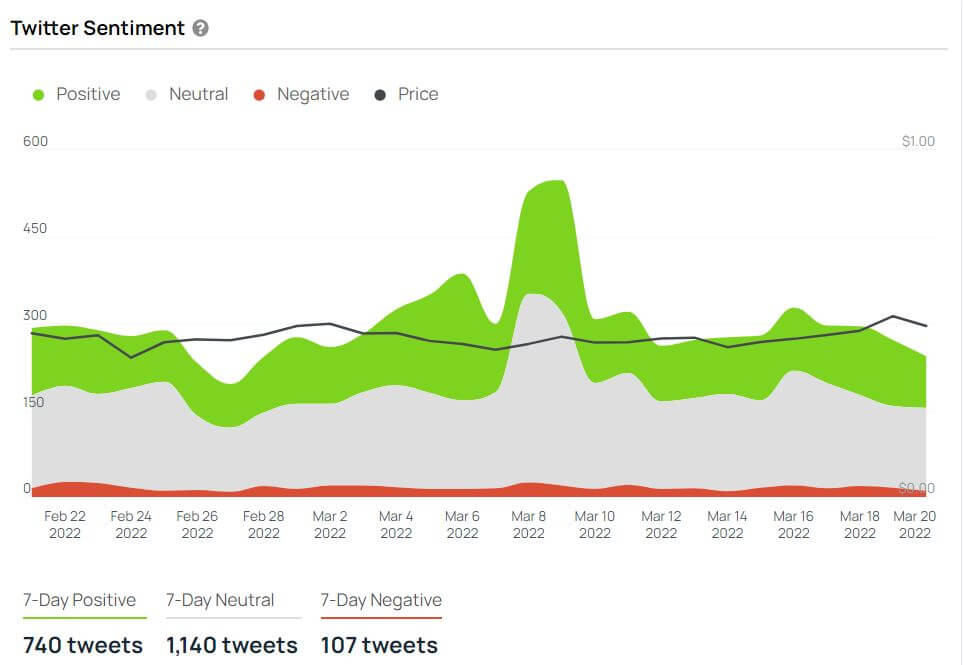
Taking a closer look at the macro trend in this space and dissecting it with Cryptoslate data, readers will note that AI tokens overall have risen by 10% in the last 7 days. According to Cryptoslate data, the world of AI and Blockchain is heating up with a number of projects coming into the scene and driving awareness of different use cases for artificial intelligence in the world of blockchain.

Blockchains are designed to help trace and verify transactions. These transactions are loaded with data. As more of the world’s leading industries and brands adopt blockchain into their business models, harnessing the power of data will be of utmost importance, and ensuring the quality of that data will be a key function of the blockchain industry in the future. Ocean protocol has already developed a foundation within the data landscape and consistently supports data-led initiatives that use blockchain technologies to bring added value to layers of untapped, open-source data. They are recognized for maintaining support for the projects using their ecosystem and have earmarked 140M USD for grants within the OceanDAO.


Related Reads

Ten-Thousand-Word Analysis: From $10 to $290, MRVL Wins the Entire AI Era by 'Not Making GPUs'

Marvell Technology's stock price surged from under $10 in 2016 to a record $290 in June 2026, fueled not by making GPUs, but by dominating AI infrastructure connectivity. This analysis argues the market misvalues MRVL as merely a smaller Broadcom in custom AI chips, overlooking its true, unique position. Marvell's core strength lies in enabling high-speed data flow for AI clusters through three interconnected businesses. First, it holds a commanding ~70% market share in high-speed optical DSPs (essential for data center light modules), a deep-moat business with accelerating growth. Second, its custom AI chip design business serves hyperscalers like AWS, Microsoft, and Google, with a significant revenue pipeline despite lower margins. Third, stable cash flows come from Ethernet switch chips and enterprise storage controllers. Together, they form a full-stack "AI data movement" platform. CEO Matt Murphy's transformative leadership since 2016, involving strategic divestments, key acquisitions (like Inphi for optical DSPs), and securing long-term agreements with major cloud providers, repositioned the company. A pivotal $2 billion strategic investment from NVIDIA in 2026 underscored Marvell's critical role in the AI ecosystem, particularly through collaborations like NVLink Fusion. While Marvell faces risks—including client concentration (losing the Amazon Trainium3 design), lower-margin business mix, competitive threats, insider selling, and complex supply chains—its fundamentals remain strong. The optical interconnect moat is widening with the acquisition of Celestial AI (photonics fabric), and financial metrics show accelerating revenue growth and operating leverage. With a PEG ratio suggesting undervaluation relative to its growth, the thesis is that the market undervalues Marvell's monopolistic position in AI "plumbing" while overemphasizing its competitive custom chip segment. The story transcends investing, symbolizing how in any complex system—from the internet to AI—the value of "connection" ultimately surpasses that of individual "nodes."

marsbitHá 14m

Ten-Thousand-Word Analysis: From $10 to $290, MRVL Wins the Entire AI Era by 'Not Making GPUs'

marsbitHá 14m

AI Relay Stations Spark Heated Debate on Zhihu: Behind Cheap Tokens, What Are Users Really Worried About?

A discussion on Zhihu about "AI relay stations" shifted the niche developer topic of "cheap tokens" into broader user awareness. Users moved beyond simply questioning the legitimacy of these services to focus on practical concerns: Where do cheap tokens truly come from? Is the model being accessed the real one? Can relay stations see prompts, code, and API keys? For occasional users, are the risks worth it? The core debate centered less on price and more on trust. A primary worry is model authenticity—the risk of "model swapping," where users paying for a premium model might be routed to a cheaper one, creating an information asymmetry. Others argued that cost comparisons matter; while cheaper than official pay-as-you-go APIs, relay stations may not be the lowest-cost option versus subscriptions, domestic models, or free tiers, making user needs assessment crucial. Speculation about token sources ranged from legitimate bulk discounts to gray-area methods like account sharing or exploiting regional pricing. This opacity makes risk assessment difficult for users. Data security emerged as a critical concern, especially for enterprise use. When processing sensitive information like code, contracts, or client data, the inability to verify a relay station's data handling, retention, or access policies poses significant compliance and confidentiality risks. The evolving consensus suggests relay stations can be used cautiously for low-sensitivity, disposable tasks (e.g., summarizing public info, simple translation). However, they should not be the default for sensitive, professional, or production workflows involving proprietary data, Agents, or automated systems. Recommendations include avoiding large prepayments, not relying on a single service, using test prompts to monitor quality, anonymizing data where possible, and keeping official channels as backups. Ultimately, the discussion framed tokens not just as a billing unit but as a measure of real cost encompassing price, model integrity, data security, and service stability. The popularity of relay stations highlights user demand for affordable access, but the debate underscores a key trade-off: the savings from cheap tokens may come at the price of trust, transparency, and control over one's data and AI experience.

marsbitHá 44m

AI Relay Stations Spark Heated Debate on Zhihu: Behind Cheap Tokens, What Are Users Really Worried About?

marsbitHá 44m

In-Depth Research Report on TradFi: The Convergence Wave of Crypto and Traditional Finance

In 2026, the crypto industry is undergoing a profound infrastructure-level transformation—TradFi assets are migrating on-chain at an unprecedented pace. According to CoinGecko's Q1 2026 report, the total value locked (TVL) of tokenized real-world assets (RWA) has surpassed $31 billion, a nearly 4x increase from $7.8 billion at the beginning of 2025, with the sector’s aggregate market capitalization reaching $19.3 billion. Among these, the market cap of tokenized stocks surged from $2 million to $486 million, with Q1 spot trading volume reaching $15.1 billion—a single quarter already surpassing the entire second half of 2025. RWA perpetual contract Q1 trading volume reached a staggering $524.8 billion, far exceeding the $313 billion for all of 2025. Meanwhile, BlackRock's BUIDL fund has reached $2.3 billion in scale and has filed for two new tokenized funds, signaling that the world's largest asset manager's tokenization strategy is evolving from pilot to product suite expansion. HTX, as a core participant in the crypto exchange sector, officially launched TradFi perpetual futures products including NVDA, AAPL, MSFT, META, and SPY in 2026, enabling crypto users to gain 24/7 trading access to core U.S. equities. Boston Consulting Group predicts that global tokenized asset scale could reach $16 trillion by 2030, while McKinsey offers a conservative estimate of approximately $2 trillion. The on-chain migration of TradFi assets is no longer a "future narrative" but a structural transformation unfolding in real time, as crypto exchanges evolve from single crypto asset trading platforms toward "multi-asset-class trading infrastructure."

HTX LearnHá 46m

In-Depth Research Report on TradFi: The Convergence Wave of Crypto and Traditional Finance

HTX LearnHá 46m

Trading

Spot
Futures

Hot Articles

How to Buy SNT

Welcome to HTX.com! We've made purchasing Status Network Token (SNT) simple and convenient. Follow our step-by-step guide to embark on your crypto journey.Step 1: Create Your HTX AccountUse your email or phone number to sign up for a free account on HTX. Experience a hassle-free registration journey and unlock all features.Get My AccountStep 2: Go to Buy Crypto and Choose Your Payment MethodCredit/Debit Card: Use your Visa or Mastercard to buy Status Network Token (SNT) instantly.Balance: Use funds from your HTX account balance to trade seamlessly.Third Parties: We've added popular payment methods such as Google Pay and Apple Pay to enhance convenience.P2P: Trade directly with other users on HTX.Over-the-Counter (OTC): We offer tailor-made services and competitive exchange rates for traders.Step 3: Store Your Status Network Token (SNT)After purchasing your Status Network Token (SNT), store it in your HTX account. Alternatively, you can send it elsewhere via blockchain transfer or use it to trade other cryptocurrencies.Step 4: Trade Status Network Token (SNT)Easily trade Status Network Token (SNT) on HTX's spot market. Simply access your account, select your trading pair, execute your trades, and monitor in real-time. We offer a user-friendly experience for both beginners and seasoned traders.

1.7k Total ViewsPublished 2024.03.29Updated 2026.06.02

How to Buy SNT

Discussions

Welcome to the HTX Community. Here, you can stay informed about the latest platform developments and gain access to professional market insights. Users' opinions on the price of SNT (SNT) are presented below.

活动图片