摩根大通首次执行DeFi交易,都做了什么?

区块律动Pubblicato 2022-11-03Pubblicato ultima volta 2022-11-03

Introduzione

摩根大通为什么选择与Polygon和Aave合作?

10 月 19 日,新加坡金融管理局(MAS)宣布启动「守护者项目」(Project Guardian),该项目将与金融业展开合作,旨在测试资产 Token 化和 DeFi 应用的可行性,同时也对金融稳定性和完整性进行风险控制。

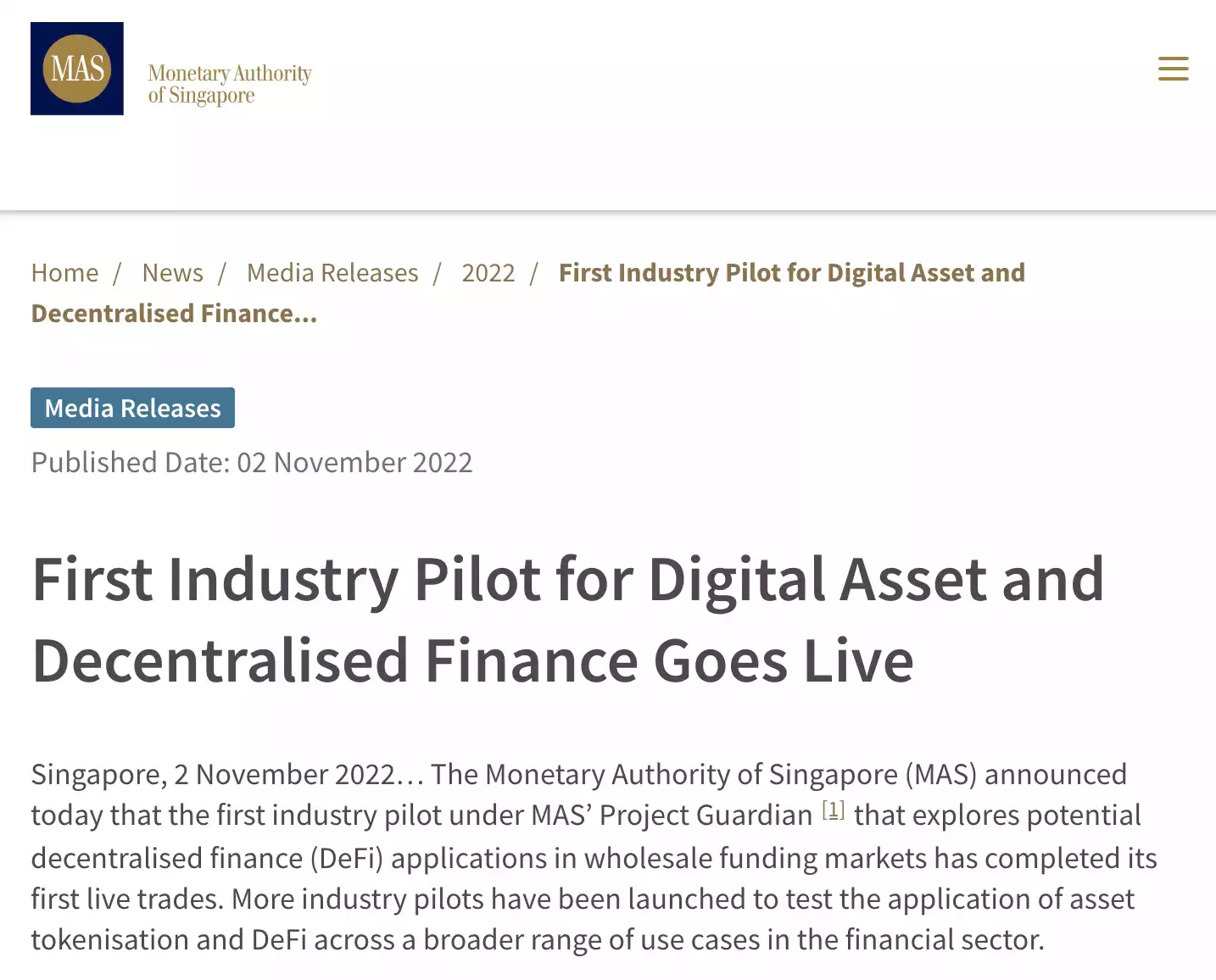
11 月 2 日,MAS 宣布,其 Project Guardian 的第一个探索批发融资市场中潜在 DeFi 应用的行业试点项目(First Industry Pilot)已完成首次实时交易。其中,星展银行(DBS Bank)、摩根大通(JP Morgan)和 SBI Digital Asset Holdings 针对由 Token 化新加坡政府债券、日本政府债券、日元(JPY)和新加坡元(SGD)组成的流动性池进行外汇和政府债券交易。该试点成功进行一笔涉及 Token 化日元和新加坡元存款的实时跨货币交易。

摩根大通 Blockchain Launch 和 Onyx 数字资产部门主管、企业以太坊联盟(Enterprise Ethereum Alliance)董事会成员 Ty Lobban 发布文章详细解释了摩根大通在 Project Guardian 扮演怎样的角色,BlockBeats 对其整理翻译如下:

摩根大通已使用 DeFi、Token 化存款和可验证凭证(Verifiable Credentials, VC)在公链上执行了第一次实时交易,这是 MAS 主导的 Project Guardian 中的一部分。

我们开创了不少世界先例,既然交易发生在公链上,本文将公开、透明地解释我们具体做了哪些事情。

第一步,我们使用 Polygon 网络进行交易。

我们起初想在以太坊上执行此交易,但由于我们希望用相对低廉的 Gas 费来进行一系列身份验证相关的昂贵操作,(我们选择了 Polygon)。当然,鉴于 MAS 的目标是开放的、可互操作的网络,Guardian 在未来也将探索其他区块链的可能。

第二步,我们使用 Aave 以采用其「许可池概念」。

我们部署了 Aave Arc 的修订版本,以便设置某些参数,例如利率和外汇汇率。请点击链接查看我们部署的借贷池。

注:Aave Arc 是一个需要权限的流动性池,专门为机构在 DeFi 领域保持监管合规而设计。这些流动性池将与 Aave 上的现有池分开,并且需要广泛 KYC。

第三步,我们发行了 Token 化的新元存款。

这种存款 Token将被纳入是摩根大通的综合债务。这是一种原生 Token,提供稳定的链上价值,没有 Stablecoin 面临的可扩展性问题。这是首个由银行发行的 Token 化存款。请点击链接查看摩根大通发行的 SGD Token 化存款合约。

第四步,我们使用万维网联盟 W3C 可验证证书 VC 为 Aave(或任何其他 DeFi 协议)提供合规访问权限。

相比白名单地址,VC 能提供更加精细的控制,包括风险限制、资产限制等。而且,我们实现了链上 VC 身份验证。

链上 VC 验证非常繁复,它为身份带来了可组合性。我们希望用为数不多的、专业的验证者,并在 dApp 中使用它们,从而为身份带来进一步的标准化和可移植性,就好像「身份乐高积木」!

我们设计的原则是确保 VC 合规检查可以与任何 DeFi 协议一起使用,而这些协议不需要了解 VC 的任何信息,从而使 DeFi 前端无需进行 KYC。合规性被推到边缘,而不是 dApp。

请点击链接查看验证器。我们在 Project Guardian 中为每个公司创建了一个验证器。所以每个公司都有自己的规则,但是任何人都可以查阅和验证这些规则。链上 VC 验证严格意义上并不是由我们开创的,我的构建并不完美,仍在探索 ZKP 技术。

补充说明:作为一家受到严格监管的银行,摩根大通禁止洗钱行为,因此 KYC 是必要的。考虑到以上问题,我们希望通过使用 VC 和白名单提高我们使用 DeFi 资金池的安全性。机构 DeFi 是值得期待的。

第五步,我们构建了一个机构钱包。

1. 交易者永远无法访问公司资金;

2. 仅有经批准的 DeFi 协议可以被机构访问;

3. VC 与交易指令捆绑,即 VC 上链则可以进行交易,否则交易失败;

总之,这是受监管的大型金融机构通过公链上基于 VC 的 DeFi 第一次进行 Token 化存款的实时交易。

Letture associate

Deep Insight: Decentralized Inference is Not Hype, but a Key Track for AI to Break Through Centralized Monopoly

Decentralized Reasoning: Beyond the Hype, a Key to Breaking AI's Centralized Monopoly A future scenario where a powerful AI model is banned by a major government illustrates the core value proposition of decentralized AI: resistance to censorship. The core bet of decentralized inference networks is mitigating this risk, with other benefits like cost being secondary. The path is extremely difficult, involving four key challenges: 1. **Running Massive Models:** Distributing a single model across a decentralized GPU swarm requires sophisticated techniques like pipeline and speculative decoding to overcome crippling network latency, aiming for usable speeds (e.g., 30-40 tokens/second). 2. **Proving Model Integrity:** Verifying that a node runs the correct model is critical. Solutions range from cryptographically secure but slow ZKML to faster, economically-secure methods like statistical fingerprints, deterministic re-execution, or live-weight proofs, each involving trade-offs between integrity, latency, and cost. 3. **Ensuring Prompt Privacy:** Simply sharding a model does not protect user inputs from nodes. Robust solutions currently require trusted hardware (TEEs) or advanced cryptography (FHE), which are not yet widely deployed in consumer swarms. 4. **Building a Real Market:** Identifying the ideal customer is tough. Beyond speculative AI agents, the viable market currently consists of startups embedding AI and projects needing batch processing (e.g., synthetic data generation), where decentralized aggregation can be an advantage over low-latency needs. The article analyzes several projects tackling these problems, such as Dolphin Network (live-weight proofs), Inference.net (statistical verification), Morpheus (TEE-based), and Darkbloom (Apple Secure Enclave). It provides a framework: decentralization is a "tax" for latency-sensitive applications (e.g., chat) but a potential supply-side advantage for throughput-oriented tasks (e.g., batch processing). The long-term vision is a closed data loop where decentralized inference generates valuable data (traces, preferences) to feed decentralized training networks, which in turn produce better open-weight models for the inference networks. A due diligence checklist advises focusing on projects that: are truly decentralized at specific layers; have a credible integrity method; offer real cost benefits; ensure genuine privacy; handle node reliability; have paying users; and are built by teams with deep AI expertise. The ultimate goal should be products that appeal beyond the crypto-native audience, using crypto mechanisms invisibly to deliver better cost, performance, or privacy.

Foresight News10 min fa

Deep Insight: Decentralized Inference is Not Hype, but a Key Track for AI to Break Through Centralized Monopoly

Foresight News10 min fa

The Final Piece of Franklin Templeton's Crypto Ambition

Franklin Templeton Completes Crypto Ambition with Acquisition of 250 Digital On June 22, Franklin Templeton announced the acquisition of 250 Digital and established Franklin Crypto, a new division focused on actively managed cryptocurrency strategies for institutional investors. The unit is led by Christopher Perkins and Seth Ginns. This acquisition marks a key piece in Franklin Templeton's multi-year crypto strategy, which began in 2018 with a digital assets team. The firm's crypto product suite now spans three layers: tokenized funds like the blockchain-based money market fund BENJI (~$831M AUM); a series of passive ETFs including Bitcoin (EZBC, ~$368M), Ethereum (EZET), XRP (XRPZ, ~$252M), Solana (SOEZ), and a multi-crypto index fund (EZPZ); and the newly added active management strategies from Franklin Crypto. The company has also expanded its crypto ecosystem through investments in projects like Ethena and Crossmint, and collaborations with blockchains such as Aptos and Sui. With approximately $18B in digital asset AUM and a total firm AUM of ~$1.78T, Franklin Templeton is positioning itself as a comprehensive crypto asset manager for pensions and sovereign wealth funds. In contrast, competitor Fidelity Investments has taken a different path, focusing early on building its own custody and trading infrastructure. Fidelity's Bitcoin ETF (FBTC) holds over $11B, significantly larger than Franklin Templeton's equivalent offering. Both giants' moves underscore the deepening trend of traditional finance entering the crypto space.

Foresight News34 min fa

The Final Piece of Franklin Templeton's Crypto Ambition

Foresight News34 min fa

Trading

Spot
Futures
活动图片