$111M Stablecoins Flow Into Exchanges, Buying Pressure For Bitcoin?

BitcoinistPublished on 2022-10-21Last updated on 2022-10-24

Abstract

On-chain data shows large amounts of stablecoins have entered exchanges recently, something that could provide buying pressure for Bitcoin. Around...

On-chain data shows large amounts of stablecoins have entered exchanges recently, something that could provide buying pressure for Bitcoin.
Around $111 Million Stablecoins Flowed Into Exchanges In Last Couple Of Days
As pointed out by an analyst in a CryptoQuant post, the latest stablecoin inflow is the largest observed in this month so far.

The relevant indicator here is the “exchange netflow,” which measures the net amount of stablecoins (of any kind) moving into or out of wallets of all centralized spot exchanges. The metric’s value is simply calculated by taking the difference between the inflows and the outflows.
Positive values of the indicator mean a net number of stables are being deposited into exchanges right now, while negative ones imply investors are withdrawing their coins at the moment.
Since stablecoins have a relatively stable price due to them being tied to fiat (as their name already suggests), crypto market participants like to use them whenever they want to avoid the volatility associated with coins such as Bitcoin.

Once they feel that prices are right to jump back into the volatile cryptos, these investors exchange their stables back for them, thus providing a bullish effect to their prices.
Because of this, a trend of investors depositing their stablecoins into spot exchanges (that is, positive netflows) can imply buying pressure for BTC and other cryptos.

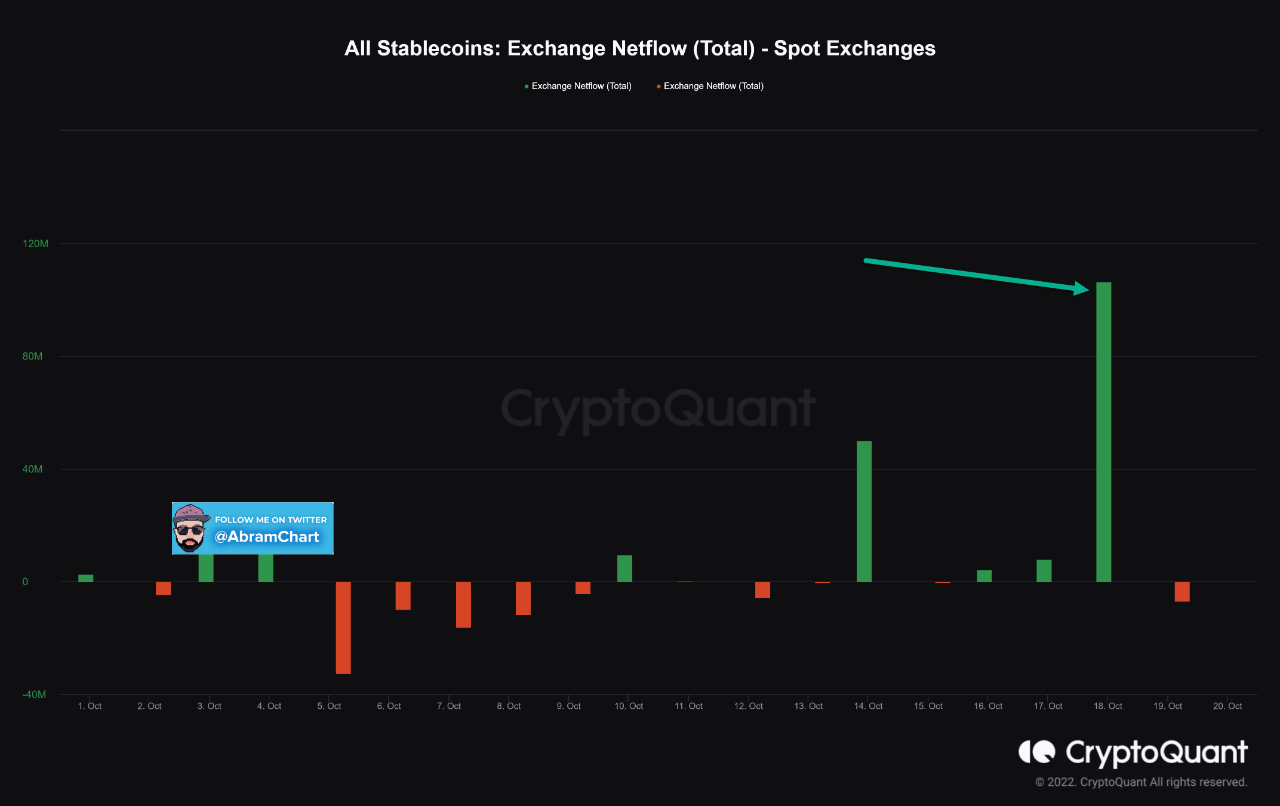
Now, here is a chart that shows the trend in the stablecoins exchange netflow over the month of October so far:
Stablecoins Exchange Netflow Bitcoin


Looks like the value of the metric has spiked up during recent days | Source: CryptoQuant
As you can see in the above graph, the stablecoin spot exchange netflows have registered a high value in the last couple of days.
This spike amounted to around $111 million worth of stables moving into spot exchange wallets. While this isn’t an extremely large value, it’s still the biggest deposit by investors in the month so far.
If these inflows have indeed been made with the aim of buying up cryptos like Bitcoin, then this may have a positive impact on the prices of the volatile cryptos in the near future.
Bitcoin Price
At the time of writing, Bitcoin’s price floats around $19.2k, up 3% in the last seven days. Over the past month, the crypto has lost 1% in value.
Below is a chart that shows the trend in the price of the coin over the last five days.

Bitcoin Price Chart


The value of the crypto has continued to show stale price movement in the last few days | Source: BTCUSD on TradingView


Related Reads

A Company Once on the Brink of Bankruptcy Just Surpassed Bitcoin in Market Cap

On June 22nd, driven by rising stock prices, SK Hynix’s market capitalization reached $1.35 trillion, surpassing Bitcoin's total market cap of approximately $1.29 trillion. This temporarily made it South Korea's highest-valued company. The core driver of this surge is HBM (High Bandwidth Memory), for which SK Hynix is the primary supplier to NVIDIA, holding over 60% market share. AI's demand for high memory bandwidth has translated into immense profitability, with SK Hynix reporting a 72% operating profit margin in Q1. The company's success follows a 13-year bet on HBM technology, beginning in 2009. It nearly failed after the 2001 dot-com bubble, was acquired by SK Group in 2012, and was subsequently recapitalized to continue its long-term HBM development. The article contrasts this with the Crypto AI narrative. Capital currently favors AI infrastructure players like SK Hynix due to "real orders, physical barriers, and quantifiable profit margins." In comparison, Crypto AI projects, promising decentralized compute and data markets, remain largely conceptual with limited tangible progress. Examples include Bittensor, whose core mechanisms are still under development, and Bitcoin miners transitioning to AI, who face significant funding gaps and execution challenges. The piece cites analysis suggesting the AI sector has absorbed nearly all new market liquidity since 2022, leaving little for crypto. It concludes that the current AI infrastructure红利 is captured by entities with proven technical barriers and supply capabilities, while crypto networks still need to define their concrete role in the value chain.

链捕手37m ago

A Company Once on the Brink of Bankruptcy Just Surpassed Bitcoin in Market Cap

链捕手37m ago

Bittensor Moves Towards Ultimate Decentralization: The Critical 18 Months for the TAO Ecosystem is Here?

Bittensor, a decentralized AI protocol, is accelerating its transition to full decentralization over the next 18 months, as outlined in a recent post by co-founder Const. The project currently operates in a "semi-decentralized" state: ownership and network participation are open and permissionless, with TAO distribution based on competitive contribution. However, protocol upgrades and governance have remained under core team control to enable rapid iteration in the fast-evolving AI sector. This strategic shift comes as the ecosystem matures, boasting 128 subnets and a large community. Const argues that continued centralization now poses risks, including single points of failure and regulatory scrutiny. The upcoming decentralization roadmap includes optimizing validator competition, opening liquidity pools, introducing governance rights for Alpha holders, and refining economic models. The move could fundamentally reshape TAO's value proposition, adding governance premiums to its existing valuation based on AI narrative and scarcity. It also signals a potential maturation of the AI crypto sector, where competition may shift from hype to sustainable protocol design and real economic activity. Bittensor positions itself not just as another AI token, but as foundational infrastructure aiming to decentralize intelligence production—analogous to Bitcoin's role in decentralizing money—with the goal of creating a resilient "Millennium Intelligence Federation."

marsbit50m ago

Bittensor Moves Towards Ultimate Decentralization: The Critical 18 Months for the TAO Ecosystem is Here?

marsbit50m ago

Japan's AI Dark Horse Emerges: How a 7B Small Model Challenges Fable and Mythos?

In June 2026, Sakana AI's new model Fugu caused a stir in the AI community. Its Fugu Ultra variant achieved scores of 73.7 on SWE-Bench Pro and 82.1 on TerminalBench 2.1, surpassing GPT-5.5 and Claude Opus 4.8, and was claimed to be comparable to export-restricted models like Fable 5 and Mythos Preview. Remarkably, the core of this high-performance system is not a massive model, but a small 7B-parameter RL Conductor model. Fugu operates as a multi-agent orchestrator: the 7B model acts as a "foreman," dynamically analyzing user tasks and delegating subtasks to a pool of top-tier global models (e.g., GPT-5, Gemini 3.1 Pro). It then synthesizes and verifies their outputs. This architecture represents a paradigm shift from monolithic models to an expert-team approach. It enhances performance in complex, multi-step engineering tasks like code review and security testing by enabling cross-validation from specialized models, improving long-session stability and token efficiency. However, Fugu's strengths come with trade-offs: it faces inherent latency due to multiple API calls, relies heavily on underlying US model APIs (creating dependency risks), and its benchmark comparisons with Fable/Mythos are based on reported scores, not head-to-head testing. For Japan's AI ecosystem, which lacks the massive compute and data resources of the US or China, Fugu exemplifies an "asymmetric breakthrough" strategy. Instead of competing directly in parameter scale, it focuses on intelligent orchestration of existing global models, offering a degree of AI sovereignty and resilience. While a significant system-level innovation, its ultimate capability is still bounded by the underlying models it coordinates.

marsbit50m ago

Japan's AI Dark Horse Emerges: How a 7B Small Model Challenges Fable and Mythos?

marsbit50m ago

Trading

Spot
Futures
活动图片