Dogecoin On Fire, Rallies After Elon Musk-Twitter Deal Confirmation

newsbtcPubblicato 2022-10-05Pubblicato ultima volta 2022-10-05

Introduzione

Dogecoin has been rallying over today’s trading session, following the general sentiment in the market and receiving support from its biggest advocate Elon Musk.

Dogecoin has been rallying over today’s trading session, following the general sentiment in the market and receiving support from its biggest advocate Elon Musk. The entrepreneur and CEO of Tesla and SpaceX confirmed a deal to purchase social media Twitter (TWTR)

Elon Musk was about to enter into a legal battle with social media; the entrepreneur announced a deal to purchase the company early in 2022 but refused to see it through due to some alleged false data on Twitter’s number of users.

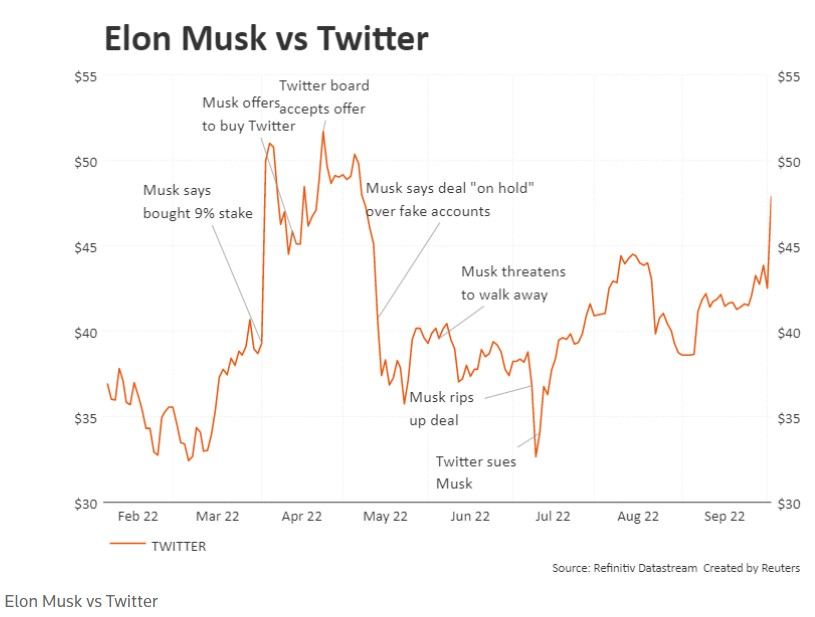
According to several reports, Elon Musk sent a letter to Twitter confirming the original offers of $44 billion or $55 per share to take over the company. As seen in the chart below, the Elon Musk-Twitter controversy has been a major driver in TWTR’s price action.

The stock’s trading has been halted during today’s trading session, after a roller-coaster year that took TWTR from a high of around $55 to a low of $35.
Elon Musk To Buy Twitter, Why This Could Be Good For Dogecoin

The news about the Musk-Twitter deal came at a seemingly right time for Dogecoin, the cryptocurrency was already moving to the upside with Bitcoin and large cryptocurrencies. However, the latter has been losing steam and could be gearing up for a re-test of previous support levels.

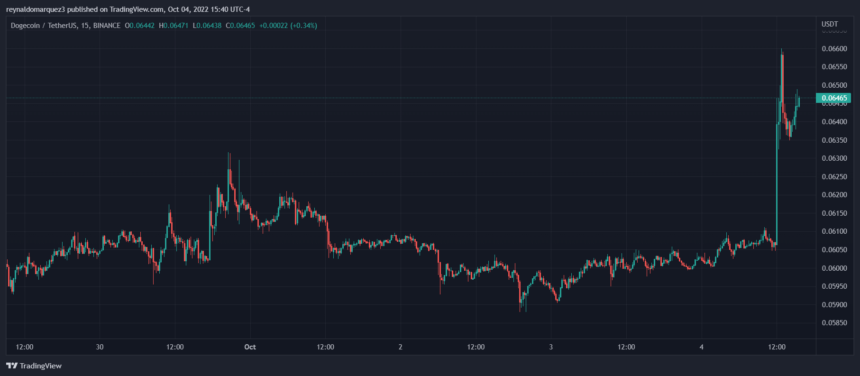
In the meantime, Dogecoin records an 8% profit over today’s trading session leading to a spike in volatility and an increase in its bullish momentum, as seen in the chart below. Dogecoin has finally broken out of a tight range and it is reclaiming an important region at $0.064.
For a while, Musk-related news has driven Dogecoin’s price action. The CEO at Tesla has been a defender of the memecoin. Today’s event triggered two massively bullish factors for the cryptocurrency, according to research firm Santiment.

As the Musk-Twitter deal was confirmed the memecoin saw a spike in the number of transactions related to large players and big funds. As the price traded to the upside, Santiment recorded no spike in funding rates, unlike in previous rallies.

In other words, traders were not taking highly leveraged positions. In that sense, the research firm wrote the following on the cryptocurrency’s potential short term.

Musk Driven Dogecoin Rally Will Be Short-Lived?

Beyond large players taking a side in Dogecoin’s price action, there is potential for this Musk-Twitter deal to become permanently bullish for the memecoin. The social has been embracing crypto and adding blockchain-based features.

The platform allows its users to set non-fungible tokens (NFTs) as profile pictures, and to use a Bitcoin or Ethereum transaction to receive tips from their followers. In the coming months, as the deal materializes, Musk could include Dogecoin as of the few cryptocurrencies supported by Twitter and boost its adoption levels.

Letture associate

Uniswap v4 Hook Analysis: Architecture Design, Common Vulnerabilities, and Protection Practices

Uniswap v4's Hook mechanism is a major innovation, enabling custom logic injection into liquidity pool lifecycle events like swaps and liquidity provisioning. This transforms the AMM into programmable infrastructure, shifting the security model from protocol-level to pool-level, as each pool's safety now depends on its bound Hook contract. The core architecture revolves around the singleton PoolManager contract, which manages all pools via a flash accounting system. State changes are tracked in transient storage and must be settled by the end of a transaction. Hook contracts are permanently bound to pools via a PoolKey, with their permissions encoded directly into their address via specific low-order bits. This design introduces unique security considerations and challenges for future upgrades. Key vulnerabilities and best practices identified include: - **Access Control Gaps:** Early versions of the BaseHook abstract contract only protect `unlockCallback()`, leaving other lifecycle functions (`beforeSwap`, `afterSwap`, etc.) exposed unless explicitly secured by developers. - **Unrestricted Pool Binding:** The `initialize()` function does not validate if a Hook "consents" to a new pool. Hooks must implement their own whitelisting in `beforeInitialize` to prevent unauthorized pool creation. - **Async/Custom Curve Hooks:** These high-risk Hooks can completely replace Uniswap's swap logic. Their security depends entirely on their own implementation, as they operate outside the native protocol's pricing safeguards. - **Delta Accounting Risks:** The system ensures final balance (NonzeroDeltaCount == 0) but cannot guarantee the *correctness* of intermediate delta states, which attackers could manipulate. - **Token Confusion:** Protocols must implement semantic validation for tokens in user-created markets, not just interface checks, to prevent cross-market confusion attacks. The article emphasizes that Hook auditing requires a "sub-protocol" approach due to extended interaction chains, highlighting a significant shift in security methodology for the v4 ecosystem.

marsbit40 min fa

Uniswap v4 Hook Analysis: Architecture Design, Common Vulnerabilities, and Protection Practices

marsbit40 min fa

Chips, Open-Source Models, and $50 Trillion: Joe Tsai Reassesses Alibaba Once Again

Alibaba Executive Chairman Joe Tsai recently outlined the company's comprehensive AI strategy in a public discussion. He believes AI represents a massive opportunity, estimating its potential economic impact at up to $50 trillion, stemming from the automation of human intelligence and productivity. Tsai detailed Alibaba's four-layer investment approach across the AI stack: starting from the chip level, moving to cloud infrastructure (Alibaba Cloud), then the model layer with its open-source Qwen model, and finally applications within its vast digital ecosystem (e-commerce, logistics, etc.). The company avoids the energy layer due to China's efficient infrastructure. This broad strategy is designed to ensure Alibaba captures value regardless of where it ultimately concentrates in the AI value chain. He dismissed concerns about an AI investment bubble, pointing to the enormous $50 trillion opportunity. While acknowledging U.S. cloud giants' higher capital expenditure, he argued Chinese firms, including Alibaba (funded by its cash-generative e-commerce core), need to invest more in AI infrastructure. A key theme was technological sovereignty. Tsai positioned open-source models like Qwen as a solution for companies, especially in Europe, seeking independence from proprietary U.S. models and greater data privacy control. He contrasted this with the trend of U.S. giants keeping their models closed-source. Tsai highlighted Alibaba's collaborations with European manufacturers like Bosch and Siemens, using AI for design and quality control. He concluded with an optimistic vision of AI agents enhancing productivity, ultimately freeing up human time for leisure, family, and experiences like live entertainment.

marsbit55 min fa

Chips, Open-Source Models, and $50 Trillion: Joe Tsai Reassesses Alibaba Once Again

marsbit55 min fa

Trading

Spot
Futures
活动图片