
Bitcoin traders willing to go long but sentiment remains firmly bearish

cryptoslatePublished on 2022-09-19Last updated on 2022-09-19

Abstract

Since bottoming at $17,700 on June 18, Bitcoin has been trading within a relatively tight band, with $25,100 marking the upper limit of this channel.

Xeggex

Since bottoming at $17,700 on June 18, Bitcoin has been trading within a relatively tight band, with $25,100 marking the upper limit of this channel.

Although the past week or so saw BTC print six consecutive daily green closes, higher-than-expected CPI inflation data, released on September 13, ended the upward momentum. On that day, BTC swung 13% to the downside to bottom at $19,800.

Price uncertainty is the dominant narrative as macro pressures continue to weigh heavy on the market leader. According to the Options 25 Delta Skew and Options Volume Put/Call Ratio, this has played out as a willingness to go long, even on minor signs of price recovery. However, the overall sentiment is bearish.

Options 25 Delta Skew

The Options 25 Delta Skew metric looks at the ratio of put vs. call options expressed in terms of Implied Volatility (IV). Puts being the right to sell a contract at a specific price and calls being the right to buy.

For options with a specific expiration date, 25 Delta Skew refers to puts with a delta of -25% and calls with a delta of +25%, netted off to arrive at a data point. In other words, this is a measure of the option’s price sensitivity given a change in the spot Bitcoin price.

The individual periods refer to option contracts expiring 1 week, 1 month, 3 months, and 6 months from now, respectively.

Below 0 indicates calls are pricer than puts. This situation has occurred only six times this year. During Bitcoin’s recent bottoming, traders scrambled for puts and then reverted to calls at the local top.
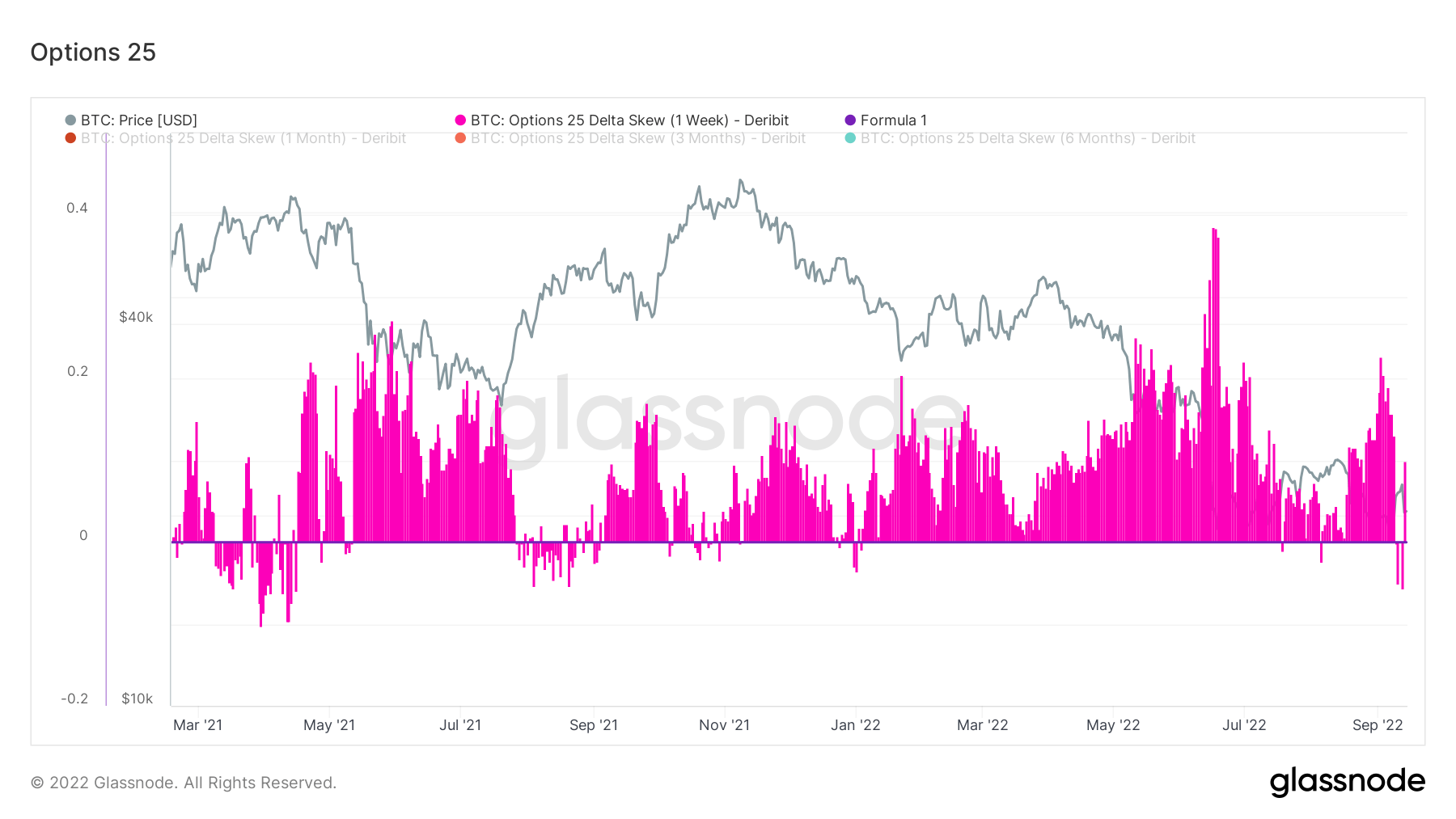
Bitcoin Options 25 Delta Skew chart

BTC Price vs. Options Skews (Source: Glassnode.com)

This changeable behavior can be explained by a long, drawn-out bear market prompting traders to react quickly, even on minor indications of price recovery.

In recent weeks, as Bitcoin flitted above and below $20,000, traders have struck for calls, to go long, on four occasions, only for the market to move against them. Consecutive back-to-back calls have not happened since the end of last year.

Options Volume Put/Call ratio

The Options Volume Put/Call Ratio shows the put volume divided by the call volume traded in options contracts in the last 24 hours. It is used to gauge the general mood of the market.

The chart below shows a heavy skew towards puts, as evidenced by sharp increases in the ratio during instances of price bottoming.

This suggests bearish sentiment is firmly embedded. But similar to the Options 25 Delta Skew data, traders will go long on signs of price recovery.
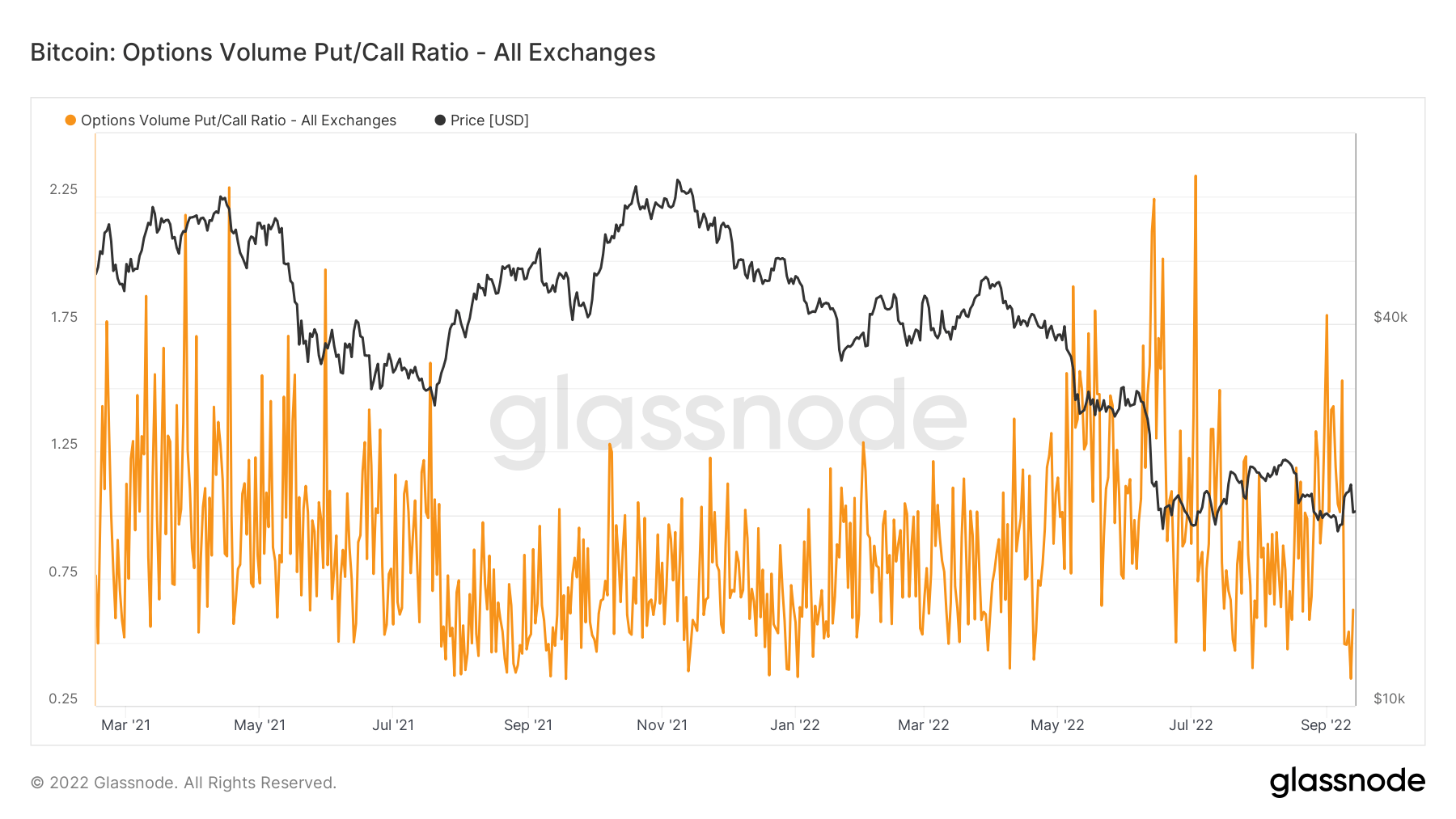
Options Volume Put/Call Ratio

Bitcoin: Options Volume Put/Call Ration (Source: Glassnode.com)

Related Reads

Bitcoin Trading Strategy Breakdown: Celebrity Predictions and Classic Models All Fail, Only These Four Indicators Remain

Analysis of Bitcoin Trading Strategies: Why Celebrity Forecasts and Classic Models Fail, Leaving Only These Four Reliable Indicators This analysis examines the failure of common Bitcoin prediction methods and identifies four reliable indicators for constructing a trading strategy. The author reviewed all major BTC prediction approaches from 2017-2025, categorizing them into three groups: celebrity price targets (consistently over-optimistic), analytical models like Stock-to-Flow (broken post-2022), and on-chain signals. The key finding is that more data often creates confusion, not clarity. The strategy discards unreliable elements: celebrity predictions (incentivized to be extreme), pure models (invalidated by post-ETF market changes), and the Fear & Greed Index used alone (too many false signals). Four reliable indicators were selected: 1. **MVRV Z-Score:** Accurately identifies cycle bottoms when entering its green zone (e.g., 2018, 2020, 2022). Note: Its ability to call tops is now ineffective post-2024. 2. **SOPR (28-day MA):** Consistently signals bottoms when below 1.0, indicating holders are selling at a loss. 3. **ETF Net Flow:** A crucial post-2024 metric showing institutional momentum (e.g., sustained inflows = buying). 4. **Macro Liquidity (Fed policy & M2):** Sets the overall directional bias (e.g., bullish during easing cycles). The core strategy involves waiting for a multi-signal共振 (resonance). For example, a bottom signal requires MVRV in the green zone + SOPR < 1.0. A top signal requires overheated on-chain data + sustained ETF outflows. Macro policy sets the overall direction. The Fear & Greed Index is only used as a weighted confirmatory signal, never alone. Action is only taken when three or more indicators align. The author automated this into a monitoring system that sends Telegram alerts only when signals trigger. As of the article's date (April 15, 2026), the system showed a strong bottom signal: extreme fear (F&G=12), MVRV in the buy zone, and SOPR < 1.0. The only contrary signal was weak ETF flows. Historically, such triple on-chain共振 has preceded 100%+ returns. The conclusion emphasizes building a personal framework over relying on external predictions, allowing for iterative improvement and customization based on individual risk tolerance.

marsbit1h ago

Bitcoin Trading Strategy Breakdown: Celebrity Predictions and Classic Models All Fail, Only These Four Indicators Remain

marsbit1h ago

Trading

Spot
Futures
活动图片