[Key interpretation] BTC pretends to rise or be verified, and deviates from eth price first

HuobiPublished on 2022-09-13Last updated on 2022-09-14

Abstract

Although the BTC price has a strong performance, it is suspected that it will induce more people to rise. Recently, we have paid attention to the negative impact of the expectation of the Federal Reserve's interest rate increase.

1. BTC releases the strongest trading volume

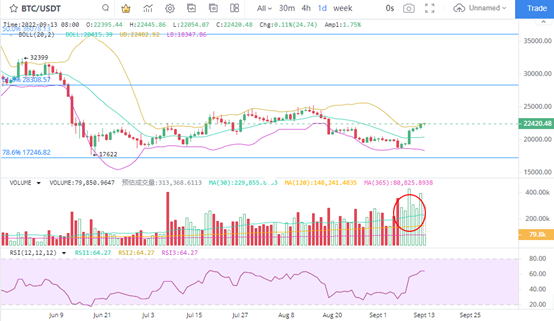
After the BTC price recovered and rebounded from the adjustment, the price easily reached above the middle rail of the brin line, rebounding from $18799 to around $22400, with a range increase of 19.2%. From the performance of trading volume, the effect of this 7 trading days is obviously better than the performance of the past 2 months, and it is also the largest average trading volume performance in the past year. Therefore, the week before the Federal Reserve raised interest rates on September 22, BTC is showing stronger rebound expectations. The recent BTC growth space depends more on the position that the trading volume can reach. The overall market will rebound in large quantities to reduce the selling pressure, and the impact of short-term selling pressure changes on the market is very important.
2. BTC medium and short-term investors' profit flight

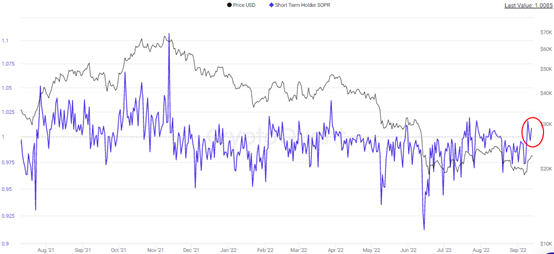
The profit flight of BTC's medium - and short-term investors shows that investors are facing the opportunity of reducing their positions. The SOPR index has been running above 0 since September 9, which indicates that investors have made profits as a whole. During BTC trading, the nature of trading is profit flight. In the next trading day, with the increase of BTC rebound space, expected profit trading will still dominate the overall market. Therefore, when judging the market trend, the higher the SOPR index can reach, the greater the short-term selling pressure it will prompt. Referring to the SOPR index that can be reached in the past year, when the index is in the range of 1.05 to 1.1, it can effectively test the effectiveness of selling points.
3. The unrecognized loss of BTC decreased significantly

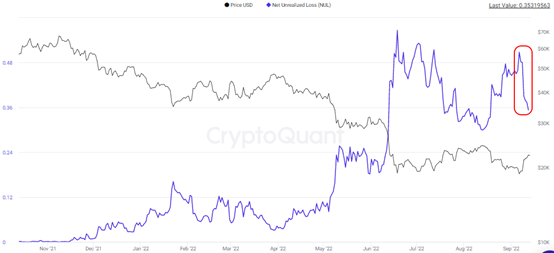
With the emergence of the rebound trend, the unconfirmed loss scale of BTC has dropped significantly, from the recent high of 0.507 on September 6 to around 0.353, and the loss scale has decreased by 15.4 percentage points. This shows that after the rebound trend of BTC in the past week, a considerable number of loss making orders have disappeared, which means that the selling pressure is also dropping rapidly.

In terms of absolute value, the proportion of unconfirmed losses on September 12 still reached 35.5%, which is still at a high level compared with the past two years. Therefore, BTC is still in the interpretation of digesting selling pressure, and we can pay further attention to the pressure level in the rebound.
4. Eth price rebounded slightly

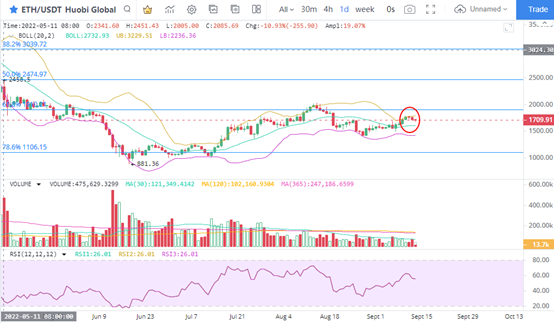
With the volatile trend of eth, the recent overall increase has not exceeded expectations. It can be seen that the ETH price trend shows a certain deviation from BTC, which indicates that the strength of the overall market may not last too long. In terms of trading volume, the daily K-line trading volume of eth is still shrinking, so the increase is not ideal. However, considering the large growth space of eth in the previous period, the advantage in terms of cumulative growth is still significant.
5. Eth transfer volume rebounded slightly

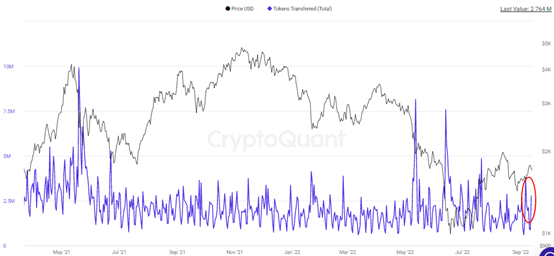
During the recent eth rebound, the number of transferred eth rebounded slightly, but it did not exceed the previous peak. From the rebound strength, it reached 3.773 million on September 6, lower than 4.857 million eth on July 21, and lower than 8.156 million and 7.569 million eth on May 12 and June 13. Therefore, the ETH price is still in a stable operation stage. The trading enthusiasm of investors has not changed, and the expectation of increase has not been strengthened.

Related Reads

Why the Establishment of SocialFi Originates from a Misunderstanding of Its Own Medium

"Why SocialFi's Establishment Stems from a Misunderstanding of Its Own Medium" This article critiques the failure of SocialFi projects by applying Marshall McLuhan's theory of "hot" and "cool" media. McLuhan posited that a medium's form—not its content—reshapes user behavior. "Hot" media (e.g., print, radio) deliver high-definition, complete information, promoting passive consumption. "Cool" media (e.g., cartoons, telephone calls) provide low-definition, fragmented signals, requiring active user participation to complete the meaning. Traditional social media platforms (like early Twitter) are quintessentially "cool." A tweet or like is an incomplete fragment; its significance emerges only through replies, shares, and community engagement—it's a participation engine disguised as a content system. SocialFi (e.g., Friend.tech) aimed to monetize social capital by attaching real-time, tradable prices to follows and posts. However, this didn't add an economic layer to a cool medium; it fundamentally transformed the medium itself. The explicit, high-resolution signal of price replaced the ambiguous, low-resolution signal of social interaction. The platform became a financial market dressed as a social network. Once the financial dynamics (speculative profits) faded, the underlying social fabric, which had been suffocated from the start, could not sustain it. The medium overheated and collapsed. This "heat death" pattern isn't unique to crypto. Over time, mainstream platforms often drift from cool to hot by adding features like public metrics, verification badges, and algorithmic feeds that optimize for clarity over participation, leading to user disengagement. The article proposes a viable alternative: the "condensation point." Here, capital is introduced locally and infrequently into a cool medium without saturating it. Examples include Substack (subscriptions), Patreon (memberships), and Bandcamp (music purchases). The core social medium remains cool and participatory, while capital condenses at specific, structurally separate points (e.g., a monthly fee). The key lesson: "Liquidity is heat." Adding it to a cool medium doesn't enhance it but alters its fundamental nature. The NFT boom and bust provides a starker example. Collecting is a classic cool medium, where value is built slowly through stories and community. By making floor prices, rarity scores, and real-time charts omnipresent, NFT platforms rapidly overheated the medium, turning collectors into traders and destroying the participatory culture that gave collections meaning in the first place. The conclusion is that for the next wave to succeed, designers must ask not how to price every social action, but how to let capital condense within a social system without disrupting the cool, participatory mechanics that create its enduring value.

marsbit13m ago

Why the Establishment of SocialFi Originates from a Misunderstanding of Its Own Medium

marsbit13m ago

After Storage, Are Copper and Fiber Optic Cables Facing an AI "Great Famine"?

Following the storage sector, copper and fiber optics are emerging as potentially the next major markets to experience explosive growth due to AI. Demand for copper, described by Goldman Sachs as "the oil of the AI era," is surging. Prices are near record highs, with LME copper up 41% over the past 12 months. This is driven by AI's immense and unique requirements: copper is the essential material for the massive electrical distribution (e.g., a 1GW AI data center requires ~27,000 tons) and advanced liquid cooling systems needed for high-power AI clusters like NVIDIA's GB200. Meanwhile, new large-scale copper mine discoveries have been scarce for a decade, tightening supply. Concurrently, a "fiber famine" is unfolding. AI's need for ultra-high-speed, long-distance interconnects between thousands of GPUs is pushing data transmission beyond the physical limits of copper cables. Demand for fiber optics is experiencing a step-change, with a single AI data center requiring up to 36 times more fiber than a traditional CPU rack. This has caused prices for standard G.652D fiber in China to nearly double in just three months. Supply is critically constrained due to the long (18-24 month) lead times required to expand production of the core preform material. In summary, AI's infrastructure demands are cascading down from semiconductors to foundational materials. Copper faces a structural supply-demand imbalance, while fiber optics is entering a period of severe shortage, positioning both as critical and potentially strained components of the AI build-out.

marsbit27m ago

After Storage, Are Copper and Fiber Optic Cables Facing an AI "Great Famine"?

marsbit27m ago

The Construction of SocialFi Originates from a Misreading of Its Own Medium

This article argues that the fundamental failure of SocialFi projects like Friend.tech stems from a misunderstanding of social media's core nature. It applies Marshall McLuhan's theory of "hot" and "cool" media. "Cool" media (like traditional social networks) rely on low-resolution, incomplete signals (e.g., a tweet) that require user participation to create meaning. "Hot" media (like radio or print) deliver complete, high-resolution information that encourages passive consumption. SocialFi attempted to layer finance onto social media by making actions like follows and posts directly tradable with visible, real-time prices. However, this financial signal is a definitive "hot" signal. By superimposing it onto the inherently "cool" medium of social interaction, it fundamentally transformed the medium. Users stopped participating socially and instead began allocating capital rationally based on prices. The financial layer consumed the social one, leaving no genuine social substrate when speculation faded. The article extends this analysis to broader platform decay (e.g., Twitter's shift from cool participation to hot performance metrics) and NFTs. NFT platforms, by optimizing collections with real-time floor prices and rarity scores, rapidly "heated up" the traditionally "cool," participation-rich medium of collecting, destroying its cultural essence and leaving only speculative trading. The solution proposed is not to abandon capital in social contexts, but to design for "condensation points"—localized, infrequent financial interfaces (like Substack subscriptions or Patreon memberships) that allow capital to gather without saturating and overheating the core cool medium. The key lesson is that "liquidity is heat"; adding it to a cool medium doesn't enhance it but alters it, often destroying what made it valuable. Successful platforms will be those that introduce capital while meticulously preserving the cool, participatory nature of their underlying medium.

链捕手29m ago

The Construction of SocialFi Originates from a Misreading of Its Own Medium

链捕手29m ago

Bitwise: Why Are Top-Tier Capitals Frenziedly Betting on New Public Blockchains? The Answer Lies in These Three Points

Recently, a wave of major funding announcements for new public blockchains like Arc, Canton, and Tempo signals a significant industry shift. This article analyzes the driving forces behind this surge. Firstly, regulatory clarity is a key catalyst. These massive investments, including Circle's Arc ($222M), Digital Asset's Canton ($300M), and Stripe's Tempo ($500M), all followed the US passage of the *Genius Act* in July 2025. This suggests that clear legislation is unlocking institutional capital. The anticipated, broader *Clarity Act* could further accelerate growth, particularly in tokenization and compliant infrastructure. Secondly, built-in privacy is emerging as a critical design feature. Unlike Ethereum or Solana, these new chains natively support confidential transactions. This directly addresses real-world business needs, where public transparency can be a liability for corporate dealings or personal salary data, making privacy a potential killer application. Finally, the entry of traditional giants marks a new competitive phase. These projects are backed by major firms: Arc by Circle, Canton by a consortium including Goldman Sachs and Nasdaq, and Tempo by Stripe with partners like Visa. While crypto-native projects remain strong contenders, this institutional involvement brings substantial capital, execution capability, and operational rigor. In conclusion, the convergence of regulatory progress, demand for privacy, and competition from established financial and tech players is rapidly reshaping the blockchain landscape, pushing innovation and expanding the industry's boundaries.

marsbit32m ago

Bitwise: Why Are Top-Tier Capitals Frenziedly Betting on New Public Blockchains? The Answer Lies in These Three Points

marsbit32m ago

Trading

Spot
Futures
活动图片