$55,000 Will Be Bitcoin's Make-or-Break Line

marsbitPublished on 2026-02-10Last updated on 2026-02-10

Abstract

Bitcoin is currently testing a critical threshold at $55,000, which may determine the structural integrity of its four-year market cycle. Historical data shows diminishing peak-to-peak growth multiples: 15.9× (2013–2017), 3.5× (2017–2021), and a projected 1.8× for the current cycle (2021–2025). This compressed upside—coupled with a recent drawdown exceeding 44% from the anticipated peak of ~$126,000 to ~$60,000—threatens the sustainability of Bitcoin’s long-term growth model. A drop below $55,000 would imply a 56% retracement and break key technical supports, including the 3000-day trendline and the previous cycle’s all-time high of $69,000. Such a breach could signal the failure of the classic cycle model, where high volatility no longer justifies reduced returns. The market now faces three potential paths: glory (reduced volatility, stabilized growth), destruction (cycle model breakdown), or reset (new demand drivers like sovereign adoption or structural capital inflows). The outcome hinges on whether Bitcoin can hold above $55,000. If it fails, the historical cycle framework may be irreparably broken.

Original Author: Dom

Original Compilation: Luffy, Foresight News

Bitcoin's price touched $60,000 last week. Under the model of diminishing returns, this is by no means simple noise. The market is touching the most fragile link in the entire four-year cycle and the logarithmic growth framework.

When the gains at the peak of Bitcoin's cycle have been severely compressed, if there is another historically deep correction, the appeal of its classic cycle will be completely lost.

This is not a prediction; it is mathematical law.

Cycle Peak Gains Are Compressing

Historical peaks of Bitcoin cycles:

  • 2013: ~$1,242
  • 2017: ~$19,700
  • 2021: ~$69,000
  • 2025: ~$126,000

Multiples of gains between cycle peaks:

  • 1,242 → 19,700 = 15.9x
  • 19,700 → 69,000 = 3.5x
  • 69,000 → 126,000 = 1.8x (weakest in history)
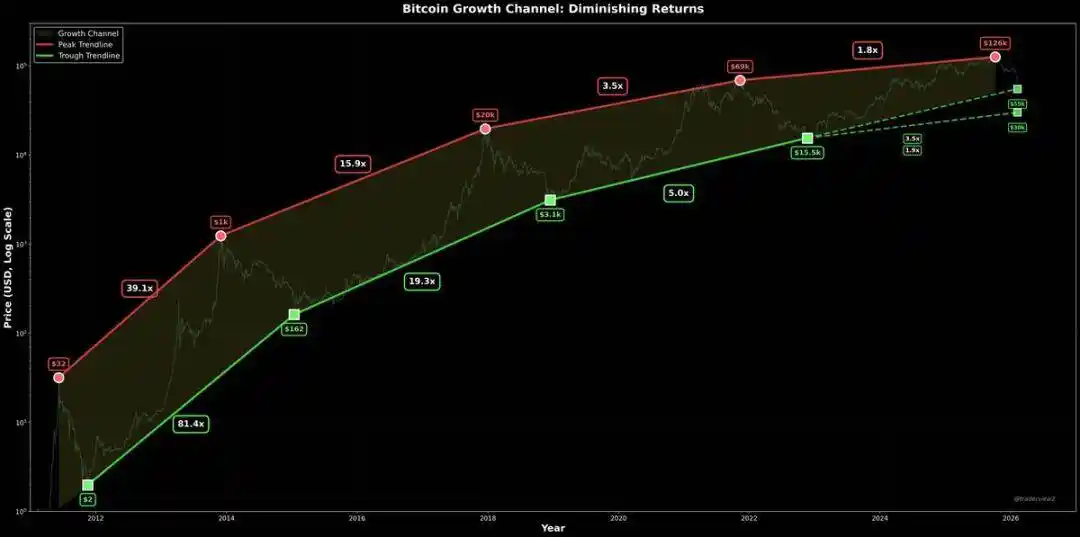
This 1.8x says it all. Compared to history, the upside potential in this cycle is minimal. This pattern cannot withstand a significant drop; otherwise, Bitcoin's growth will completely flatten.

This 1.8x gain is the core truth of the current market. Relative to historical levels, Bitcoin's upside space is now extremely narrow. This cycle pattern can no longer withstand a major pullback; otherwise, Bitcoin's long-term growth momentum will completely stall.

Pure Mathematical Constraint Formula

Definitions:

  • m = Cycle peak multiple = Current cycle peak ÷ Previous all-time high
  • d = Drawdown from peak (as a decimal)

Then, the bottom level of the next cycle relative to the previous high equals the current peak gain multiple multiplied by the remaining price proportion after the drawdown.

To ensure the bottom of the next cycle is not lower than the previous all-time high, the following condition must be met:
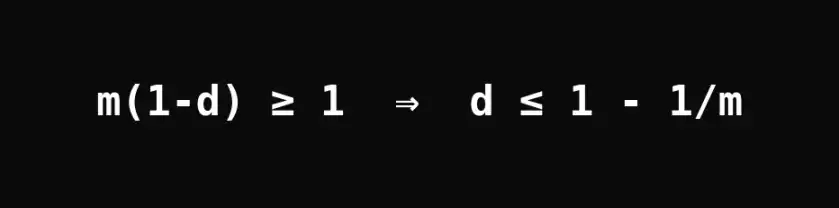
Substituting current cycle data: Previous ATH ≈ $69,000, Current cycle peak ≈ $126,000, we get:

Current peak multiple ≈ 1.8x. To maintain an intact bull market structure, the maximum allowed drawdown is approximately 44%. Currently, Bitcoin's drawdown has broken through this critical value.

Falling from about $126,000 to $60,000, Bitcoin's drawdown has exceeded the 44% "safety limit."

This means that if the previous all-time high was supposed to act as structural support, the current market is forcibly breaking through this support, forcing the market to a final conclusion.

$55,000 is the Key Make-or-Break Line

If Bitcoin falls to $55,000, two key signals will appear:

  • A drawdown of 56%, far exceeding the 44% allowed upper limit
  • The bottom price will be 20% lower than the previous all-time high ($69,000)

Once the price stays below $55,000, it means the market accepts that in this weak cycle with only a 1.8x gain, the cycle bottom can be significantly lower than the previous all-time high.

The subsequent impact will be: If the next cycle still maintains a 1.8x gain multiple, Bitcoin's price will rise from $55,000 to $99,000, and long-term growth momentum will stagnate. This is essentially a structural failure of the growth model; the market must change.

This is the core contradiction: Bitcoin's profit space has been severely compressed, but its volatility has not decreased proportionally. It's still a highly volatile market, but the peak gains have shrunk drastically. Such a cycle model is simply unsustainable.

Technical Support Near $55,000
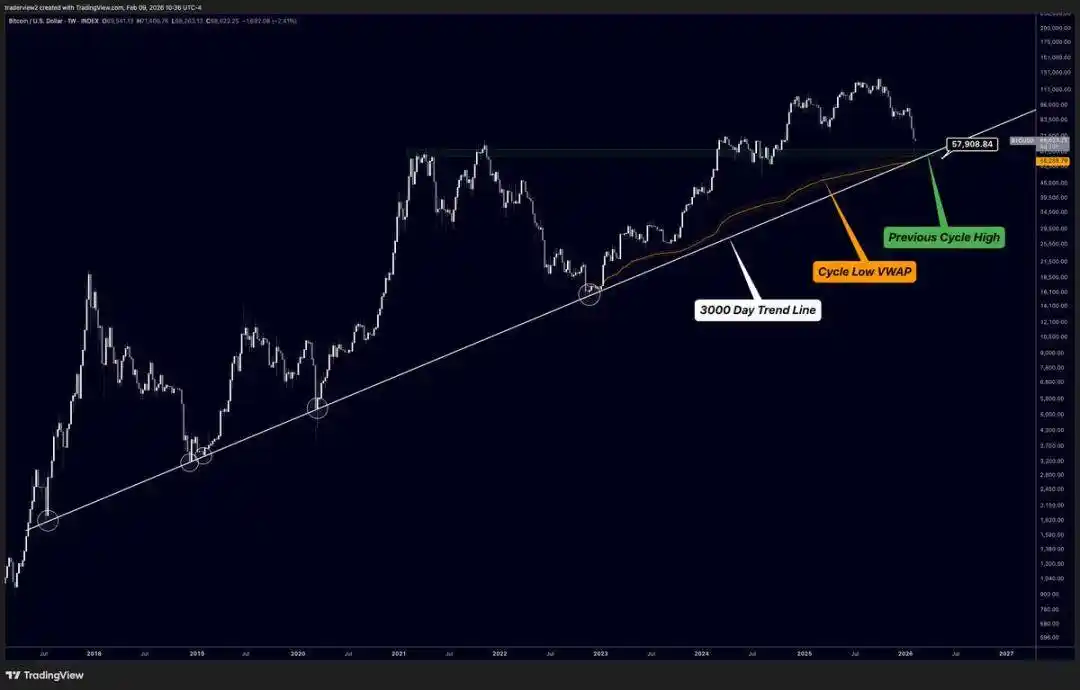
From a technical perspective, the mid-$55,000 range has extremely strong structural support, mainly including:

  • The 3000-day trendline (spanning over 8 years)
  • The Volume-Weighted Average Price (VWAP) of the 2022 cycle low
  • Support extension from the previous cycle's all-time high ($69,000)

Let's ponder: Why would an asset whose core belief is "long-term ultra-high returns" break below this triple structural support built up over years? Especially with the formal launch of convenient investment channels like ETFs, such a trend is completely contrary to the long-term growth trajectory.

The Cliff of Risk-Adjusted Returns

This contradiction makes Bitcoin's entire cycle logic black and white: If the cycle peak multiple continues to shrink, but the drawdown magnitude does not shrink proportionally, Bitcoin's risk-reward ratio will completely deteriorate:

  • The potential upside of the four-year cycle is only 20% to 50%
  • The downside risk could still reach 50%
  • Cycle trading would completely lose its meaning.
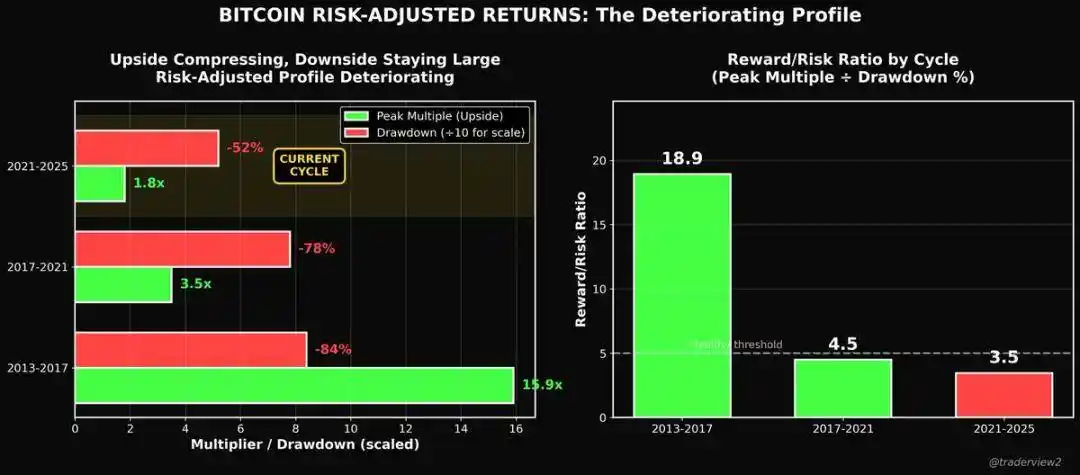
Faced with this dilemma, the market has only three ways out:

  • Volatility contracts significantly (Path to Glory)
  • The four-year cycle framework completely fails (Path to Ruin)
  • A new demand driver emerges, resetting the growth curve and ending the trend of decaying gain multiples

ETFs are the most commonly mentioned potential driver, but they have already been launched. To truly reset the growth curve, three types of power are needed more: large-scale structural capital allocation, adoption at the sovereign national level, or sustained, price-insensitive rigid demand.

The Harsh Reality: Why This Cycle is So Different

When I entered the crypto market in 2017, the entire industry was full of hope and innovative vitality. People firmly believed these blockchain networks could bring real solutions to the world.

Nearly nine years later, it's hard to say that any large crypto ecosystem has truly achieved sustainable mainstream utility value matching the initial promises.

This cycle has harvested countless participants; the vast majority of tokens have performed almost nothing. More and more people are realizing the truth of the market: For the vast majority of crypto assets, this is essentially a PvP game where participants rely on leverage, liquidations, and capital rotation to profit from other participants, not from the value growth of the assets themselves.

The market's selection rule has never failed: In the long run, the vast majority of cryptocurrencies will eventually go to zero. Bitcoin, along with a few quality assets in the crypto space, still has a chance to escape this fate and achieve true value breakthrough.

The Choice Between Glory and Ruin

Path to Glory

Bitcoin achieves "breaking the circle and upgrading": Volatility contracts significantly, drawdowns are far below historical levels, and the previous all-time high region re-establishes itself as solid structural support. Although the cycle peak multiple shrinks, the asset's stability improves significantly, the risk-reward ratio optimizes greatly, and it truly becomes a sustainable long-term investment.

Path to Ruin

The four-year cycle framework completely fails. It's not that Bitcoin itself perishes, but the cycle logic that has sustained it for years no longer holds. Volatility remains at historical highs, but the profit space continues to compress. The previous all-time high no longer acts as a bottom support. The past growth channel becomes a historical relic. Bitcoin may still experience阶段性上涨 (periodic rises) in the future, and may continue to gain adoption, but the former cycle规律 (laws) will no longer be the dominant rules of the market.

Path to Reset

A全新的 (brand new) demand driver强势出现 (forcefully emerges), completely breaking the model of decaying gain multiples and reshaping Bitcoin's growth curve. This could come from large-scale structural capital allocation, widespread adoption by sovereign nations, or passive buying by institutional funds forming long-term support.

Additional Hidden Danger: The Long-Term Test at the Protocol Layer

This is not a core factor affecting the current market, but it is worth long-term attention: In the long run, Bitcoin must prove that it can evolve at the protocol layer, especially possessing quantum resistance. The core of the quantum issue concerns the security of Bitcoin ownership and protocol upgrade coordination, not mining itself. The security of early Bitcoin (like Satoshi's holdings) is the real potential threat.

If Bitcoin hopes to become a long-lasting asset, it must ultimately pass the test of "completing protocol upgrades without破坏市场信任 (destroying market trust)". This is like a background timer, not yet triggered, but始终是 (always is) an important hidden danger for Bitcoin's long-term development.

Simple Judgment Criteria

If, after the washout, Bitcoin reclaims and holds firmly above $69,000: The cycle structure is preserved, and the path to glory remains highly possible.

If Bitcoin's price remains in the $55,000 to $69,000 range: The market is under maximum pressure, and the cycle model faces its final test.

If Bitcoin's price stays consistently below $55,000: Against the backdrop of a weak cycle with a 1.8x peak multiple, a structural breakdown occurs, and the market structure is highly likely to undergo a fundamental change.

Conclusion

Bitcoin cannot long-term possess two traits simultaneously: low-gain asset, high-drawdown asset. If risk-adjusted returns still have meaning, the two cannot coexist long-term.

Bitcoin's touch near $60,000 is the market testing this life-and-death boundary in real time. Once the price falls below the $50,000 range, all debates will end, and the market will deliver its final verdict, either走向荣耀 (heading towards glory) or坠入毁灭 (plunging into ruin).


Related Questions

QWhat is the critical price level for Bitcoin according to the article, and why is it considered a 'life or death' line?

AThe critical price level is $55,000. It is considered a 'life or death' line because if Bitcoin falls and sustains below this level, it would signify a structural breakdown of its long-term logarithmic growth model. A drop to $55,000 represents a 56% drawdown from the projected cycle peak of ~$126,000, far exceeding the mathematically 'safe' maximum drawdown of 44% required to keep the bull market structure intact. This would mean the cycle low has fallen below the previous all-time high (~$69,000), potentially leading to a complete failure of the classic four-year cycle framework and a stagnation of Bitcoin's long-term growth trajectory.

QWhat are the three potential paths (outcomes) for Bitcoin's future that the article outlines?

AThe article outlines three potential paths for Bitcoin's future: 1. The Path to Glory: Bitcoin 'breaks through' with significantly reduced volatility and drawdowns. The previous all-time high becomes solid structural support, and it transforms into a sustainable long-term investment despite smaller cycle peaks. 2. The Path to Ruin: The four-year cycle framework completely fails. Volatility remains high while potential gains shrink further. The previous growth channel becomes a historical relic, and the old cyclical规律 are no longer the market's dominant rules. 3. The Path to Reset: A new, powerful demand driver emerges (e.g., massive structural capital allocation, sovereign adoption) that resets the growth curve and breaks the trend of diminishing peak multiples.

QAccording to the mathematical constraint formula, what is the maximum allowed drawdown from the projected cycle peak to maintain the bull market structure, and what is the current situation?

AAccording to the mathematical constraint formula, the maximum allowed drawdown from the projected cycle peak (~$126,000) to maintain the bull market structure (i.e., ensuring the next cycle's bottom doesn't fall below the previous all-time high of ~$69,000) is approximately 44%. The current situation is that Bitcoin's drawdown has already breached this critical 'safety limit,' having fallen from ~$126,000 to around $60,000, which is a drawdown of over 44%.

QWhat does the compression of cycle peak multiples (from 15.9x to 3.5x to 1.8x) indicate about Bitcoin's market?

AThe compression of cycle peak multiples from 15.9x (2013-2017) to 3.5x (2017-2021) to a projected 1.8x (2021-2025) indicates that Bitcoin's potential upside gains in each four-year cycle are diminishing dramatically. This 'weakest ever' 1.8x multiple suggests that the market's upward space is extremely narrow compared to its historical performance. This compressed growth model cannot withstand significant price retracements without risking the complete flattening of Bitcoin's long-term growth trend and the potential failure of its classic cyclical model.

QWhat underlying contradiction does the article highlight regarding Bitcoin's current market profile?

AThe article highlights a core contradiction: Bitcoin's potential reward space (upside gains per cycle) has been severely compressed, but its volatility (the magnitude of price swings and drawdowns) has not decreased proportionally. It remains a highly volatile asset while offering dramatically reduced peak gains. This combination of high risk (large potential losses) and low reward (small potential gains) creates an unsustainable and severely worsened risk-adjusted return profile, which fundamentally threatens the logic and appeal of trading based on its four-year cycles.

Related Reads

Should You Buy SpaceX Stock at $1.7 Trillion? Here's What the Market Is Worried About

SpaceX is preparing for a massive IPO aiming to raise around $75 billion at a valuation of approximately $1.75 trillion. While its achievements in reusable rockets and the profitable Starlink satellite internet service are clear, the market is concerned about the aggressive valuation. Key issues include: the current $1.75 trillion valuation, which is about 94 times 2025 revenue, seems to price in not just existing businesses but also unproven future ventures like AI infrastructure and orbital data centers. Financially, while Starlink is profitable, the AI division, bolstered by the acquisition of xAI, is incurring massive losses and consuming the majority of capital expenditures. This acquisition also introduced complex related-party financing arrangements and debt onto SpaceX's balance sheet. Furthermore, corporate governance poses a challenge. SpaceX's dual-class share structure ensures founder Elon Musk retains absolute control, limiting ordinary shareholders' influence over high-risk, long-term strategic decisions. The future success of ambitious projects like the Starship rocket—critical for lowering costs and enabling new services—remains a significant variable for the valuation. In summary, the market's apprehension (FUD) centers not on doubting SpaceX's past technological triumphs but on questioning how much premium public investors should pay for a future that combines proven profits with highly speculative and capital-intensive new ventures, all under a governance structure that offers limited shareholder oversight.

marsbit53m ago

Should You Buy SpaceX Stock at $1.7 Trillion? Here's What the Market Is Worried About

marsbit53m ago

Breaking the DeFi Cascading Liquidation Curse: Vitalik Proposes a New Solution

Vitalik Buterin has proposed a new DeFi design to eliminate the automatic liquidation mechanism that causes market instability during sharp downturns. The current system, used by protocols like Aave, triggers forced sales when collateral value falls below a threshold, often exacerbating price drops and creating systemic selling pressure. Buterin's alternative model is based on splitting an asset like ETH into two synthetic option-like tokens, P and N, pegged to a price index. Their combined value always equals one ETH. Instead of sudden liquidation, a position's value gradually drifts from its target peg if the market moves. Users must proactively rebalance their holdings to maintain their desired exposure, transferring the management burden from the protocol to the user or automated tools. A key advantage is the reduced reliance on real-time oracles. Pricing decisions are deferred until contract expiry, allowing for more robust, fault-tolerant oracle designs. This removes a clear liquidation threshold that speculators can target for manipulation or MEV extraction. However, significant challenges remain. Frequent rebalancing could incur high slippage and transaction costs, necessitating new liquidity provider models. The design is better suited for hedging instruments than for stablecoins requiring a rigid 1:1 peg. While not an immediate replacement for existing systems, the proposal challenges the foundational assumption that instantaneous forced liquidation is an unavoidable necessity in DeFi, opening the door for fundamentally different risk management architectures.

marsbit58m ago

Breaking the DeFi Cascading Liquidation Curse: Vitalik Proposes a New Solution

marsbit58m ago

The End of Single-Factor Cryptography

The article "The End of Single-Factor Crypto" posits a fundamental shift in the cryptocurrency ecosystem. It argues the era where crypto asset valuations were predominantly driven by, and correlated with, Bitcoin's price is ending. The space is bifurcating into two distinct economies: endogenous and exogenous. The endogenous economy represents traditional crypto, where token and project values are directly tied to crypto market prices. The emerging exogenous economy comprises projects and businesses that may utilize blockchain technology or tokens but derive their fundamental value from external, non-crypto factors like consumer demand, subscription revenue, or real-world utility. Examples include AI inference platforms like Venice, fintech lenders using blockchain for efficiency, and stablecoin/payment infrastructure companies acquired by giants like Mastercard and Stripe. This shift means investment analysis must change. For exogenous assets, evaluating traditional business fundamentals—such as revenue streams, unit economics, and competitive moats—becomes more critical than tracking Bitcoin charts. While endogenous assets like Bitcoin remain relevant, the growth of the exogenous category is driven by measurable demand independent of crypto price cycles, paving the way for a new, more diversified market phase. Consequently, crypto is evolving from a single-factor, reflexive asset class into a multifaceted ecosystem with varied drivers and investment theses.

marsbit58m ago

The End of Single-Factor Cryptography

marsbit58m ago

Morning Post | Bitmine Plans to Raise $300 Million Through Preferred Stock Issuance; Polymarket Accuses Kalshi of Commercial Espionage

ChainCatcher's Daily Crypto Brief: Key developments from the past 24 hours include significant funding moves, regulatory actions, and market predictions. Bitmine announced a $300 million preferred stock fundraising. Polymarket accused rival prediction platform Kalshi of corporate espionage, citing numerous suspicious coincidences in product launches, a claim Kalshi strongly denied. The U.S. Department of Justice, in a joint "Disruption Week" anti-fraud operation with companies like Coinbase and Meta, froze over $3.8 million in cryptocurrency linked to scams. In infrastructure news, Macau completed its integration with the multi-central bank digital currency bridge, mBridge, aiming to build efficient cross-border payment channels. Cosmos Labs acquired the block explorer Mintscan. Market-wise, Geoffrey Kendrick, Standard Chartered's Head of Digital Assets Research, stated Bitcoin is nearing a bottom around $63,000, maintaining a year-end target of $100,000. He noted stability in U.S. spot Bitcoin ETF holdings. Ahead of SpaceX's anticipated IPO, internal insiders at Rocket Lab (RKLB) sold over $18.41 million in stock. In tokenization, Goldman Sachs partnered with Apex and Archax to launch a tokenized real estate fund. The meme token tracker GMGN reported the top trending tokens: on Ethereum, HEX, SHIB, LINK, PEPE, mUSD; on Solana, TROLL, swarms, WORLDCUP, neet, Buttcoin; and on Base, PEPE, toby, ODDS, ELSA, SKI.

链捕手1h ago

Morning Post | Bitmine Plans to Raise $300 Million Through Preferred Stock Issuance; Polymarket Accuses Kalshi of Commercial Espionage

链捕手1h ago

Trading

Spot
Futures

Hot Articles

Discussions

Welcome to the HTX Community. Here, you can stay informed about the latest platform developments and gain access to professional market insights. Users' opinions on the price of S (S) are presented below.

活动图片