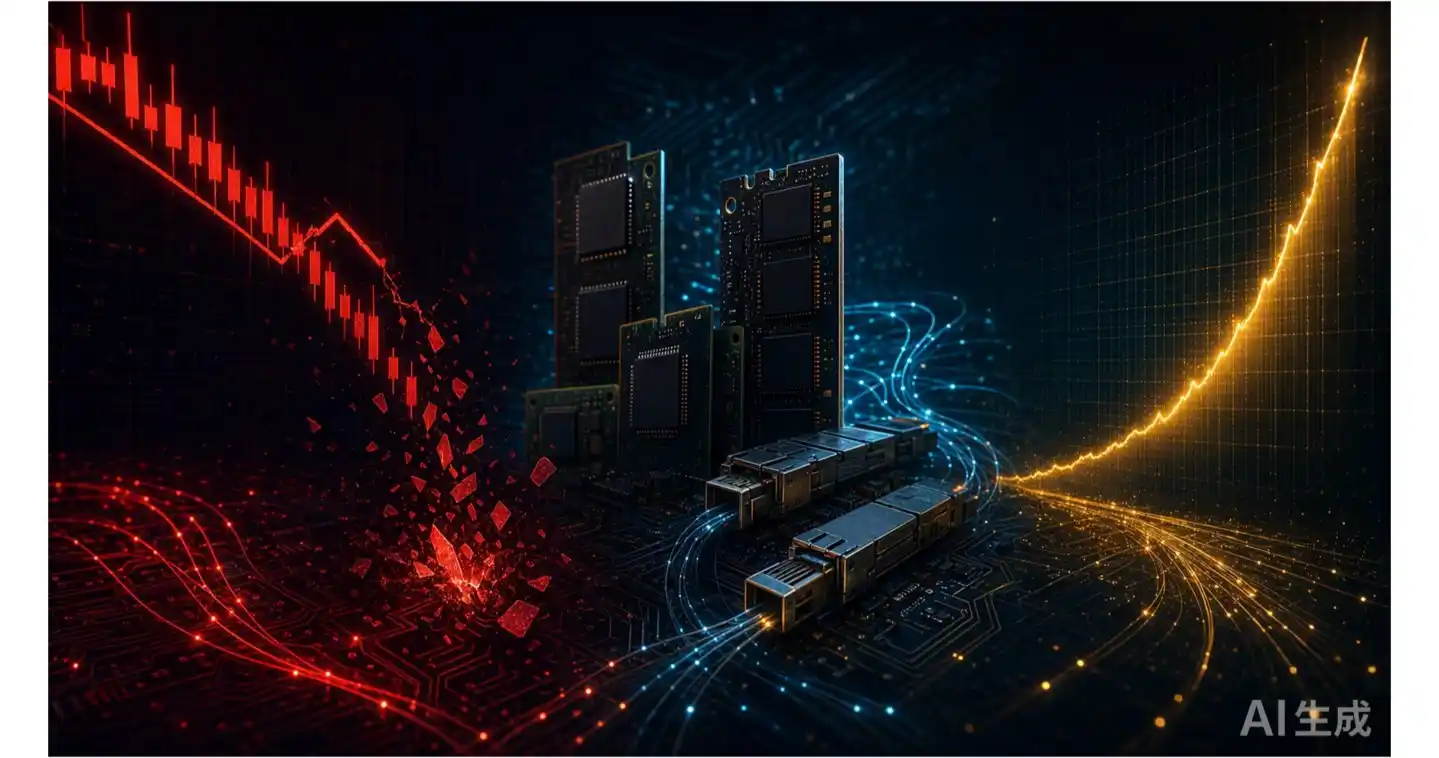
费半一夜跌近5%,光与存储集体“崩了”:美债利率飙升,AI信仰开始动摇

marsbit2026-08-19 tarihinde yayınlandı2026-08-19 tarihinde güncellendi

Özet

8月18日美股市场,AI硬件核心板块遭遇罕见抛售,费城半导体指数跌近5%,光通信与存储芯片股领跌。市场焦点从“AI资本开支想象”转向“资本成本”,主因是长期美债收益率飙升(30年期创2007年以来新高)推高贴现率,严重冲击盈利预期久期长的成长股。地缘局势推高油价,加剧通胀与利率上行压力。抛售集中于前期涨幅大、仓位拥挤的AI纯正品种(如HBM存储、高速光模块),其估值对资本开支叙事和利率高度敏感。此次下跌更多是估值与拥挤交易修正,而非AI基本面证伪。后市需关注美债收益率、油价及AI项目发债成本等信号。对A股相关板块,短期情绪冲击难免,但中期逻辑需结合国内资本开支与业绩兑现情况判断。市场正对AI投资进行更严格的回报率审视。

昨夜(8月18日)美股,AI硬件板块最锋利的两支矛,光通信与存储芯片,遭遇了本轮行情以来罕见的大面积抛售。费城半导体指数收跌4.98%,30只成分股全数下跌,创7月29日以来最大单日跌幅;美股三大指数连续第三个交易日收跌。

市场叙事的焦点正在切换,从“AI资本开支的无限想象”,切换为“这笔钱到底要付多高的利息”。

先看全景。道指收跌0.22%,标普500跌0.69%,纳指跌1.33%。表面看跌幅并不夸张,但把镜头拉近到AI硬件内部,会发现这是一场结构性踩踏。

存储板块全线重挫。铠侠ADR暴跌超13%,闪迪跌9.01%,希捷跌9.16%,西部数据跌7.43%,美光跌7.02%,SK海力士ADR跌超9%。光通信与AI基础设施板块跌幅更深。Fabrinet暴跌19.38%,Coherent跌12.75%,CoreWeave跌12.10%,Lumentum跌9.87%,迈威尔跌超6%,康宁跌超4%。

大型科技股亦难独善其身。Meta跌4.45%,英伟达跌2.34%;中概AI资产同步承压,百度因业绩发布收跌12.73%,世纪互联跌近17%。

一个值得注意的细节是,跌得最深的,恰恰是前期涨得最猛、AI叙事最“纯正”的品种。这不是一场普跌,而是AI叙事内部的定价重置。市场开始按不同的风险重新排序,首当其冲的就是久期最长、仓位最拥挤的资产。

三重压力与结构性因素

30年期美债收益率盘中一度触及5.337%,创2007年6月以来新高,19年来的最高水平。10年期收益率也一度升至4.75%,为2025年1月以来最高。这是一场全球性的长端利率上行,日本10年期国债收益率升至30年最高,德国30年期创2011年以来新高,法国30年期为2008年以来最高。

有分析师对此的概括颇为精炼:“投资所要求的回报门槛又在提高。但这一次,不是因为市场重新上调短期利率预期,而是油价、政府债券供给,以及长端期限溢价共同作用的结果。”

对成长股而言,这无异于估值公式的分子分母同时恶化。成长股定价的本质是未来现金流的折现,贴现率每上一个台阶,盈利兑现期越远的资产杀伤越大。AI硬件股恰恰是美股市场“久期最长”的板块,它的盈利兑现被定价在三五年之后,对利率的敏感度远超其他行业。城堡证券的警告颇具代表性,美联储在通胀高于目标时不愿收紧货币政策,本身就推升了长债收益率的风险。

这一轮长债收益率的抬升,并非孤立的市场事件。高盛数据显示,今年迄今AI相关债券供给已达4890亿美元,超过2025年全年的3220亿美元;另有超过1万亿美元的AI年资本开支正涌入债市。AI行业的融资需求,正在与传统的主权国家借款方争夺资金。

一个典型案例足以说明问题。黑石旗下QTS为微软数据中心发行39亿美元、5年期债券,认购需求高达230亿美元,发行收益率达7.228%。这条信息有两个读数。其一,市场对AI资产的认购热情依然高涨;其二,7.2%的融资成本意味着数据中心项目必须赚回高于此的回报率。债券市场正在用真金白银给AI“算账”,而算出来的这道利息门槛,正在抬高每一项资本开支的回报要求。

特朗普政府暂停与伊朗的接触,特朗普本人称“目前和未来不会与伊朗进行任何会谈”,霍尔木兹海峡控制权的僵局仍未打破;伊朗议会议长则称海峡“将继续关闭”。布伦特原油涨至91美元/桶上方,WTI报84.94美元/桶,逼近85美元关口,标普500能源指数涨1.8%,创3月以来新高。

油价上行的传导路径并不复杂,油价→通胀预期→长端利率。但对成长股而言,这是最坏的组合,盈利预期与估值同时承压。分析师普遍判断布伦特原油将继续在70至100美元这一较宽区间内运行,地缘变量短期内很难消失。

三个结构性原因。

其一,涨幅最大、仓位最拥挤。HBM存储、800G/1.6T光模块是本轮AI行情中叙事最纯正、弹性最大的品种,前期积累了大量的动量资金与杠杆资金。拥挤交易的出清往往呈现两个特征,一是跌幅远超指数,二是修复需要更长时间,因为浮盈盘与杠杆盘同时夺路而逃,抛售往往以不计成本的方式完成。

其二,对资本开支叙事最敏感。存储和光通信的需求,直接挂钩云厂商资本开支的“加速度”而非“绝对值”。任何关于AI投资可持续性的质疑,都会首先冲击这一环节。它们是为“想象空间”定价的资产,而不是为“当期盈利”定价的资产。

其三,产业链弹性放大。光模块、存储企业的盈利与估值波动天然大于平台型龙头,一旦贴现率上行触发估值收缩,戴维斯双杀的幅度远高于盈利稳定的巨头。

但这里有一个容易被忽视的细节,本轮抛售并未伴随AI基本面的证伪。英伟达只跌了2.34%,而非崩盘式下跌,说明市场杀的是估值与拥挤度,而不是逻辑本身。真正的分歧在于,这是一次剧烈回调,还是趋势拐点。

三个指标决定方向

亚洲盘已经给出了第一轮回应。韩国KOSPI开盘跌5%,三星电子跌6.7%、SK海力士跌7.4%;日经225低开近1%。A股算力、光通信、存储板块同步承压,由于A股光模块龙头与美股光通信股联动极强,短期情绪传染难以避免。

后续走势,盯住三个指标。

第一,30年期美债收益率能否止步于5.3%附近。若继续上行并站稳,成长股的估值收缩尚未结束;若从该位置回落,超跌反弹的窗口就会打开。One Point BFG Wealth Partners首席投资官Peter Boockvar的判断代表空方:“如果利率继续沿这一趋势上涨,那么利率对股市产生冲击,不是‘会不会’的问题,而只是‘什么时候’的问题。”

第二,油价与地缘局势。布伦特能否维持在70至100美元区间、霍尔木兹海峡僵局如何演绎,直接决定通胀叙事是强化还是弱化。

第三,AI债券融资的定价信号。QTS这类发债的认购倍数与发行收益率,是市场对AI资产风险溢价最直接的投票;同时关注美联储对油价通胀的表态,这在很大程度上决定了长端利率的走向。

对A股而言,短期映射难免,但中期逻辑需要分开看。A股光模块与存储的中期驱动力,是国内云厂商资本开支与国产算力需求,与外盘利率的相关性并不完全同步。急跌之后既要警惕“错杀”,也要防范“高位补跌”,区别二者的关键,仍是资本开支的真实兑现。对持仓者而言,比预判指数更重要的,是复盘自己持有品种的盈利兑现节奏,业绩在报表上已经落地、估值仍在合理区间的品种,回撤更多是情绪扰动;而纯靠叙事支撑的高位品种,则需要用利率的尺子重新量一遍。

昨夜不是AI叙事的终点,而是定价逻辑的一次换挡,从“故事”切换到“利息”。当数据中心融资成本站上7%、30年美债收益率创下19年新高,每一分资本开支都必须回答回报率的问题。市场给AI算的这笔账,才刚刚开始。

(本文首发钛媒体APP,作者 | 硅谷Tech_news,编辑 | 秦聪慧)

Trend Kriptolar

İlgili Sorular

Q文章指出昨夜美股AI硬件板块大跌的核心触发因素是什么?

A核心触发因素是美债收益率飙升,尤其是30年期美债收益率创下2007年以来新高。这提高了未来现金流的贴现率,对久期长、盈利兑现预期在未来的AI成长股(如光通信、存储芯片)估值造成了直接冲击。

Q除了利率因素,文章还提到了哪些共同导致市场担忧的原因?

A文章提到了三重压力:1) 美债长端利率飙升。2) AI行业巨额资本开支和债券融资(今年已超4890亿美元)与传统主权债争夺资金,推高了融资成本(例如数据中心债券发行收益率达7.2%)。3) 地缘政治紧张(如霍尔木兹海峡僵局)推高油价(布伦特原油突破91美元),加剧了通胀预期,进一步利空成长股。

Q为什么文章说光通信和存储板块是本轮下跌中受冲击最严重的?

A主要有三个结构性原因:1) 前期涨幅最大、资金仓位最拥挤,积累了大量杠杆和动量资金,一旦转向容易引发不计成本的踩踏式抛售。2) 它们的需求高度依赖于AI资本开支的“加速度”,对投资可持续性的叙事最敏感。3) 作为产业链弹性环节,其盈利和估值波动性天然大于平台型龙头,在贴现率上行时更容易遭遇“戴维斯双杀”。

Q文章认为这次大跌是否意味着AI投资逻辑被证伪?为什么?

A文章认为并未证伪AI基本面的逻辑。关键证据是英伟达仅下跌2.34%,而非崩盘式下跌。这表明市场主要是在杀估值和拥挤交易,调整的是对未来盈利过于乐观的贴现和风险溢价,而非彻底否定AI的长期趋势。真正的分歧在于这是一次剧烈回调还是趋势拐点。

Q对于后续市场方向,文章建议关注哪三个关键指标?

A文章建议关注三个指标:1) 30年期美债收益率能否在5.3%附近止步,这决定了成长股的估值收缩是否结束。2) 油价(如布伦特原油)走势及霍尔木兹海峡等地缘局势,这影响通胀叙事。3) AI相关债券(如QTS为微软数据中心发行的债券)的认购倍数和发行收益率,这是市场对AI资产风险溢价的直接定价信号。

İlgili Okumalar

Is RWA Still Meaningful Without DeFi?

The article "Would RWA Still Matter Without DeFi?" argues that tokenizing real-world assets (RWA) alone, like putting a barcode on a container, is not transformative. True value emerges when these tokenized assets are integrated into decentralized finance (DeFi) ecosystems, enabling valuation, financing, hedging, trading, and loss management in a programmable, automated manner. Tokenization provides digital representation, but DeFi provides utility through leverage, liquidity, and composability. The core challenge lies in aligning the different "time clocks" of blockchain (fast, 24/7), traditional markets (limited hours), and asset redemption (slow processes), which creates liquidation risks and gaps. Effective RWA integration requires more than a token; it needs a full stack: legally enforceable rights, reliable data oracles, clear transfer rules, executable secondary liquidity, appropriate collateral parameters, and credible loss resolution paths. Liquidity is defined not by total value locked (TVL) but by the ability to exit a position under stress within a required timeframe. Risk management for RWAs must be modeled as a dependency graph, monitoring interconnected nodes like issuers, custodians, oracles, and liquidity pools for early warning signs beyond just price data. While tokenized government bonds serve as an initial "ping test," the future lies in more complex assets like computing power and energy, which require bespoke risk models. Tokenized stocks paired with perpetual futures present a major test, combining global equity ownership with crypto-native leverage, necessitating robust architectural safeguards like isolation and dynamic collateral rules. The conclusion is that without DeFi, RWA tokenization offers limited value—improving distribution and transparency. The significant opportunity arises when tokenized assets become functional components within open, programmable capital markets, where they can be used as collateral and facilitate complex financial strategies. The token is merely the barcode; the market operating system is the real machine.

marsbit12 dk önce

Is RWA Still Meaningful Without DeFi?

marsbit12 dk önce

Government Intervention in the Bond Market: What Does It Mean?

On August 19, 2026, the U.S. Treasury unexpectedly announced it would at least double the size of its long-term Treasury buyback operations, starting September 9. The move triggered an immediate market reaction, with the 30-year yield falling 9 basis points. This intervention came against a backdrop of the 30-year yield hitting a 19-year high of 5.34% the previous day, driven by persistent inflation, high oil prices, deteriorating U.S. fiscal health with public debt surpassing $40 trillion, and a global "buyers' strike" for long-dated bonds. Treasury buybacks involve the government repurchasing older, less liquid bonds from the market via reverse auctions to improve market functioning, not to reduce overall debt. While the action provided tactical relief and signaled the Treasury's willingness to intervene, analysts caution it does not address core structural issues: massive fiscal deficits, high borrowing needs, and fading demand from traditional buyers like foreign central banks. For investors, the announcement offered short-term support for long-duration bond ETFs and boosted assets like gold, which rose 2.7%. However, it's unlikely to significantly lower mortgage rates or alter the challenging environment for long-term bonds. The key takeaway is the distinction between a tactical market operation and the unresolved structural pressures that continue to push yields higher, requiring close monitoring of upcoming economic data, Treasury auctions, and potential signals of more aggressive policy measures.

marsbit16 dk önce

Government Intervention in the Bond Market: What Does It Mean?

marsbit16 dk önce

After 'Bessent Put', How Far Is the U.S. from Restarting QE?

Following an unscheduled announcement from the U.S. Treasury Department on August 19th, investor discussions have intensified regarding the potential for future policy interventions in long-term bond markets. The Treasury increased the maximum size of its regular buyback operations for 10-to-30 year bonds from $2 billion to $4 billion, citing a desire to improve liquidity. This move came shortly after a surge in long-term yields, with the 30-year Treasury yield briefly touching 5.34%. Market analysts, rather than focusing on the modest operational size, have interpreted the timing—outside the normal quarterly communication window—as a significant signal. The move has been dubbed the "Bessent Put," implying the market's growing expectation that Treasury officials, led by Deputy Secretary Josh Bessent, may act to prevent a disorderly rise in long-term borrowing costs. This perception represents a potential shift in the market's view of the government's "policy reaction function." The underlying pressures on long-term bonds are multifaceted, including large fiscal deficits, increased Treasury supply, a rise in corporate debt issuance for AI infrastructure (creating a "crowding out" effect), and uncertainty around foreign holdings, particularly from Japan. Geopolitical risks in the Middle East further complicate the policy landscape, potentially creating conflicting pressures between fighting inflation and managing financing costs. However, the article clarifies that this Treasury buyback program is distinct from Quantitative Easing (QE). It is a debt management operation, not a Federal Reserve balance sheet expansion. While the announcement opens the door for market speculation about more forceful tools like Yield Curve Control (YCC) or a return to QE, analysts note that conditions would need to deteriorate significantly for such measures to be implemented. For now, the "Bessent Put" reflects a change in market expectations about possible policy boundaries, not an imminent launch of new monetary stimulus.

marsbit16 dk önce

After 'Bessent Put', How Far Is the U.S. from Restarting QE?

marsbit16 dk önce

Is Stablecoin Really Necessary for Cross-border Payments?

"Is Stablecoin Truly Necessary for Cross-Border Payments? While stablecoins are often praised as superior for cross-border transfers—especially if the recipient desires crypto—their advantage is less clear in traditional cross-currency scenarios (e.g., USD to Mexican Peso). The existing correspondent banking system is slow and costly (≈15% fees) due to multiple intermediaries. Modern fintech solutions like Wise have dramatically improved this by using a netting model: they hold local currency pools and settle payments domestically, avoiding actual cross-border fund movement. This offers near-instant transfers with low, transparent fees (averaging ~0.52%). The 'stablecoin sandwich' model (convert fiat to stablecoin, transfer on-chain, convert to local fiat) offers similar user experience but doesn't inherently provide major cost or speed advantages over fintech. Its on-chain transfer is cheap, but fiat conversion spreads remain. Stablecoin's real innovation is 'unbundling' the cross-border payment stack. Instead of requiring a proprietary global network like Wise, businesses only need reliable on- and off-ramps in specific corridors. This lowers market entry barriers, fosters competition among local providers, and can drive down costs, particularly for niche or underserved corridors (e.g., US to Africa). While vertical integration may reoccur, the open, permissionless nature of the underlying blockchain layer makes monopolistic pricing difficult. The long-term benefit is the potential redistribution of value—previously captured as intermediary rents—to consumers through lower costs."

marsbit20 dk önce

Is Stablecoin Really Necessary for Cross-border Payments?

marsbit20 dk önce

Ethereum Finally 'Bounces Back'! ETH Returns to the Golden Line, What's Different About This Rally?

Ethereum has surged above $2,300, a level not seen in over three months, marking a significant recovery and technical breakthrough by reclaiming key resistance levels, including the weekly EMA50 for the first time in the current bear market. The rally has been fueled by a combination of factors: improved market risk appetite, positive regulatory sentiment, and a major short squeeze where over 88% of recent ETH liquidations were short positions. The ETH/BTC ratio has also broken its long-term downtrend, indicating renewed strength for Ethereum relative to Bitcoin. Fundamentally, Ethereum spot ETFs have shown strong inflows, outperforming their Bitcoin counterparts in recent months. Wall Street institutions like Morgan Stanley and JPMorgan have notably increased their ETH exposure, while several banks have added or expanded positions in ETH ETFs. On-chain fundamentals remain robust, with the proportion of staked ETH reaching a new all-time high of nearly 33.7%. Data indicates long-term holding sentiment, as small wallet holdings increased while large outflows were often directed towards staking or contracts, not selling. However, potential headwinds include declining staking yields and community debate over proposals to adjust staking rewards at high participation levels. The upcoming Glamsterdam upgrade, featuring improvements to validator exit efficiency, could enhance liquidity and further attract institutional stakers. While the rebound is supported by sentiment, capital flows, and fundamentals, its sustainability hinges on continued positive developments.

marsbit20 dk önce

Ethereum Finally 'Bounces Back'! ETH Returns to the Golden Line, What's Different About This Rally?

marsbit20 dk önce

İşlemler

Spot

Popüler Makaleler

NIGHT Nasıl Satın Alınır

HTX.com’a hoş geldiniz! Midnight (NIGHT) satın alma işlemlerini basit ve kullanışlı bir hâle getirdik. Adım adım açıkladığımız rehberimizi takip ederek kripto yolculuğunuza başlayın. 1. Adım: HTX Hesabınızı OluşturunHTX'te ücretsiz bir hesap açmak için e-posta adresinizi veya telefon numaranızı kullanın. Sorunsuzca kaydolun ve tüm özelliklerin kilidini açın. Hesabımı Aç2. Adım: Kripto Satın Al Bölümüne Gidin ve Ödeme Yönteminizi SeçinKredi/Banka Kartı: Visa veya Mastercard'ınızı kullanarak anında Midnight (NIGHT) satın alın.Bakiye: Sorunsuz bir şekilde işlem yapmak için HTX hesap bakiyenizdeki fonları kullanın.Üçüncü Taraflar: Kullanımı kolaylaştırmak için Google Pay ve Apple Pay gibi popüler ödeme yöntemlerini ekledik.P2P: HTX'teki diğer kullanıcılarla doğrudan işlem yapın.Borsa Dışı (OTC): Yatırımcılar için kişiye özel hizmetler ve rekabetçi döviz kurları sunuyoruz.3. Adım: Midnight (NIGHT) Varlıklarınızı SaklayınMidnight (NIGHT) satın aldıktan sonra HTX hesabınızda saklayın. Alternatif olarak, blok zinciri transferi yoluyla başka bir yere gönderebilir veya diğer kripto para birimlerini takas etmek için kullanabilirsiniz.4. Adım: Midnight (NIGHT) Varlıklarınızla İşlem YapınHTX'in spot piyasasında Midnight (NIGHT) ile kolayca işlemler yapın.Hesabınıza erişin, işlem çiftinizi seçin, işlemlerinizi gerçekleştirin ve gerçek zamanlı olarak izleyin. Hem yeni başlayanlar hem de deneyimli yatırımcılar için kullanıcı dostu bir deneyim sunuyoruz.

412 Toplam GörüntülenmeYayınlanma 2025.12.08Güncellenme 2026.06.02

NIGHT Nasıl Satın Alınır

Tartışmalar

HTX Topluluğuna hoş geldiniz. Burada, en son platform gelişmeleri hakkında bilgi sahibi olabilir ve profesyonel piyasa görüşlerine erişebilirsiniz. Kullanıcıların NIGHT (NIGHT) fiyatı hakkındaki görüşleri aşağıda sunulmaktadır.

活动图片