A New Era: The Fundamental Transformation of China's Entrepreneurs

marsbitPubblicato 2026-08-03Pubblicato ultima volta 2026-08-03

Introduzione

A profound generational shift is underway among Chinese entrepreneurs. The wealth and influence once dominated by real estate and internet giants is now being claimed by a new wave of founders driving breakthroughs in AI, semiconductors, and robotics. This change is vividly reflected in 2026's wealth rankings. Figures like Zhang Yiming (ByteDance), Liang Wenfeng (DeepSeek), Chen Tianshi (Cambricon), and Wang Xingxing (Unitree Robotics) are ascending. Their wealth stems not from traditional business models but from market expectations for future technological competitiveness, with AI, chips, and smart hardware becoming the primary engines of wealth creation. Their common trait is a foundational focus on technology, often starting from the laboratory rather than a business plan. Examples include Chen Tianshi's decade-long push in AI chips, Liang Wenfeng's core algorithmic innovations at DeepSeek with a compact team, and Zhu Yiming's "no salary until profitable" 9-year journey to build Changxin Memory into a global DRAM player. This transition marks a fundamental shift in China's economic imperative: from commercial expansion and learning to indigenous innovation and deep industrial capability. While the previous generation built the foundational market and infrastructure, this new cohort is tasked with achieving global leadership in core technologies, moving China from "keeping pace" to pioneering original, breakthrough innovations that are industrialized at scale. The baton...

The summer of 2026 is destined to be recorded in the annals of Chinese business history.

On July 27th, ChangXin Memory Technologies (CXMT) made its debut on the STAR Market (China's Nasdaq-style board), with its market capitalization soaring past 3.28 trillion yuan, instantly becoming the most valuable stock on the A-share market. On the morning of July 31st, it further surged past 4 trillion yuan. Zhu Yiming, the company's founder—a Tsinghua University physics graduate who pledged "no salary until the company turns profitable" and went without a single yuan in salary for seven full years—saw his personal shareholding value exceed 90 billion yuan.

In the same month, Wang Xingxing, founder of robotics company Unitree Robotics, graced the cover of TIME magazine under the headline, "The Robot Age Has Arrived." The full-page cover featured a photo of him standing beside the company's 2.7-meter-tall mass-produced manned mech, the GD01. TIME described him as "an atypical prophet of the AI era." It had been a full eight years since the last Chinese entrepreneur, Baidu founder Robin Li, appeared on the magazine's cover.

Just a month prior, AI chipmaker Cambricon became the first company on the STAR Market to surpass a market cap of 1 trillion yuan, with shares held by its 'post-85s' founder Chen Tianshi valued at nearly 300 billion yuan. Meanwhile, Liang Wenfeng, founder of DeepSeek which had just completed its first funding round, topped the global AI wealth list with a fortune of $36 billion, while ByteDance founder Zhang Yiming retained the top spot on the New Fortune 'Creation & Wealth' list with 543.9 billion yuan.

This cluster of events points unmistakably to the same profound shift: China's entrepreneur community is undergoing a deep-seated generational transition.

01. From "Internet" to "Artificial Intelligence"

The changing composition of China's wealth lists offers the most direct window into the evolution of the Chinese economy.

Over the past two decades, the protagonists of China's rich lists have changed several times. Real estate, retail, internet, FMCG, e-commerce, social media, and mobile internet entrepreneurs have successively entered the core positions of the wealth rankings.

Behind this lies the constant shifting of China's leading industries.

Today, the wealth landscape is undergoing another major reshuffle.

Zhang Yiming's defense of his top spot is first and foremost a testament to ByteDance's commercial success. However, to view it merely as the victory of an internet company would be to underestimate the deeper significance of this wealth shift: ByteDance is itself in the midst of migrating from the internet era to the AI era.

Zhang Yiming's ascension, in a sense, reflects the shifting primary drivers of wealth creation in China—from demographic dividends to technological dividends. The development prospects of AI business are also a key factor driving the continuous revaluation of ByteDance's market capitalization.

Zhang Yiming first appeared on a major wealth list in 2018, with his estimated holdings valued at around 12 billion yuan. The rocket-like speed of his wealth accumulation in the following few years is backed by the super-cycle of mobile internet and AI convergence, as well as the market's continuous revaluation of ByteDance's global business and AI potential.

A significant change here is: Entrepreneurial wealth increasingly reflects market expectations for future technological competitiveness.

This is even more evident in the 2026 New Fortune list. The list shows that 114 individuals from the TMT (Technology, Media, Telecommunications) sector made the cut, with a combined shareholding value of 4.6 trillion yuan, accounting for 26.9% of the total wealth on the list—a record high. AI large language models, chips, optical modules, embodied AI, and AI hardware emerged as the most concentrated wealth creation directions.
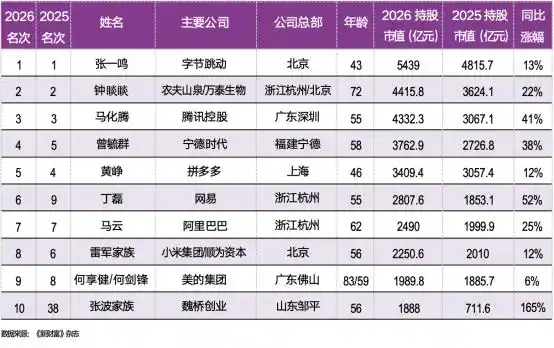
▲ Top 10 of the 2026 New Fortune 500 Creation & Wealth List. Source: Shenzhen News Network

Independent innovation and breakthroughs in core technologies, with AI leading the charge, are creating and concentrating wealth at an unprecedented speed and scale. In the 2025 New Fortune 500 list, DeepSeek founder Liang Wenfeng debuted on the list, entering the top ten with a fortune of 184.62 billion yuan. According to relevant institution statistics, the large model sector has already created at least 36 billionaires, with cumulative wealth reaching several hundred billion yuan.

The reshaping of the wealth map is not merely an industrial replacement, but a generational handover of entrepreneurs. Names like 43-year-old Zhang Yiming, 41-year-old Liang Wenfeng, 36-year-old Wang Xingxing, and 41-year-old Chen Tianshi are replacing those born in the 1960s and 1950s as the leading figures on China's wealth lists.

This is not a transfer of wealth between different individuals, but the passing of the baton from one era to the next.

02. From "Doing Business" to "Developing Technology"

If the most important keywords of the previous wave of Chinese business were "market" and "business model," then today's most important keyword is "technology."

This generation of entrepreneurs shares a distinct common trait: the starting point for many of their ventures is not a business plan, but a laboratory.

Chen Tianshi is a typical case.

Born in 1985, he entered the Special Class for the Gifted Young (SCGY) at the University of Science and Technology of China at age 16, completed his undergraduate and doctoral studies there, and then conducted research at the Institute of Computing Technology, Chinese Academy of Sciences, focusing on deep learning and artificial intelligence, becoming a world-class scientist in the AI field. In 2016, he co-founded Cambricon with his brother Chen Yunji, choosing a direction that was at the time extremely cutting-edge and challenging—AI chips.

Cambricon did not rapidly monetize through a proven business model. Instead, it underwent a long period of technological investment. At its 2020 IPO, its revenue was only 4.59 billion yuan, with a net loss attributable to shareholders of 4.35 billion yuan. In subsequent years, revenue fluctuated around 7 billion yuan, while net losses attributable to shareholders expanded annually, reaching a peak loss of 12.57 billion yuan in 2022.

Finally, the turning point arrived in 2025. The company achieved revenue of 64.97 billion yuan, with a net profit attributable to shareholders of 20.59 billion yuan, marking its first annual profit. In Q1 2026, revenue reached 28.85 billion yuan, a year-on-year increase of 159.56%; net profit attributable to shareholders was 10.13 billion yuan, up 185.04% year-on-year. On June 30th, Cambricon's market capitalization broke through 1 trillion yuan for the first time, becoming the first company on the STAR Market to achieve a trillion-yuan valuation.

Regarding this journey from losses to profitability, from a valuation of tens of billions at IPO to a trillion yuan, what deserves the most attention is not the stock price increase, but one fact: China's AI chips have progressed from laboratory technology to the stage of industrial-scale production.
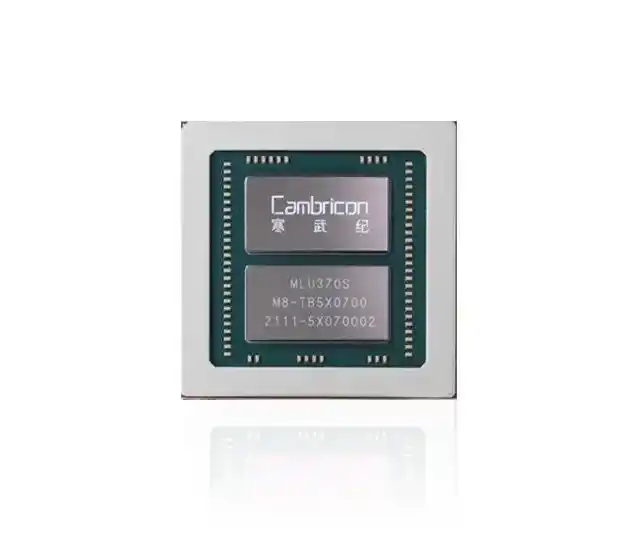
▲ Image Source: Cambricon

Liang Wenfeng presents another type of archetype.

He studied at Zhejiang University for his bachelor's and master's degrees. In 2015, he co-founded quantitative hedge fund High-Flyer Capital (幻方量化), before later entering the large model field. The emergence of DeepSeek made the world reassess Chinese AI entrepreneurs.

Its unique aspect is that Liang Wenfeng did not start with "building an AI application." Instead, he began from more fundamental problems like model architecture, training algorithms, and computational efficiency optimization, leading to disruptive innovation. At the time DeepSeek shone on the world stage, its core R&D team, including Liang Wenfeng, numbered fewer than 150 people—a stark contrast to the scale of international AI giants like OpenAI.

This mode of entrepreneurship is indeed different from traditional internet startups. Internet entrepreneurship often starts by finding users, then searching for a product; technological entrepreneurship frequently reverses this: first solving a technical problem, then discovering the industrial potential it can unlock.

Zhu Yiming's story illustrates this change even more profoundly.

In 2005, he returned to China to found GigaDevice. In 2016, he dedicated himself to building China's domestic DRAM industry; after 2018, he focused his primary efforts on ChangXin Memory Technologies, pledging not to take a salary until the project became profitable. For a full seven years, he did not receive a single yuan in salary.

ChangXin also experienced a long period of losses, with a net loss attributable to shareholders of 16.34 billion yuan in 2023, and 7.145 billion yuan in 2024. In 2025, the company achieved revenue of 61.799 billion yuan, a year-on-year increase of 155.60%; net profit was 7.144 billion yuan, marking its first annual profit.

In Q1 2026, driven by rising DRAM prices, growing computing power demand, and production capacity ramp-up, revenue further reached 50.8 billion yuan, up 719.13% year-on-year; net profit attributable to shareholders was 24.762 billion yuan. On its first trading day, July 27th, ChangXin's market cap soared to 3.28 trillion yuan.

But more noteworthy than the market capitalization is the position this company has reached—a position where few Chinese enterprises have been able to firmly stand before.

DRAM is a highly concentrated market with extremely high technical barriers, long dominated by Samsung, SK Hynix, and Micron. According to Omdia data, based on Q4 2025 sales statistics, ChangXin's global market share has increased to 7.67%, making it the world's fourth-largest DRAM manufacturer.

It has not yet changed the established global memory market landscape, but it has entered the list of major global players. This is a historic leap.

The length of this journey far exceeded most people's imaginations. From the project launch in 2016 to its first profit in 2025, ChangXin walked a full nine years. This is not a story about wealth; it is a story about faith in technology.

A UBS report shows that in 2025, 70 new billionaires emerged in mainland China, with the technology sector becoming the primary engine of wealth creation. The emergence of these "engineer billionaires" signifies a fundamental change in the composition of China's business elite:

The starting point of entrepreneurship is shifting from "doing business" to "developing technology."

03. From "Expanding the Market" to "Deepening the Industry"

Rather than saying Chinese entrepreneurs are simply undergoing a change of guard, it's more accurate to say: the Chinese economy is presenting entrepreneurs with a new set of questions.

The previous generation of entrepreneurs laid the foundation; today's tech entrepreneurs are building the skyscraper upon it.

Without the foundation, the building cannot rise high.

If not for the groundwork laid by Wang Shi and Wang Jianlin in urbanization and real estate, the internet popularization driven by Jack Ma and Pony Ma, the supply chain accumulation from decades of Chinese manufacturing, the influx of a large number of engineering talents into the industry, and the massive digital consumer market, there wouldn't be the fertile industrial soil for today's AI, chip, and robotics entrepreneurs.

The pioneer-level entrepreneurs solved the most critical questions of one or even several eras. Today, the questions have changed.

The 2025 Government Work Report proposed developing New Quality Productive Forces according to local conditions, promoting the integrated development of technological innovation and industrial innovation, cultivating future industries like biomanufacturing, quantum technology, embodied AI, and 6G, and continuously advancing the "AI Plus" initiative.

By the 2026 Government Work Report, it was further noted that China had taken a lead in the R&D and application of AI, biopharmaceuticals, robotics, and quantum technologies, achieving new breakthroughs in chip self-reliance, and seeing domestic large models leading the global open-source ecosystem.

Consequently, the entire Chinese economy has bid farewell to the stage of "crossing the river by feeling the stones," entering a new era of true innovation-driven, and moreover, independent innovation-driven growth: achieving the possible where others deem it impossible, and reaching global leadership in areas others thought China could not.

For Zhu Yiming's ChangXin, the turning point from massive losses to huge profits was singular: product competitiveness brought by technological breakthroughs.

For Chen Tianshi's Cambricon, the leap from losses to profit crossed not just financial thresholds, but critical points in technological capability.

For Liang Wenfeng's DeepSeek, challenging OpenAI's massive compute route with a low-cost training strategy is not about following, but about originality.

These names represent a new type of entrepreneur: original, groundbreaking, global in impact. The stage they are ascending is no longer just China's business arena, but the table of global industrial competition.

This so-called "generational handover" never concerns just wealth or titles. What is being handed over is a nation's structural capacity to participate in global competition.

The previous generation of entrepreneurs accomplished the commercial expansion through learning and catching up; the task for the new generation is to push Chinese technology from "keeping up" to "capable of original innovation, breakthroughs, and industrialization."

The shift from business innovation to technological innovation, from traffic-driven growth to technology-driven growth, from "expanding the market" to "deepening the industry"—it's all just beginning.

The names highlighted today—Zhu Yiming, Chen Tianshi, Liang Wenfeng, Wang Xingxing... are merely the first batch of individuals stepping into the center stage of this era.

This article is from the WeChat public account "HuaShang Strategy" by HuaShang Strategy.

Crypto di tendenza

Domande pertinenti

QAccording to the article, what is the most significant change happening to the Chinese entrepreneur group?

AThe most significant change is a profound generational transition, characterized by a shift from 'doing business' based on market models and population dividends to 'doing technology' focused on original innovation, core technological breakthroughs, and global industrial competition in fields like AI, semiconductors, and robotics.

QWhat key event symbolized the rise of this new generation of technology-driven entrepreneurs in 2026, as described in the article?

AThe symbolic event was Changxin Technology's listing on the STAR Market in July 2026, where its market capitalization soared to over 3.28 trillion yuan, making it the 'share king' of the A-share market, representing the success of a long-term, R&D-intensive venture in the core DRAM semiconductor field.

QHow does the article characterize the difference in the starting point for business between the older generation of entrepreneurs and the new generation?

AThe older generation often started with business plans seeking markets and models, while the new generation frequently starts from laboratories, tackling fundamental technical problems first—like AI chip architecture or foundational AI models—before seeking their industrial applications and market space.

QWhat economic shift does the success of entrepreneurs like Zhang Yiming (ByteDance) and Liang Wenfeng (DeepSeek) reflect, according to the article?

ATheir success reflects a shift in China's wealth creation engine from relying on population and market scale dividends to relying more on technology dividends. Their wealth increasingly represents the market's valuation of future technological competitiveness and potential for original innovation.

QWhat is the new core proposition or mission for China's economy and its new generation of entrepreneurs, as outlined in the article's conclusion?

AThe new mission is to move from commercial expansion and learning/catching-up to achieving original, breakthrough, and industrializing technological capabilities. The goal is to lead in global industrial competition, particularly in domains like AI, chips, and robotics, transforming China's participation in the global economy from following to pioneering.

Letture associate

XRP Ledger Active Users Approach 200,000

The number of daily active users on the XRP Ledger is approaching 200,000, one of the highest levels in recent months. Despite XRP continuing to trade below key technical resistance, on-chain data shows accelerated network activity, suggesting growing ecosystem usage even as price momentum remains subdued. The increase to roughly 190,800 daily active users has been sustained through late July, marking a significant recovery from levels around 100,000 during the broader market correction. This rise indicates user return driven by sustained engagement rather than just speculative trading. Higher address activity typically reflects broader blockchain adoption and can boost transaction counts, payment volumes, and dApp liquidity—considered healthier indicators than price fluctuations. However, XRP's price has not mirrored this network improvement, currently trading near $1.07 and struggling to break resistance at $1.10. It remains below its 50-day and 100-day moving averages, with a recent attempt to break out of a symmetrical triangle losing momentum. The technical outlook remains mixed; while blockchain activity shows improving fundamentals, price action lacks confirmation of a broader recovery. A decisive break above the 200-day moving average near $1.21 is needed to strengthen the long-term technical outlook. Momentum indicators like the RSI, around 47, show a balanced forecast with reduced selling pressure. In conclusion, XRP Ledger user activity nears a yearly high despite the asset's price being below major technical barriers. Sustained user growth, coupled with a price recovery above key moving averages, could begin to align the technical structure with the strengthening on-chain fundamentals.

cryptonews.ru23 min fa

XRP Ledger Active Users Approach 200,000

cryptonews.ru23 min fa

ZEC Price Just Surpassed $490 — Here's What Fueled the Rally

ZEC Surges Past $490, Key Drivers Behind the Rally On August 3, the privacy-focused cryptocurrency Zcash (ZEC) surged nearly 5%, climbing over $20 in a six-hour rally to a session high near $494. This move helped ZEC's market cap reclaim $8 billion, solidifying its position as the most valuable privacy coin and marking an almost 8% gain for the month. While benefiting from a broader market uptrend, ZEC's outperformance was driven by significant fundamental catalysts. The primary driver was the integration by privacy infrastructure project Nym of Zcash's new shielded pool, Ironwood. This enables direct, end-to-end private payments in ZEC for network services, a landmark development for privacy-first decentralized finance. The rally coincides with renewed industry focus on privacy as digital assets mature. Industry observers note privacy is becoming the "next frontier," evolving from Bitcoin's proof-of-concept to Ethereum's programmability and Solana's scalability. Commentary highlighted that true privacy, via zero-knowledge (ZK) technology which is now production-ready, was a foundational goal for early crypto pioneers. Further momentum came from Zcash's progress in decentralized governance, launching a retroactive grant funding (RetroPGF-like) program. This shifts treasury fund distribution from closed committees to direct coin holder voting, pioneering a privacy-native funding mechanism. ZEC's surge helped push the total market capitalization of privacy-focused coins above $30 billion. Other notable gainers included NEAR, ZK, and NOCK. However, losses in coins like ZANO, ZBT, and a significant drop in last week's leader COTI partially offset the sector's overall gains.

cryptonews.ru38 min fa

ZEC Price Just Surpassed $490 — Here's What Fueled the Rally

cryptonews.ru38 min fa

Trading

Spot

Articoli Popolari

Cosa è $S$

Comprendere SPERO: Una Panoramica Completa Introduzione a SPERO Mentre il panorama dell'innovazione continua a evolversi, l'emergere delle tecnologie web3 e dei progetti di criptovaluta gioca un ruolo fondamentale nel plasmare il futuro digitale. Un progetto che ha attirato l'attenzione in questo campo dinamico è SPERO, denotato come SPERO,$$s$. Questo articolo mira a raccogliere e presentare informazioni dettagliate su SPERO, per aiutare gli appassionati e gli investitori a comprendere le sue basi, obiettivi e innovazioni nei domini web3 e crypto. Che cos'è SPERO,$$s$? SPERO,$$s$ è un progetto unico all'interno dello spazio crypto che cerca di sfruttare i principi della decentralizzazione e della tecnologia blockchain per creare un ecosistema che promuove l'impegno, l'utilità e l'inclusione finanziaria. Il progetto è progettato per facilitare interazioni peer-to-peer in modi nuovi, fornendo agli utenti soluzioni e servizi finanziari innovativi. Al suo interno, SPERO,$$s$ mira a responsabilizzare gli individui fornendo strumenti e piattaforme che migliorano l'esperienza dell'utente nello spazio delle criptovalute. Questo include la possibilità di metodi di transazione più flessibili, la promozione di iniziative guidate dalla comunità e la creazione di percorsi per opportunità finanziarie attraverso applicazioni decentralizzate (dApps). La visione sottostante di SPERO,$$s$ ruota attorno all'inclusività, cercando di colmare le lacune all'interno della finanza tradizionale mentre sfrutta i vantaggi della tecnologia blockchain. Chi è il Creatore di SPERO,$$s$? L'identità del creatore di SPERO,$$s$ rimane piuttosto oscura, poiché ci sono risorse pubblicamente disponibili limitate che forniscono informazioni dettagliate sul suo fondatore o fondatori. Questa mancanza di trasparenza può derivare dall'impegno del progetto per la decentralizzazione—un ethos che molti progetti web3 condividono, dando priorità ai contributi collettivi rispetto al riconoscimento individuale. Centrando le discussioni attorno alla comunità e ai suoi obiettivi collettivi, SPERO,$$s$ incarna l'essenza dell'empowerment senza mettere in evidenza individui specifici. Pertanto, comprendere l'etica e la missione di SPERO rimane più importante che identificare un creatore singolo. Chi sono gli Investitori di SPERO,$$s$? SPERO,$$s$ è supportato da una varietà di investitori che vanno dai capitalisti di rischio agli investitori angelici dedicati a promuovere l'innovazione nel settore crypto. Il focus di questi investitori generalmente si allinea con la missione di SPERO—dando priorità a progetti che promettono avanzamenti tecnologici sociali, inclusività finanziaria e governance decentralizzata. Queste fondazioni di investitori sono tipicamente interessate a progetti che non solo offrono prodotti innovativi, ma contribuiscono anche positivamente alla comunità blockchain e ai suoi ecosistemi. Il supporto di questi investitori rafforza SPERO,$$s$ come un concorrente degno di nota nel dominio in rapida evoluzione dei progetti crypto. Come Funziona SPERO,$$s$? SPERO,$$s$ impiega un framework multifunzionale che lo distingue dai progetti di criptovaluta convenzionali. Ecco alcune delle caratteristiche chiave che sottolineano la sua unicità e innovazione: Governance Decentralizzata: SPERO,$$s$ integra modelli di governance decentralizzati, responsabilizzando gli utenti a partecipare attivamente ai processi decisionali riguardanti il futuro del progetto. Questo approccio favorisce un senso di proprietà e responsabilità tra i membri della comunità. Utilità del Token: SPERO,$$s$ utilizza il proprio token di criptovaluta, progettato per servire varie funzioni all'interno dell'ecosistema. Questi token abilitano transazioni, premi e la facilitazione dei servizi offerti sulla piattaforma, migliorando l'impegno e l'utilità complessivi. Architettura Stratificata: L'architettura tecnica di SPERO,$$s$ supporta la modularità e la scalabilità, consentendo un'integrazione fluida di funzionalità e applicazioni aggiuntive man mano che il progetto evolve. Questa adattabilità è fondamentale per mantenere la rilevanza nel panorama crypto in continua evoluzione. Coinvolgimento della Comunità: Il progetto enfatizza iniziative guidate dalla comunità, impiegando meccanismi che incentivano la collaborazione e il feedback. Nutrendo una comunità forte, SPERO,$$s$ può affrontare meglio le esigenze degli utenti e adattarsi alle tendenze di mercato. Focus sull'Inclusione: Offrendo basse commissioni di transazione e interfacce user-friendly, SPERO,$$s$ mira ad attrarre una base utenti diversificata, inclusi individui che potrebbero non aver precedentemente interagito nello spazio crypto. Questo impegno per l'inclusione si allinea con la sua missione generale di empowerment attraverso l'accessibilità. Cronologia di SPERO,$$s$ Comprendere la storia di un progetto fornisce preziose intuizioni sulla sua traiettoria di sviluppo e sui traguardi. Di seguito è riportata una cronologia suggerita che mappa eventi significativi nell'evoluzione di SPERO,$$s$: Fase di Concettualizzazione e Ideazione: Le idee iniziali che formano la base di SPERO,$$s$ sono state concepite, allineandosi strettamente con i principi di decentralizzazione e focus sulla comunità all'interno dell'industria blockchain. Lancio del Whitepaper del Progetto: Dopo la fase concettuale, è stato rilasciato un whitepaper completo che dettaglia la visione, gli obiettivi e l'infrastruttura tecnologica di SPERO,$$s$ per suscitare interesse e feedback dalla comunità. Costruzione della Comunità e Prime Interazioni: Sono stati effettuati sforzi attivi di outreach per costruire una comunità di early adopters e potenziali investitori, facilitando discussioni attorno agli obiettivi del progetto e ottenendo supporto. Evento di Generazione del Token: SPERO,$$s$ ha condotto un evento di generazione del token (TGE) per distribuire i propri token nativi ai primi sostenitori e stabilire una liquidità iniziale all'interno dell'ecosistema. Lancio della Prima dApp: La prima applicazione decentralizzata (dApp) associata a SPERO,$$s$ è stata attivata, consentendo agli utenti di interagire con le funzionalità principali della piattaforma. Sviluppo Continuo e Partnership: Aggiornamenti e miglioramenti continui alle offerte del progetto, inclusi partnership strategiche con altri attori nello spazio blockchain, hanno plasmato SPERO,$$s$ in un concorrente competitivo e in evoluzione nel mercato crypto. Conclusione SPERO,$$s$ rappresenta una testimonianza del potenziale del web3 e delle criptovalute di rivoluzionare i sistemi finanziari e responsabilizzare gli individui. Con un impegno per la governance decentralizzata, il coinvolgimento della comunità e funzionalità progettate in modo innovativo, apre la strada verso un panorama finanziario più inclusivo. Come per qualsiasi investimento nello spazio crypto in rapida evoluzione, si incoraggiano potenziali investitori e utenti a ricercare approfonditamente e a impegnarsi in modo riflessivo con gli sviluppi in corso all'interno di SPERO,$$s$. Il progetto mostra lo spirito innovativo dell'industria crypto, invitando a ulteriori esplorazioni delle sue innumerevoli possibilità. Mentre il percorso di SPERO,$$s$ è ancora in fase di sviluppo, i suoi principi fondamentali potrebbero effettivamente influenzare il futuro di come interagiamo con la tecnologia, la finanza e tra di noi in ecosistemi digitali interconnessi.

220 Totale visualizzazioniPubblicato il 2024.12.17Aggiornato il 2024.12.17

Cosa è $S$

Cosa è AGENT S

Agent S: Il Futuro dell'Interazione Autonoma in Web3 Introduzione Nel panorama in continua evoluzione di Web3 e criptovalute, le innovazioni stanno costantemente ridefinendo il modo in cui gli individui interagiscono con le piattaforme digitali. Uno di questi progetti pionieristici, Agent S, promette di rivoluzionare l'interazione uomo-computer attraverso il suo framework agentico aperto. Aprendo la strada a interazioni autonome, Agent S mira a semplificare compiti complessi, offrendo applicazioni trasformative nell'intelligenza artificiale (AI). Questa esplorazione dettagliata approfondirà le complessità del progetto, le sue caratteristiche uniche e le implicazioni per il dominio delle criptovalute. Cos'è Agent S? Agent S si presenta come un innovativo framework agentico aperto, progettato specificamente per affrontare tre sfide fondamentali nell'automazione dei compiti informatici: Acquisizione di Conoscenze Specifiche del Dominio: Il framework apprende in modo intelligente da varie fonti di conoscenza esterne ed esperienze interne. Questo approccio duale gli consente di costruire un ricco repository di conoscenze specifiche del dominio, migliorando le sue prestazioni nell'esecuzione dei compiti. Pianificazione su Lungo Orizzonte di Compiti: Agent S impiega una pianificazione gerarchica potenziata dall'esperienza, un approccio strategico che facilita la suddivisione e l'esecuzione efficiente di compiti complessi. Questa caratteristica migliora significativamente la sua capacità di gestire più sottocompiti in modo efficiente ed efficace. Gestione di Interfacce Dinamiche e Non Uniformi: Il progetto introduce l'Interfaccia Agente-Computer (ACI), una soluzione innovativa che migliora l'interazione tra agenti e utenti. Utilizzando Modelli Linguistici Multimodali di Grandi Dimensioni (MLLM), Agent S può navigare e manipolare senza sforzo diverse interfacce grafiche utente. Attraverso queste caratteristiche pionieristiche, Agent S fornisce un framework robusto che affronta le complessità coinvolte nell'automazione dell'interazione umana con le macchine, preparando il terreno per innumerevoli applicazioni nell'AI e oltre. Chi è il Creatore di Agent S? Sebbene il concetto di Agent S sia fondamentalmente innovativo, informazioni specifiche sul suo creatore rimangono elusive. Il creatore è attualmente sconosciuto, il che evidenzia sia la fase embrionale del progetto sia la scelta strategica di mantenere i membri fondatori sotto anonimato. Indipendentemente dall'anonimato, l'attenzione rimane sulle capacità e sul potenziale del framework. Chi sono gli Investitori di Agent S? Poiché Agent S è relativamente nuovo nell'ecosistema crittografico, informazioni dettagliate riguardanti i suoi investitori e sostenitori finanziari non sono documentate esplicitamente. La mancanza di approfondimenti pubblicamente disponibili sulle fondazioni di investimento o sulle organizzazioni che supportano il progetto solleva interrogativi sulla sua struttura di finanziamento e sulla roadmap di sviluppo. Comprendere il supporto è cruciale per valutare la sostenibilità del progetto e il suo potenziale impatto sul mercato. Come Funziona Agent S? Al centro di Agent S si trova una tecnologia all'avanguardia che gli consente di funzionare efficacemente in contesti diversi. Il suo modello operativo è costruito attorno a diverse caratteristiche chiave: Interazione Uomo-Computer Simile a Quella Umana: Il framework offre una pianificazione AI avanzata, cercando di rendere le interazioni con i computer più intuitive. Mimando il comportamento umano nell'esecuzione dei compiti, promette di elevare le esperienze degli utenti. Memoria Narrativa: Utilizzata per sfruttare esperienze di alto livello, Agent S utilizza la memoria narrativa per tenere traccia delle storie dei compiti, migliorando così i suoi processi decisionali. Memoria Episodica: Questa caratteristica fornisce agli utenti una guida passo-passo, consentendo al framework di offrire supporto contestuale mentre i compiti si sviluppano. Supporto per OpenACI: Con la capacità di funzionare localmente, Agent S consente agli utenti di mantenere il controllo sulle proprie interazioni e flussi di lavoro, allineandosi con l'etica decentralizzata di Web3. Facile Integrazione con API Esterne: La sua versatilità e compatibilità con varie piattaforme AI garantiscono che Agent S possa adattarsi senza problemi agli ecosistemi tecnologici esistenti, rendendolo una scelta attraente per sviluppatori e organizzazioni. Queste funzionalità contribuiscono collettivamente alla posizione unica di Agent S all'interno dello spazio crittografico, poiché automatizza compiti complessi e multi-fase con un intervento umano minimo. Man mano che il progetto evolve, le sue potenziali applicazioni in Web3 potrebbero ridefinire il modo in cui si svolgono le interazioni digitali. Cronologia di Agent S Lo sviluppo e le tappe di Agent S possono essere riassunti in una cronologia che evidenzia i suoi eventi significativi: 27 Settembre 2024: Il concetto di Agent S è stato lanciato in un documento di ricerca completo intitolato “Un Framework Agentico Aperto che Usa i Computer Come un Umano”, mostrando le basi per il progetto. 10 Ottobre 2024: Il documento di ricerca è stato reso pubblicamente disponibile su arXiv, offrendo un'esplorazione approfondita del framework e della sua valutazione delle prestazioni basata sul benchmark OSWorld. 12 Ottobre 2024: È stata rilasciata una presentazione video, fornendo un'idea visiva delle capacità e delle caratteristiche di Agent S, coinvolgendo ulteriormente potenziali utenti e investitori. Questi indicatori nella cronologia non solo illustrano i progressi di Agent S, ma indicano anche il suo impegno per la trasparenza e il coinvolgimento della comunità. Punti Chiave su Agent S Man mano che il framework Agent S continua a evolversi, diversi attributi chiave si distinguono, sottolineando la sua natura innovativa e il potenziale: Framework Innovativo: Progettato per fornire un uso intuitivo dei computer simile all'interazione umana, Agent S porta un approccio nuovo all'automazione dei compiti. Interazione Autonoma: La capacità di interagire autonomamente con i computer attraverso GUI segna un passo avanti verso soluzioni informatiche più intelligenti ed efficienti. Automazione di Compiti Complessi: Con la sua metodologia robusta, può automatizzare compiti complessi e multi-fase, rendendo i processi più veloci e meno soggetti a errori. Miglioramento Continuo: I meccanismi di apprendimento consentono ad Agent S di migliorare dalle esperienze passate, migliorando continuamente le sue prestazioni e la sua efficacia. Versatilità: La sua adattabilità attraverso diversi ambienti operativi come OSWorld e WindowsAgentArena garantisce che possa servire un'ampia gamma di applicazioni. Man mano che Agent S si posiziona nel panorama di Web3 e delle criptovalute, il suo potenziale per migliorare le capacità di interazione e automatizzare i processi segna un significativo avanzamento nelle tecnologie AI. Attraverso il suo framework innovativo, Agent S esemplifica il futuro delle interazioni digitali, promettendo un'esperienza più fluida ed efficiente per gli utenti in vari settori. Conclusione Agent S rappresenta un audace passo avanti nell'unione tra AI e Web3, con la capacità di ridefinire il modo in cui interagiamo con la tecnologia. Sebbene sia ancora nelle sue fasi iniziali, le possibilità per la sua applicazione sono vaste e coinvolgenti. Attraverso il suo framework completo che affronta sfide critiche, Agent S mira a portare le interazioni autonome al centro dell'esperienza digitale. Man mano che ci addentriamo nei regni delle criptovalute e della decentralizzazione, progetti come Agent S giocheranno senza dubbio un ruolo cruciale nel plasmare il futuro della tecnologia e della collaborazione uomo-computer.

676 Totale visualizzazioniPubblicato il 2025.01.14Aggiornato il 2025.01.14

Cosa è AGENT S

Come comprare S

Benvenuto in HTX.com! Abbiamo reso l'acquisto di Sonic (S) semplice e conveniente. Segui la nostra guida passo passo per intraprendere il tuo viaggio nel mondo delle criptovalute.Step 1: Crea il tuo Account HTXUsa la tua email o numero di telefono per registrarti il tuo account gratuito su HTX. Vivi un'esperienza facile e sblocca tutte le funzionalità,Crea il mio accountStep 2: Vai in Acquista crypto e seleziona il tuo metodo di pagamentoCarta di credito/debito: utilizza la tua Visa o Mastercard per acquistare immediatamente SonicS.Bilancio: Usa i fondi dal bilancio del tuo account HTX per fare trading senza problemi.Terze parti: abbiamo aggiunto metodi di pagamento molto utilizzati come Google Pay e Apple Pay per maggiore comodità.P2P: Fai trading direttamente con altri utenti HTX.Over-the-Counter (OTC): Offriamo servizi su misura e tassi di cambio competitivi per i trader.Step 3: Conserva Sonic (S)Dopo aver acquistato Sonic (S), conserva nel tuo account HTX. In alternativa, puoi inviare tramite trasferimento blockchain o scambiare per altre criptovalute.Step 4: Scambia Sonic (S)Scambia facilmente Sonic (S) nel mercato spot di HTX. Accedi al tuo account, seleziona la tua coppia di trading, esegui le tue operazioni e monitora in tempo reale. Offriamo un'esperienza user-friendly sia per chi ha appena iniziato che per i trader più esperti.

1.3k Totale visualizzazioniPubblicato il 2025.01.15Aggiornato il 2026.06.02

Come comprare S

Discussioni

Benvenuto nella Community HTX. Qui puoi rimanere informato sugli ultimi sviluppi della piattaforma e accedere ad approfondimenti esperti sul mercato. Le opinioni degli utenti sul prezzo di S S sono presentate come di seguito.

活动图片