OUSD Fake Partnership Controversy? Stablecoins and the Credit Game of Giant Endorsements

链捕手Pubblicato 2026-07-06Pubblicato ultima volta 2026-07-06

Introduzione

Author: Chloe, ChainCatcher Last week, Open Standard launched the dollar stablecoin OpenUSD (OUSD) with a list of over 140 supposedly supporting companies, including major names like Visa, Mastercard, Stripe, American Express, BlackRock, BNY, Standard Chartered, Google, Shopify, Samsung, Coinbase, Solana, and Ripple. The announcement initially impacted Circle's stock price, but doubts about the list quickly emerged. Several Korean firms named, including Samsung Electronics, Shinhan Financial Group, Dunamu (Upbit's parent), and K Bank, clarified they had not formally agreed to join the alliance. Some stated they were only approached for potential interest or learned of their inclusion from news reports, expressing surprise. Similar concerns were raised by U.S. entities, suggesting the list may be misleading. OUSD, led by Zach Abrams of Bridge (acquired by Stripe in 2024), promotes zero-fee minting/redemption, no transaction limits, and sharing reserve asset yields with partners instead of keeping profits. However, this model makes listed partnership imply economic benefits, turning it into a serious credibility issue. This incident reflects a common crypto marketing tactic of leveraging big names. A Chainstory analysis found over 62% of crypto press releases in late 2025 were high-risk or scams. The situation recalls Facebook's Libra (later Diem), which collapsed in 2022 after initial heavyweight backers like Visa and PayPal withdrew under regulatory pressure. Circle CEO ...

Author: Chloe, ChainCatcher

Last week, Open Standard launched the dollar stablecoin OpenUSD (OUSD), unveiling an impressive roster of over 140 endorsing companies, ranging from Visa, Mastercard, Stripe, American Express, to BlackRock, BNY, Standard Chartered, and further to Google, Shopify, Samsung, Coinbase, Solana, and Ripple. The news caused Circle's stock price to drop that same day. However, within just a few days, cracks began to appear in this dazzling list.

Multiple Korean Companies Distance Themselves

OUSD is led by Zach Abrams, co-founder of Bridge (which was acquired by Stripe in 2024). It highlights three key differences from existing stablecoins: zero fees for minting and redemption, no transaction volume caps, and the sharing of most of the revenue generated from reserve assets with partners driving adoption, rather than keeping it all for the issuer. In terms of governance, it has no single controlling entity; instead, decisions are made collectively by a board composed of partners, resembling the structure of payment networks like Visa and Mastercard. It plans to launch first on Solana, Polygon, Aptos, and Stellar chains.

However, according to a report by the Korean media 'Chosun Biz' on July 3rd, multiple companies among the 13 Korean firms listed have distanced themselves. Samsung Electronics stated that no formal negotiations have taken place, and the company is not even clear on what role it is supposed to play in the alliance. Shinhan Financial Group, Dunamu (parent of Upbit), and K Bank gave nearly identical statements: Open Standard merely asked if they 'were willing to participate,' and their response was simply 'we will evaluate it,' yet their names directly appeared on the official member list. More awkwardly, some companies said they only discovered their listing through local news reports, and their initial response was merely 'we would consider it if things go well,' expressing shock at being written into the alliance.

This skepticism is not limited to Korea. Gabor Gurbacs, founder of the US-based OpenAssets, said that several of his clients on the list told him they have never signed or agreed to anything, speculating that 'either the media has severely distorted this, or this participant list is misleading.' Objectively speaking, the list is not entirely fictitious; executives from companies like Mastercard, Stripe, Visa, Coinbase, BlackRock, BNY, and Adyen have indeed given named endorsements, with Stripe even stating its intention to make OUSD the default stablecoin for its platform merchants.

The real controversy lies in OUSD's model of sharing reserve yields. Being listed as a partner implies having economic interests, which makes the question of formal participation no longer just a matter of PR wording but a tangible commercial and reputational issue.

Stacking Reputation as a Marketing Habit: Past 'All-Star Alliances' Have Fallen from Grace

Stacking the reputation of giants to build momentum is a long-standing marketing habit in the crypto industry.

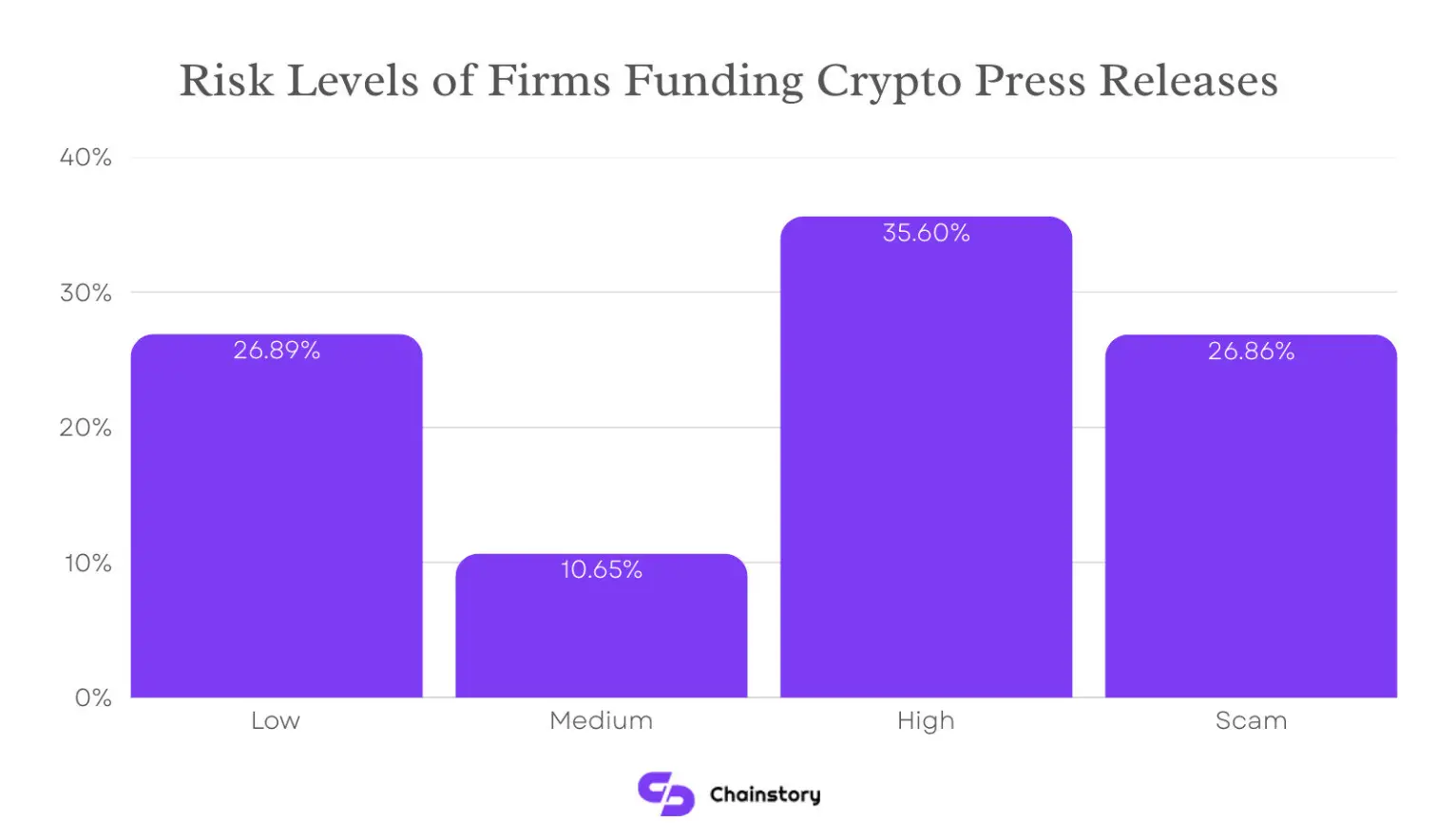
Chainstory analyzed nearly three thousand crypto press releases from the second half of 2025. Projects rated as high-risk accounted for 35.6% of all announced projects, and those marked as scams accounted for 26.9%. These suspicious categories combined made up over 62% of the total press releases. Meanwhile, low-risk projects accounted for only about 27% of the total press releases.
When it comes to how 'all-star alliances' can fall from grace, the most classic and fitting parallel is Facebook's Libra.

In the summer of 2019, Facebook announced with great fanfare, accompanied by a white paper, its intention to launch the stablecoin Libra. The lineup was unprecedentedly star-studded: on the payments side, there were Visa, Mastercard, PayPal, Stripe; in e-commerce, eBay and Shopify; in the crypto space, Coinbase; and even top-tier VCs like a16z were listed. Nearly half of Silicon Valley seemed to be cheering for it.

Later, a congressional hearing shifted its fate. Governments worldwide were concerned about threats to sovereign currencies and the dollar's dominance. France was the first to oppose it, while the U.S. Congress relentlessly questioned Facebook's past privacy and data scandals, challenging 'why should this company be the one to do this.' Regulatory pressure quickly spread to its allies. On October 4, 2019, PayPal was the first to withdraw; just a week later, Stripe, Visa, eBay, and Mastercard collectively exited. All this happened just days before Libra's first council meeting was scheduled to take place—before the first meeting even convened, the whole group was almost disbanded.

What followed was a series of desperate measures to survive: rebranding to Diem, moving its headquarters from Switzerland back to the U.S., pegging its value solely to the U.S. dollar, operating independently from Facebook, and the departure of key figures. By 2022, the entire project sold its assets to Silvergate for approximately $200 million, marking its official end.

The lesson of Libra is not about an erroneous currency issuance strategy, but that an alliance roster, no matter how dazzling, is not equivalent to a functioning product, let alone established real-world channels. Coincidentally, Visa, Mastercard, and Stripe, which abandoned Libra back then, are now the marquee names on the OUSD list. The same giants, in a different alliance—whether the story will be different remains to be seen.

Circle CEO Welcomes Competition with Open Arms

Facing the aggressive entry of OUSD, Circle CEO Jeremy Allaire stated that he welcomes competition and directly pointed out what he sees as the nature of this business: stablecoin networks are a business of platforms and network effects, where market structure tends towards winner-take-all, and building such networks takes a very long time.

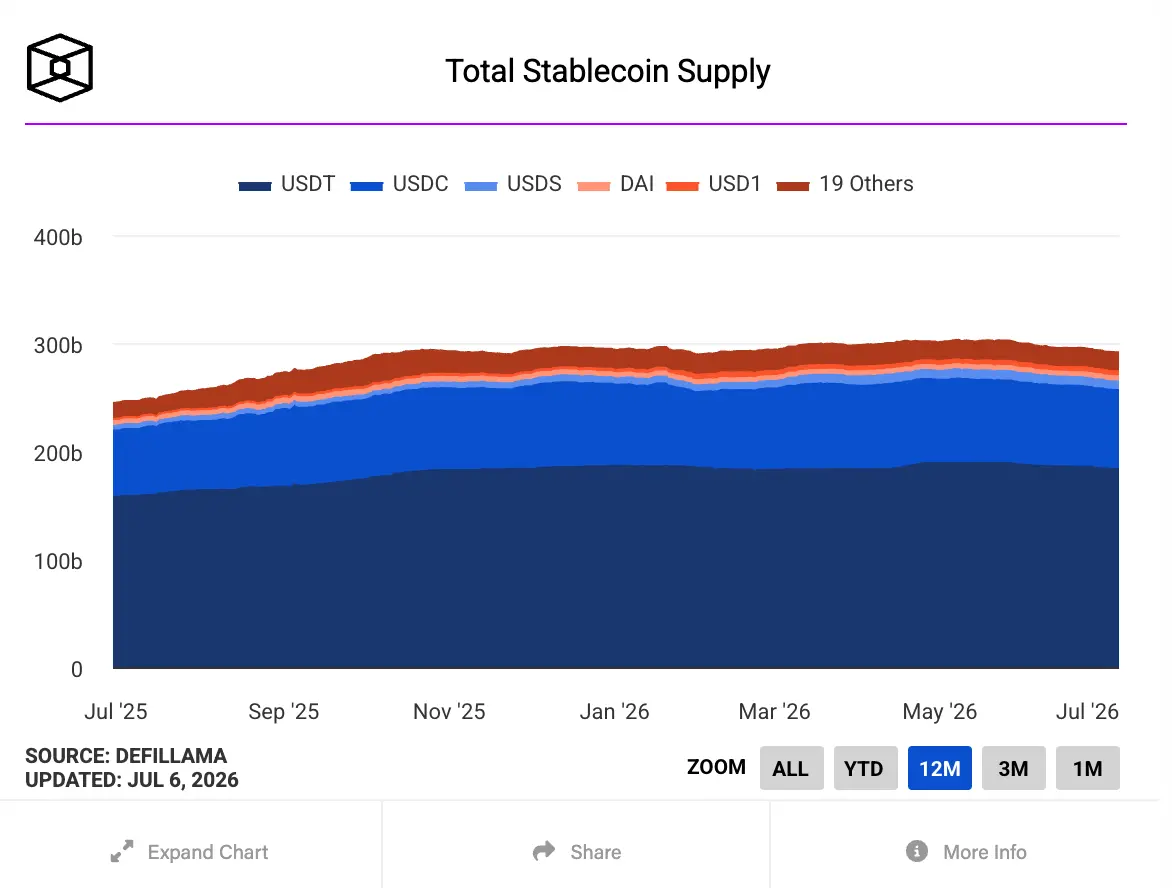
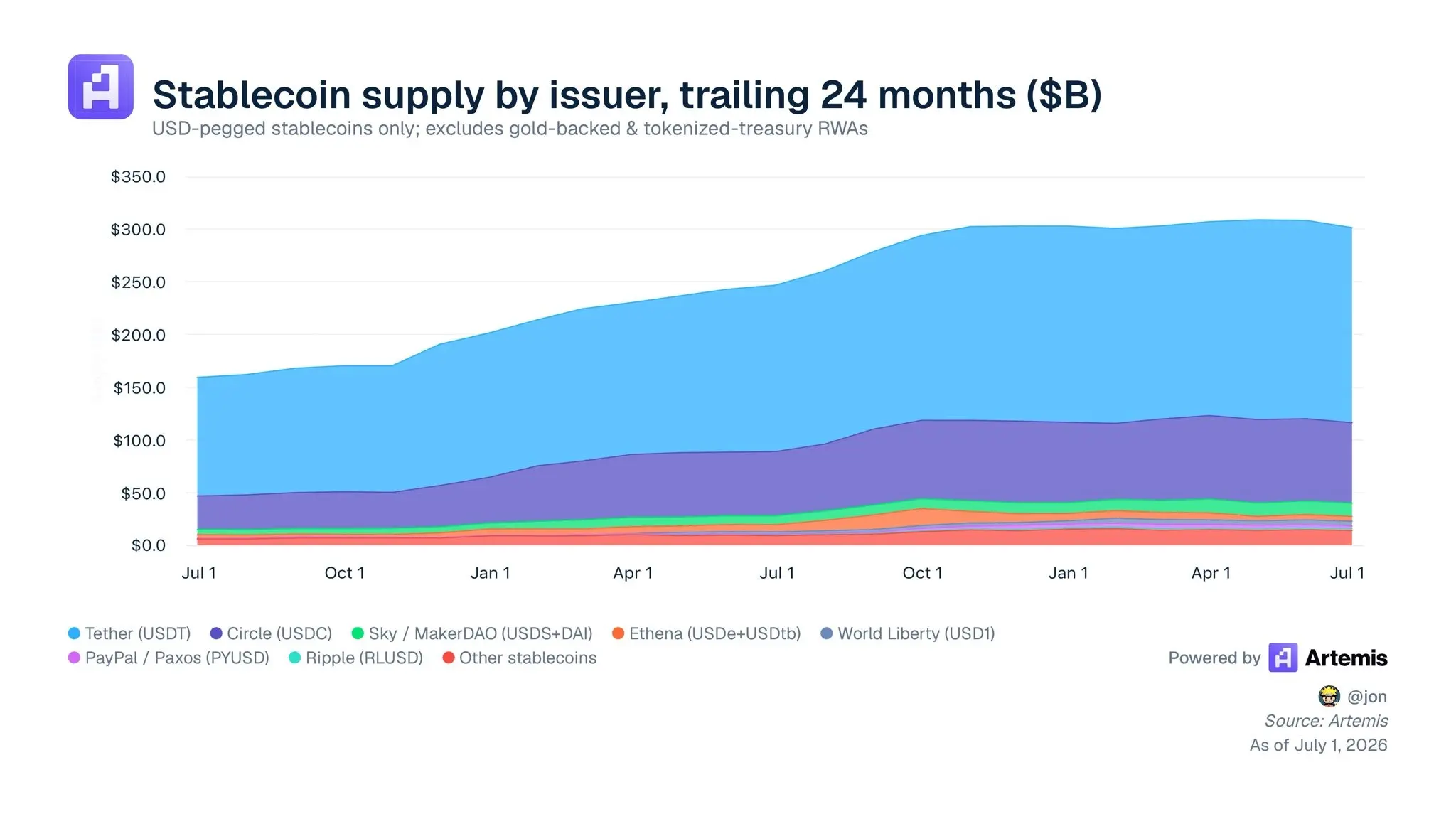
According to data from The Block's dashboard, the total market capitalization of USD-pegged stablecoins exceeds $291 billion, with Tether's USDT accounting for approximately $184.3 billion and Circle's USDC over $73 billion.
Furthermore, regarding OUSD's 'zero-fee minting and redemption' selling point, he believes market realities often force projects to adjust their approach; Circle handles it through contractual mechanisms rather than a blanket zero-fee policy. Regarding 'sharing revenue with everyone,' he bluntly stated that distributing all revenue is equivalent to 'starving the infrastructure,' leading to systemic underinvestment and preventing the platform from ever scaling up.

Additionally, there is his view on the 'alliance model.' Allaire believes consortium-type products have a historically poor track record in achieving scale, product-market fit, or even basic agility. 'A big group of big companies coming together, poor coordination, misaligned incentives, slow progress, and often, they all have their own agendas and 'starve' the consortium itself.' He also observed that when such alliances are formed, everyone is eager to put their logo on the list, endorse it, and loudly proclaim its openness, but in the end, each company's business units will still make optimal decisions for their clients.

According to statistics from the third-party institution Artemis, as of July 2026, the total supply of USD stablecoins is approximately $3 trillion, with USDT around $1.8 trillion and USDC around $780 billion, together accounting for nearly 90%; all new entrant stablecoins combined total about $40 billion, just a tiny sliver at the bottom of the stacked chart. Allaire believes many stablecoins may have circulating supply, but most of it comes from promotions and incentives, with extremely limited real usage because liquidity and network utility cannot sustain them.
Conclusion

It can be said that the success of a stablecoin does not rely on assembling a group of alliance members for marketing purposes, but depends on whether it has real use cases and real users, including in specific scenarios such as B2B payments, merchant settlements, cross-border payroll, etc.

However, we cannot yet determine the final outcome for OUSD. It does have genuine heavyweight endorsements and a product model distinct from the existing market landscape, and it may not necessarily follow Libra's path. Yet, what this controversy reveals is a recurring issue in the crypto industry: a giant alliance can give a project immense momentum even before launch, but the positions of USDT and USDC are built upon real application scenarios in exchanges, DeFi, payments, and cross-border flows. Before achieving that, is OUSD merely issuing empty promises to the market? The market will provide its own answer.

Domande pertinenti

QAccording to the article, what are the three main features that distinguish OUSD from existing stablecoins?

AThe three main distinguishing features of OUSD are: zero fees for minting and redemption, no transaction volume limits, and distributing the majority of the yield generated from reserve assets to partners driving adoption, instead of keeping it solely for the issuer.

QWhat issue emerged regarding the Korean companies listed as partners for OUSD, according to the article?

ASeveral Korean companies, including Samsung Electronics, Shinhan Financial Group, Dunamu (Upbit's parent company), and K Bank, stated that they were listed as official members without their formal agreement or a clear understanding of their role. Some reported they had only expressed a willingness to consider participation in preliminary talks, and others learned of their inclusion from the news.

QHow does Circle CEO Jeremy Allaire view the business model of stablecoin networks and the 'alliance model' used by OUSD?

AJeremy Allaire believes stablecoin networks are a platform business with strong network effects, tending towards winner-takes-all dynamics that take a long time to build. He is skeptical of the 'alliance model,' stating that historically, such alliances suffer from poor coordination, misaligned incentives, slow progress, and often starve the alliance itself of resources, making it difficult to achieve scale and product-market fit.

QWhat historical example does the article use to illustrate the risks of a 'star-studded alliance' in the crypto industry?

AThe article uses Facebook's Libra (later renamed Diem) as a classic example. Despite initial backing from major companies like Visa, Mastercard, PayPal, and Stripe, the project faced intense regulatory pressure, leading key partners to withdraw. It ultimately failed, with its assets sold off in 2022.

QWhat does the article suggest is the ultimate determinant of a stablecoin's success, rather than a strong partner list?

AThe article suggests that a stablecoin's success ultimately depends on having real-world use cases and real users, such as in B2B payments, merchant settlements, and cross-border payroll, rather than just a list of high-profile partners for marketing.

Letture associate

MSTR Discloses Sale of 3,588 Bitcoins, Stock Price Drops Over 5% at One Point During Trading

MicroStrategy, the world's largest corporate holder of Bitcoin, has significantly shifted its business model. Between June 29 and July 5, the company sold 3,588 bitcoins for approximately $216 million to fund quarterly dividends for its preferred stock. This marks its largest-ever Bitcoin sale and signals a strategic pivot: Bitcoin is transitioning from a "buy-and-hold" reserve asset to a liquidity management tool for the company. This move follows a recent authorization allowing Bitcoin sales when equity fundraising is less attractive. The announcement contributed to a more than 5% intraday drop in MicroStrategy's stock price, while Bitcoin fell to around $61,800—below the company's average holding cost of roughly $75,700. The sale represents a major departure from MicroStrategy's long-standing "never sell" commitment, which saw its first minor breach in May with a $2.5 million sale. The latest, hundred-times-larger transaction underscores growing financial pressures. Analysts note the company faces about $1.5 billion in annual preferred dividend obligations, far exceeding cash flow from its software business. As of July 5, MicroStrategy holds 843,775 bitcoins. Its current operational logic involves buying Bitcoin during favorable financing conditions and selling portions to cover dividends when needed, creating a flexible capital management cycle amidst a challenging market environment.

华尔街日报4 h fa

MSTR Discloses Sale of 3,588 Bitcoins, Stock Price Drops Over 5% at One Point During Trading

华尔街日报4 h fa

Q-Day Countdown: Will Quantum Computing End Cryptocurrencies?

Quantum Computing's Threat to Cryptocurrency: A Countdown to Q-Day Quantum computing, specifically Shor's algorithm, poses a fundamental threat to the public-key cryptography (e.g., ECDSA, RSA) that secures blockchain networks like Bitcoin and Ethereum. This critical juncture, known as Q-Day, is estimated to occur potentially within the next 5-15 years. The core vulnerability stems from the public and immutable nature of blockchains. Assets in addresses where the public key is already exposed on-chain (e.g., spent outputs) are at direct risk, as a sufficiently powerful quantum computer could derive the private key. This threatens the very trust model of cryptocurrencies. The response lies in Post-Quantum Cryptography (PQC)—algorithms like lattice-based ML-DSA and hash-based SLH-DSA, which are resistant to quantum attacks. NIST has standardized key PQC algorithms (FIPS 203, 204, 205), providing a migration path. However, the primary challenge is not technical but socio-economic and involves complex governance: * **Bitcoin's** path is constrained by its conservative ethos. Migrating requires a soft-fork to new address types, facing hurdles like significantly larger signature sizes and, most critically, the divisive governance question of how to handle at-risk legacy UTXOs without violating core principles. * **Ethereum** is pursuing a "cryptographic agility" strategy, with a multi-layered roadmap. It leverages account abstraction for user accounts and is developing compressed hash-based signatures (e.g., leanXMSS) for its consensus layer, aiming for a full-stack upgrade over time. In conclusion, quantum computing does not spell an instant end for cryptocurrency but initiates a critical countdown. The industry has a limited "engineering comfort window" to orchestrate a coordinated, ecosystem-wide migration to PQC. The ultimate bottlenecks are the immense coordination efforts and governance decisions required for this foundational transition.

marsbit5 h fa

Q-Day Countdown: Will Quantum Computing End Cryptocurrencies?

marsbit5 h fa

Trump, the President Who Knows Best How to 'Trade Stocks'

Former US President Donald Trump reported a record-breaking $2.2 billion in personal income for 2025, the highest annual income ever disclosed by a sitting president. This figure, from a 927-page government ethics filing, represented a 3.5-fold increase from his $600 million income in 2024 and boosted his net worth to $6.5 billion. The primary drivers were cryptocurrency (64% of income, approximately $1.4 billion) and real estate (26%, approximately $575 million). His crypto earnings stemmed largely from the launch of his personal meme coin, $TRUMP, generating over $600 million in licensing fees, and substantial profits from the WLFI token and its parent company. Despite a sluggish property market, his Mar-a-Lago resort and associated golf clubs saw revenue surges of 50% and 27%, respectively, attributed to their use as venues for presidential events. Trump's financial disclosure also revealed an unprecedented level of stock market activity, with over 22,000 trades executed in 2025, averaging 87 trades per market day. Media analyses noted several instances where significant trading coincided with major policy announcements, such as proposed tariffs, raising questions about potential conflicts of interest. While the White House stated these trades were handled by a family-managed trust fund and not Trump directly, critics highlighted this as a departure from the blind trusts traditionally used by presidents post-Watergate. The report has intensified debate over the commercialization of the presidency. Supporters view it as a success story of a businessman-president, while critics argue it demonstrates an unprecedented conversion of public influence into private wealth, with policy decisions potentially linked to personal financial gains. The controversy centers on whether Trump's earnings represent innovative entrepreneurship or a fundamental conflict of interest, sparking renewed calls for stricter ethics reforms in US governance.

marsbit5 h fa

Trump, the President Who Knows Best How to 'Trade Stocks'

marsbit5 h fa

Countdown to Q-Day: Will Quantum Computing End Cryptocurrencies?

The article explores the existential threat quantum computing poses to cryptocurrencies and the urgent need for "post-quantum" migration. It outlines that quantum computers, through Shor's algorithm, could break the elliptic-curve cryptography (ECC) underlying blockchain security, potentially allowing private keys to be derived from public keys. The core challenge is not a lack of post-quantum cryptography (PQC) standards—like NIST's ML-KEM and ML-DSA—but the immense complexity of upgrading entire ecosystems before "Q-Day" (when quantum computers become capable of such attacks, estimated around 2035-2045). Key points include: * **Bitcoin's** risk is concentrated in legacy UTXOs with exposed public keys (e.g., early P2PK outputs). Migration faces massive hurdles: PQC signatures are much larger, increasing transaction size and cost, and the governance dilemma of handling un-migrated assets threatens its "code is law" ethos. * **Ethereum's** strategy focuses on "cryptographic agility," using Account Abstraction for user accounts and developing compressed hash-based signatures (like leanXMSS with SNARK aggregation) for consensus. Its migration is a complex, full-stack overhaul of execution, consensus, and data layers. * The "security debt" is enormous. The comfortable engineering window for a coordinated, ecosystem-wide upgrade is only 5-8 years. High-value infrastructure (exchanges, bridges) may face pressure before mainnet protocols. In conclusion, quantum computing is not an instant "doomsday" event but a forcing function for systemic change. Bitcoin's ultimate test is social consensus and property rights governance, while Ethereum's is technical complexity. Failure to migrate in time could lead to a fundamental re-pricing of crypto assets.

链捕手5 h fa

Countdown to Q-Day: Will Quantum Computing End Cryptocurrencies?

链捕手5 h fa

Trading

Spot
活动图片