Are the "Magnificent Seven" No Longer Enough? SpaceX IPO Attracts Retail Frenzy, Wall Street Serves Up the "AI Tech Ten"

marsbitPublished on 2026-06-16Last updated on 2026-06-16

Abstract

The article discusses a potential shift in Wall Street's categorization of major tech stocks, driven by SpaceX's highly successful IPO. On its first day of trading, SpaceX attracted $117 million in net purchases from retail investors, accounting for 56% of all U.S. retail stock buys that day. This surge has prompted research firm Vanda to propose a new group called the "FAB 10" (Frontier AI & Big Tech 10). This concept suggests replacing the long-standing "Magnificent Seven" with ten companies believed to define the next decade of AI and technology. The proposed FAB 10 would include the original seven giants plus SpaceX and the yet-to-be-public AI firms OpenAI and Anthropic, both anticipated to go public later this year with valuations potentially reaching trillions. This contrasts with another proposed grouping, Bank of America's "AI Big 10," which adds semiconductor companies like Broadcom, AMD, and Micron to the core seven, focusing more on hardware. The divergence highlights different bets on the future drivers of tech growth. Analysts note that the massive influx of retail money into new listings like SpaceX might divert capital from other hot sectors, such as chip stocks, and warn that high valuations across the tech sector may indicate bubble risks.

Author: Claude, TechFlow Deep Tide

Deep Tide TechFlow Introduction:SpaceX's debut on Friday attracted $117 million in net retail purchases, accounting for 56% of the total U.S. retail stock buying that day. Based on this, research firm Vanda proposed the new "FAB 10" concept, advocating for replacing the long-standing "Magnificent Seven" with a frontier AI and tech top ten, including SpaceX, OpenAI, and Anthropic. The latter two are not yet public, but are expected to list later this year with valuations potentially exceeding a trillion dollars each.
SpaceX's market debut is rewriting the way Wall Street labels tech stocks.

According to a report released by Vanda Research last Sunday, cited by Cailian Press, the frenzy among retail investors for SpaceX's IPO last Friday was a huge success, sparking discussions in the market about redefining the entire tech industry. Prior to this, this fundraising round of approximately $75 billion was already the largest IPO on record. SpaceX priced its shares at $135 each, giving it a valuation of about $1.75 trillion, placing it among the world's ten most valuable publicly listed companies.

On SpaceX's Debut, Retail Buying Constituted 56% of the Day's Entire Market

Vanda's data quantifies this frenzy. The report stated that SpaceX attracted $117 million in net retail purchases on its first trading day, accounting for 56% of the total retail stock buying across the entire U.S. market that day.

This figure only reflects secondary market buying on the first day and does not include funds from retail investors who participated in the IPO allocation through brokers. Separate data indicates that retail investors ultimately received about 20% of the allocation in this $75 billion offering, above average; hedge funds got 10%, while long-term institutional investors took 70%.

The concentrated bets by retail investors are further channeling capital towards a handful of mega-cap tech companies. Vanda believes these companies are not only dominating stock market performance but are also driving the entire wave of tech investment.

Vanda: Replace the "Magnificent Seven" with the "FAB 10"

It is based on this judgment that Vanda proposed a new classification framework.

"If markets were dominated by the 'Magnificent Seven' over the past few years, then last Friday might be the clearest signal yet that investors are starting to focus on what we call the 'FAB 10'," Vanda wrote in the report. FAB 10 is short for Frontier AI & Big Tech 10, referring to the ten frontier AI and big tech giants.

According to Vanda's definition, the FAB 10 adds SpaceX, OpenAI, and Anthropic to the original seven giants. The latter two are not yet public, but the market expects them to enter the capital market later this year, with valuations potentially reaching hundreds of billions or even trillions of dollars.

Vanda's reasoning is straightforward: these companies collectively represent the direction of the AI and tech industry for the next decade.

The Same Concept, But Bank of America's Version is Different

Vanda is not the only player packaging mega-cap tech stocks into a new index.
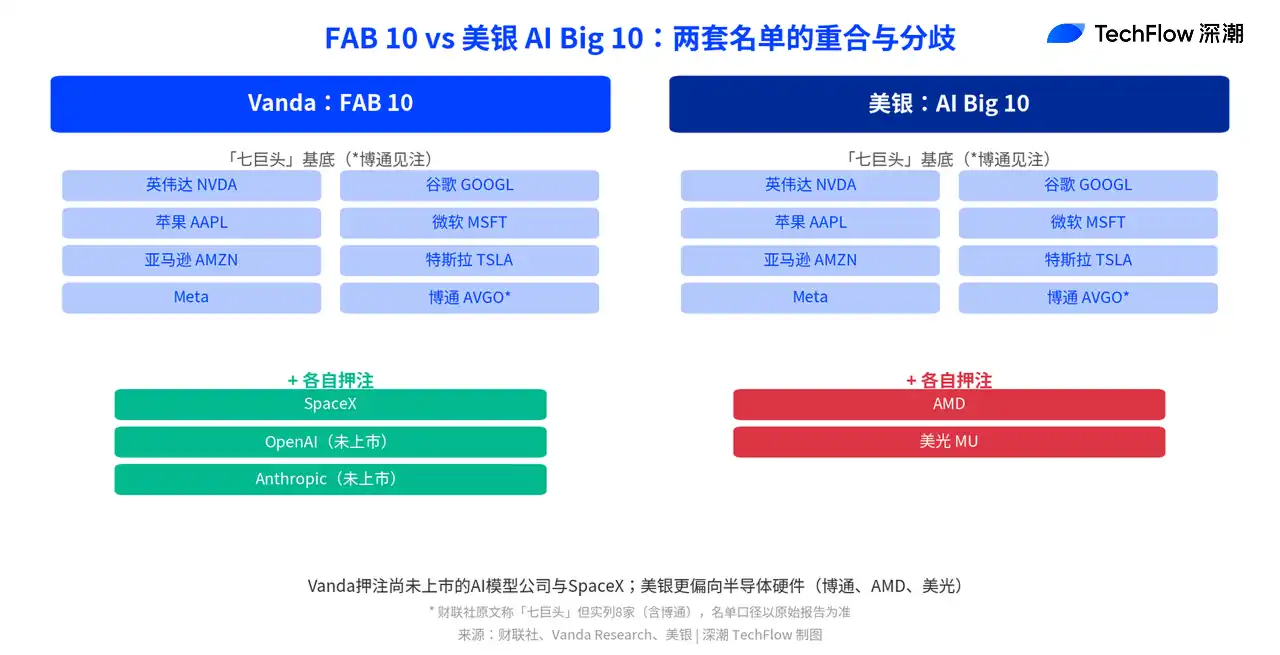
Bank of America's chief strategist, Michael Hartnett, previously proposed an "AI Big 10" portfolio in his "Guide to the Investment Universe." The difference from the FAB 10 lies in the stock selection: BofA's version is the Magnificent Seven plus Broadcom, AMD, and Micron, leaning more towards semiconductor hardware, while Vanda is betting on unlisted AI model companies and SpaceX.

The divergence between the two lists is essentially a different bet on "who defines the next ten years." One side favors the chipmakers, the other favors the model builders and rocket launchers.

Retail Floods into SpaceX, Chip Stocks May Suffer Capital Drain

The other side of the new concept is the redistribution of capital.

Vanda researchers noted that the fervor for SpaceX may be drawing funds away from other hot sectors, especially previously soaring chip stocks, which may be losing favor with retail investors. In other words, even within the FAB 10, favor might not be evenly spread; the capital-attracting effect of new entrants could come at the cost of pullbacks for older members.

However, analysts also caution that valuations across the tech sector are already showing signs of froth. SpaceX's IPO at a $1.75 trillion valuation itself is built on optimistic expectations for AI infrastructure. How long this optimism can last remains for the market to answer.

Related Questions

QWhat is the concept of 'FAB 10' proposed by Vanda Research, and which companies does it include?

AThe concept of 'FAB 10' (Frontier AI & Big Tech 10), proposed by Vanda Research, is a new classification framework aiming to replace the long-standing 'Magnificent Seven.' It includes the original seven tech giants (like Apple, Microsoft, etc.) and adds SpaceX, OpenAI, and Anthropic. These ten companies are seen as representing the direction of the AI and tech industry for the next decade.

QHow did retail investors contribute to SpaceX's IPO debut, and what was their market share?

AAccording to Vanda Research, on SpaceX's first day of trading, retail investors made a net purchase of $117 million, which accounted for 56% of all retail stock buying in the U.S. market that day. In the overall $75 billion IPO, retail investors ultimately received about 20% of the allocated shares, which is higher than the average allocation.

QWhat is the difference between Vanda's 'FAB 10' and Bank of America's 'AI Big 10' list?

AThe key difference lies in the selected companies. Vanda's 'FAB 10' includes the Magnificent Seven plus SpaceX, OpenAI, and Anthropic, focusing on AI models and space tech. Bank of America's 'AI Big 10' includes the Magnificent Seven plus Broadcom, AMD, and Micron, with a stronger emphasis on semiconductor hardware companies.

QWhat potential market impact does Vanda suggest the rise of 'FAB 10' might have?

AVanda suggests that the influx of capital into new members like SpaceX could draw funds away from other hot sectors. Specifically, semiconductor stocks, which previously experienced significant gains, might lose favor with retail investors. This indicates a potential redistribution of capital within the tech sector, where new entrants' success might come at the expense of older members' performance.

QWhat was SpaceX's valuation at its IPO, and what caution do analysts express regarding this?

ASpaceX went public with a valuation of approximately $1.75 trillion at a share price of $135, making it one of the top ten most valuable publicly traded companies globally. Analysts caution that this valuation, built on optimistic expectations for AI infrastructure, shows signs of a bubble in the overall tech sector, and its sustainability remains to be tested by the market.

Related Reads

Warsh's Debut: Will the FED Chair Who Knows Crypto Best Bring Surprises or Shocks to the Market?

Kevin Warsh, the new Federal Reserve Chairman, prepares for his inaugural press conference amidst a challenging macroeconomic landscape: resurgent inflation, a bond market sell-off, and political pressure from President Trump for rate cuts. Uniquely, Warsh holds indirect investments in over 20 crypto and Web3 entities (e.g., Solana, dYdX), making him the first Fed Chair with disclosed crypto exposure. His stance may combine a hawkish, inflation-focused monetary policy with a crypto-friendly regulatory philosophy that shifts from Powell’s “same risk, same rule” approach toward a framework acknowledging blockchain’s productivity value. Warsh’s leadership could impact crypto markets across three dimensions: a paradigm shift in regulation (potentially accelerating pro-innovation legislation and stable币 rules), a re-pricing of risk premiums based on clearer communication and his view of AI as a structural disinflationary force, and a long-term reallocation of global institutional capital driven by increased legitimacy. Two potential scenarios for the press conference are outlined. A “positive surprise” would involve a dovish-leaning tone on rates coupled with signals of regulatory openness, potentially boosting crypto asset valuations. Conversely, a “negative shock” would see a more hawkish-than-expected stance on inflation and rates, triggering a broad risk-asset selloff that crypto markets would not escape. While ethics rules required Warsh to divest his crypto holdings upon confirmation, his deep understanding of the technology may fundamentally lower policy uncertainty and build a more receptive long-term foundation for digital assets’ integration into the mainstream financial system.

marsbit7h ago

Warsh's Debut: Will the FED Chair Who Knows Crypto Best Bring Surprises or Shocks to the Market?

marsbit7h ago

Trading

Spot
Futures

Hot Articles

Discussions

Welcome to the HTX Community. Here, you can stay informed about the latest platform developments and gain access to professional market insights. Users' opinions on the price of S (S) are presented below.

活动图片