Peter Todd警告:对于比特币隐私推进,Zcash技术风险过高

bitcoinistPubblicato 2026-06-05Pubblicato ultima volta 2026-06-05

Introduzione

比特币开发者彼得·托德反对将Zcash式的隐私技术引入比特币共识层,认为其密码学风险过高。此前,ZODL开发团队披露了影响Zcash Orchard隐私池的问题,引发了一场关于隐私、可审计性与比特币固化的争论。 托德指出,比特币历史上的漏洞(如2010年数值溢出事件)因其透明性易于被发现和回滚,而Zcash等隐私系统的隐蔽性可能导致漏洞难以察觉、追溯和修复。他认为,隐私技术虽然重要,但其高风险特性不适合作为比特币基础协议的一部分。 反对者则认为,比特币也曾遭遇严重漏洞,且拒绝创新可能阻碍发展。托德回应称,不同密码学技术的风险等级不同,Zcash式技术风险更高,这一点已从其更多严重问题中得到体现。他强调,隐私池中资产若受损将灾难性影响大量用户,而比特币的透明模型更能抵御系统性风险。 当前,ZEC价格约为532美元。讨论凸显了在追求隐私与维护网络安全、可审计性之间的核心权衡。

比特币开发者Peter Todd反驳了将Zcash式隐私引入比特币共识层的呼声,他认为其密码学风险对网络的基础协议而言太高了。这场争论在ZODL开发者披露了一个影响Orchard屏蔽池的问题后爆发,短暂的将技术事件演变成了关于隐私、可审计性和比特币僵化性的广泛辩论。

Todd最初的帖子很直接:“为什么在共识层为比特币添加Zcash式隐私是个坏主意。”他是在回应Zcash开放开发实验室的帖子,该帖子称,在常规审计和安全审查过程中发现影响Zcash Orchard池的问题后,正在进行“协调的Zcash网络升级”。

Peter Todd为何对Zcash式隐私发出警告

争论很快超出了ZEC本身。一位用户辩称,比特币自身也有严重漏洞的历史,他提到2010年的价值溢出事件和2013年的链分裂作为证据,认为“没有协议能免于技术问题”。同一帖子还指责比特币极端主义者一方面推动“完全僵化”,另一方面却面临量子计算等未来威胁。

Todd通过区分可见和隐蔽的故障来回应。“这正是我的观点。对于比特币,回滚链是可行的,因为只有一小部分币受到影响,而且利用过程很容易被发现,”他写道。他的论点并非比特币没有漏洞,而是其记账模型使得某些灾难性漏洞更容易被检测和撤销。

这一点成为了分歧的核心。当另一位用户辩称,以漏洞风险为由拒绝共识层隐私会“阻止任何创新/开发”时,Todd回应说并非所有密码学技术都具有相同的操作风险。“不同类型的密码学有不同的风险水平。Zcash式密码学风险非常高,远高于比特币的密码学。这反映在Zcash已出现比比特币严重得多的问题上。”

反对意见是,比特币本身也遭受过严重的早期故障。一位参与者引用了2010年的价值溢出事件和2018年的CVE-2018-17144漏洞作为例子,挑战Todd的论点框架。Todd否定了这种比较,称这两种情况都没有使货币面临同类的生存风险。

“这些漏洞都没有任何机会摧毁这种货币,”Todd写道。“哪些币是伪造的显而易见,从而可以轻松回滚。Zcash则不然。”

分歧集中在屏蔽系统的一个特定属性上:隐私性可能会降低透明度,而这种透明度使得供应审计变得直接明了。在Todd看来,这改变了比特币的风险计算。透明记账中的漏洞可以被注意到,因为无效输出或伪造币在链上是可见的。他认为,在深度屏蔽的系统中,损害可能更难观察、更难归因,也更难逆转。

Zcash的捍卫者也反对这种论点框架。一位用户告诉Todd,他并不理解“十字转门构造”,并辩称“没有这样的漏洞会影响ZEC的总供应量”。Todd将焦点从总供应量转移到了屏蔽用户的余额上,指出很大一部分ZEC已经存在于屏蔽池中。“30%的Zcash供应量处于屏蔽状态。这部分供应被销毁将是一场灾难,并将彻底抹去高比例Zcash用户的持有资产。我个人持有少量Zcash,全部都是屏蔽的。”

截至发稿时,ZEC的交易价格为532美元。
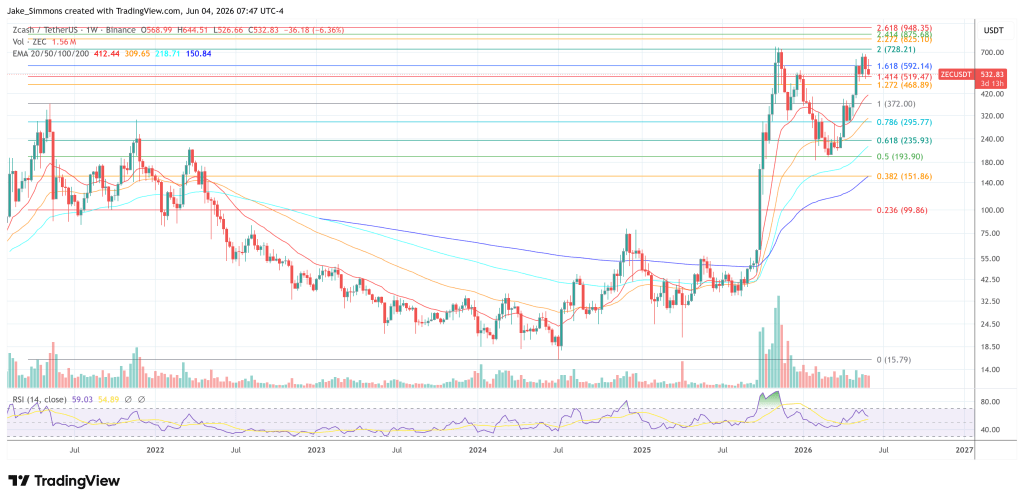
ZEC再次跌破1.618斐波那契线,周线图 | 来源:TradingView.com 上的 ZECUSDT

Domande pertinenti

Q比特币开发者Peter Todd为什么反对将Zcash风格的隐私技术引入比特币共识层?

A他认为Zcash所依赖的密码学技术风险过高,不适于作为比特币基础协议的一部分。他特别担心隐私性会降低系统的可审计性,使潜在的严重漏洞更难被发现和修复。

Q在文章中,Peter Todd如何区分比特币和Zcash在面对技术故障时的不同?

ATodd指出,比特币的透明账本模型使得诸如伪造币这样的问题很容易被察觉,从而有可能进行链回滚来修复。而Zcash的屏蔽池系统因为隐私性,潜在的损害可能更隐蔽、更难归因且更难以逆转。

Q反驳Peter Todd观点的用户主要提出了什么论据?

A反驳者指出比特币自身也有严重故障的历史,如2010年的价值溢出事件和2013年的链分裂,以此说明没有协议能完全豁免技术问题。他们还认为,以存在漏洞风险为由拒绝共识层隐私创新会阻碍任何技术进步。

QPeter Todd如何回应关于‘Zcash的屏蔽构造能保护总供应量不受影响’的论点?

ATodd将焦点从总供应量转移到屏蔽用户余额上。他指出已有30%的ZEC供应量位于屏蔽池中,如果这部分供应因漏洞被销毁,对大量Zcash用户将是灾难性的,他自己的ZEC也全部在屏蔽池中。

Q这场争论的核心分歧点是什么?

A核心分歧在于对密码学技术操作风险等级的评估,以及隐私性、可审计性和系统稳健性之间的权衡。Todd认为Zcash式的高风险密码学不应纳入比特币基础层,而反对者则认为不能因噎废食,阻止必要的创新来应对未来威胁。

Letture associate

Behind HYPE's Repeated Record Highs, the 'Minions' in the Ecosystem Can't Keep Up

While HYPE, the native token of the Hyperliquid ecosystem, surges to new all-time highs above $76 and attracts significant institutional ETF inflows, a starkly different reality unfolds within its HyperEVM application layer. Multiple core DeFi protocols across lending, NFTs, stablecoins, and DEXs have announced shutdowns between May and June. The article argues HYPE functions more like an "application stock" than a traditional ecosystem token. Its value is anchored to the trading fees from Hyperliquid's core perpetual contracts platform (HyperCore), which boasts a diversified revenue stream from crypto, commodities, and indices. Approximately 97% of protocol fees fund buybacks and burns of HYPE. This means HYPE's price is largely decoupled from the health of projects built on HyperEVM. The closures of significant projects like lending protocol HypurrFi (peak TVL >$300M) and NFT marketplace Drip.Trade highlight a structural tension. Hyperliquid's minimalist philosophy offers infrastructure without official grants, liquidity support, or marketing coordination for HyperEVM projects. This forces protocols into a fiercely competitive environment from day one. Furthermore, the success of HyperCore creates a liquidity vacuum, and mechanisms like HIP-3 (allowing direct perpetual market deployment) divert user attention and capital away from application-layer projects. The stronger the core perpetual trading business becomes, the more difficult it is for peripheral "DeFi lego" projects to survive and capture value, despite the flagship token's rising price.

Foresight News9 min fa

Behind HYPE's Repeated Record Highs, the 'Minions' in the Ecosystem Can't Keep Up

Foresight News9 min fa

Conversation with Arthur Hayes: AI Has Drained Market Liquidity, BTC Will Be Below 100k by Year-End

In this June 2026 podcast interview, BitMEX co-founder Arthur Hayes explains his decision to sell his major crypto holdings (HYPE, NEAR, Worldcoin, Zcash). His rationale is based on a macro view linking oil prices, the Iran conflict, US politics, and an impending AI bubble burst. Hayes argues that high oil prices, driven by the ongoing war, will pressure domestic US inflation. To salvage the Republican Party's chances in the midterm elections, he believes Donald Trump may pivot to a populist, anti-AI stance—advocating for taxes and regulation—which would deflate the AI investment narrative. He sees the AI sector, particularly massive capital expenditure on data centers, as having absorbed nearly all excess market liquidity (around $1.5 trillion in debt issuance since 2025), starving other assets like Bitcoin. He highlights the upcoming SpaceX IPO at a ~$1.8 trillion valuation and 100x price-to-sales ratio as a potential tipping point. If these hyped IPOs underperform, it could shatter market confidence in AI. In such a scenario, all risk assets, including crypto, would fall together as correlations converge to 1 during a broad correction. Hayes has moved his portfolio into Treasuries and energy stocks (like ExxonMobil), predicting Bitcoin will be below $100k by year-end. He sees a potential crypto bull market only after the AI frenzy cools, liquidity stops flowing exclusively into AI, and possibly after a significant market downturn prompts new monetary stimulus.

marsbit20 min fa

Conversation with Arthur Hayes: AI Has Drained Market Liquidity, BTC Will Be Below 100k by Year-End

marsbit20 min fa

Fed's Internal Doves Flock to Hawkish Stance, Warsh's Debut "Between a Rock and a Hard Place"

U.S. Federal Reserve officials who previously advocated for rate cuts, including Governor Christopher Waller, have recently shifted their stance, with many now not ruling out the possibility of future rate hikes. This sets a challenging stage for new Fed Chair Kevin Warsh's first policy meeting. Appointed by President Trump based on his dovish views, Warsh now faces a committee where the debate has pivoted from "when to cut" to "whether to hike," driven by persistent inflation above 3%, a strong labor market, and supply-side pressures from AI infrastructure demands and geopolitical tensions. Key figures illustrate the shift. Governor Waller, once concerned about employment, now says data has pushed him toward considering rate increases. Even moderate voices like Governor Lisa Cook, while expecting inflation to ease, have indicated readiness to hike if it fails to do so. Long-time hawks such as regional Fed presidents Beth Hammack, Lorie Logan, and Neel Kashkari have grown more vocal, arguing that the real policy rate is effectively falling and that action may soon be needed. The upcoming Fed meeting is expected to keep rates steady but will likely remove the "easing bias" from its statement, signaling a neutral stance between cuts and hikes. The quarterly "dot plot" is anticipated to show most officials projecting no cuts this year, with some potentially indicating hikes. Chair Warsh, a critic of the Fed's reliance on forward guidance like the dot plot, must navigate communicating this pivot using tools he has questioned, all while steering policy in a direction counter to the preferences of the president who appointed him. The consensus suggests the Fed's next move could well be a rate increase.

marsbit1 h fa

Fed's Internal Doves Flock to Hawkish Stance, Warsh's Debut "Between a Rock and a Hard Place"

marsbit1 h fa

The Trillion-Yuan Market Cap 'Yi Zhong Tian': Who is the True Value King?

The article analyzes the three leading Chinese optical module companies, collectively nicknamed "Yi Zhong Tian": Xinyisheng, Zhongji Innolight, and TFC Optical Communication. It evaluates their "cost-performance" not by current stock price, but through three lenses: PEG ratio (growth vs. valuation), earnings quality, and premium/discount for certainty. Xinyisheng shows the most attractive PEG ratio and high profitability, but its valuation reflects discounts for risks like high customer concentration and reliance on overseas markets. Zhongji Innolight, the most expensive, commands a premium for its market leadership, dominant share in key products like 800G/1.6T modules, and higher earnings certainty, though it faces geopolitical risks. TFC Optical, as an upstream component supplier ("water seller"), has the highest gross margin and bets on the long-term CPO/NPO architecture trend, but trades at a high valuation with more stable, less explosive growth. The core argument is that while these companies dominate module assembly, the true profit pool and technological moat lie upstream in laser and switch chips, currently controlled by U.S. firms like Lumentum and Coherent. The long-term "cost-performance" for these Chinese leaders hinges on whether the domestic industry, exemplified by companies like Yuanjie Technology, can successfully move up the value chain into high-power laser chips. Otherwise, their high growth may remain confined to the lower-margin assembly segment.

marsbit1 h fa

The Trillion-Yuan Market Cap 'Yi Zhong Tian': Who is the True Value King?

marsbit1 h fa

Trading

Spot
Futures

Articoli Popolari

Come comprare PUSH

Benvenuto in HTX.com! Abbiamo reso l'acquisto di Push Protocol (PUSH) semplice e conveniente. Segui la nostra guida passo passo per intraprendere il tuo viaggio nel mondo delle criptovalute.Step 1: Crea il tuo Account HTXUsa la tua email o numero di telefono per registrarti il tuo account gratuito su HTX. Vivi un'esperienza facile e sblocca tutte le funzionalità,Crea il mio accountStep 2: Vai in Acquista crypto e seleziona il tuo metodo di pagamentoCarta di credito/debito: utilizza la tua Visa o Mastercard per acquistare immediatamente Push ProtocolPUSH.Bilancio: Usa i fondi dal bilancio del tuo account HTX per fare trading senza problemi.Terze parti: abbiamo aggiunto metodi di pagamento molto utilizzati come Google Pay e Apple Pay per maggiore comodità.P2P: Fai trading direttamente con altri utenti HTX.Over-the-Counter (OTC): Offriamo servizi su misura e tassi di cambio competitivi per i trader.Step 3: Conserva Push Protocol (PUSH)Dopo aver acquistato Push Protocol (PUSH), conserva nel tuo account HTX. In alternativa, puoi inviare tramite trasferimento blockchain o scambiare per altre criptovalute.Step 4: Scambia Push Protocol (PUSH)Scambia facilmente Push Protocol (PUSH) nel mercato spot di HTX. Accedi al tuo account, seleziona la tua coppia di trading, esegui le tue operazioni e monitora in tempo reale. Offriamo un'esperienza user-friendly sia per chi ha appena iniziato che per i trader più esperti.

536 Totale visualizzazioniPubblicato il 2024.12.13Aggiornato il 2026.06.02

Come comprare PUSH

Discussioni

Benvenuto nella Community HTX. Qui puoi rimanere informato sugli ultimi sviluppi della piattaforma e accedere ad approfondimenti esperti sul mercato. Le opinioni degli utenti sul prezzo di PUSH PUSH sono presentate come di seguito.

活动图片