XRP Falters In Face Of Rival XLM: Why Retail Traders Are Dumping One For The Other

bitcoinistPublished on 2026-06-03Last updated on 2026-06-03

Abstract

Rival cryptocurrencies XRP and XLM are seeing a shift in retail trader preference, particularly in South Korea. Data from the Upbit exchange shows XLM's 24-hour trading volume ($252.3M) has surpassed XRP's ($125.7M) for the first time. This shift is attributed to increased interest in Stellar's role in tokenized finance, fueled by news linking the network to the US DTCC. While XLM's price surged over 55% to $11, XRP fell below $1.3 despite its historical popularity in Asian markets. A separate analyst suggests XRP could follow with a significant rally, potentially targeting new highs, though this remains speculative.

The rivalry between XRP and Stellar (XLM) has lasted for years, with investors often comparing the two payment-focused cryptocurrencies due to their shared origins and similar use cases. While XRP has long maintained a larger market presence, XLM appears to be gaining the upper hand in some regions. A new report shows that retail traders in South Korea are now dumping XRP for XLM, fueling a surge in Stellar’s market value while XRP’s price continues to decline.

XLM Surpasses XRP In Trading Volume In South Korea

Stellar’s native token, XLM has moved ahead of XRP in a major shift on South Korea’s largest crypto exchange, Upbit. The development comes as retail traders pour into XLM, pushing its trading activity above one of the country’s most popular digital assets.

Data shared by market analyst Xaif Crypto shows XLM recorded about $252.3 million in 24-hour trading volume on Upbit. XRP, by comparison, posted around $125.7 million during the same period, less than half the volume seen in XLM. This staggering gap marks the first time XLM has surpassed XRP in trading volume, now ranking number one on Upbit.
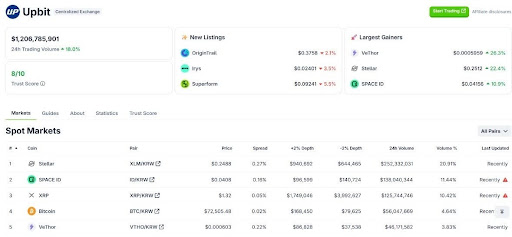
Source: CoinCodex

The latest surge comes after interest in Stellar’s role in tokenized finance surged in South Korea. Traders reacted positively to recent plans linking the blockchain network to tokenization efforts involving the US Depository Trust & Clearing Corporation (DTCC), one of the largest financial market infrastructure firms in the world.

The DTCC news helped fuel fresh demand for XLM among South Korean investors, who usually prefer to trade XRP. Notably, XLM has also seen strong price gains alongside the rise in trading activity. Reports show the token climbed more than 55% to $11 over the past week as momentum continued to build across the market. XRP, meanwhile, has struggled to match the rally, even falling below $1.3, despite its longstanding popularity among South Korean traders.

This shift in interest and demand is notable because XRP has historically been one of the most traded cryptocurrencies in Asian markets like South Korea, Japan, and Thailand. Just weeks ago, XRP was leading trading volume on South Korea’s Upbit ahead of Bitcoin and Ethereum. However, the latest figures suggest retail attention has now rotated toward XLM as traders chase the strongest momentum in the market.

Analyst Forecasts Bull Run For XRP After XLM Rally

In a separate analysis, crypto analyst CW believes XRP could be the next major winner after Stellar’s recent breakout. In a post shared on X, the analyst said the bullish rally for XLM has already begun and suggested XRP is now in a similar position before its own move higher.

According to CW, XRP is waiting for a “start signal” and is currently trading around the same level where XLM was before its recent 57% price rally. The analyst argued that XRP could follow XLM’s bullish path if momentum continues to build.
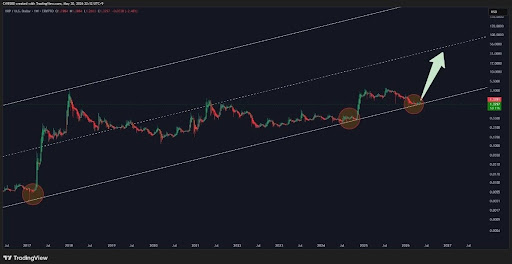
Source: X

However, CW’s chart projects a much larger move for XRP, targeting potential new all-time highs near $56. While the prediction remains highly speculative and ambitious given the cryptocurrency’s current low price, it reflects growing optimism among some market participants who believe XRP has yet to make its biggest move in the current cycle.

Price follows market downward trajectory | Source: XRPUSDT on Tradingview.com

Trending Cryptos

Related Questions

QWhich cryptocurrency surpassed XRP in trading volume on South Korea's largest exchange Upbit, and what was the approximate 24-hour volume difference?

AStellar's XLM surpassed XRP in trading volume on Upbit. XLM recorded about $252.3 million, while XRP posted around $125.7 million, making XLM's volume roughly double that of XRP.

QAccording to the article, what is the primary reason for the increased interest and demand for XLM among South Korean traders?

AThe primary reason is Stellar's role in tokenized finance, particularly following plans linking the Stellar blockchain network to tokenization efforts involving the US Depository Trust & Clearing Corporation (DTCC).

QWhat price movement did the analyst CW predict for XRP following XLM's recent rally, and what was the ambitious target price mentioned?

AAnalyst CW predicted that XRP could follow a similar bullish path to XLM. The ambitious target price mentioned for XRP was near $56, which would represent new all-time highs.

QHow did the article describe the historical popularity of XRP in certain Asian markets prior to this recent shift?

AThe article described XRP as historically being one of the most traded cryptocurrencies in Asian markets like South Korea, Japan, and Thailand. Just weeks before the article, XRP was leading trading volume on Upbit, ahead of Bitcoin and Ethereum.

QWhat two specific cryptocurrencies are highlighted as rivals throughout the article due to their shared origins and similar use cases?

AThe two rival cryptocurrencies highlighted are XRP (from Ripple) and XLM (from Stellar). They are compared due to their shared origins and similar focus on payment use cases.

Related Reads

Unveiling the Whales of the World Cup Prediction Market: Smart Money Stumbles on the Pitch, 'Buy No' Outperforms 'Buy Yes'

**Title: Unveiling the Whales of the World Cup Prediction Market: "Smart Money" Stumbles on the Pitch as "Buying No" Outperforms "Buying Yes"** An analysis of pre-match trades over $5,000 on Polymarket for 20 completed group stage matches reveals a counterintuitive finding: large "smart money" bets were not consistently accurate. Aggregated pre-match buying volume was $89.55 million, with a weighted hit rate of only 48.5%. Holding these positions would have resulted in an estimated net loss of about $1.76 million (ROI -2.0%), challenging the notion that big money reliably predicts outcomes. The data highlights several key dynamics. Draws proved to be a major risk, significantly impacting bets on favored teams, as seen in Belgium-Egypt and Spain-Cape Verde. Markets were more efficient for clear mismatches (e.g., Germany's big win) but became prone to bias when favorites were overvalued. Notably, buying "No" shares (betting against a specific outcome) significantly outperformed buying "Yes," with hit rates of 62.4% vs. 37.5%. This suggests the market often overprices popular narratives, creating value in contrarian positions. Individual trades showed extreme volatility. One wallet (mintblade) earned an estimated $6.77 million by betting against Iran, while another (LEEEROYJENKINS) lost roughly $8.39 million on a Belgium win. The market favors high-risk, high-reward information trading rather than steady arbitrage. For sustained insight, wallets with consistent performance across multiple matches (e.g., swisstony) are more telling than one-off big bets. Ultimately, the Polymarket acts less as a crystal ball and more as a mirror, reflecting crowd bias and the inherent unpredictability of football. True "smart money" may lie not in predicting the future, but in identifying and exploiting market mispricings while respecting risk.

marsbit19m ago

Unveiling the Whales of the World Cup Prediction Market: Smart Money Stumbles on the Pitch, 'Buy No' Outperforms 'Buy Yes'

marsbit19m ago

Bezos' Third Startup Still Can't Avoid Musk

Jeff Bezos Returns as CEO for Third Venture, Still Can't Avoid Musk After stepping down as Amazon CEO in 2021, Jeff Bezos has returned to the front lines as co-CEO of Prometheus, an AI startup he founded. In a recent CNBC interview, Bezos described the experience as "Type 2 fun"—exhausting but ultimately rewarding. Founded less than a year ago, Prometheus has already raised over $18 billion in two funding rounds, achieving a staggering $41 billion valuation. Prometheus aims to develop a "General Engineer AI" to accelerate the entire "invention loop"—design, simulation, testing, and manufacturing—for complex physical products like jet engines, spacecraft, and medical devices. This positions the company at the intersection of Bezos's past experiences: Amazon's platform-building scale and Blue Origin's rigorous physical engineering. This marks Bezos's third major venture, following Amazon and Blue Origin. His co-CEO is Vik Bajaj, bringing expertise from life sciences and hard tech. Bezos now dedicates most of his time to Prometheus, signaling his belief in its transformative potential. The move also comes as Bezos's space company, Blue Origin, faces challenges, including a recent test explosion delaying its New Glenn rocket. Meanwhile, Elon Musk's SpaceX achieved a record-breaking IPO, surpassing Amazon's market cap. While Musk focuses on AI for executing physical tasks (like Tesla's robots and SpaceX's engineering), Bezos is betting on AI to *invent* in the physical world. Prometheus enters a crowded industrial AI field with players like OpenAI, NVIDIA, and Tesla's Optimus. Its lofty valuation bets on the unproven but massive opportunity to become the foundational platform for engineering in the AI era—a "blue ocean" Bezos hopes to define before Musk does.

marsbit22m ago

Bezos' Third Startup Still Can't Avoid Musk

marsbit22m ago

Won't US Stocks Ever Fall Again? The 'Great Melt-up' Trap in the Era of High Debt

The article analyzes a popular theory circulating online that the U.S. stock market may be mathematically incapable of a true, sustained decline due to the country's massive and growing national debt. The argument suggests that the government's only path to managing this debt is through inflation and money printing, which would nominally lift asset prices like stocks, creating a perpetual "melt-up." The author places this idea within the historical context of market melt-ups, such as the dot-com bubble and Japan's asset bubble, where prices detach from fundamentals driven by momentum and FOMO. While acknowledging that a high-debt environment creates incentives for inflation, which is generally favorable for assets over cash, the article refutes key claims of the online theory. It clarifies that interest payments are not about to exceed GDP, that printing money is not the only option for the government, and that stocks do not reliably rise in lockstep with hyperinflation, citing historical examples from Germany, Zimbabwe, and Venezuela. The more probable outcome, according to the author, is a prolonged period of financial repression—moderate inflation above interest rates that slowly erodes debt and cash purchasing power, leading to nominally higher asset prices but potentially lower real returns. The core warning is that while long-term market trends may be upward, this does not eliminate the risk of significant interim crashes (30%, 40%, or more) or guarantee real wealth creation during inflationary times. The conclusion advises against betting one's entire financial future on a smooth, perpetually rising market narrative. Instead, it recommends a disciplined, diversified strategy involving productive assets (stocks, real estate, some gold, short-term bonds) and an adequate cash buffer to avoid forced selling during downturns. The key takeaway is to avoid extreme concentration in expensive assets and leverage, and not to base investment decisions on the hope that every market dip will inevitably be rescued.

marsbit42m ago

Won't US Stocks Ever Fall Again? The 'Great Melt-up' Trap in the Era of High Debt

marsbit42m ago

Trading

Spot
Futures

Hot Articles

What is XRP 2.0

XRP 2.0: A New Frontier in the Cryptocurrency Landscape Introduction to XRP 2.0 In the ever-evolving realm of cryptocurrency, new projects continuously emerge, vying for attention and adoption. One such promising initiative is XRP 2.0, a novel cryptocurrency project designed to leverage advanced blockchain technology and robust encryption methodologies. While the name draws parallels with Ripple’s XRP, it’s crucial to note that XRP 2.0 operates independently, focusing on enhancing transaction security, privacy, and scalability. As the digital financial landscape increasingly embraces decentralized solutions, XRP 2.0 aims to contribute meaningfully to web3 and the overall expansion of crypto projects. What is XRP 2.0? At its core, XRP 2.0 is a cryptocurrency project that aims to create a secure and decentralized digital currency ecosystem. Its foundational technology integrates sophisticated blockchain principles with cutting-edge encryption techniques. The overarching goal of XRP 2.0 is to establish itself as a reliable and efficient platform enabling swift transaction execution while prioritizing enhanced privacy protections for its users. The project is promoted as a solution to many limitations faced by existing cryptocurrencies, proposing a system that can handle a higher volume of transactions with improved speed and privacy. This versatility positions XRP 2.0 as a significant contender in a marketplace riddled with various digital currencies. Who is the Creator of XRP 2.0? The identity of the creator behind XRP 2.0 has been flagged as ‘Wilbur.’ However, comprehensive details regarding Wilbur or their associated entity remain elusive. The anonymity of many cryptocurrency creators is not an uncommon phenomenon in the industry, often designed to maintain a degree of privacy and security. Who are the Investors of XRP 2.0? As of now, specific information related to the investment foundations or organizations supporting XRP 2.0 is not publicly available. In the cryptocurrency sector, the backing by reputed investors can significantly influence a project's credibility and success, yet the transparency regarding the financial supporters of XRP 2.0 has not been established. How Does XRP 2.0 Work? XRP 2.0 stands out by employing a combination of blockchain technology and advanced encryption algorithms that ensures secure and decentralized transactions. Its innovative structure includes unique features designed to foster user engagement and broaden functionalities beyond conventional cryptocurrency transactions. Among these features, XRP 2.0 incorporates AI-powered capabilities, such as text-to-image and text-to-speech functionalities. These additions are designed to enhance the interactive experience for users, promoting broader applicability across various sectors. By bridging technological advancements with user-centered design, XRP 2.0 aims to capture the attention of a diverse range of individuals and enterprises looking to integrate cryptocurrency solutions into their operational frameworks. Timeline of XRP 2.0 Understanding XRP 2.0 requires examining the milestones that have defined its journey thus far: July 23, 2023: XRP 2.0 is introduced as a novel cryptocurrency project, aiming to revolutionize secure and decentralized transaction capabilities in the blockchain domain. September 8, 2023: The launching of another project, XRP20, occurs, marking the emergence of an ERC-20 token on the Ethereum blockchain that remains unrelated to XRP 2.0. November 13, 2023: The XRP Ledger undergoes a significant update with the release of rippled server software version 2.0.0. It is essential to note that this development is disconnected from the XRP 2.0 cryptocurrency project. Key Points About XRP 2.0 To distill the essence of XRP 2.0, several critical factors emerge: Unique Features: The inclusion of features like AI-powered text-to-image and text-to-speech further diversifies the potential applications of XRP 2.0. Blockchain Technology: The framework utilizes advanced blockchain mechanisms and encryption protocols, ensuring a secure and decentralized environment for transactions. Scalability and Privacy: XRP 2.0 prioritizes enhanced privacy protections in transaction processes and the scalability necessary to accommodate a growing user base. No Affiliation with Ripple: Importantly, despite its name, XRP 2.0 does not have any allegiance or collaboration with Ripple’s XRP, distinguishing its operational framework and objectives within the cryptocurrency ecosystem. Conclusion XRP 2.0 represents an ambitious venture into the cryptocurrency sphere, aiming to offer a combination of security, privacy, and efficiency in digital transactions. By integrating sophisticated technologies and user-friendly features, the project sets out to broaden the horizons of what cryptocurrency can achieve in today's digital economy. While the anonymity of its creator and lack of disclosed investors might raise questions for some, XRP 2.0's focus on advanced functionalities and decentralisation enhances its appeal amidst an increasingly crowded crypto market. As the cryptocurrency landscape continues to evolve, XRP 2.0 may yet emerge as a pivotal player in the expansion of secure and scalable blockchain solutions.

956 Total ViewsPublished 2024.04.01Updated 2024.12.03

What is XRP 2.0

Discussions

Welcome to the HTX Community. Here, you can stay informed about the latest platform developments and gain access to professional market insights. Users' opinions on the price of XRP (XRP) are presented below.

活动图片