OpenSea 推出 ERC-8257:AI Agent 的工具商店,买个 NFT 就能解锁 API

marsbitPublished on 2026-05-27Last updated on 2026-05-27

Abstract

OpenSea推出了新的以太坊标准ERC-8257,即“AI Agent工具商店”。该标准旨在为AI智能体(Agent)提供一个去中心化的工具发现与访问控制基础设施。 传统上,AI工具分散在各个平台,缺乏统一的发现和标准化访问机制。ERC-8257通过在链上建立一个工具注册表来解决这一问题。工具开发者可以在此发布工具,并设定访问规则(例如要求持有特定NFT或订阅),这些规则由智能合约(访问谓词)自动执行。 对于AI智能体而言,它们可以自主浏览注册表,查看使用某个工具所需满足的条件(如购买某个NFT),并自动完成购买和支付流程,全程无需人类干预。文章举例说明,一个评估NFT价格的AI智能体在调用专业工具被拒后,可以自动去购买所需的访问凭证(NFT),然后成功获取服务。 这一标准为NFT赋予了新的潜在效用,持有特定NFT可能让用户的AI智能体获得更便宜或独占的API服务。技术栈中,ERC-8257与MCP(工具发现)、ERC-8004(Agent身份)及x402(支付)等协议可组合协同工作。 目前该标准已在以太坊和Base链上线,OpenSea提供了相关的开发工具包(SDK)以供开发者构建工具。项目仍处于草案阶段,鼓励社区参与改进。

作者:OpenSea

编译:深潮 TechFlow

深潮导读:当一个 AI Agent 因为权限不足被 API 拒绝时,它自己去链上买了个 NFT 然后重试成功——这不是科幻,OpenSea 刚刚合并的 ERC-8257 标准让这一切成为现实。对 NFT 持有者来说,你手里的 JPG 可能突然变成了 Agent 经济的钥匙;对开发者来说,工具发布、定价、访问控制全部上链,不再需要中心化平台背书。

App Store 给了开发者一个发布工具的地方,给了用户一个浏览的地方,并内置了访问控制和支付。AI Agent 的工具生态也需要同样的基础设施。

但今天,Agent 工具散落在文档、GitHub 仓库和中心化目录里。没有开放的工具注册表,没有标准化的访问控制,Agent 无法浏览可用工具并按需获取。

看着一个软件自主付费给另一个软件以获得访问权限,没有任何人类介入——这感觉确实有点奇怪。但这正是关键所在。

ERC-8257: Agent Tool Registry 就是让这一切运转的基础层。这是我们刚刚合并的以太坊开放标准:一个链上注册表,任何人都可以发布工具、声明访问规则和定价,让 Agent 自主满足这些要求。

对工具开发者:发布一次,为你的 NFT 持有者设置访问门槛,提供订阅套餐,限制席位数量,让它们在公开市场上交易。你的规则,链上执行。

对 Agent:浏览注册表,查看需要什么,然后处理。购买 NFT、铸造订阅、签署支付。无需人类介入。

想象这个场景

一个 AI Agent 在帮你评估 NFT 价格。它尝试调用一个专业定价工具。工具回应:访问被拒,你需要持有特定 NFT 才能获得折扣价。Agent 立即去链上买了一个,重试,拿到了答案。

几秒钟,不是几天。全程没有人类参与。

这就是 ERC-8257 让成为可能的世界。不是五年后。就是今天。

为什么要上链

加密是唯一能让访问规则既丰富又自助的基础设施。x402 证明了这一点:按次付费,立即获得访问。但按次付费只是一种访问形式。交易信号可能需要限制席位。合作伙伴 API 可能只对持有者开放。研究订阅可能需要分级定价。ERC-8257 全都能处理。

工作原理

你用一个清单(工具功能、调用方式、费用)和一个"访问谓词"来注册工具。访问谓词是一个智能合约,只回答一个问题:这个地址有访问权吗?

谓词可以检查任何条件:NFT 所有权、活跃订阅(ERC-5643)、白名单、ZK 证明、DAO 投票、质押额度。谓词是可插拔的,和 Seaport zones、Uniswap v4 hooks 一样的模式:一个扩展点,开放的设计空间。

ERC-8257 负责发现和访问控制。支付由最合适的协议处理:x402 用于小额支付,MPP 用于计量计费,其他协议按需加入。这些层可组合。

这对 NFT 意味着什么

每个 NFT 系列都刚刚获得了新的潜在效用。

持有正确的代币,你的 Agent 就能用更便宜的 API 套餐。铸造一个限量席位,你的 Agent 获得别人花多少钱都买不到的访问权。PFP 系列、会员通行证、CC0 艺术品,任何链上资产都可能成为 Agent 完成工作所需工具的钥匙。

那些围绕社区建立身份的项目,现在有了将成员资格延伸到 Agent 经济的方式。

它在技术栈中的位置
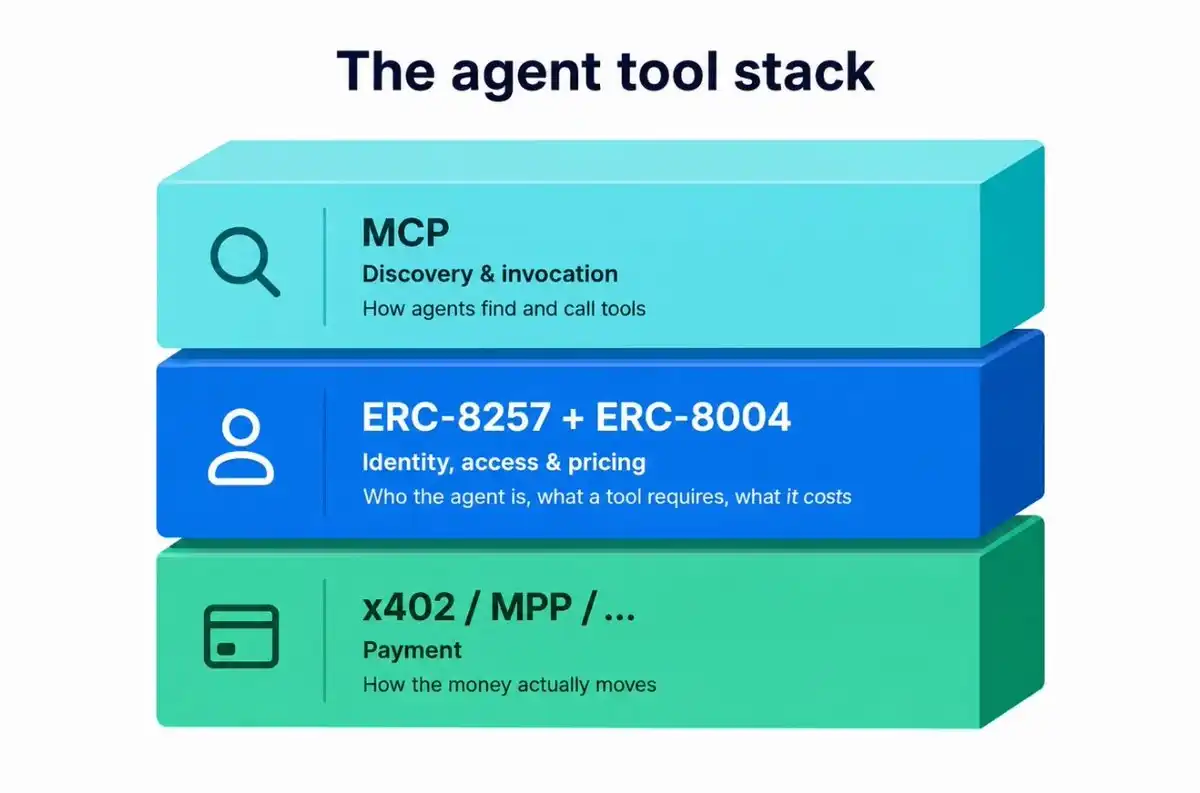
MCP 告诉你的 Agent 有哪些工具存在。ERC-8004 定义你的 Agent 身份。ERC-8257 说明如何实际使用工具。x402 处理支付。每一层都可组合。

通过 ERC-8004 注册的 Agent 可以在其 services 数组中链接来自 ERC-8257 注册表的受限工具。你不需要在它们之间选择。它们是同一个技术栈的不同层。

看它运行

nft-appraisal-tool:指向任何 NFT,它会返回价格评估,包含低/中/高区间、置信度、近期交易和可比案例。两个档位:任何人 0.05 美元/次,Base 上的 CHONK 持有者 0.01 美元/次。

一个没有 CHONK 的 Agent 调用持有者端点。响应:403——谓词门禁拒绝。你需要 Base 上的 CHONK。

Agent 买了一个,重试,同样的调用返回成功。

$ npx @opensea/tool-sdk pay https://nft-appraisal-tool.vercel.app/api/holder --auth siwe \

--body '{"chain":"ethereum","contractAddress":"0x79fcdef22feed20eddacbb2587640e45491b757f","tokenId":"4707"}'

Wallet: 0x3184...0465

Response (403):

{"error":"Predicate gate: access predicate denied","toolId":"2","predicate":"0xc872..."}

谓词明确告诉它需要什么:Base 上的 CHONK。Agent 在 OpenSea 上买了一个并重试,调用通过。

$ npx @opensea/tool-sdk pay https://nft-appraisal-tool.vercel.app/api/holder --auth siwe \
--body '{"chain":"ethereum","contractAddress":"0x79fcdef22feed20eddacbb2587640e45491b757f","tokenId":"4707"}'
Wallet: 0x5eca...e2a8

Response (200):
{
"low": {"amount": "1.8", "currency": "ETH", "usd": 5460},
"mid": {"amount": "2.3", "currency": "ETH", "usd": 6970},
"high": {"amount": "3.1", "currency": "ETH", "usd": 9400},
"confidence": "medium",
"reasoning": "Comparable Squiggles in this color band sold between 1.9 and 2.6 ETH...",
...
}

从 403 到 200 之间没有人类。谁持有访问 NFT,谁就有访问权。

接下来可以构建什么

专业定价预言机。链上分析订阅。研究订阅。合作伙伴白名单 API。像其他资产一样在公开市场交易的限量席位工具。

这些在一年前都不需要存在。注册表上线的那一刻,它们全都成为可能。

开始构建

已在 Ethereum 和 Base 上线。

@opensea/tool-sdk 处理底层细节,提供脚手架、门禁、注册、部署到 Vercel、Cloudflare 或 Express。包含可用示例。

npx @opensea/tool-sdk init my-tool

完整规范见 8257.ai。

参与进来

ERC-8257 还在草案阶段。在我们发布注册表 1.0 正式版之前,帮助我们改进规范。发布一个工具,哪怕很小。我们会推广有趣的项目。

加入 Telegram 群组 t.me/ERC8257,与作者@CodinCowboy 和@ralxz 讨论 ERC、工具 SDK 等话题。

免责声明:本内容仅供参考,不构成财务或交易建议。提及特定项目、产品、服务或代币不构成 OpenSea 的背书、赞助或推荐。OpenSea 不保证所呈现信息的准确性或完整性,读者应在采取行动前独立验证任何声明。读者在做出任何决定前应自行尽职调查并承担全部责任。


Related Questions

Q什么是ERC-8257,它的主要作用是什么?

AERC-8257是以太坊的一个开放标准,名为“Agent Tool Registry”,它是一个链上注册表。其主要作用是作为AI Agent的工具商店基础设施,允许任何人发布工具、声明访问规则和定价,并让AI Agent自主满足这些要求,实现工具发布、定价和访问控制完全上链,无需中心化平台背书。

Q文章中描述了一个AI Agent自主付费购买NFT来解锁API的场景,这个过程依赖于哪些核心技术和标准?

A这个过程主要依赖于ERC-8257标准及其定义的“访问谓词”(智能合约)来实现链上的访问控制。同时,支付环节可能由其他协议处理,如x402协议用于小额支付。此外,AI Agent的身份由ERC-8004标准定义,工具发现则可能涉及MCP协议。这些技术和标准共同构成了一个可组合的技术栈。

Q对于NFT持有者来说,ERC-8257标准带来了什么新的价值或可能性?

A对于NFT持有者来说,ERC-8257为其持有的NFT赋予了新的潜在效用。手中的NFT(例如PFP、会员通行证等)可能成为其AI Agent访问特定工具或API的“钥匙”。例如,持有特定NFT可以获得工具使用折扣、独家访问权限或限量席位。这使得NFT不仅是收藏品或身份象征,还成为了参与AI Agent经济的接入凭证。

Q请解释一下ERC-8257中“访问谓词”的概念及其作用。

A“访问谓词”是ERC-8257标准中的一个核心组件,它是一个智能合约,只回答一个核心问题:“这个地址有访问权吗?”。它是一个可插拔的扩展点,可以检查任何链上条件,例如:NFT所有权、活跃订阅状态(如ERC-5643)、白名单、ZK证明、DAO投票结果、质押额度等。它负责执行工具发布者设定的访问规则,是实现灵活且自助式访问控制的关键。

Q开发者如何使用ERC-8257标准来发布一个工具?可以简要说明其提供的开发工具和流程。

A开发者可以使用OpenSea提供的@opensea/tool-sdk来快速开始。首先,通过命令行`npx @opensea/tool-sdk init my-tool`初始化一个工具项目。该SDK提供了脚手架、门禁控制、注册和部署(到Vercel、Cloudflare或Express等平台)的功能。开发者需要定义一个工具清单(包括功能、调用方式、费用)和一个“访问谓词”合约来设定访问规则,然后即可将工具发布到ERC-8257链上注册表中。

Related Reads

Sharplink CEO: One Million Ethereum Developers, Who Can Compete?

Etherean Ecosystem: One Million Developers and a Formidable Moat The Ethereum network has surpassed a significant milestone: over one million unique lifetime developers, with approximately 232,000 active in the past year. This vast and growing talent pool is Ethereum's core advantage, far more critical than transient metrics like speed or transaction fees. The central question is not which blockchain is fastest, but where the best builders choose to build long-term. Ethereum's answer lies in a decade-long accumulation of infrastructure, standards, tools, liquidity, and collaborative culture that is exceptionally difficult to replicate. It has become the default operating system for programmable finance. This massive developer base is actively working on complex, high-risk challenges that deepen Ethereum's strategic moat: * **Glamsterdam Upgrade (2026):** Focused on core protocol scalability (ePBS, parallel execution) while preserving core values like credible neutrality. * **Synchronous Composability:** Aims to make numerous Rollups interoperate like a single chain, directly addressing fragmentation concerns. * **Quantum Resistance:** Ethereum leads mainstream ecosystems in coordinated preparation for post-quantum cryptography, with a targeted migration plan around 2029. This developer advantage is self-reinforcing, fueled by: * **Deep Composability:** Applications interact like interoperable financial Lego bricks via shared standards (e.g., EVM, Solidity). * **Credible Neutrality:** Secured by over 900,000 validators, making it trusted by major institutions. * **Modularity:** Rollups (Base, Arbitrium, etc.) expand, rather than fracture, the ecosystem into a tightly connected modular internet economy. * **Culture:** Attracts top-tier researchers and standard-setters who guide the entire industry. In essence, while other chains generate activity, Ethereum is consolidating as the trusted, long-term coordination layer for internet-native finance. Its future is being built now by the architects of the next-generation financial infrastructure.

Odaily星球日报14m ago

Sharplink CEO: One Million Ethereum Developers, Who Can Compete?

Odaily星球日报14m ago

Ethereum Reaches the Milestone of One Million Developers, Sharplink CEO Delves Deep into Ethereum's Future Possibilities

Ethereum Surpasses One Million Developers Milestone: A Look at Its Unshakeable Dominance and Future Joseph Chalom, CEO of Sharplink, reflects on his recent Asia trip where he engaged deeply with Ethereum developers and ecosystem leaders. The most striking takeaway was not just the industry's vibrancy, but the rigorous, long-term vision of local builders. This context brings to life a pivotal statistic: Ethereum has now surpassed one million cumulative developers (1,012,824), with approximately 232,000 remaining active in the past year—a talent pool unmatched by any other crypto ecosystem. The critical question isn't which blockchain is fastest, but where top developers choose to build long-term. Ethereum's answer is unequivocal. Its decade-long lead stems from a unique convergence of technology, institutional culture, economic systems, and composability, cementing its role as the foundational operating system for programmable finance. This massive developer base is tackling the industry's hardest problems, continuously strengthening Ethereum's moat. Key initiatives include: * **The Glamsterdam Upgrade (planned 2026):** Introducing ePBS and Block-level Access Lists for parallel execution and higher throughput while preserving core values like credible neutrality and fair MEV distribution. * **Synchronous Composability:** Projects are working to enable atomic transactions across dozens of Rollups, making them function as one unified chain and eliminating ecosystem fragmentation. * **Post-Quantum Security:** Ethereum is far ahead in preparing for quantum computing threats, with a dedicated foundation working group and testnets targeting a full migration by ~2029—a crucial factor for institutional adoption. Beyond developers, Ethereum's core network effects are its unparalleled composability and unified standards (like EVM and Solidity), which create a powerful flywheel: more developers → better tools → greater liquidity → more institutional participation. Its other decisive advantages include credible neutrality (over 900k validators), a secure modular architecture with interconnected Rollups, and a deeply entrenched culture shaped by top-tier researchers. Ultimately, there's a vast difference between generating short-term activity and becoming the trusted, long-term coordination layer for global native finance. Major institutions prioritize security, trust, and liquidity—areas where Ethereum holds dominant mindshare. The industry's trajectory shows resources consolidating around unified standards, deep liquidity, and developer consensus. After meeting the builders in Seoul and Hong Kong, Chalom is more convinced than ever: Ethereum's unshakeable future is being built right now.

Foresight News25m ago

Ethereum Reaches the Milestone of One Million Developers, Sharplink CEO Delves Deep into Ethereum's Future Possibilities

Foresight News25m ago

Saylor's Latest Long Read: Bitcoin is Not Money, It's Digital Capital, and Money is Built Upon It

Michael Saylor presents his "Digital Asset Stack" theory, positioning Bitcoin as the foundational layer of digital capital. He argues Bitcoin itself should remain unchanged—no staking, inflation, or protocol alterations. Instead, a five-layer financial architecture should be built atop it: Digital Capital (BTC), Digital Credit (e.g., yield instruments like STRC), Digital Currency (stable, yield-bearing instruments pegged to fiat), Digital Yield (leveraged/structured products), and Digital Equity (e.g., MSTR stock, absorbing residual volatility). Saylor asserts this stack transforms Bitcoin's high-volatility, high-energy capital into tailored products: stable currencies for payments/savings, yield instruments for income seekers, and equity for growth investors. This approach meets diverse needs—corporate treasuries, banks, retirees, emerging market users—without compromising Bitcoin's core properties (scarcity, decentralization). The "killer use case" is rebuilding global money, credit, and capital markets on Bitcoin, bridging the fiat world with a superior digital asset foundation. The system leverages traditional finance principles (risk layering, structured products) while using Bitcoin as the ultimate collateral. This expands Bitcoin's utility, drives adoption, and offers a better monetary experience: digital, yield-bearing, stable-value tools for everyday use.

marsbit38m ago

Saylor's Latest Long Read: Bitcoin is Not Money, It's Digital Capital, and Money is Built Upon It

marsbit38m ago

Can SK Hynix's Stock Double Again in This Rally?

The article discusses the highly optimistic price target of approximately $3,500 for SK Hynix stock, set by Aletheia Capital. This target is significantly above the consensus range of $2,000-$2,520 from major brokerages. The core debate is whether SK Hynix deserves a fundamental re-rating beyond its traditional cyclical discount, based on the long-term impact of AI-driven demand. The $3,500 target hinges on three key assumptions holding simultaneously until at least 2027: 1) Continued shortage and high pricing for HBM (High Bandwidth Memory), a critical component for AI chips; 2) Sustained high prices for standard DRAM, as HBM production consumes capacity and constrains general supply; and 3) Strong AI server demand generating substantial, above-expectation free cash flow. SK Hynix's leading ~58% market share in HBM and its early certification with key clients like Nvidia provide a competitive advantage, allowing it to capture significant supply chain premiums. The HBM shortage is seen not just as a niche growth driver but as a catalyst that amplifies profitability across the entire memory business by tightening overall DRAM supply. However, the article cautions that this target represents an optimistic "tail scenario." Key risks include potential supply increases from competitors (Samsung, Micron) by 2027, a possible slowdown in HBM price growth, and high capital expenditures that could erode the projected free cash flow. The divergence in analyst targets reflects the market's uncertainty over whether the current AI-driven boom will temporarily elevate earnings or permanently raise the memory industry's profit baseline.

marsbit41m ago

Can SK Hynix's Stock Double Again in This Rally?

marsbit41m ago

Trading

Spot
Futures

Hot Articles

How to Buy NFT

Welcome to HTX.com! We've made purchasing AINFT (NFT) simple and convenient. Follow our step-by-step guide to embark on your crypto journey.Step 1: Create Your HTX AccountUse your email or phone number to sign up for a free account on HTX. Experience a hassle-free registration journey and unlock all features.Get My AccountStep 2: Go to Buy Crypto and Choose Your Payment MethodCredit/Debit Card: Use your Visa or Mastercard to buy AINFT (NFT) instantly.Balance: Use funds from your HTX account balance to trade seamlessly.Third Parties: We've added popular payment methods such as Google Pay and Apple Pay to enhance convenience.P2P: Trade directly with other users on HTX.Over-the-Counter (OTC): We offer tailor-made services and competitive exchange rates for traders.Step 3: Store Your AINFT (NFT)After purchasing your AINFT (NFT), store it in your HTX account. Alternatively, you can send it elsewhere via blockchain transfer or use it to trade other cryptocurrencies.Step 4: Trade AINFT (NFT)Easily trade AINFT (NFT) on HTX's spot market. Simply access your account, select your trading pair, execute your trades, and monitor in real-time. We offer a user-friendly experience for both beginners and seasoned traders.

7.0k Total ViewsPublished 2024.03.29Updated 2026.06.02

How to Buy NFT

What is Altura NFT?

Altura: Providing One-Stop NFT Solutions for Game Developers

56.0k Total ViewsPublished 2024.06.12Updated 2024.06.12

What is Altura NFT?

What is AINFT

EternaFi Agents and $AINFT: A Comprehensive Analysis of AI-Powered NFT Infrastructure in the Web3 Ecosystem The intersection of artificial intelligence (AI) and blockchain technology is rapidly evolving, establishing innovative platforms that redefine ownership models and economic participation. EternaFi Agents, along with its native token $AINFT, exemplifies a groundbreaking approach to the tokenization of AI infrastructures through the means of non-fungible tokens (NFTs). Launched in July 2025 by the development team at Nova Club, EternaFi merges the advancements of AI with the decentralized financial mechanisms of blockchain, presenting a unique investment opportunity for participants within the web3 ecosystem. This article aims to provide an in-depth assessment of EternaFi Agents, covering its core components, functionality, and significance within the crypto landscape. Introduction and Project Overview EternaFi Agents stands as a salient example of how blockchain technology can democratize access to advanced AI capabilities. The project endeavors to reshape the paradigm of AI ownership by diversifying economic participation, making sophisticated AI systems accessible to a larger pool of stakeholders. At its core, the project tokenizes a proprietary large language model (LLM) developed by Nova Club, allowing NFT holders to gain fractional exposure to the model's economic performance. By utilizing NFTs representing stakes in the LLM, EternaFi Agents fosters a model wherein stakeholders not only participate in AI service consumption but also enjoy sharing in the economic rewards generated by the platform. This transformative approach enables the development of sustainable revenue models for AI services, all the while promoting broad community engagement and facilitating transparent governance. What is EternaFi Agents? EternaFi Agents represents an AI-NFT infrastructure project that aims to blend the capabilities of AI with blockchain technology in a coherent ecosystem. The essential feature of this project is the creation of NFTs that serve as financial instruments, representing fractions of ownership in Nova Club's proprietary AI infrastructure. Each NFT symbolizes direct exposure to the economic performance of the underlying AI system, providing a lucrative opportunity for investors. The project operates on the Base blockchain, known for its scalability and efficiency, thus ensuring manageable transaction costs while facilitating a seamless operational experience. One of the notable features includes a revenue-sharing mechanism, wherein NFT holders can receive portions of subscription income generated by the AI services provided on the platform. This innovative approach establishes a connection between the success of the AI services and the economic dividends distributed among the holders, thus ensuring an alignment of interests across the community. Who is the Creator of EternaFi Agents? The creative force behind EternaFi Agents is Nova Club, a development team based in Singapore proficient in the amalgamation of AI and blockchain technology. Their prior experience in AI development and cryptocurrency analysis gives credence to the project, contributing a breadth of expertise to the creation of EternaFi Agents. Nova Club’s mission centers on democratizing access to cutting-edge AI technologies while building sustainable economic models that benefit users alongside developers. Their commitment to transparency, community governance, and innovation is reflected in the design and implementation of the EternaFi platform, aiming to establish a unique ecosystem that fosters positive engagement and long-term value creation. Who are the Investors of EternaFi Agents? The specific details concerning investors or investment organizations backing EternaFi Agents are not publicly available. However, EternaFi has adopted an inclusive approach to funding its development through the sale of NFTs to the public, allowing a wide array of participants to invest in the ecosystem. The project’s architecture ensures that core infrastructure is funded responsibly while allowing community members to partake in the ownership and economic returns generated from the AI services. This model emphasizes community engagement by aligning the interests of investors and project developers, creating a collaborative environment where long-term participation is incentivized. How Does EternaFi Agents Work? EternaFi Agents operates through a multifaceted ecosystem where NFTs serve as a primary means of ownership representation within the project. Each NFT holder is entitled to a share of the monthly subscription income produced by the underlying AI-powered platform, thereby positioning NFT ownership as a lucrative investment vehicle. Revenue Generation Mechanism The primary source of revenue generation for the EternaFi platform stems from subscription fees related to the AI services provided. Users can access various tiered services, ranging from basic market analysis tools to comprehensive AI-assisted trading solutions. These services are monetized and form the basis for the revenue-sharing framework, which distributes profits to NFT holders through automated smart contracts. An innovative feature of the EternaFi ecosystem is the revenue-sharing mechanism that operates transparently, ensuring that rewards are allocated based on verifiable metrics from the AI platform's operations. This creates a direct link between the performance of AI services and the returns available to community investors, establishing a sustainable economic model. Staking and Vesting Mechanisms Participants within EternaFi can engage in staking their NFTs to unlock additional economic benefits. The vesting schedule is designed to promote long-term commitment among participants, rewarding those who exhibit ongoing support for the project. This ensures a robust alignment of interests and fosters a sense of community engagement essential for achieving the project's long-term goals. Transparent Governance EternaFi Agents embraces decentralized governance, allowing NFT holders to play an active role in decision-making regarding the platform's development and future directions. The governing structure includes community voting mechanisms, providing NFT holders with the opportunity to influence significant decisions and contributing to a collaborative approach to project growth. Timeline of EternaFi Agents The development trajectory of EternaFi Agents showcases a systematic approach toward building a sustainable AI infrastructure while meeting the needs of community participants. Below is a timeline of important milestones in the project’s history: July 2025: Launch of EternaFi Agents, including the public sale of NFTs and deployment of the $AINFT token on the Base blockchain. Q4 2025: Establishment of market infrastructure including liquidity pools and launch of staking dashboards for NFT holders. 2026: Initiation of community engagement programs, expanding AI capabilities, and integration with cross-chain technologies. Q4 2026: Implementation of the dividend distribution system, allowing NFT holders to reap economic benefits from their investments. These milestones signify the focus on establishing a functional and participative ecosystem while ensuring continuous evolution to meet market demands. Technological Infrastructure and Blockchain Integration EternaFi Agents is anchored in an advanced technological framework combining AI systems with blockchain capabilities. Operating on the Base blockchain, the project leverages the advantages of scalability and low transaction costs. The underlying smart contract architecture governs the NFT ownership, revenue sharing, and community management features, ensuring efficiency and transparency. AI System Development The proprietary large language model underpinning EternaFi Agents has been independently developed and designed to cater to revenue-generating applications without reliance on proprietary external frameworks. This endeavor reflects a commitment to creating a versatile and adaptable AI infrastructure capable of delivering meaningful services to users, thus generating economic value for investors. Security Measures The robustness of EternaFi’s security infrastructure is paramount. Regular audits and stringent security measures ensure the integrity of the AI systems and blockchain mechanisms, safeguarding against potential vulnerabilities while fostering confidence among participants. Conclusion EternaFi Agents signifies a landmark innovation within the realm of artificial intelligence and blockchain technology, opening avenues for community ownership and economic participation in advanced AI capabilities. The project’s comprehensive strategy to tokenize AI infrastructure via NFTs establishes a precedent for future decentralized ecosystems. By harmonizing technical sophistication with user-centric economic models, EternaFi not only fosters engagement but also generates a sustainable revenue-sharing framework for community participants. The significance of EternaFi extends well beyond its operational success as it exemplifies how blockchain can democratize cutting-edge AI technologies, paving the way for future ventures in this intersectional space. The evolution of EternaFi Agents may herald a new era of AI development characterized by participant-driven governance, sustainable economic models, and transparent verification, ultimately contributing to the broader democratization of AI and technology accessibility across industries.

4.0k Total ViewsPublished 2025.08.14Updated 2025.08.14

What is AINFT

Discussions

Welcome to the HTX Community. Here, you can stay informed about the latest platform developments and gain access to professional market insights. Users' opinions on the price of NFT (NFT) are presented below.

活动图片