$414mln exits crypto funds – Why sentiment is suddenly shifting

ambcryptoPublished on 2026-03-31Last updated on 2026-03-31

Abstract

In the last week of March, cryptocurrency investment products experienced significant outflows totaling $414 million, marking the first net withdrawals in five weeks. This shift was driven by escalating global tensions, high inflation, and anticipation around Federal Reserve meetings, reducing total assets under management to $129 billion. Ethereum was hit hardest with $222 million in outflows, while Bitcoin saw $194 million withdrawn despite strong year-to-date inflows. Solana also recorded outflows, whereas XRP was the sole asset with inflows of $15.8 million. On-chain metrics showed reduced network engagement for major cryptocurrencies. The U.S. led outflows with $454 million, while Canada and Germany saw modest inflows. Despite a recent market cap rebound to $2.34 trillion, short-term volatility remains high due to macroeconomic uncertainty, cautioning investors against relying on temporary rallies for long-term predictions.

The last week of March (from the 23rd to the 24th) was not good for the cryptocurrency investment product. As per a weekly report from CoinShares, digital assets funds recorded their first outflows in five weeks, worth $414 million.

This has more to do with just investors’ sentiments and price actions.

Escalating global tensions involving the U.S and Iran, accompanied by high inflation and the growing expectations around the upcoming Federal Reserve meetings, are the major reasons behind this shift.

Because of these developments from politics to economics, the total Assets under Management (AuM) have declined to $129 billion. If looked carefully, such levels have already been hit during early February and back in April 2025, when volatility was high due to changing tariff policies.
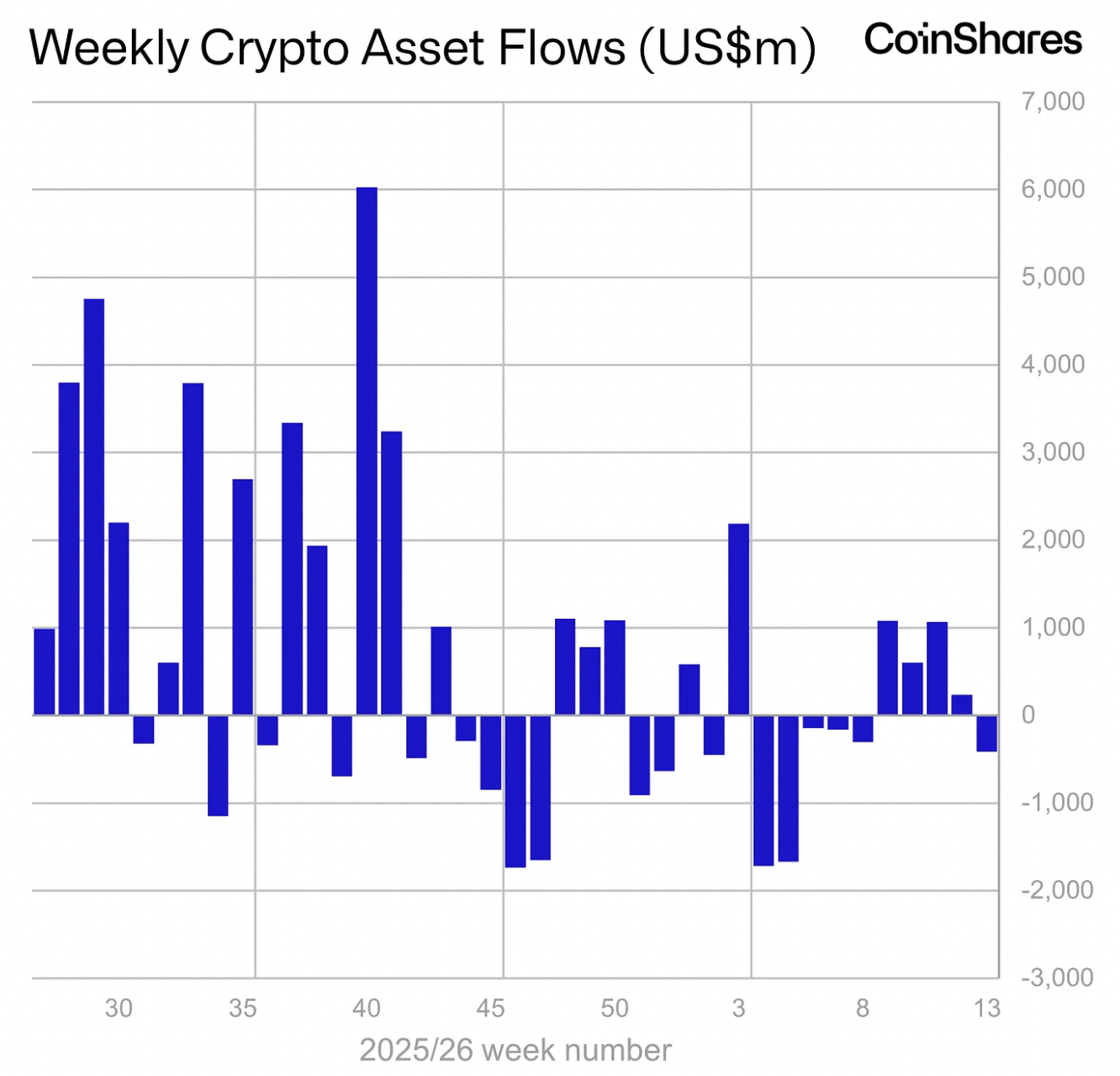
Source: CoinShares

Winners and losers of the last week

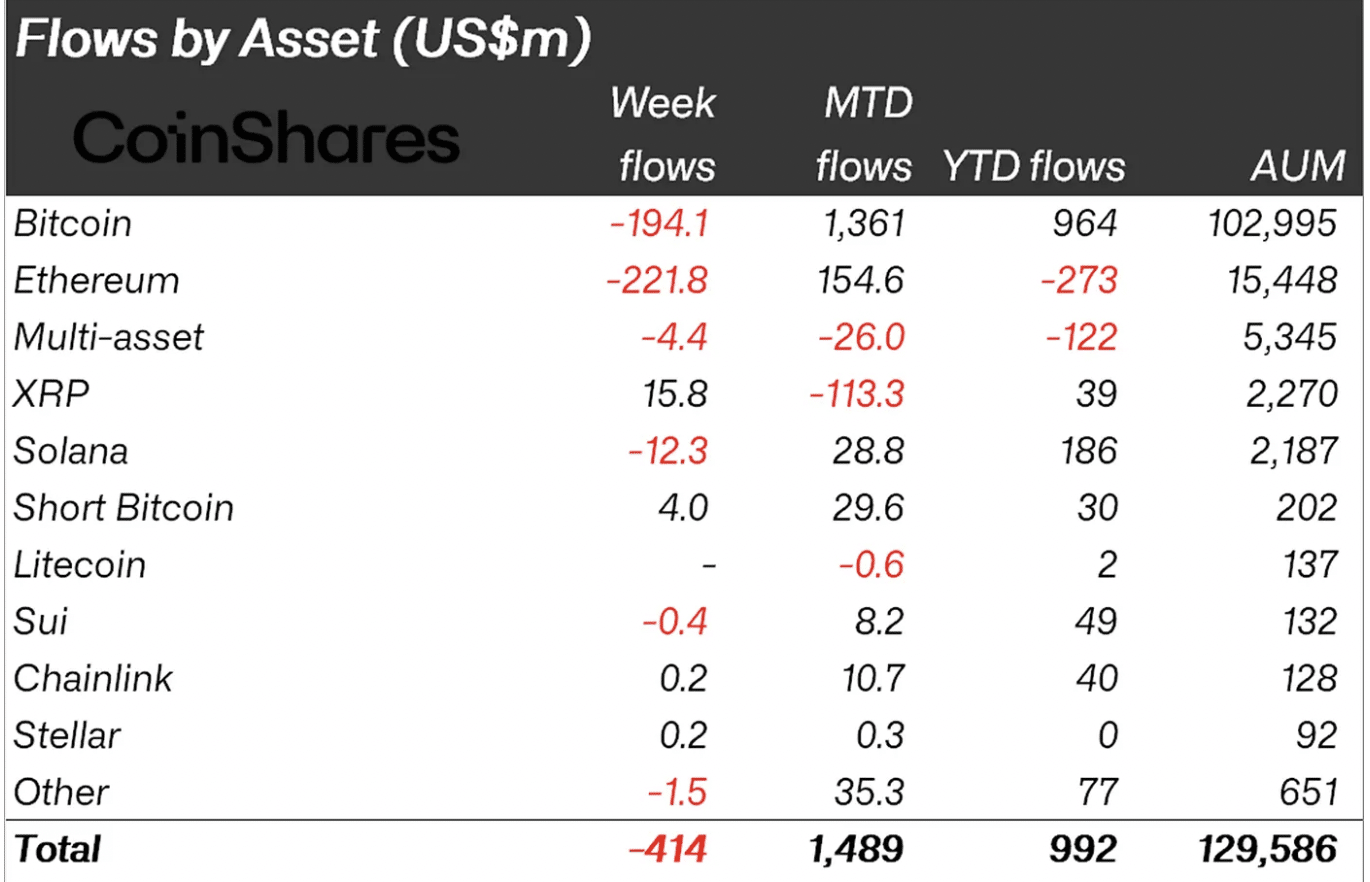
That said, in this outflow, Ethereum [ETH] was hit the hardest, recording $222 million worth of outflows. This further caused its year-to-date outflow to fall to $273 million.

Well, this drop might be due to the ongoing uncertainty around the CLARITY Act. Meanwhile, ETH’s price was also choppy as it faced a downturn of 2.48% in the past week.

Interestingly, Bitcoin [BTC] was standing strong, but the room for caution still remained. The leading cryptocurrency recorded outflows worth $194 million in the last week.

However, if you looked at its year-to-date data, its net inflow stood strong at $964 million. This came as Bitcoin’s price witnessed a weekly drop of 3.48%.
Source: CoinShares

Needless to say, Solana [SOL] was no exception as it too recorded $12.3 million in outflows as its price swung down by 5.97% in the past week.

Interestingly, Ripple’s XRP was the only one to record inflows worth $15.8 million. However, its price mirrored the broader market downturn, dropping by 4.68% in the past week.

Thus, XRP was the winner of the digital asset funds in the past week, whereas ETH was the loser.

Are on-chain metrics in favour?

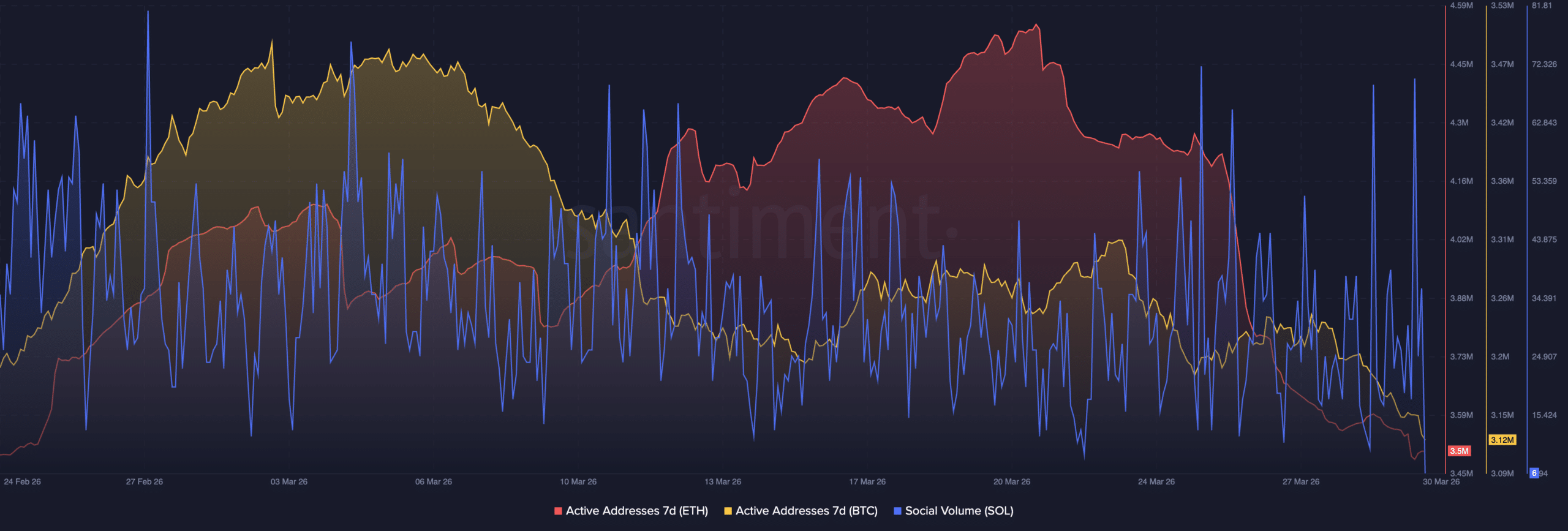
This sentiment was further confirmed by the active address metric by Santiment, wherein Bitcoin and Ethereum had both seen a drop in the aforementioned metric by the end of March.
Source: Santiment

This suggests that only a few people were invested in the network as compared to the high activity seen in early March.

Meanwhile, Solana’s Social Volume has also dropped, meaning fewer people are talking about the altcoin.

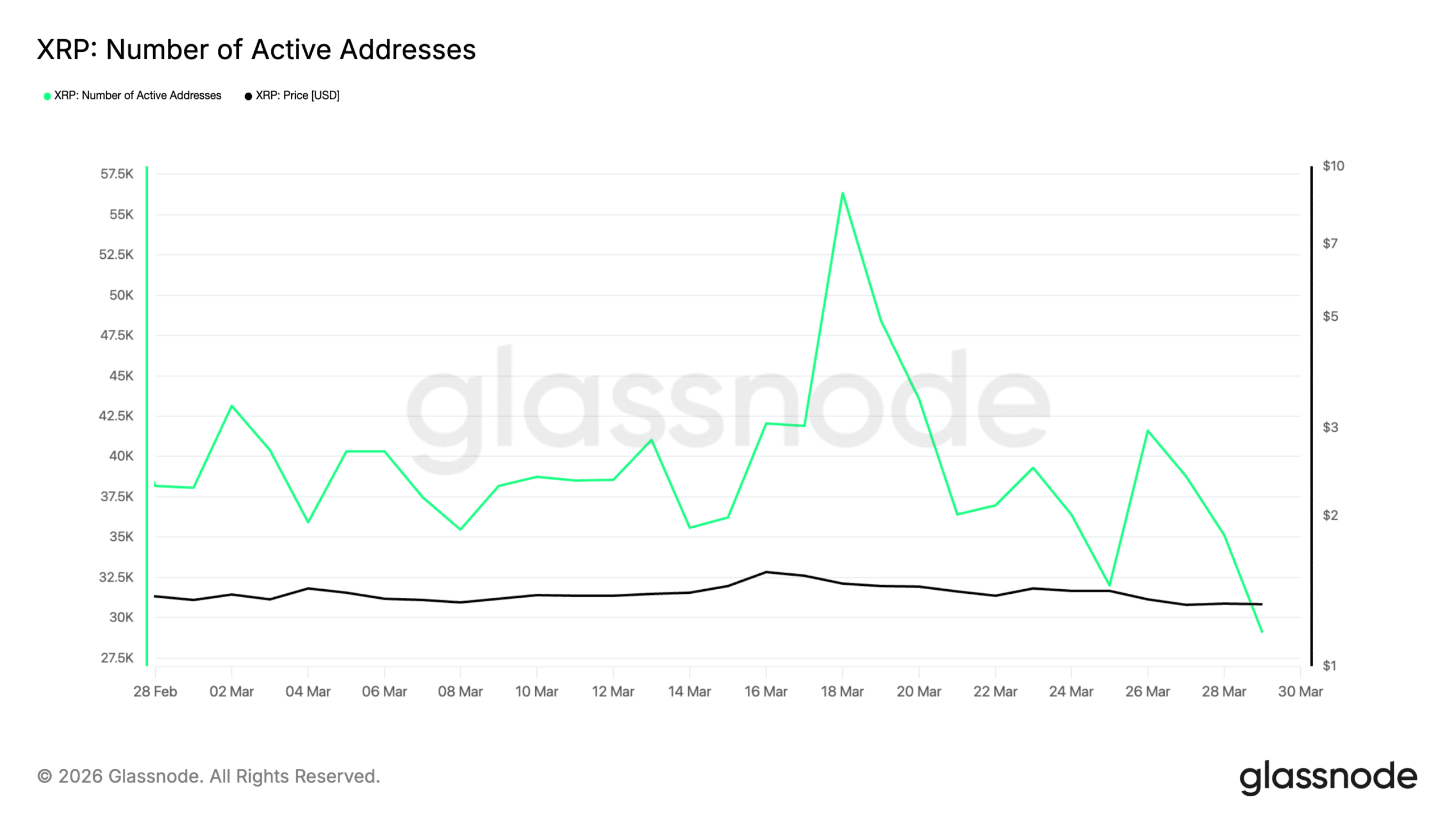
Lastly, though XRP was the winner, its network activity suggests that caution remains due to a sharp drop in active addresses in late March.
Source: Glassnode

The U.S faces the most choppy week

Now, while the U.S saw maximum outflows worth $454 million, Switzerland saw $4 million in outflows. Whereas Canada and Germany saw inflows worth $15.9 million and $21.2 million, respectively

However, as we move towards the end of March and with the 30th of March being the first day of a fresh week, the market is picking up again. The total crypto market cap is back in bullish hands, trading at $2.34 trillion at press time.

Yet despite this surge, investors should not be fooled by short-term booms, as even last week $635 millon had flowed in just before the Fed meeting and created optimism in the market.

However, as soon as the meeting drew to a conclusion, $405 million flowed out of the market, leaving investors in shock. Therefore, until situations calm down globally, short-term prices are not a clear sign for long-term market predictions.


Final Summary

  • The shift from inflows to outflows suggests that there is a lot of FUD in the market, and investors are positioning their bets cautiously.
  • Bitcoin is holding strong, but XRP stealing the spotlight highlights that investors are no longer just betting on Bitcoin.


Related Questions

QWhat was the total value of outflows from cryptocurrency investment funds in the last week of March, and what was the primary reason for this shift?

AThe total value of outflows was $414 million. The primary reasons were escalating global tensions involving the U.S. and Iran, high inflation, and growing expectations around the upcoming Federal Reserve meetings.

QWhich cryptocurrency was hit the hardest with outflows, and what was the specific amount?

AEthereum (ETH) was hit the hardest, recording $222 million worth of outflows.

QDespite the overall outflows, which digital asset was the only one to record inflows, and how much was it?

ARipple's XRP was the only digital asset to record inflows, worth $15.8 million.

QAccording to on-chain metrics from Santiment, what trend was observed for Bitcoin and Ethereum by the end of March?

ABoth Bitcoin and Ethereum saw a drop in their active address metrics by the end of March, suggesting reduced network activity.

QWhich country faced the maximum outflows, and what was the amount? Which countries saw inflows?

AThe U.S. faced the maximum outflows, worth $454 million. Canada and Germany saw inflows of $15.9 million and $21.2 million, respectively.

Related Reads

U.S. Government Bans Foreign Nationals from Using Fable 5, Anthropic Issues Rebuttal

U.S. Government Bans Foreign Access to Fable 5, Anthropic Issues Rebuttal On June 12th, the U.S. government ordered AI company Anthropic to immediately suspend all foreign access—including foreign nationals within the U.S. and Anthropic's own foreign employees—to its newly released Fable 5 and Mythos 5 AI models, citing national security concerns. This forced Anthropic to temporarily disable access to both models for all users globally, as it cannot technically differentiate user nationality at scale. The models, released just three days prior, represent Anthropic's highest public capability tier. Fable 5 is the first publicly available model from the advanced "Mythos" family, while Mythos 5 is a less-restricted version for approved cybersecurity and critical infrastructure partners. The government's directive was reportedly triggered by claims from another company that it could "jailbreak" Mythos 5, raising alarm within the Trump administration. Anthropic, in a detailed public statement, strongly challenged this rationale. The company argues the demonstrated "jailbreak" is a narrow, non-generalized technique that merely involves identifying minor, known software vulnerabilities—a capability common to other publicly available models like OpenAI's GPT-5.5 and routinely used by cybersecurity defenders. Anthropic stated it has complied with the order but disagrees with the government's standard, warning that applying it industry-wide would halt all new frontier model deployments. The company criticized the lack of a transparent, fact-based legal process and expressed confidence the situation stems from a misunderstanding. It is working to restore access and will release more technical details within 24 hours. Other Anthropic models remain unaffected.

链捕手11m ago

U.S. Government Bans Foreign Nationals from Using Fable 5, Anthropic Issues Rebuttal

链捕手11m ago

The Revelation from the Raydium Theft Incident: New DeFi Vulnerabilities Lurking in Forgotten Old Contracts

**Raydium Exploit Reveals DeFi's Hidden Risk: Forgotten "Zombie" Contracts** A recent attack on Raydium's deprecated V3 AMM pools resulted in a loss of approximately $1.34 million. The hacker exploited pools that were no longer supported by Raydium's current UI or SDK but remained fully functional and accessible on-chain. This incident highlights a critical, often overlooked category of risk in DeFi: inactive or legacy smart contracts that projects fail to properly decommission. Since March 2025, there have been at least 8 publicly reported attacks targeting such abandoned contracts, with total losses around $10.8 million. Including older pools and deprecated features, the count rises to 10 incidents with roughly $22.5 million in losses. These "zombie contracts" represent a lifecycle management failure rather than a code vulnerability, yet they are typically misclassified under general "code bug" categories in security reports, masking the true scale of the problem. The root cause is that projects often merely document a contract as "deprecated" without taking essential technical steps to secure it: withdrawing remaining assets, disabling external call functions, and implementing ongoing monitoring. These forgotten, under-monitored components become prime targets for attackers. To address this, the industry needs to recognize "zombie contracts" as a distinct risk category and establish standardized decommissioning protocols. Essential steps should include: 1) a formal retirement announcement, 2) removal of all front-end integrations, 3) withdrawal of locked assets, 4) disabling key contract functions, 5) ongoing security monitoring, 6) clear user communication, and 7) a post-mortem analysis. The value of a DeFi project lies not only in its current TVL but also in the security of its historical codebase, which has now become a new attack surface.

Foresight News2h ago

The Revelation from the Raydium Theft Incident: New DeFi Vulnerabilities Lurking in Forgotten Old Contracts

Foresight News2h ago

Robots Begin to 'Consume Data': The Hidden Production Chain from Indian Data Factories to Billion-Dollar Humanoid Robots

Robots have started to 'consume data,' driving the formation of a new industrial supply chain focused on producing training data for embodied AI. Unlike large language models, which are trained on vast internet text corpora, embodied AI models face a 'data desert' in the physical world. This has created a massive demand for first-person perspective video data (Ego Data), captured by workers wearing cameras in places like Indian garment factories. Companies like Neocambrian AI are establishing 'data factories' where workers perform standardized tasks (e.g., sorting clothes, kitchen organization) to generate thousands of hours of video. Research, such as NVIDIA's EgoScale, demonstrates that scaling this human demonstration data predictably improves robot performance, particularly for dexterous manipulation. This has validated a training path combining large-scale human data for pre-training with smaller amounts of robot-specific data for fine-tuning. The value of different data types varies significantly, forming a 'data pyramid.' The base consists of low-cost, large-scale internet and Ego Data. Higher layers include more expensive motion-capture data (e.g., from data gloves), simulation/synthetic data, and the most costly and scarce layer: real robot teleoperation data. This demand has spawned a layered ecosystem of data suppliers: low-cost data factories, motion capture and alignment specialists, robot-native teleoperation service providers, simulation data companies, and platforms aiming for data standardization. Robot companies themselves are adopting a 'layered procurement' strategy: outsourcing generic Ego Data while building in-house capabilities for robot-specific adaptation data and the critical deployment/failure data generated in real-world applications. The industry is shifting focus from hardware and basic mobility to the data pipelines required for general-purpose capability. While parallels exist to data labeling companies like Scale AI in the LLM boom, the physical complexity of robot data—involving action success ambiguity and sim-to-real gaps—requires more integrated solutions for data collection, annotation, and a continuous feedback loop. The race is on to build the data engines that will teach robots to operate reliably in the unstructured real world.

marsbit4h ago

Robots Begin to 'Consume Data': The Hidden Production Chain from Indian Data Factories to Billion-Dollar Humanoid Robots

marsbit4h ago

Trading

Spot
Futures
活动图片