Musk vs. Altman: Who Will Be the 'Fisherman'?

marsbitPublished on 2026-05-09Last updated on 2026-05-09

Abstract

Elon Musk and Sam Altman are locked in a fierce legal and commercial battle. Musk, a co-founder of OpenAI, has sued the company and Altman, alleging they betrayed its original non-profit, open-source mission by transforming into a for-profit entity with significant Microsoft backing, now valued at $852 billion. He demands damages, a return to a non-profit structure, and management changes. The lawsuit hinges on whether OpenAI's founding charter was a legally binding charitable trust or merely an idealistic statement. OpenAI counters that Musk himself pushed for a for-profit model in 2017 but left when he couldn't gain full control, and now acts as a commercial rival with his xAI venture. Despite the high-profile feud, the article suggests the real winners (the "fishermen") may be others in the AI race. While Musk has folded xAI into SpaceX to pursue a "space-based computing" vision, his Grok chatbot lags in market share and user growth compared to leaders. OpenAI faces its own challenges, notably from rival Anthropic, which is rapidly catching up in revenue and enterprise adoption. Musk is reportedly leasing significant computing power to Anthropic, creating an "enemy of my enemy" dynamic. Furthermore, Chinese AI models like DeepSeek are quickly closing the capability gap. Ultimately, the lawsuit is seen as setting a precedent for AI governance, but the intense competition between Musk and Altman may primarily benefit other players, infrastructure providers like Nvidia, an...

By | TingtongTech (ID:tingtongtech),Author | Yang Lin,Editor | Rao Xiafei

The showdown between Elon Musk and Sam Altman is intensifying.

Their feud, which has been brewing for a decade, has escalated from public spats on platform X to direct competition between their companies' product lines, and now to a courtroom confrontation.

Musk accuses Altman of "stealing a charity," arguing that OpenAI, now valued at approximately $852 billion and planning an IPO, has betrayed its founding principles.

The world's richest man believes Altman and others swindled him out of $38 million in donations and personal assistance. In his lawsuit, he has two core demands: one, seeking $130-150 billion in damages; two, requesting the court to order OpenAI to revert to a non-profit status and replace its current management.

The market defines this duel as the "AI Century Lawsuit." For the AI era, in a sense, whether discussing legal principles, capital competition, or discourse power, the essence of this game is no longer merely a personal grudge between the two men.

In the market's view, the true significance of this lawsuit lies in the fact that the judgment will essentially anchor the basic industry rules for the global AI ecosystem.

Although the final winner will not change the rules of the AI game, this is a microcosm of an era of global industry differentiation and fierce competition.

Especially, behind the scenes of frantic pursuit, there is an even more important question to ask: while Musk and Altman are tearing each other apart in court and competing fiercely outside, who will be the real "fisherman"?

A Courtroom Battle Exposing More Than Just a Personal Feud

"Without me, OpenAI would never have existed," Musk has repeatedly emphasized.

In 2015, Musk invested about $38 million in seed funding and co-authored the founding manifesto for OpenAI with Altman, pledging to "build safe, beneficial AGI (artificial general intelligence) for humanity, unconstrained by the need for financial return."

Musk poached top researchers from Google and personally contacted Nvidia CEO Jensen Huang to secure early supercomputers for the startup. However, in February 2018, he left the board due to disagreements over direction.

A decade later, OpenAI is no longer a non-profit lab. It has established a for-profit subsidiary, brought in Microsoft investment, and rapidly grown into a tech empire valued at around $852 billion and planning an IPO.

All disputes between the two revolve around that initial pledge. The core controversy is whether it was a charitable trust agreement or a legally non-binding "idealistic slogan."

In fact, from a legal interpretation perspective, if it is deemed merely a visionary statement, it holds no legal binding force. Then OpenAI's for-profit transformation would have no legal flaws, Musk's accusations would completely collapse, and the lawsuit would end immediately.

However, if the founding manifesto is deemed to constitute a legally effective "charitable trust" or an enforceable "public welfare commitment," then every subsequent step by OpenAI could constitute a fundamental violation of the original promise.

Musk's accusation is that OpenAI transformed from a "non-profit organization" into a "for-profit entity." He wants Altman and his AI empire to face the consequences: a $150 billion compensation demand, dissolution of OpenAI's for-profit structure, removal of Altman and Brockman, forced disclosure of technology, and cancellation of Microsoft's licensing agreement.
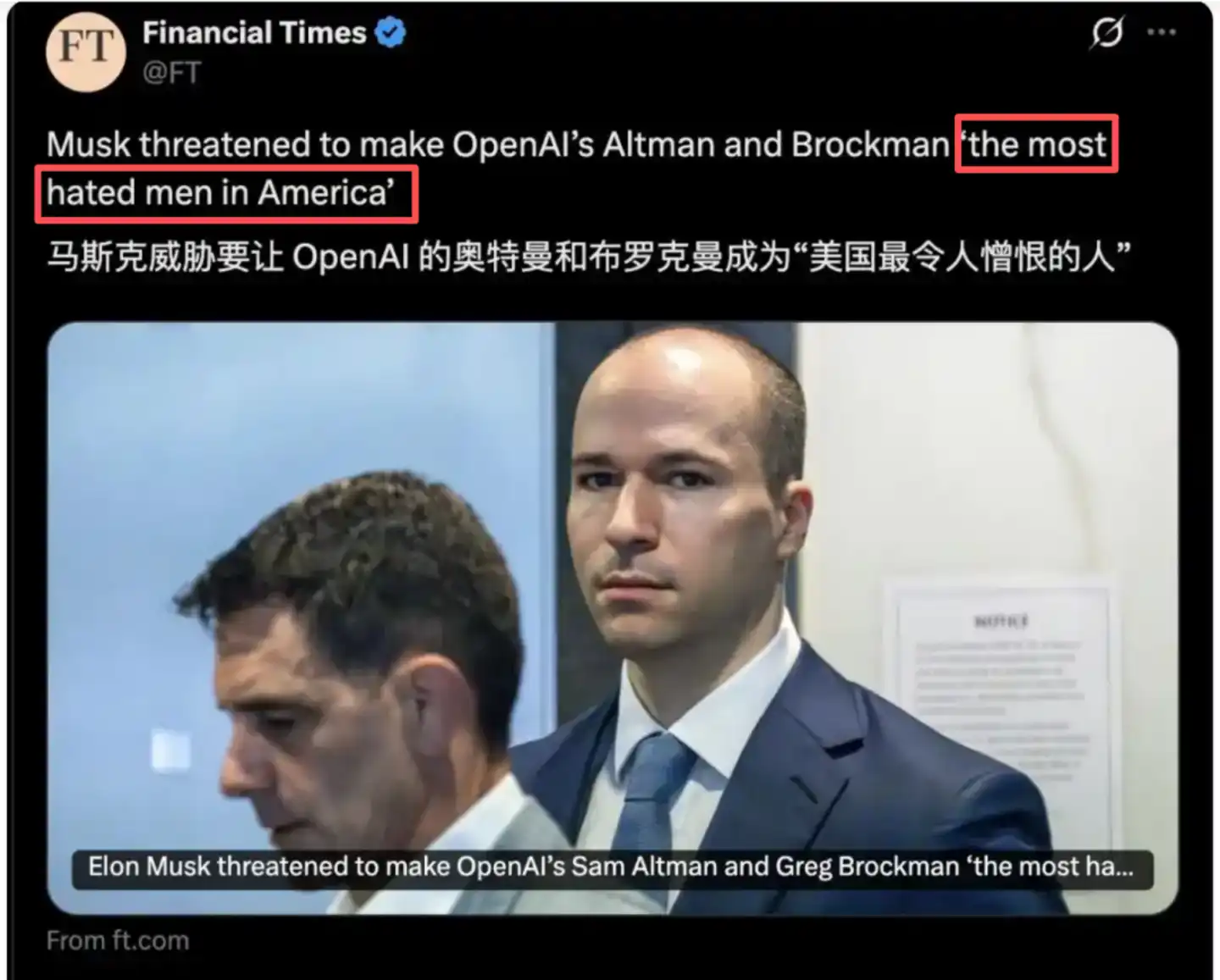
But OpenAI has presented a counter-narrative pointing in a different direction.

In their view, Musk was once a power-holder and is now a business rival. According to media reports, OpenAI lawyers also believe Musk filed the lawsuit not to guard any non-profit mission, but because "he didn't get the outcome he wanted."

For instance, court documents from OpenAI show that Musk himself had suggested establishing a for-profit entity as early as 2015, and in 2017 not only engaged in control struggles but also secretly registered a for-profit company in OpenAI's name.

OpenAI President Greg Brockman testified that in 2017, Musk himself had pushed for OpenAI to transform into a for-profit company, but with the condition that he have "complete control."

In fact, Musk also admitted that his xAI had used OpenAI's models to train its own Grok, which, in the market's view, corroborates OpenAI's assertion of "commercial rivals suppressing each other."

Some market commentary also points out: If Musk is truly fighting for the benefit of all humanity, why did he angrily exit in 2018 after failing to gain control when proposing a for-profit entity? Why publicly mock OpenAI and then found xAI in 2023?

In other words, what Musk wants—is it a "non-profit organization," or an AI enterprise/dominance he can control?

Or perhaps, Musk just wants to "defeat Altman"?

The AI Game Between Two Companies

Indeed, judging from the scope of Musk's empire, he certainly wants to "defeat Altman." After all, Musk's journey in AI has not been easy.

On the product side, Musk had high hopes for xAI. But during the second week of the trial, Musk dropped a bombshell on X: xAI would be fully integrated into SpaceX, renamed SpaceXAI, completely abandoning its independent identity.

"xAI will no longer exist as an independent company; it will simply be SpaceXAI, the AI product of SpaceX," Musk defined this move.
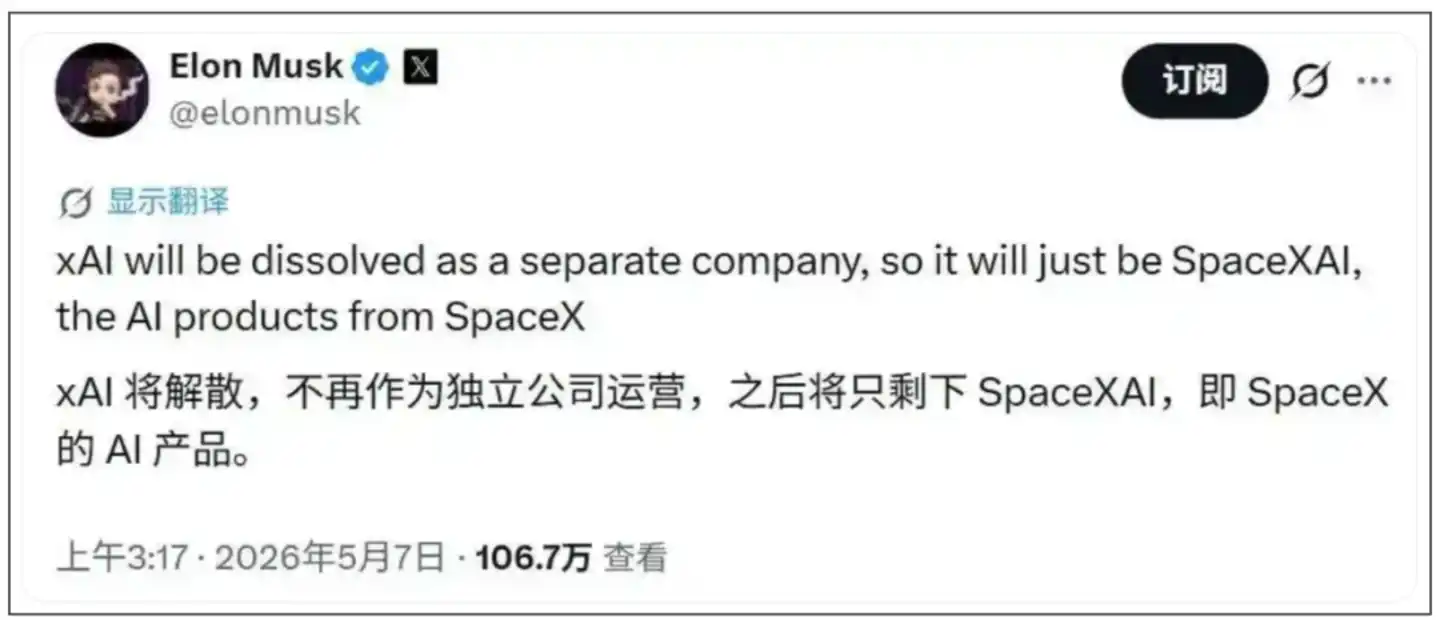
In the market's view, this move might be Musk's attempt to deeply integrate his AI business with aerospace. After all, Musk's X platform can provide over 500 million real-time data points daily to train his Grok model.

Musk's vision is: X provides usable data, Starlink provides global communications, and SpaceX rockets send computing equipment into space. In his view, Earth's energy and heat dissipation limits will soon constrain AI development; he estimates that within two to three years, the minimum cost for generative AI computation will shift to space. Thus, he aims to link AI from Earth to space, creating a closed-loop commercial ecosystem.

However, more analysis suggests this might be Musk's "smokescreen," because, on the product side, Musk's AI performance is not as "excellent" as he describes.

In fact, Grok, which Musk considers "the smartest AI on Earth," has shown increasingly mediocre market performance.

By late 2025, Grok was the runner-up globally among AI chat apps, second only to ChatGPT. But now, it has been overtaken by Claude, Gemini, and even DeepSeek.

Looking at global AI tool traffic, a year ago, Grok could still occupy the second spot in the US AI market with a 7.03% share. By early 2026, it had shrunk to 3.44%, surpassed by DeepSeek's 3.7% share.

Public data shows that in April 2026, Grok's global mobile daily active users dropped from 13.9 million to 12.2 million, a 12.5% decline. The drop was more significant in the US market, falling from 1.4 million to 1.1 million, a 15.6% reduction.

During the same period, however, Claude's daily active users surged from 16 million to 23 million, a 44% month-over-month spike, leaving Grok far behind.

Most embarrassing for xAI is its user composition. Public reports state that over the past six months, Grok's user base has been "overwhelmingly male," a gender imbalance extremely rare among mainstream AI products.

Market analysis points out this directly reflects that Grok's user scenarios primarily come from traffic diversion from social platform X, rather than establishing independent brand recognition and user ecosystems. Much analysis suggests that once the traffic红利 from platform X diminishes or user interest shifts, Grok's growth engine will face severe challenges.

Behind the user data lies the worrying operational status of xAI.

Although xAI was valued at $250 billion in its independent funding round, its core AI business scale remains relatively small, with no public independent ARR (Annual Recurring Revenue) data released yet.

Meanwhile, in Q1 2026, OpenAI's ARR had already reached $25 billion.

In March 2026, Musk himself publicly admitted that xAI would need until the end of 2026 to catch up with leading AI firms and might only achieve a significant lead by 2029.

This, perhaps, is the fundamental reason behind Musk's decision to disband xAI.

In contrast, OpenAI's market data performance is clearly better than xAI's.

Just a month before the trial, OpenAI pulled off a move significant enough to shake Silicon Valley, announcing the completion of a $122 billion financing round, with a post-money valuation of $852 billion, setting a record for the highest private financing in business history.

Moreover, OpenAI's annualized revenue exceeds $25 billion, with monthly revenue of $2 billion. ChatGPT boasts over 900 million weekly active users and over 50 million paying subscribers.

Musk has to face the fact that, despite his AI ambition lying in "space-based computing," at least on the product side, OpenAI's growth has indeed left xAI far behind.

Who Will Be the Real 'Fisherman'?

Of course, regardless of how Musk and Altman compete, and regardless of the trial's final outcome, the AI field will certainly not pause because of the feud between two individuals.

Especially, both Musk and Altman must realize that in this "two tigers fighting" war of attrition, the real "fisherman" is making an entrance.

At least for now, OpenAI's biggest challenger is not Musk's xAI, but its arch-rival Anthropic.

As is well known, Anthropic's announced annualized revenue of $30 billion in April 2026 already exceeds OpenAI's $25 billion level from February. Claude's global downloads tripled year-over-year, while ChatGPT's US weekly active users saw their first year-on-year decline.

Particularly in OpenAI's core enterprise user segment, Anthropic is catching up and might even surpass it. Data shows that in March 2026, nearly one-third of US enterprises used Anthropic's Claude tools, an increase of over 6 percentage points month-over-month, almost neck and neck with OpenAI's 35%.

On May 8th, according to media reports, Anthropic is considering raising tens of billions of dollars this summer to significantly expand computing capacity. If realized, Anthropic's valuation would approach $1 trillion, surpassing OpenAI.

More interestingly, after disbanding xAI, Musk will lease all 300 megawatts of computing power and 220,000 GPUs from the Colossus 1 supercomputer to Anthropic to support model training and inference. The market jokes that Musk has turned "the enemy of my enemy into an ally."
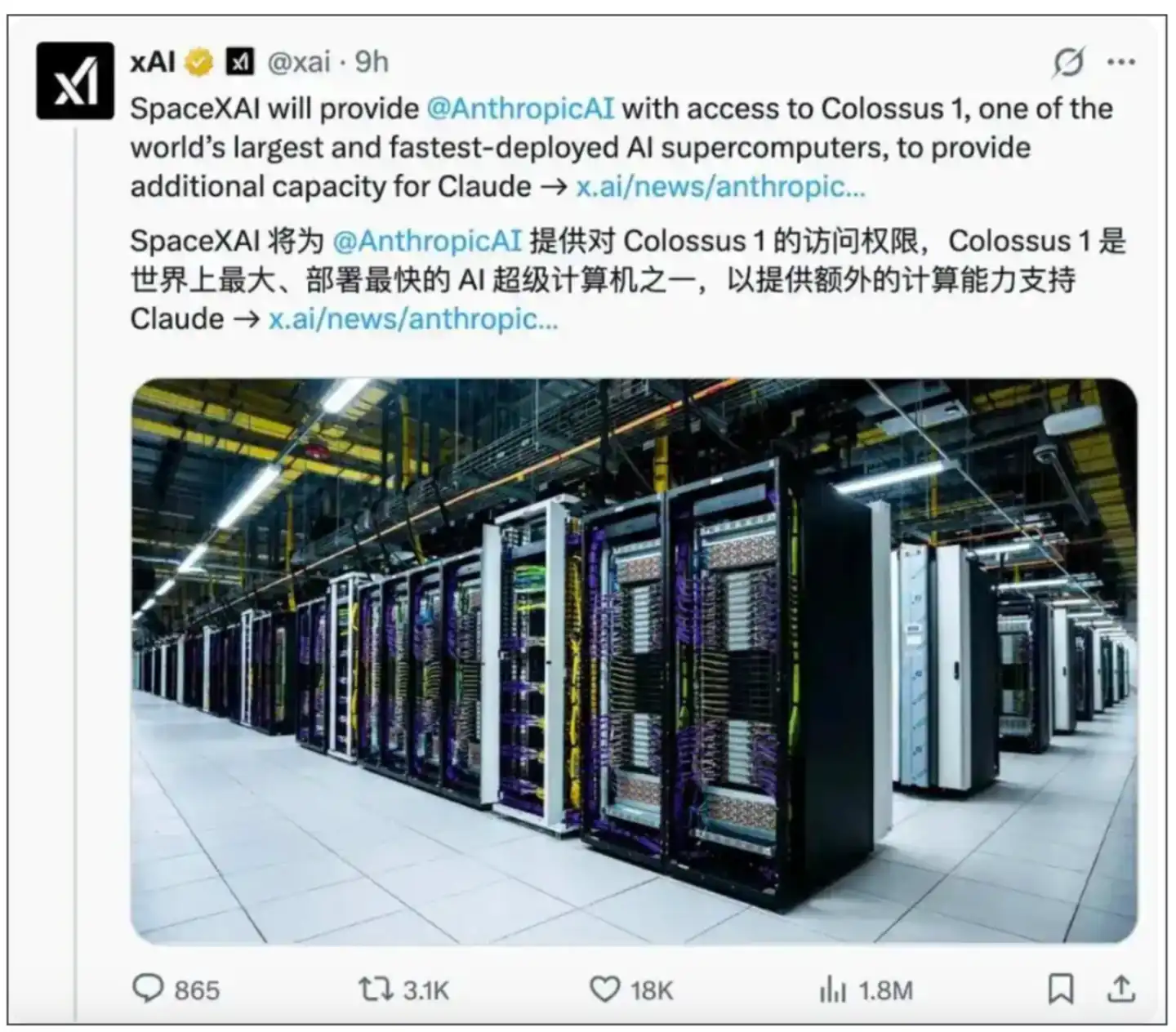
It is worth noting that Anthropic's founders also left OpenAI to start their venture. In a way, this mirrors the story of Altman breaking away from Musk.

Another reality is that China's large language models are demonstrating rapid iterative capabilities.

Public data shows that the gap between top-tier Chinese and US AI in human evaluation tests has narrowed to 2.7%, almost negligible.

Especially, DeepSeek's low-cost, high-quality model once surpassed ChatGPT in download rankings on the Apple App Store.

Although the release of DeepSeek R2 has been repeatedly delayed, in terms of foundational capabilities, Chinese AI is no longer just a "follower." Moreover, China's other large models are also rapidly catching up.

Of course, in the market's view, regardless of who wins between the two, looking back at computing power, there are more winners behind the scenes, such as Nvidia and Google.

Returning to the lawsuit itself, at least for the market, this litigation has subjected the governance structures, ethical commitments, and business logic of all AI companies to public scrutiny. Regardless of the final verdict, its symbolic significance for AI governance rules has been established.

Especially, beyond legal victory or defeat, a more thought-provoking question is: In the AI race, involving hundreds of billions of dollars and capturing the entire industry's attention, who will be the ultimate winner?

Perhaps, in the AI industry, the real "fisherman" is never a single company or individual.

The true beneficiaries might be other players who, leveraging this century-defining duel to hype the market, are quietly accumulating strength elsewhere; they might be the sellers of computing infrastructure, the "water vendors," or the rising "third forces."

When the snipe and the clam grapple, the fisherman profits. And this fisherman is quietly watching it all.

(All images are from the internet, contact for removal if infringement.)

(Disclaimer: This article is for information exchange only and does not constitute any investment advice.)


Related Questions

QWhat is the core legal dispute between Elon Musk and Sam Altman regarding OpenAI's origins?

AThe core dispute centers on whether the founding declaration of OpenAI, which promised to 'build safe and broadly beneficial AGI for humanity, unfettered by the need to generate financial return,' constituted a legally binding charitable trust or was merely an unenforceable 'idealistic slogan.' Musk argues it was the former, while OpenAI contends it was the latter.

QHow has OpenAI's financial and market position changed since its founding, according to the article?

AOpenAI has transformed from a non-profit lab into a for-profit tech empire with a valuation of approximately $852 billion (planning an IPO). It recently completed a record $122 billion private funding round. Its annual recurring revenue (ARR) has reached $25 billion, with over 900 million weekly active ChatGPT users and more than 50 million subscribers.

QWhat were the key factors behind Elon Musk's decision to disband xAI and merge it into SpaceX as 'SpaceXAI'?

AKey factors include Grok's declining market performance (being surpassed by competitors like Claude and DeepSeek), its shrinking user base and gender imbalance, its relatively small business scale with no public ARR data compared to OpenAI's $25 billion, and Musk's strategic vision to integrate AI with SpaceX's space-based computing and communication infrastructure to overcome Earth's energy and thermal limits.

QWho are the potential 'beneficiaries' or 'fishermen' mentioned in the article that could gain from the Musk-Altman rivalry?

AThe potential 'fishermen' include Anthropic (OpenAI's direct competitor, which is growing rapidly and may receive compute resources from Musk), Chinese AI models like DeepSeek (which are rapidly closing the capability gap), and foundational infrastructure providers like NVIDIA and Google who supply the essential computing power (the 'water sellers').

QWhat significance does the article attribute to the Musk vs. Altman lawsuit beyond their personal conflict?

AThe article states that the lawsuit's true significance lies in its potential to substantially anchor the basic industry rules for the global AI ecosystem. Regardless of the verdict, it has already subjected the governance structures, ethical commitments, and business logic of all AI companies to intense public scrutiny, establishing a landmark precedent for AI governance.

Related Reads

Fed's Internal Doves Flock to Hawkish Stance, Warsh's Debut "Between a Rock and a Hard Place"

U.S. Federal Reserve officials who previously advocated for rate cuts, including Governor Christopher Waller, have recently shifted their stance, with many now not ruling out the possibility of future rate hikes. This sets a challenging stage for new Fed Chair Kevin Warsh's first policy meeting. Appointed by President Trump based on his dovish views, Warsh now faces a committee where the debate has pivoted from "when to cut" to "whether to hike," driven by persistent inflation above 3%, a strong labor market, and supply-side pressures from AI infrastructure demands and geopolitical tensions. Key figures illustrate the shift. Governor Waller, once concerned about employment, now says data has pushed him toward considering rate increases. Even moderate voices like Governor Lisa Cook, while expecting inflation to ease, have indicated readiness to hike if it fails to do so. Long-time hawks such as regional Fed presidents Beth Hammack, Lorie Logan, and Neel Kashkari have grown more vocal, arguing that the real policy rate is effectively falling and that action may soon be needed. The upcoming Fed meeting is expected to keep rates steady but will likely remove the "easing bias" from its statement, signaling a neutral stance between cuts and hikes. The quarterly "dot plot" is anticipated to show most officials projecting no cuts this year, with some potentially indicating hikes. Chair Warsh, a critic of the Fed's reliance on forward guidance like the dot plot, must navigate communicating this pivot using tools he has questioned, all while steering policy in a direction counter to the preferences of the president who appointed him. The consensus suggests the Fed's next move could well be a rate increase.

marsbit34m ago

Fed's Internal Doves Flock to Hawkish Stance, Warsh's Debut "Between a Rock and a Hard Place"

marsbit34m ago

The Trillion-Yuan Market Cap 'Yi Zhong Tian': Who is the True Value King?

The article analyzes the three leading Chinese optical module companies, collectively nicknamed "Yi Zhong Tian": Xinyisheng, Zhongji Innolight, and TFC Optical Communication. It evaluates their "cost-performance" not by current stock price, but through three lenses: PEG ratio (growth vs. valuation), earnings quality, and premium/discount for certainty. Xinyisheng shows the most attractive PEG ratio and high profitability, but its valuation reflects discounts for risks like high customer concentration and reliance on overseas markets. Zhongji Innolight, the most expensive, commands a premium for its market leadership, dominant share in key products like 800G/1.6T modules, and higher earnings certainty, though it faces geopolitical risks. TFC Optical, as an upstream component supplier ("water seller"), has the highest gross margin and bets on the long-term CPO/NPO architecture trend, but trades at a high valuation with more stable, less explosive growth. The core argument is that while these companies dominate module assembly, the true profit pool and technological moat lie upstream in laser and switch chips, currently controlled by U.S. firms like Lumentum and Coherent. The long-term "cost-performance" for these Chinese leaders hinges on whether the domestic industry, exemplified by companies like Yuanjie Technology, can successfully move up the value chain into high-power laser chips. Otherwise, their high growth may remain confined to the lower-margin assembly segment.

marsbit44m ago

The Trillion-Yuan Market Cap 'Yi Zhong Tian': Who is the True Value King?

marsbit44m ago

Has the Crypto Market Bottomed? Here's What Institutions Think

The crypto market is in a period of significant debate, with leading institutions offering differing views on whether a bottom has been reached. Three prominent firms have published detailed analyses: * **Galaxy Digital** argues Bitcoin has **not yet bottomed**. Their analysis of 13 historical indicators across six dimensions (valuation, profit-taking, miner pressure, etc.) shows only four are fully met. They project a potential bottom range between $30k and $54k. * **NYDIG** states a bottom is **possible but not likely**. While metrics are close to historic bear market extremes, they note the absence of a classic panic-selling event. They also suggest increased institutional adoption may have structurally altered the market cycle, potentially leading to a shallower downturn. * **Standard Chartered Bank** asserts the **bottom has already occurred** at around $59k. They cite two key factors: potential US-Iran diplomatic progress and the anticipated SpaceX IPO, which they believe absorbed capital and caused ETF selling pressure that is now subsiding. They forecast a year-end price target of $100k. Despite the surface-level disagreement, the reports share critical common ground more valuable for long-term investors: 1. All three believe the market bottom will form **within this year**. 2. All agree the current price is **closer to the bottom than to previous highs**. 3. All maintain a **bullish long-term outlook** for Bitcoin and a new cycle. The core takeaway is that while the exact bottom price ($40k, $50k, or $60k) is debated, the consensus is that a bottom is imminent. For long-term holders, the primary focus should not be pinpointing the absolute low, but on the future potential for prices to reach $100k, $200k, or higher. The fundamental thesis for Bitcoin—sovereign debt accumulation, inflation, declining trust in centralized institutions, global digitization, and improved accessibility—remains intact and is arguably strengthening. The overall landscape is viewed as more favorable than in previous crypto winters.

marsbit54m ago

Has the Crypto Market Bottomed? Here's What Institutions Think

marsbit54m ago

The 'Chip' Challenge and Breakthroughs in China's Optical Industry Chain

China's Photonics Industry: Bottlenecks and Breakthroughs In the global AI race, computing chips dominate the narrative, but the underlying bottleneck increasingly defining the scale of AI clusters is light—or more specifically, optical connectivity. Optical modules, which translate electrical signals to light and vice versa, are crucial for connecting thousands of GPUs in AI data centers, preventing data congestion and ensuring efficient model training. High-speed modules (800G, 1.6T) are now standard, with performance hinging on advanced DSP (Digital Signal Processor) chips. This is where a critical dependency lies. Two US giants—Marvell and Broadcom—collectively dominate over 90% of the high-end DSP chip market. Chinese optical module leaders like Zhongji Innolight and Eoptolink rely on these chips to manufacture modules for overseas AI customers, primarily in North America. While this creates a supply chain vulnerability, complete decoupling is difficult. Marvell derives over half its revenue from Greater China, and the US firms depend on Chinese partners for chip packaging and optical components. The risk from laser chips (e.g., from Lumentum), another key component, is considered more manageable due to multiple global suppliers and faster progress in domestic alternatives from companies like YOFC and Accelink. To mitigate risks, China's industry is pursuing a multi-pronged strategy: diversifying supply chains and locking in long-term orders; fostering a domestic market ecosystem to adopt homegrown DSPs from firms like Huawei HiSilicon and CETC; accelerating R&D in high-speed DSPs and advanced packaging; and investing in next-gen technologies like silicon photonics and Co-Packaged Optics (CPO) to reduce reliance on discrete DSPs. The ultimate solution lies not in short-term博弈 but in persistent advancement of domestic high-end chip R&D and manufacturing. While challenges remain in performance, certification, and ecosystem building, China's vast domestic market and manufacturing base provide a crucial buffer, buying time for the industry to achieve greater technological independence.

marsbit1h ago

The 'Chip' Challenge and Breakthroughs in China's Optical Industry Chain

marsbit1h ago

Trading

Spot
Futures

Hot Articles

How to Buy ID

Welcome to HTX.com! We've made purchasing SPACE ID (ID) simple and convenient. Follow our step-by-step guide to embark on your crypto journey.Step 1: Create Your HTX AccountUse your email or phone number to sign up for a free account on HTX. Experience a hassle-free registration journey and unlock all features.Get My AccountStep 2: Go to Buy Crypto and Choose Your Payment MethodCredit/Debit Card: Use your Visa or Mastercard to buy SPACE ID (ID) instantly.Balance: Use funds from your HTX account balance to trade seamlessly.Third Parties: We've added popular payment methods such as Google Pay and Apple Pay to enhance convenience.P2P: Trade directly with other users on HTX.Over-the-Counter (OTC): We offer tailor-made services and competitive exchange rates for traders.Step 3: Store Your SPACE ID (ID)After purchasing your SPACE ID (ID), store it in your HTX account. Alternatively, you can send it elsewhere via blockchain transfer or use it to trade other cryptocurrencies.Step 4: Trade SPACE ID (ID)Easily trade SPACE ID (ID) on HTX's spot market. Simply access your account, select your trading pair, execute your trades, and monitor in real-time. We offer a user-friendly experience for both beginners and seasoned traders.

3.0k Total ViewsPublished 2024.03.29Updated 2026.06.02

How to Buy ID

Discussions

Welcome to the HTX Community. Here, you can stay informed about the latest platform developments and gain access to professional market insights. Users' opinions on the price of ID (ID) are presented below.

活动图片