Piratage de Kelp DAO : Aave DAO propose de contribuer à hauteur de 25 000 ETH aux efforts de rétablissement

bitcoinistPublished on 2026-04-25Last updated on 2026-04-25

Abstract

Aave DAO a proposé de déployer 25 000 ETH de son trésor pour soutenir les efforts de récupération suite à l'exploit de Kelp DAO survenu le 18 avril. L'attaque, ciblant un adaptateur rsETH, a entraîné le vol de 152 577 rsETH (environ 163 183 ETH). Grâce aux interventions coordonnées, dont le gel de fonds par Kelp DAO et la récupération sur Arbitrum, le déficit a été réduit à environ 75 081 ETH. Une coalition "DeFi United", comprenant EtherFi, Lido, Ethena et une facilité de crédit de Mantle, s'est mobilisée. La contribution d'Aave, qui ne sera pas réduite par d'autres dons, est une pierre angulaire de ce plan visant à combler le déficit restant et à rétablir l'intégrité du système.

Aave DAO a dévoilé une proposition de déployer 25 000 ETH de son trésor pour soutenir un effort de rétablissement coordonné suite à la récente exploitation de Kelp DAO. Cette initiative s'inscrit dans le cadre d'une initiative plus large « DeFi United » visant à restaurer les fonds des utilisateurs et à stabiliser les marchés de prêt affectés.

Le 18 avril, KelpDAO a subi une attaque majeure ciblant son adaptateur rsETH Ethereum LayerZero, permettant à un pirate de siphonner des actifs et de rompre la relation de garantie entre le collatéral ETH verrouillé et les jetons émis à travers les chaînes. La brèche a déclenché un défi de liquidité et de solvabilité en cascade sur les plateformes DeFi qui avaient intégré rsETH et sa variante enveloppée.

Un écart de plus de 160 000 ETH subsiste alors que les efforts de rétablissement prennent de l'ampleur

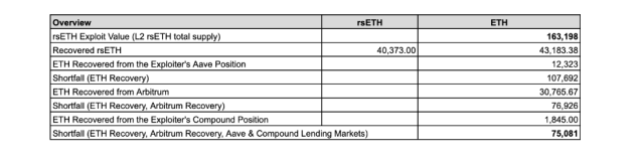
Selon la proposition de gouvernance d'Aave DAO, l'attaquant a volé 152 577 rsETH, ce qui représente environ 163 183 ETH sur la base des taux de conversion en vigueur. Depuis lors, une intervention coordonnée des participants de l'écosystème a considérablement réduit l'écart. Kelp DAO a réussi à geler 40 373 rsETH, équivalant à environ 43 168 ETH. De plus, le Conseil de Sécurité d'Arbitrum a récupéré 30 766 ETH que l'attaquant détenait encore sur sa plateforme.
Source : Aave DAO

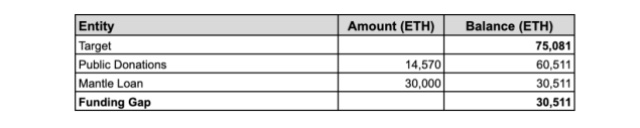
Notamment, d'autres récupérations sont attendues grâce aux processus de liquidation sur les plateformes de prêt. Les positions de l'attaquant sur Aave pourraient rapporter jusqu'à 12 323 ETH, tandis qu'un supplément de 1 845 ETH pourrait être récupéré sur des positions sur Compound. Au total, ces efforts représentent environ 87 955 ETH, soit un peu plus de la moitié du déficit initial. Malgré ces progrès, un déficit de financement d'environ 75 081 ETH subsiste, nécessitant une injection de capitaux coordonnée supplémentaire pour restaurer entièrement la garantie.

Aave DAO intervient avec un engagement de 25 000 ETH alors que la coalition se mobilise

Pour combler le déficit restant, la coalition DeFi United combine dons, facilités de crédit et soutien du trésor. Jusqu'à présent, des contributeurs de l'écosystème, dont EtherFi, Lido et Ethena, ont promis 14 570 ETH, tandis que Mantle a étendu une facilité de crédit allant jusqu'à 30 000 ETH.
Source : Aave DAO

La proposition d'Aave DAO de contribuer à hauteur de 25 000 ETH représente une pierre angulaire de cette pile de rétablissement. Notamment, la contribution est « ancrée », ce qui signifie qu'elle ne sera pas réduite par des dons futurs. Au lieu de cela, tout fonds supplémentaire collecté sera utilisé pour rembourser le capital emprunté, limitant ainsi l'exposition à long terme d'Aave.

Le plan nécessite qu'environ 120 015 ETH (à l'exclusion des 43 168 ETH immédiatement gelés par Kelp DAO) soient réintroduits dans le coffre-fort LayerZero pour restaurer pleinement l'intégrité du système. Cependant, une partie des récupérations attendues reste illiquide, ce qui justifie le besoin d'un financement par prêt à court terme de la part des partenaires de l'écosystème.

Capitalisation boursière totale des crypto-monnaies évaluée à 2,57 billions de dollars sur le graphique quotidien | Source : Graphique TOTAL sur Tradingview.com

Related Questions

QQuelle est la proposition d'Aave DAO suite à l'exploit de Kelp DAO ?

AAave DAO a proposé de déployer 25 000 ETH de son trésor pour soutenir les efforts de récupération coordonnés suite à l'exploit de Kelp DAO.

QCombien d'ETH l'attaquant a-t-il initialement volé lors de l'exploit de Kelp DAO ?

AL'attaquant a volé 152 577 rsETH, ce qui équivaut approximativement à 163 183 ETH selon les taux de conversion en vigueur.

QQuels sont les montants d'ETH qui ont déjà été récupérés ou gelés après l'attaque ?

AKelp DAO a gelé 40 373 rsETH (environ 43 168 ETH) et le Conseil de Sécurité d'Arbitrum a récupéré 30 766 ETH. Des liquidations sur Aave et Compound pourraient récupérer respectivement 12 323 ETH et 1 845 ETH supplémentaires.

QQuel est le déficit de financement restant après les efforts de récupération initiaux ?

AMalgré les progrès réalisés, un déficit de financement d'environ 75 081 ETH subsiste.

QQuelles autres entités de l'écosystème se sont engagées à contribuer aux efforts de sauvetage ?

AEtherFi, Lido et Ethena ont engagé 14 570 ETH, et Mantle a accordé une facilité de crédit allant jusqu'à 30 000 ETH pour combler le déficit restant.

Related Reads

The Fate of Digital Banks: No Fancy App Can Outshine a Banking License

The Fate of Digital Banks: A Flashy App is No Match for a Banking License The article argues that despite attracting billions of users with fee-free checking accounts and sleek apps, most "neobanks" struggle to be profitable because their core business—transaction fees—is inherently low-margin. The real profit engine of banking is lending (credit), which generates interest income. However, many early neobanks operated without their own banking licenses, which restricted their ability to lend at scale. Examples like Nubank, Revolut, and Chime illustrate the point. While they gained users with free accounts, their eventual profitability came from rolling out credit products. The piece highlights systemic risks for neobanks that rely on third-party infrastructure, citing the Synapse bankruptcy, which froze user funds and revealed the fragility of such models. The solution, according to the author, is obtaining a formal banking license, like the U.S. OCC's national trust charter. This provides regulatory backing, allows direct custody of funds, and eliminates dependency on intermediary partners. The trend is now evident in the crypto sector, where companies like Kraken, SoFi, and others are actively pursuing such licenses. The article concludes that while technology changes, the fundamental business logic of banking—profiting from lending—remains constant. Successful digital banks ultimately conform to this old model, just with better interfaces and fairer terms.

Foresight News5m ago

The Fate of Digital Banks: No Fancy App Can Outshine a Banking License

Foresight News5m ago

In the Name of Charity, For the Benefit of the Family: How the Trump Family Turns Philanthropy into Profit?

Charity for Profit: How the Trump Family Turned Philanthropy into Personal Gain Amid a recent controversy over misleading claims about his cryptocurrency company American Bitcoin, Eric Trump invoked his children's cancer charity as evidence of his good intentions. While his Curetivity foundation (formerly the Eric Trump Foundation) has donated over $25 million to St. Jude Children's Research Hospital, an investigation reveals a pattern of self-dealing and opaque practices that benefited the Trump family business. Internal documents show that from 2011 to 2016, over $500,000 from the charity was funneled back to Trump-owned properties for event costs, transactions often omitted from tax filings. This created clear conflicts of interest, with figures like former club manager and current White House aide Dan Scavino involved on both sides. Public claims of "one of the lowest expense ratios" were contradicted by records showing significant spending on entertainment, auctions, and transportation. Facing scrutiny in 2017, Eric Trump distanced himself from the board and rebranded the foundation. After a state investigation shifted focus to compliance rather than enforcement, he returned as the public face. Fundraising events, now less transparent, continue at Trump venues. Estimates suggest these events have directed over $1 million to the Trump Organization over two decades. The same playbook of optimistic claims and obscured financial realities is now evident in Eric Trump's role at American Bitcoin. He promoted it as a highly profitable venture with low mining costs, but reports indicate most Bitcoin was purchased with funds from constant stock issuance, not mined, with actual costs far higher than claimed. While the company's stock has crashed nearly 90% from its peak, Eric Trump's personal stake remains valuable. The recurring pattern involves aggressive public defense, legal maneuvering to bury records, making minimal changes to satisfy regulators, and eventually repackaging the venture to regain trust, often successfully.

marsbit14m ago

In the Name of Charity, For the Benefit of the Family: How the Trump Family Turns Philanthropy into Profit?

marsbit14m ago

Bernstein Report: Agentic AI Will Transform CPU from Supporting Role to Leading Role, Bullish on Hygon Information

Bernstein research report: Agentic AI will turn CPUs from supporting players to leading roles, bullish on Hygon Information. Analysts led by David Dai argue that AI is transitioning from the chatbot era to the agentic AI era. Unlike simple query-response models, agentic AI involves complex workflows including retrieval, planning, tool calling, and multi-step reasoning. This shift dramatically increases the demand for CPU compute to orchestrate these tasks, manage memory, and prevent expensive GPU idling. The report forecasts that the GPU-to-CPU ratio in inference clusters will reverse from 8:1 in 2025 to 1:1 by 2029. In agentic AI workloads, CPUs could account for 50% of the compute, on par with GPUs. Consequently, the server CPU Total Addressable Market (TAM) is projected to surge from $37 billion in 2025 to $223 billion by 2030, representing a 6x expansion. Arm is identified as a key beneficiary due to its superior performance-per-watt and a strategic shift from IP licensing to designing its own chips, targeting $15 billion in chip revenue by 2030. Bernstein raises Arm's price target to $500. For x86 vendors, the report is Overweight on AMD (target $600) and Hygon Information (target CNY 450), citing leadership and strong growth in the Chinese market respectively. Intel's target is raised to $100, reflecting upgraded earnings assumptions. The analysis acknowledges significant supply-side risks, questioning whether foundry and memory capacity can support such rapid CPU growth. The optimistic demand forecast also heavily relies on Nvidia's guidance for over $1 trillion in annual AI infrastructure spend by 2027.

marsbit22m ago

Bernstein Report: Agentic AI Will Transform CPU from Supporting Role to Leading Role, Bullish on Hygon Information

marsbit22m ago

Will UNI Reach $100 in Four Years? Can Standard Chartered's Prediction Come True?

TL;DR: Standard Chartered Bank predicts UNI token will reach $100 by 2030, based on the growth of tokenized assets fueling demand for open DeFi liquidity and Uniswap's potential to capture fees from that trading. However, institutional tokenized products like BlackRock's BUIDL fund show that strict access controls and permissioned systems remain major barriers. Standard Chartered's $100 price target for Uniswap's (UNI) governance token by 2030 projects massive growth from current levels. The bank's thesis hinges on tokenized real-world assets (RWA) reaching trillions in value and a significant portion flowing into open, decentralized markets for trading and liquidity, rather than remaining in closed, permissioned systems. Uniswap's position as a leading decentralized exchange (DEX) infrastructure could allow it to capture a major share of this future trading activity. A key challenge is whether tokenized assets like bonds, funds, and stocks will trade openly on DEXs or be restricted to controlled, institutional platforms. The case of BlackRock's BUIDL fund exemplifies this tension: while it uses Uniswap's technology for settlements, trading is strictly limited to pre-approved, whitelisted institutional participants. This hybrid model provides DeFi efficiency but maintains traditional access barriers. For UNI to achieve such a high valuation, Uniswap must not only see increased trading volume from tokenized assets but also implement effective value-capture mechanisms for token holders. Recent governance proposals aim to direct protocol fees to UNI stakers, creating a clearer link between platform usage and token value. Ultimately, the realization of Standard Chartered's prediction depends on the future structure of the tokenized asset market. If open liquidity pools and reduced restrictions prevail, Uniswap's role could expand far beyond crypto-native trading. If permissioned, walled-garden systems dominate, its growth from institutional tokenization may be limited. The prediction itself signals growing institutional recognition of DeFi's potential role in the future of finance.

marsbit30m ago

Will UNI Reach $100 in Four Years? Can Standard Chartered's Prediction Come True?

marsbit30m ago

Trading

Spot
Futures

Hot Articles

How to Buy DAO

Welcome to HTX.com! We've made purchasing DAO Maker (DAO) simple and convenient. Follow our step-by-step guide to embark on your crypto journey.Step 1: Create Your HTX AccountUse your email or phone number to sign up for a free account on HTX. Experience a hassle-free registration journey and unlock all features.Get My AccountStep 2: Go to Buy Crypto and Choose Your Payment MethodCredit/Debit Card: Use your Visa or Mastercard to buy DAO Maker (DAO) instantly.Balance: Use funds from your HTX account balance to trade seamlessly.Third Parties: We've added popular payment methods such as Google Pay and Apple Pay to enhance convenience.P2P: Trade directly with other users on HTX.Over-the-Counter (OTC): We offer tailor-made services and competitive exchange rates for traders.Step 3: Store Your DAO Maker (DAO)After purchasing your DAO Maker (DAO), store it in your HTX account. Alternatively, you can send it elsewhere via blockchain transfer or use it to trade other cryptocurrencies.Step 4: Trade DAO Maker (DAO)Easily trade DAO Maker (DAO) on HTX's spot market. Simply access your account, select your trading pair, execute your trades, and monitor in real-time. We offer a user-friendly experience for both beginners and seasoned traders.

2.4k Total ViewsPublished 2024.03.29Updated 2026.06.02

How to Buy DAO

Discussions

Welcome to the HTX Community. Here, you can stay informed about the latest platform developments and gain access to professional market insights. Users' opinions on the price of DAO (DAO) are presented below.

活动图片