Bitcoin Recovery Fails To Lift Market Sentiment From Extreme Fear

bitcoinistPubblicato 2026-04-17Pubblicato ultima volta 2026-04-17

Introduzione

Despite Bitcoin's recent recovery to around $74,800, the overall market sentiment remains in "extreme fear," according to the Crypto Fear & Greed Index. The index, which measures investor sentiment based on factors like volatility, social media, and trading volume, is at a value of 23, just inside the extreme fear zone. This marks a continued period of bearish sentiment since late 2025. Although Bitcoin's rally provided a brief uplift in mid-March, the current price movement has not been enough to shift market psychology into a more positive or greedy territory. For sentiment to improve, a sustained bullish momentum may be required.

Data shows the crypto Fear & Greed Index is still inside the extreme fear territory despite the recovery that Bitcoin and other coins have made.

Bitcoin Fear & Greed Index Is Still Pointing At ‘Extreme Fear’

The “Fear & Greed Index” is an indicator created by Alternative that tells us about the average sentiment present among traders in the Bitcoin and wider cryptocurrency markets. The index takes into account for the data of the following five factors to determine the investor mentality: trading volume, market cap dominance, volatility, social media sentiment, and Google Trends.

To represent the market sentiment, the metric makes use of a numerical scale running from zero to hundred. All values on this scale that lie below 47 correspond to a net sentiment of fear, while those above 53 suggest the dominance of greed among investors. Naturally, the values lying between these two cutoffs imply a neutral mentality.

Besides these three main zones, there are also two ‘extreme’ regions called the extreme fear (25 and under) and extreme greed (above 75). Historically, these two have held significance for the market as they have been where major tops and bottoms have tended to form.

The relationship between prices and sentiment has been an inverse one, however, with tops appearing during extreme greed and bottoms alongside extreme fear.

Recently, the crypto sector has been stuck in the latter of the two, as the below chart shows.
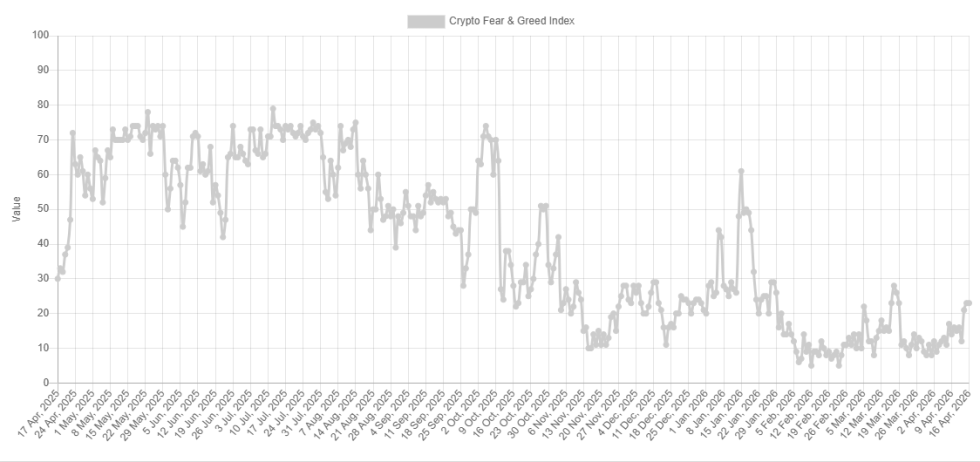
How the Fear & Greed Index has changed over the past year | Source: Alternative

The long stay in the extreme fear zone has been a consequence of the bearish action that Bitcoin and other assets have faced since Q4 2025. In mid-March, BTC’s recovery to $75,000 meant that the market saw a temporary respite from rock-bottom sentiment, with the Fear & Greed Index surging to a peak of 28. After the BTC rally fizzled out, however, the sentiment also cooled back deep into the extreme fear zone again.

From the above chart, it’s apparent that in the last few days, the metric has again made some recovery. The uplift in sentiment is due to BTC’s rally toward the $76,000 mark. Unlike the surge from mid-March, though, this one hasn’t yet been able to take the Fear & Greed Index out of the extreme fear region.

As is visible in the meter, the indicator is sitting at a value of 23 right now, which is just inside the extreme fear boundary.
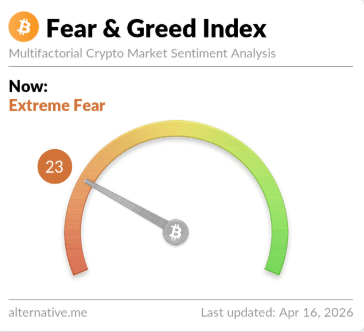
The latest value of the Fear & Greed Index | Source: Alternative

It’s possible that if bull momentum continues in the coming days, the Fear & Greed Index will escape the extreme fear zone. But for now, it seems that the market isn’t convinced about the price rally.

BTC Price

At the time of writing, Bitcoin is floating around $74,800, up nearly 5% in the last seven days.

The price of the coin seems to have been moving sideways since its upward move earlier in the week | Source: BTCUSDT on TradingView


Domande pertinenti

QWhat is the Bitcoin Fear & Greed Index and what does it measure?

AThe Bitcoin Fear & Greed Index is an indicator created by Alternative that measures the average sentiment among traders in the Bitcoin and wider cryptocurrency markets. It uses a numerical scale from 0 to 100, taking into account five factors: trading volume, market cap dominance, volatility, social media sentiment, and Google Trends.

QWhat value on the Fear & Greed Index represents 'extreme fear' and what is its historical significance?

AValues of 25 and below on the Fear & Greed Index represent 'extreme fear.' Historically, this zone has been significant for the market as major bottoms have tended to form during periods of extreme fear.

QDespite Bitcoin's recent price recovery, what is the current reading of the Fear & Greed Index?

ADespite Bitcoin's recent rally toward $76,000, the Fear & Greed Index is currently sitting at a value of 23, which is still inside the extreme fear territory.

QWhat was the peak value the Fear & Greed Index reached during Bitcoin's mid-March recovery to $75,000?

ADuring Bitcoin's mid-March recovery to $75,000, the Fear & Greed Index surged to a peak of 28, providing a temporary respite from the rock-bottom sentiment.

QWhat is the inverse relationship between market sentiment and Bitcoin prices mentioned in the article?

AThe article states that the relationship between prices and sentiment has been inverse, with major tops in the market tending to form during periods of extreme greed, while major bottoms have typically occurred alongside extreme fear.

Letture associate

A 120,000 Yuan Tombstone or 399 Yuan AI Immortality: Which Would You Choose?

"The 'Deathcare Moutai' Fushouyuan, once a highly profitable cemetery operator, has halted trading amid a severe crisis, with its net profit plummeting by 52.8% in 2024. This reflects a broader trend of people rejecting expensive traditional burials, as average grave prices in China have soared to over ¥120,000. In response, the industry is pivoting to digital alternatives, with companies like Fushouyuan offering AI-powered memorial services, such as virtual farewell halls and AI-generated recreations of the deceased. Simultaneously, a low-cost, unregulated AI 'resurrection' industry has emerged online, with services priced as low as ¥399. These often use open-source tools to create crude digital avatars from photos and voice clips, exploiting vulnerable individuals, particularly bereaved parents who have lost their only child. However, these services raise significant ethical and legal concerns, including data privacy risks and potential use in scams. Academic studies warn that such AI companions may exacerbate grief, leading to prolonged mourning disorders and emotional dependency, rather than providing genuine comfort. While regulations are being drafted to manage digital human services, the deep emotional drive to 'reconnect' with loved ones often overshadows rational concerns. Ultimately, the article questions whether digital immortality truly preserves memory or merely offers a commercialized illusion, emphasizing that no technology can replace the real, irreplaceable loss of a human life."

marsbit30 min fa

A 120,000 Yuan Tombstone or 399 Yuan AI Immortality: Which Would You Choose?

marsbit30 min fa

Anthropic Starts Poaching Scientists? $27K Weekly Onsite Stipend to Fix Claude's Expert-Level Errors

Anthropic has launched a new STEM Fellow program, offering $3,800 per week for a three-month, in-person residency in San Francisco. The role targets experts from science, technology, engineering, and mathematics (STEM) fields—machine learning experience is helpful but not required. Instead, Anthropic values scientific judgment and a willingness to learn quickly. Fellows will work with Claude models and internal tools under the guidance of an Anthropic researcher. Example projects include a materials scientist identifying errors in Claude’s reasoning or a climate scientist integrating atmospheric modeling software with Claude. The goal is to have experts "tell Claude where it's wrong" and improve its scientific capabilities. This initiative is part of Anthropic’s broader strategy to strengthen its scientific ecosystem, following earlier programs like the AI Safety Fellows and AI for Science programs. The company acknowledges that current AI models, while powerful, still produce high-confidence errors and lack end-to-end research autonomy. The program aims to embed domain expertise directly into model development, turning scientists into "high-level reviewers" for AI. Anthropic CEO Dario Amodei has previously emphasized AI’s potential to accelerate scientific breakthroughs, particularly in biology and healthcare. The company believes that the next phase of AI competition will depend not on scaling parameters, but on integrating human expertise to refine model accuracy and reliability.

marsbit1 h fa

Anthropic Starts Poaching Scientists? $27K Weekly Onsite Stipend to Fix Claude's Expert-Level Errors

marsbit1 h fa

Trading

Spot
Futures
活动图片