Plasma sube un 12% – ¿Podrá XPL superar ESTA resistencia?

ambcryptoPublished on 2026-03-17Last updated on 2026-03-17

Abstract

El token Plasma (XPL) experimentó un aumento del 12,89% el 17 de marzo, alcanzando un precio de $0,1238, con un volumen de operaciones que se disparó más de un 155%. Esta subida refleja un renovado interés de los compradores tras una fase de consolidación. El precio ha recuperado el nivel de soporte clave de $0,1045 y se acerca a una resistencia crítica en $0,1259. Los indicadores técnicos muestran una fortaleza alcista, con el DMI señalando el dominio de los compradores y el ADX indicando una tendencia en desarrollo. Además, los flujos netos negativos de tokens desde los exchanges (aproximadamente -$664K) sugieren una reducción de la oferta disponible, lo que podría amplificar las subidas de precio. La acumulación de liquidez por encima del precio actual, especialmente alrededor de $0,128, podría actuar como un imán para el precio y desencadenar liquidaciones en corto. En resumen, XPL se encuentra en una fase crítica: un movimiento decisivo por encima de $0,1259 podría acelerar la tendencia alcista, siempre que se mantenga el soporte en $0,1045.

El 17 de marzo, Plasma [XPL] experimentó una subida del 12.89%, alcanzando los $0.1238, mientras que el volumen de operaciones aumentó más de un 155%, lo que refleja un fuerte incremento en la participación.

El token se ha recuperado de los mínimos recientes, y los compradores han intervenido de forma agresiva durante las últimas sesiones. Este movimiento sugiere que el interés ha regresado después de una prolongada fase de enfriamiento.

Sin embargo, el repunte no se ha producido de forma aislada, ya que tanto la estructura del mercado como la dinámica de liquidez han comenzado a alinearse con la tendencia alcista.

La expansión de la actividad indica que los operadores se están reposicionando en lugar de salir.

Como resultado, este cambio sitúa a XPL en una fase crítica en la que la continuación depende de cómo interactúe el precio con las zonas de resistencia cercanas y la fuerza de la demanda subyacente.

¿Podrá XPL mantener el soporte y desafiar la resistencia?

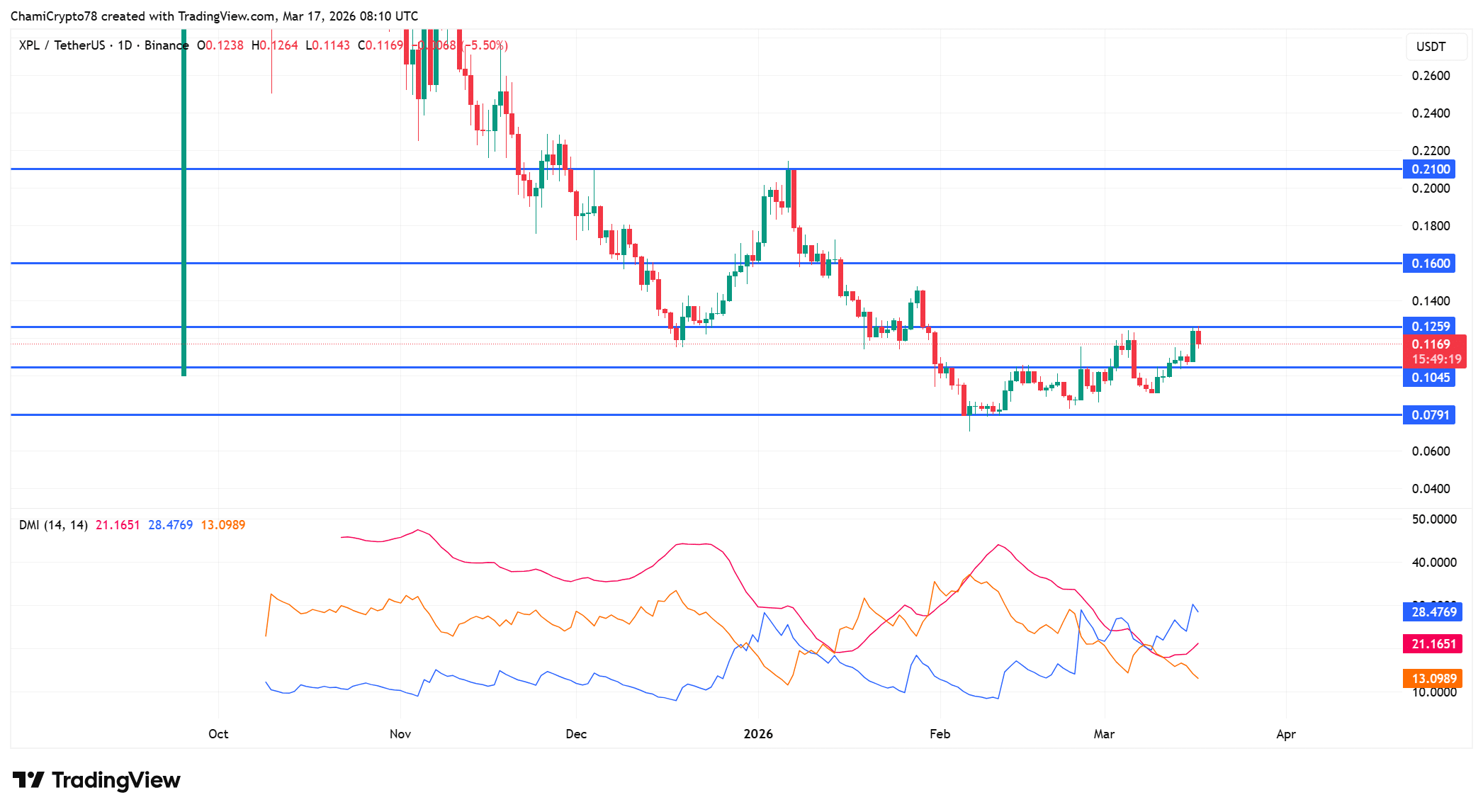
El precio ha recuperado el nivel de $0.1045, que anteriormente actuó como una base de soporte sólida durante la consolidación.

Desde entonces, XPL se ha dirigido hacia la resistencia de $0.1259, donde anteriormente se ha producido un rechazo.

Esta área sirve ahora como una barrera clave que podría definir el próximo movimiento direccional.

Sin embargo, la estructura muestra que se están formando mínimos más altos, lo que refleja un fortalecimiento del control de los compradores. Cada caída ha atraído demanda, evitando retrocesos más profundos.

La estructura del DMI ha cambiado notablemente, ya que la línea +DI se ha movido por encima de la línea -DI, lo que indica que los compradores han comenzado a dominar la acción del precio reciente.

Al mismo tiempo, el ADX se ha mantenido alrededor de 21, lo que indica que la fuerza de la tendencia ha comenzado a construirse en lugar de desvanecerse.

Esta alineación refleja una transición de una fase neutral a una tendencia direccional en desarrollo.

A medida que el precio se comprime por debajo de la resistencia, la presión continúa acumulándose dentro de este rango.

Una mantención sostenida por encima de $0.1045 mantiene la estructura intacta, mientras que las pruebas repetidas de $0.1259 aumentan la probabilidad de una ruptura.

Esta configuración sugiere que XPL se está posicionando para un movimiento decisivo en lugar de moverse lateralmente.
Fuente: TradingView

Las salidas de exchanges reducen la oferta disponible

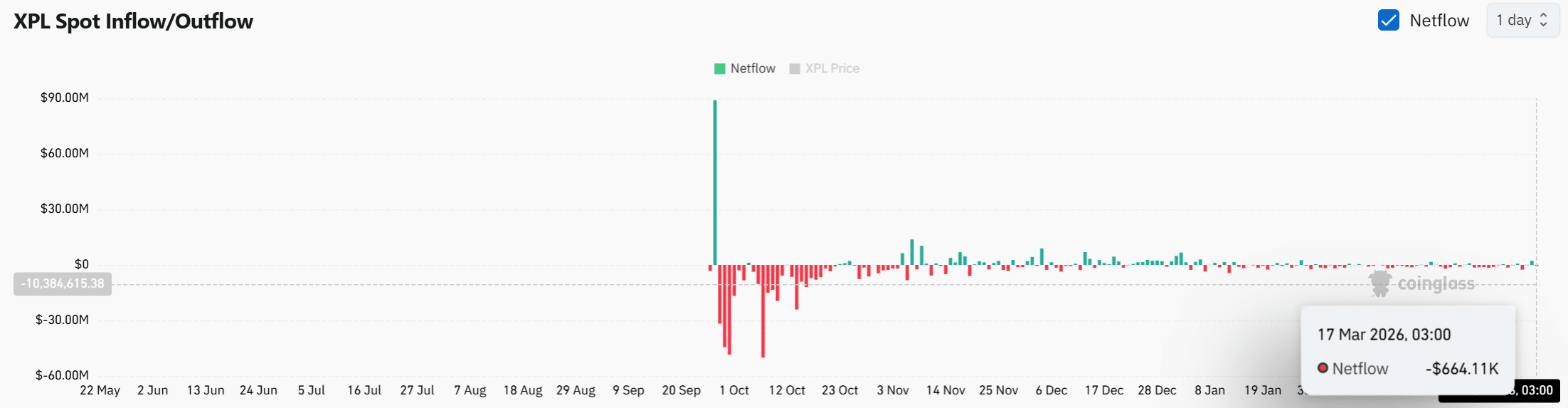
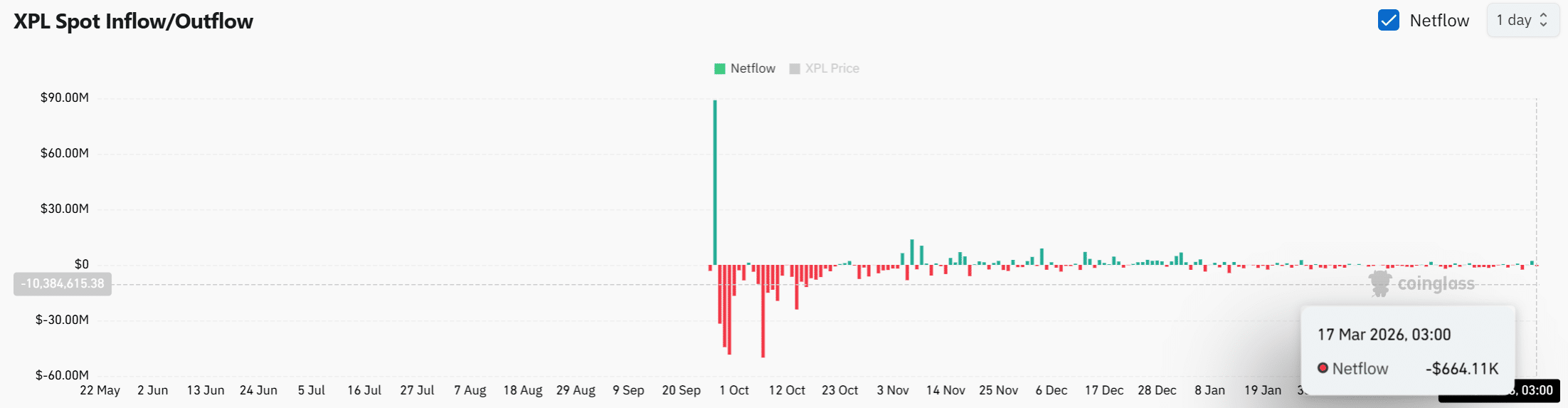
Los Flujos Netos en Spot se han mantenido negativos al cierre de esta edición, con salidas recientes de aproximadamente $664K desde los exchanges.

Este cambio indica que los tokens se han estado moviendo fuera de las plataformas de trading en lugar de prepararse para una venta inmediata.

A medida que la oferta en los exchanges disminuye, la liquidez disponible se reduce, lo que puede amplificar las reacciones de los precios durante períodos de fuerte demanda.

Además, la reducción de la presión de venta crea condiciones en las que los movimientos alcistas enfrentan menos resistencia.

Sin embargo, esta dinámica también depende de si la demanda continúa igualando la oferta reducida.

Mientras persistan las salidas, la estructura del mercado respalda un comportamiento de acumulación en lugar de distribución.

Este patrón refuerza el contexto alcista ya visible en la acción del precio y los indicadores técnicos.
Fuente: CoinGlass

Los cúmulos de liquidez por encima del precio señalan una configuración de squeeze

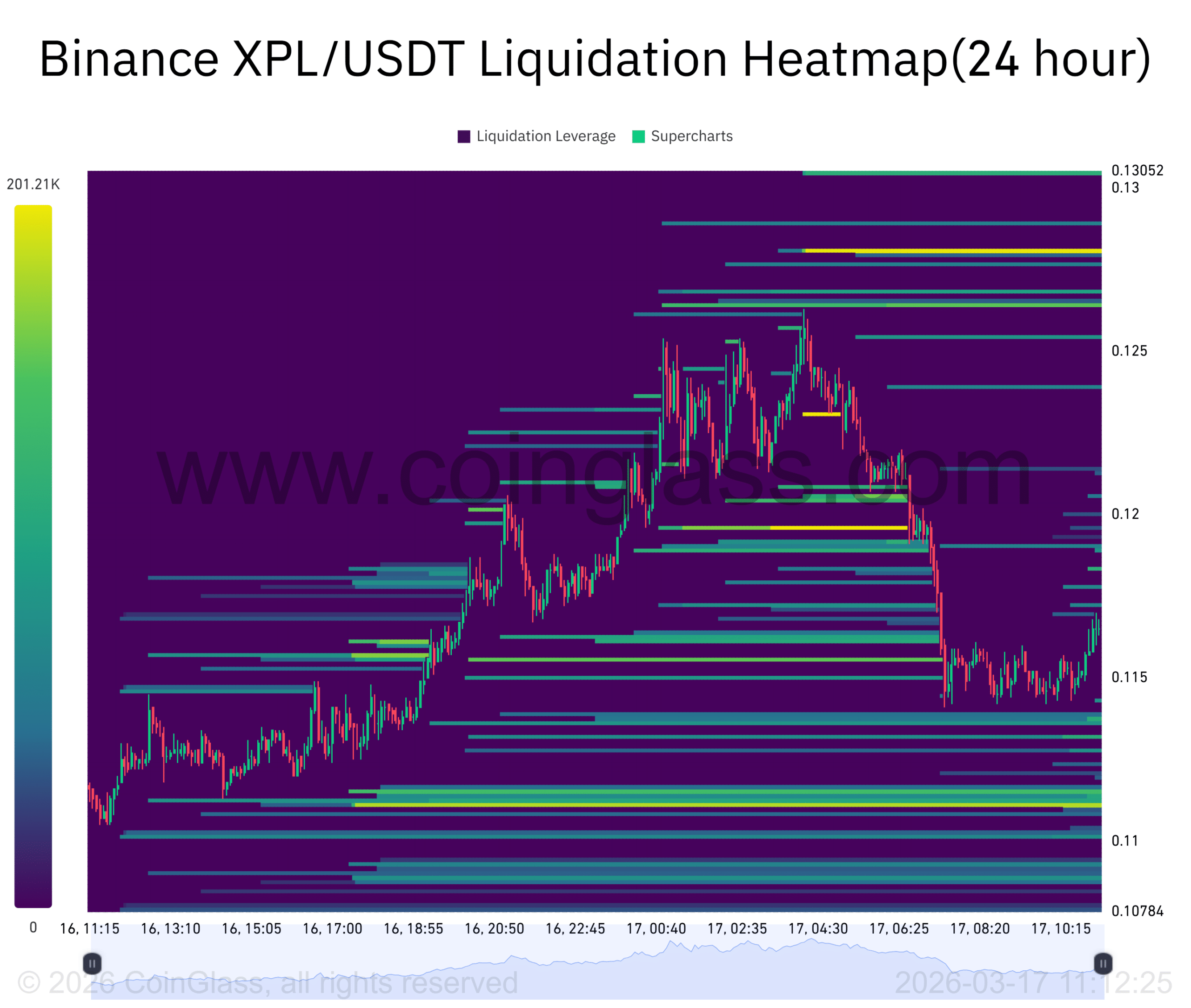
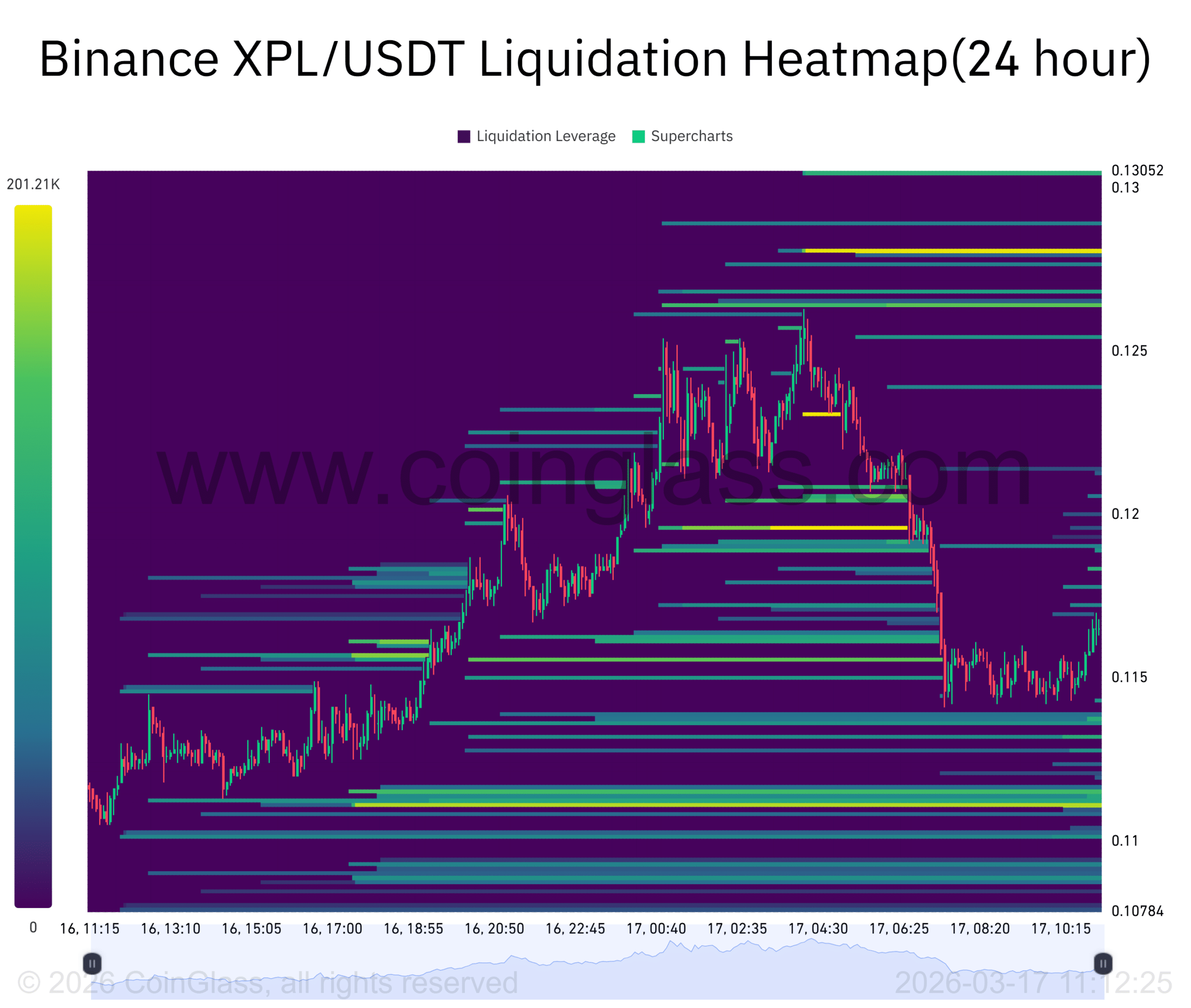
El Mapa de Calor de Liquidaciones ha revelado densos cúmulos de liquidez situados por encima del precio actual, particularmente alrededor de la región de $0.128.

Estas zonas representan áreas donde las posiciones cortas podrían enfrentar cierres forzados si el precio sube. A medida que XPL se acerca a estos niveles, la presión alcista podría acelerarse debido a liquidaciones en cascada.

Sin embargo, el precio primero debe romper la resistencia cercana para desencadenar este efecto.

La presencia de liquidez apilada por encima de los niveles actuales crea un efecto similar a un imán, atrayendo el precio hacia esas zonas.
Fuente: CoinGlass

XPL parece posicionado para una continuación, ya que el fortalecimiento de la estructura, el aumento de la demanda y la reducción de la oferta se alinean con la presión alcista.

Un movimiento decisivo por encima de $0.1259 probablemente liberaría liquidez alrededor de $0.128, acelerando el repunte.

Sin embargo, la fuerza sostenida depende de mantener el soporte de $0.1045. Mientras los compradores defiendan esta base, la configuración actual favorece una mayor expansión alcista.


Resumen Final

  • La estructura de XPL muestra que los compradores están interviniendo temprano, construyendo presión que podría impulsar la continuación más allá de los niveles de resistencia cercanos.
  • La liquidez situada por encima del precio de Plasma [XPL] crea un camino para una rápida expansión alcista si la fuerza bajista se mantiene sostenida aquí.


Trending Cryptos

Related Questions

Q¿Cuál fue el porcentaje de aumento de Plasma [XPL] el 17 de marzo y a qué precio cerró?

AEl 17 de marzo, Plasma [XPL] experimentó un aumento del 12.89%, cerrando a un precio de $0.1238.

Q¿Qué nivel de resistencia clave se menciona que XPL debe superar para una continuación alcista?

AEl nivel de resistencia clave que XPL debe superar es de $0.1259, un área donde anteriormente ha sido rechazado.

QSegún el artículo, ¿qué indican los flujos netos negativos (outflows) de los exchanges?

ALos flujos netos negativos, con salidas de aproximadamente $664K de los exchanges, indican que los tokens se están retirando de las plataformas de trading en lugar de prepararse para una venta inmediata, lo que sugiere acumulación y reduce la presión de venta.

Q¿Qué herramienta de análisis revela la presencia de clusters de liquidez densos por encima del precio actual y en qué nivel?

AEl Liquidation Heatmap (Mapa de Calor de Liquidaciones) revela clusters de liquidez densos por encima del precio actual, particularmente alrededor de la región de $0.128.

Q¿Cuál es el nivel de soporte crítico que XPL debe mantener para que la estructura alcista se mantenga intacta?

AEl nivel de soporte crítico que XPL debe mantener es de $0.1045. Mantenerse por encima de este nivel es crucial para que la estructura alcista se mantenga intacta.

Related Reads

TechFlow Intelligence Bureau: Anthropic IPO Odds Exceed 80%, Iran Closes Strait of Hormuz Again, Triggering Oil Price Volatility

**Market Digest** **AI & Tech:** Anthropic is widely expected to announce an IPO before November 2026, raising questions about balancing its trillion-dollar valuation ambitions with its core "AI safety" mission. Brands are increasingly adopting AI-generated virtual influencers for marketing. Cloudflare introduced temporary accounts for AI agents to ease automation workflows. **Infrastructure & Hardware:** Google's IPv6 traffic surpassed 50%, marking a major internet milestone. Goldman Sachs warned that massive projected AI capital expenditure ($5.3T) is approaching credit saturation limits, potentially curbing the "AI arms race." **Space & Robotics:** SpaceX's IPO saw a historic $370M retail buying frenzy in three days. Hyundai Motor Group plans to acquire full ownership of Boston Dynamics. Elon Musk speculated about future "septillion-dollar" investments in antimatter for interstellar travel. **Energy & Geopolitics:** Iran's military announced another closure of the strategic Strait of Hormuz, accusing Israel of violating a ceasefire, causing oil market volatility. However, ship-tracking data indicated some traffic continued. Concurrently, Iran resumed crude loadings at Kharg Island, potentially releasing up to 20 million barrels to the market. **Finance & Macro:** A European CLO (collateralized loan obligation) experienced its first post-2008-crisis-era equity tranche default, raising alarms in credit markets. Nomura warned that new Federal Reserve Chair Wash's perceived hawkish debut speech could signal a significant policy shift. **The Undercurrent:** Seemingly disparate events—the Strait of Hormuz tension, the European CLO default, and warnings on AI spending—point to a tightening of global liquidity and rising marginal costs across energy, credit, and tech investment. Meanwhile, capital continues chasing grand narratives like space exploration and advanced AI, highlighting a divergence where old-world leverage frays as new-world stories grow more ambitious.

marsbit7h ago

TechFlow Intelligence Bureau: Anthropic IPO Odds Exceed 80%, Iran Closes Strait of Hormuz Again, Triggering Oil Price Volatility

marsbit7h ago

Trading

Spot
Futures

Hot Articles

What is PLASMA

Plasma: A Cutting-Edge Solution for Blockchain Scalability Introduction to Plasma As the cryptocurrency landscape evolves, so too does the need for enhanced efficiency within blockchain networks. Plasma, a Layer 2 scaling solution, emerges as a pioneering player in this sphere, particularly in the realm of Web3 development. By strategically shifting a substantial portion of tasks from the main chain to a series of smaller chains, Plasma vows to significantly boost the scalability and performance of Ethereum—a widely-used blockchain platform at the forefront of decentralised applications. What is Plasma? Plasma is an innovative off-chain scaling solution particularly designed for the Ethereum blockchain. It was introduced in August 2017 by Vitalik Buterin, co-founder of Ethereum, and Joseph Poon, a prominent advocate of scaling solutions like the Lightning Network. Plasma serves as a framework that enables the creation of scalable applications by establishing a hierarchical structure of child chains above the main Ethereum chain. At its core, Plasma allows for the development of potentially infinite side chains that can operate independently while still relying on the Ethereum network for security and consensus. This architecture is underpinned by smart contracts and Merkle Trees, which efficiently handle transactions and data storage. Core Objectives of Plasma The primary aim of Plasma is to increase the throughput of the Ethereum network. By diverting a substantial volume of transactions away from the congested main chain, Plasma's architecture offers higher transaction speeds, more efficient data processing, and lower transaction costs. This is particularly vital in an age where demand for decentralised applications—especially in finance, gaming, and supply chain management—is reaching unprecedented levels. Creator of Plasma Plasma is the brainchild of two renowned figures in the blockchain community: Vitalik Buterin and Joseph Poon. Buterin is celebrated primarily for co-founding Ethereum and pushing the boundaries of what blockchain technology can achieve. Poon, on the other hand, is known for advocating scalable solutions, which enable faster and more cost-effective transactions on blockchain networks. Their collaboration on the Plasma framework has greatly contributed to its innovative nature, combining advanced technical insights with practical applications. Investors of Plasma While the specific investment foundations or organizations supporting Plasma remain undisclosed, the project has garnered interest from various prominent figures and players in the blockchain and cryptocurrency space. With its potential for enhancing scalability within Ethereum, it has caught the attention of various entities aiming to push the boundaries of blockchain technology. How Does Plasma Work? Plasma's unique functionality is attributed to its architectural framework that relies on child chains and their interaction with the main Ethereum network. Below are some key factors that contribute to Plasma's innovative approach: Child Chains: Plasma establishes numerous child chains that can execute transactions independently of the main Ethereum chain. Each child chain operates as a separate smart contract with unique features, allowing developers to create tailored solutions based on their specific requirements. Smart Contracts and Merkle Trees: The framework utilises smart contracts, which are self-executing agreements with predefined conditions, paired with Merkle Trees that enable efficient verification of data. This technology allows Plasma to achieve both high scalability and security. Transaction Compression: By batching transactions on the child chains, Plasma reduces the data load on the Ethereum network. This means that fewer transactions need to be recorded on the main chain—thereby freeing up space and reducing congestion. Enhanced Security: Despite being off-chain, Plasma leverages the security measures of the main Ethereum network, ensuring that all transactions on child chains maintain a high level of integrity and security. Timeline of Plasma Understanding the development of Plasma involves tracing its significant milestones: August 2017: Plasma was first introduced by Vitalik Buterin and Joseph Poon as a scalable solution to address Ethereum's performance challenges. 2018: The Plasma framework was officially developed and made available on GitHub, marking a crucial step towards its implementation in practical applications. 2019: As awareness about Plasma grew, it began to attract developers interested in scaling Ethereum applications, thus increasing its adoption. 2020: Plasma continued evolving, with substantial enhancements made to its architecture and functionality—making it even more appealing to developers. Key Features of Plasma Plasma boasts several characteristics that make it a transformative solution in the blockchain space: Scalability: By creating multiple child chains, Plasma can handle a higher volume of transactions without further taxing the main Ethereum chain. Speed: Each child chain can process transactions more swiftly, providing users with better experience and service. Lower Transaction Costs: Plasma's structure effectively reduces the costs associated with transactions by minimizing the burden on the main chain. Interoperability: The architecture allows Plasma to seamlessly interact with multiple blockchains, enhancing cross-network functionality. Security: By harnessing the security of Ethereum’s main chain, Plasma ensures the integrity of its operations while utilising its child chains. Use Cases for Plasma The innovative architecture of Plasma opens the door for various practical applications across different sectors: Decentralized Finance (DeFi): Plasma has the capacity to enhance the scalability and efficiency of DeFi applications, creating smoother and more effective trading processes. Gaming: The framework facilitates the development of quick and cost-efficient gaming experiences, making it appealing to developers in the gaming industry. Supply Chain Management: With the ability to archive efficient transaction processing, Plasma can foster the development of decentralised supply chain management solutions. Conclusion Plasma stands at the forefront of blockchain technology, positioned as a pivotal Layer 2 scaling solution aimed at enhancing the efficiency of the Ethereum network and beyond. Through its unique structure of child chains, smart contracts, and Merkle Trees, Plasma offers a compelling solution to the scalability crisis that has long plagued blockchain networks. As blockchain technology continues to advance, solutions like Plasma promise to reshape how developers approach scalability challenges, potentially revolutionising how decentralised applications function. The ongoing efforts by its creators and the interest of various stakeholders signal a bright future for Plasma as it seeks to elevate blockchain capabilities to new heights in the digital realm.

1.5k Total ViewsPublished 2024.12.03Updated 2024.12.03

What is PLASMA

How to Buy XPL

Welcome to HTX.com! We've made purchasing Plasma (XPL) simple and convenient. Follow our step-by-step guide to embark on your crypto journey.Step 1: Create Your HTX AccountUse your email or phone number to sign up for a free account on HTX. Experience a hassle-free registration journey and unlock all features.Get My AccountStep 2: Go to Buy Crypto and Choose Your Payment MethodCredit/Debit Card: Use your Visa or Mastercard to buy Plasma (XPL) instantly.Balance: Use funds from your HTX account balance to trade seamlessly.Third Parties: We've added popular payment methods such as Google Pay and Apple Pay to enhance convenience.P2P: Trade directly with other users on HTX.Over-the-Counter (OTC): We offer tailor-made services and competitive exchange rates for traders.Step 3: Store Your Plasma (XPL)After purchasing your Plasma (XPL), store it in your HTX account. Alternatively, you can send it elsewhere via blockchain transfer or use it to trade other cryptocurrencies.Step 4: Trade Plasma (XPL)Easily trade Plasma (XPL) on HTX's spot market. Simply access your account, select your trading pair, execute your trades, and monitor in real-time. We offer a user-friendly experience for both beginners and seasoned traders.

2.9k Total ViewsPublished 2025.09.26Updated 2026.06.02

How to Buy XPL

Discussions

Welcome to the HTX Community. Here, you can stay informed about the latest platform developments and gain access to professional market insights. Users' opinions on the price of XPL (XPL) are presented below.

活动图片