Plasma melonjak 12% – Bisakah XPL menembus resistensi INI?

ambcryptoPublished on 2026-03-17Last updated on 2026-03-17

Abstract

XPL (Plasma) mengalami kenaikan signifikan sebesar 12,89% menjadi $0,1238 pada 17 Maret, didukung peningkatan volume perdagangan lebih dari 155%. Token ini bangkit dari posisi terendah baru-baru ini dengan minat beli yang agresif, menandakan kembalinya minat pasar. Struktur teknis menunjukkan pembentukan higher low dan pergeseran DMI yang mengonfirmasi dominasi buyer, sementara ADX mengindikasikan penguatan tren. Level kunci yang perlu diperhatikan adalah support di $0,1045 dan resistance di $0,1259. Keluar dari exchange senilai $664K menunjukkan pengetatan pasokan yang dapat mendukung tekanan bullish. Kluster likuiditas di sekitar $0,128 berpotensi memicu akselerasi kenaikan jika breakout terjadi. Secara keseluruhan, XPL menunjukkan sinyal bullish selama dapat mempertahankan level support dan menembus resistance.

Pada 17 Maret, Plasma [XPL] melonjak 12,89% menjadi $0,1238, sementara volume perdagangan naik lebih dari 155%, mencerminkan kenaikan tajam dalam partisipasi.

Token ini telah bangkit dari posisi terendah baru-baru ini, dan pembeli telah masuk dengan agresif selama sesi terbaru. Langkah ini menunjukkan bahwa minat telah kembali setelah fase pendinginan yang berkepanjangan.

Namun, reli ini tidak terjadi secara terisolasi, karena struktur pasar dan dinamika likuiditas mulai selaras dengan kenaikan.

Ekspansi dalam aktivitas menunjukkan bahwa para trader sedang memposisikan ulang daripada keluar.

Akibatnya, pergeseran ini menempatkan XPL dalam fase kritis di mana kelanjutannya bergantung pada bagaimana harga berinteraksi dengan zona resistensi terdekat dan kekuatan permintaan yang mendasarinya.

Bisakah XPL mempertahankan support dan menantang resistensi?

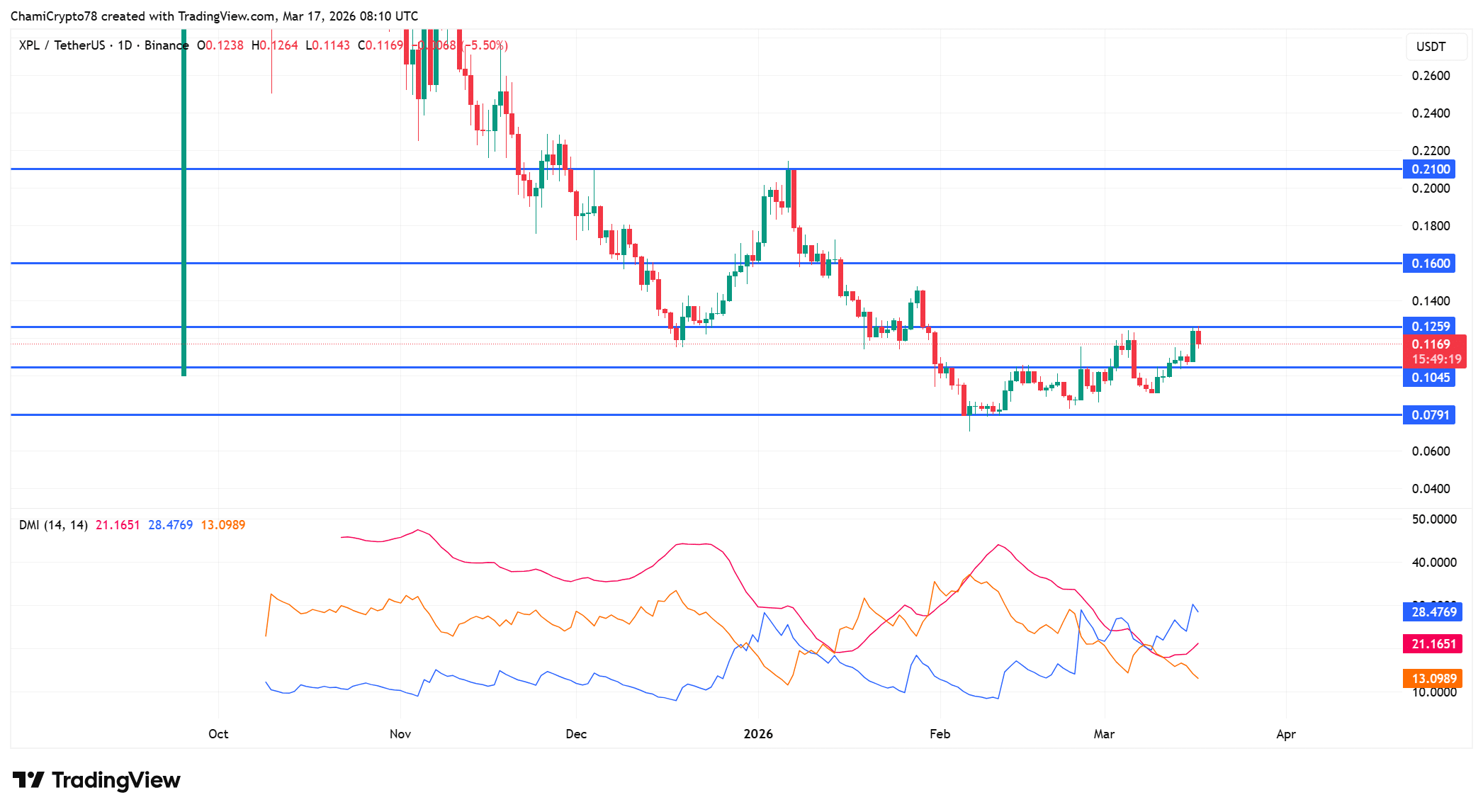
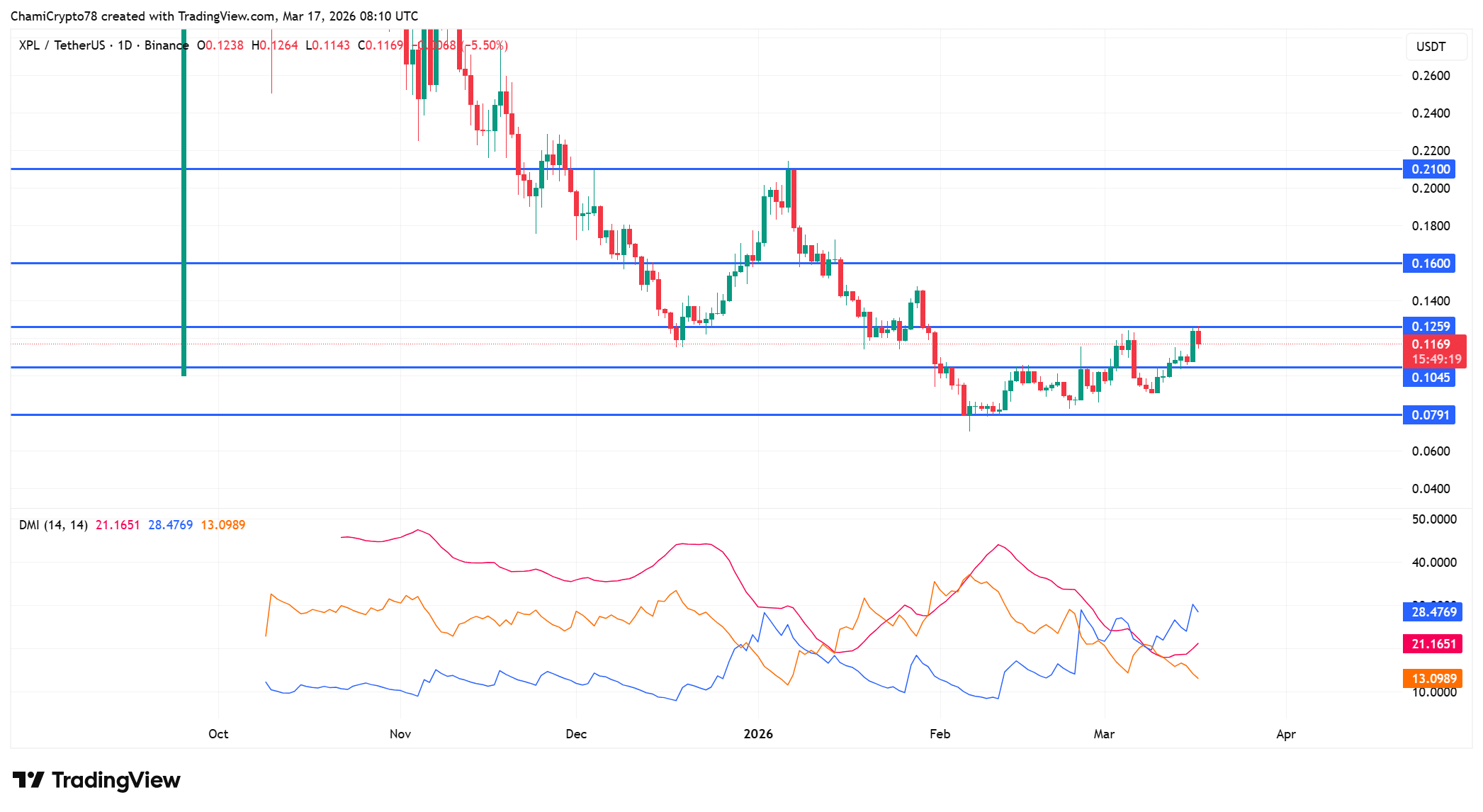
Harga telah merebut kembali level $0,1045, yang sebelumnya bertindak sebagai basis support yang kuat selama konsolidasi.

Sejak itu, XPL telah mendorong ke arah resistensi $0,1259, di mana penolakan telah muncul sebelumnya.

Area ini sekarang berfungsi sebagai penghalang utama yang dapat menentukan langkah arah berikutnya.

Namun, strukturnya menunjukkan pembentukan posisi terendah yang lebih tinggi, yang mencerminkan penguatan kendali pembeli. Setiap penurunan menarik permintaan, mencegah retracement yang lebih dalam.

Struktur DMI telah bergeser secara signifikan, karena garis +DI telah bergerak di atas garis -DI, menandakan bahwa pembeli telah mulai mendominasi aksi harga baru-baru ini.

Pada saat yang sama, ADX telah berada di sekitar 21, menunjukkan bahwa kekuatan tren telah mulai membangun daripada memudar.

Keselarasan ini mencerminkan transisi dari fase netral ke tren arah yang sedang berkembang.

Seiring harga terkompresi di bawah resistensi, tekanan terus menumpuk dalam rentang ini.

Pertahanan yang berkelanjutan di atas $0,1045 menjaga struktur tetap utuh, sementara pengujian berulang pada $0,1259 meningkatkan probabilitas breakout.

Penyiapan ini menunjukkan bahwa XPL sedang memposisikan diri untuk langkah yang tegas daripada bergerak sideways.
Sumber: TradingView

Arus keluar bursa mengencangkan pasokan yang tersedia

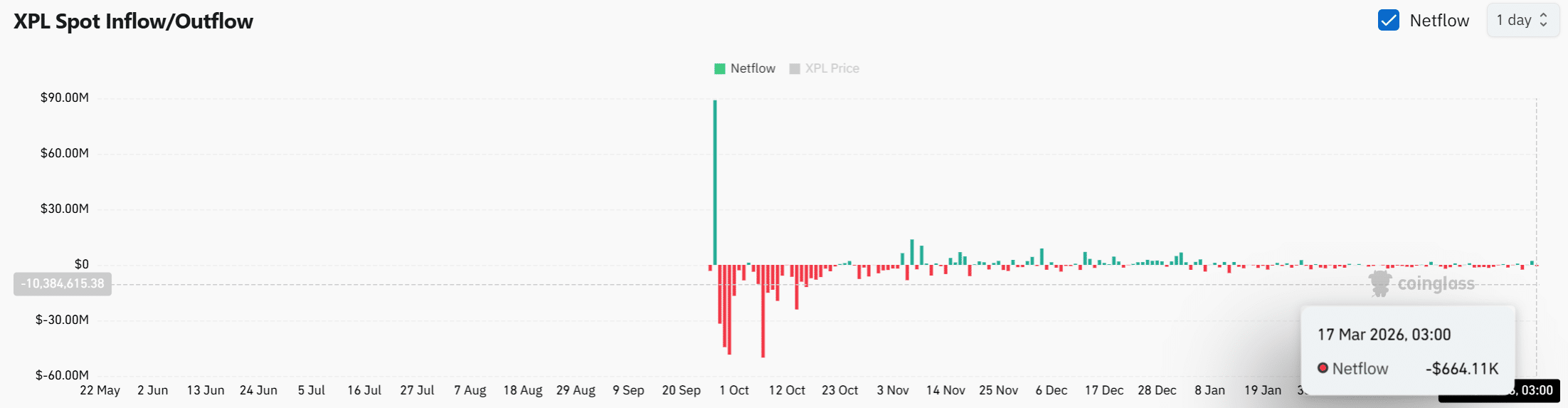
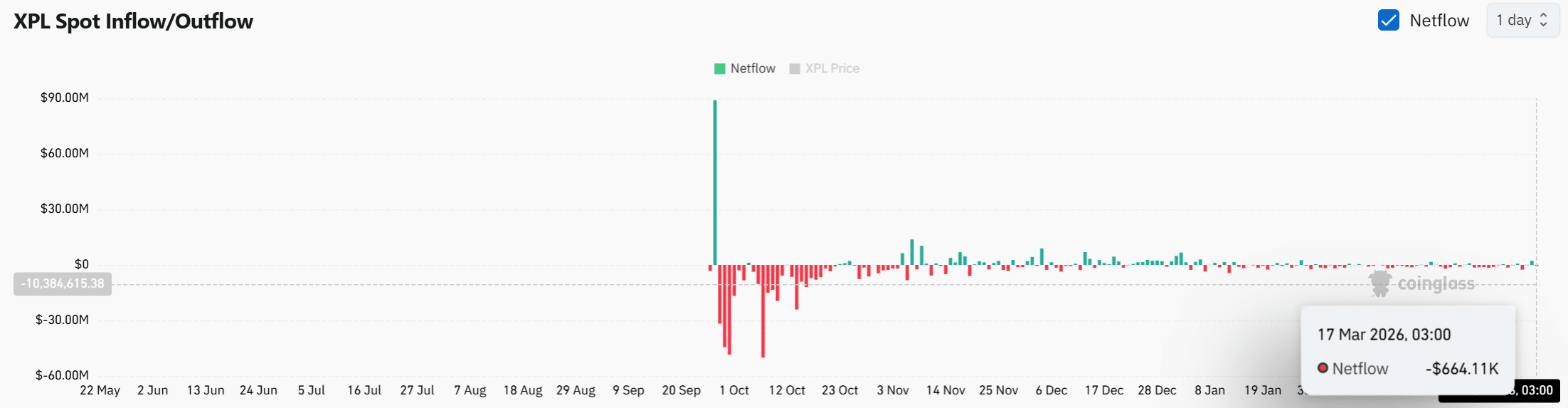
Netflow Spot tetap negatif pada saat pencetakan, dengan arus keluar baru-baru ini sekitar $664K dari bursa.

Pergeseran ini menunjukkan bahwa token telah berpindah dari platform perdagangan daripada bersiap untuk penjualan segera.

Seiring menurunnya pasokan di bursa, likuiditas yang tersedia mengencang, yang dapat memperkuat reaksi harga selama periode permintaan yang kuat.

Selain itu, berkurangnya tekanan sisi jual menciptakan kondisi di mana pergerakan naik menghadapi lebih sedikit resistensi.

Namun, dinamika ini juga bergantung pada apakah permintaan terus sesuai dengan pasokan yang berkurang.

Selama arus keluar terus berlanjut, struktur pasar mendukung perilaku akumulasi daripada distribusi.

Pola ini memperkuat konteks bullish yang sudah terlihat dalam aksi harga dan indikator teknis.
Sumber: CoinGlass

Kluster likuiditas di atas harga menandakan setup squeeze

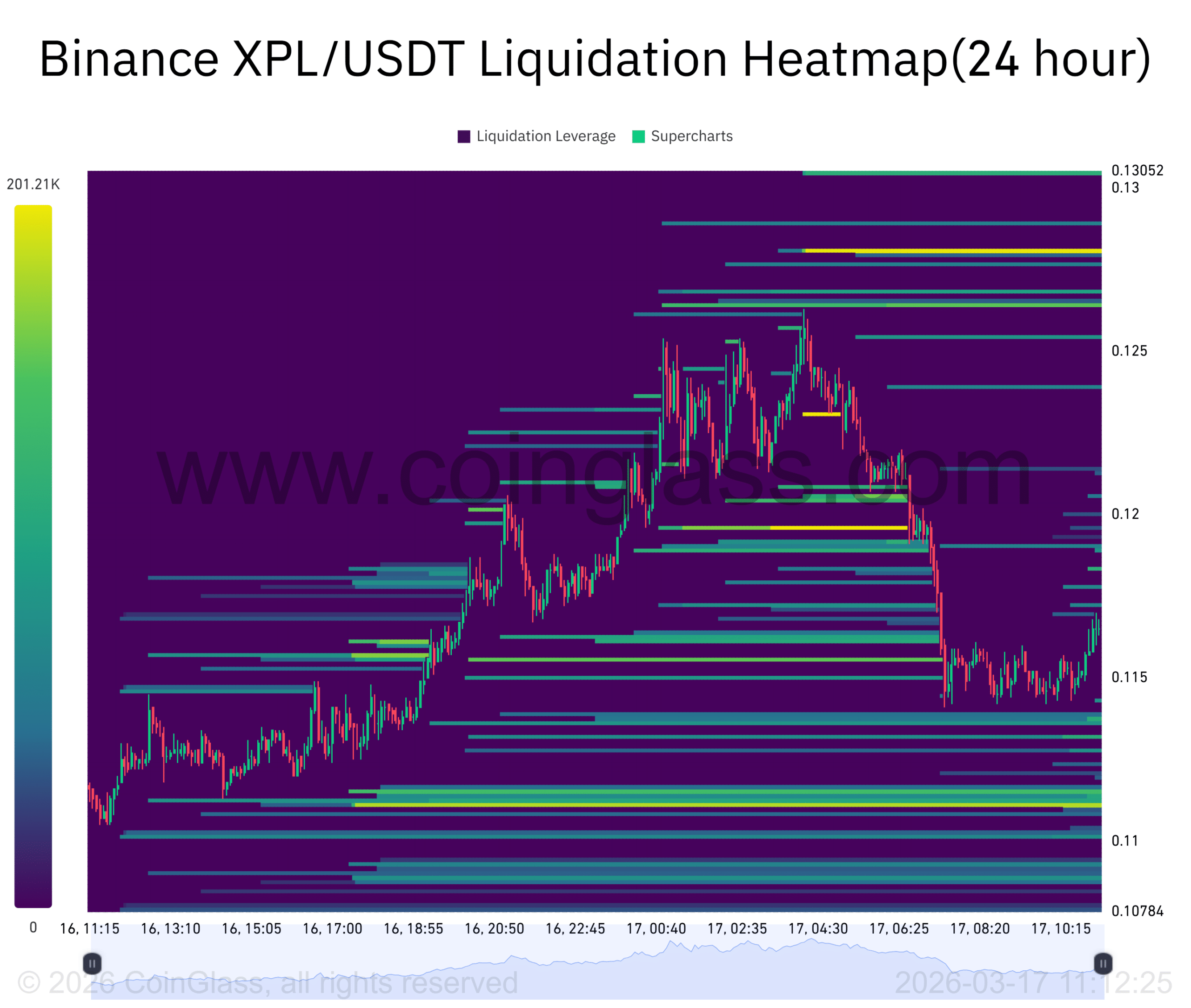
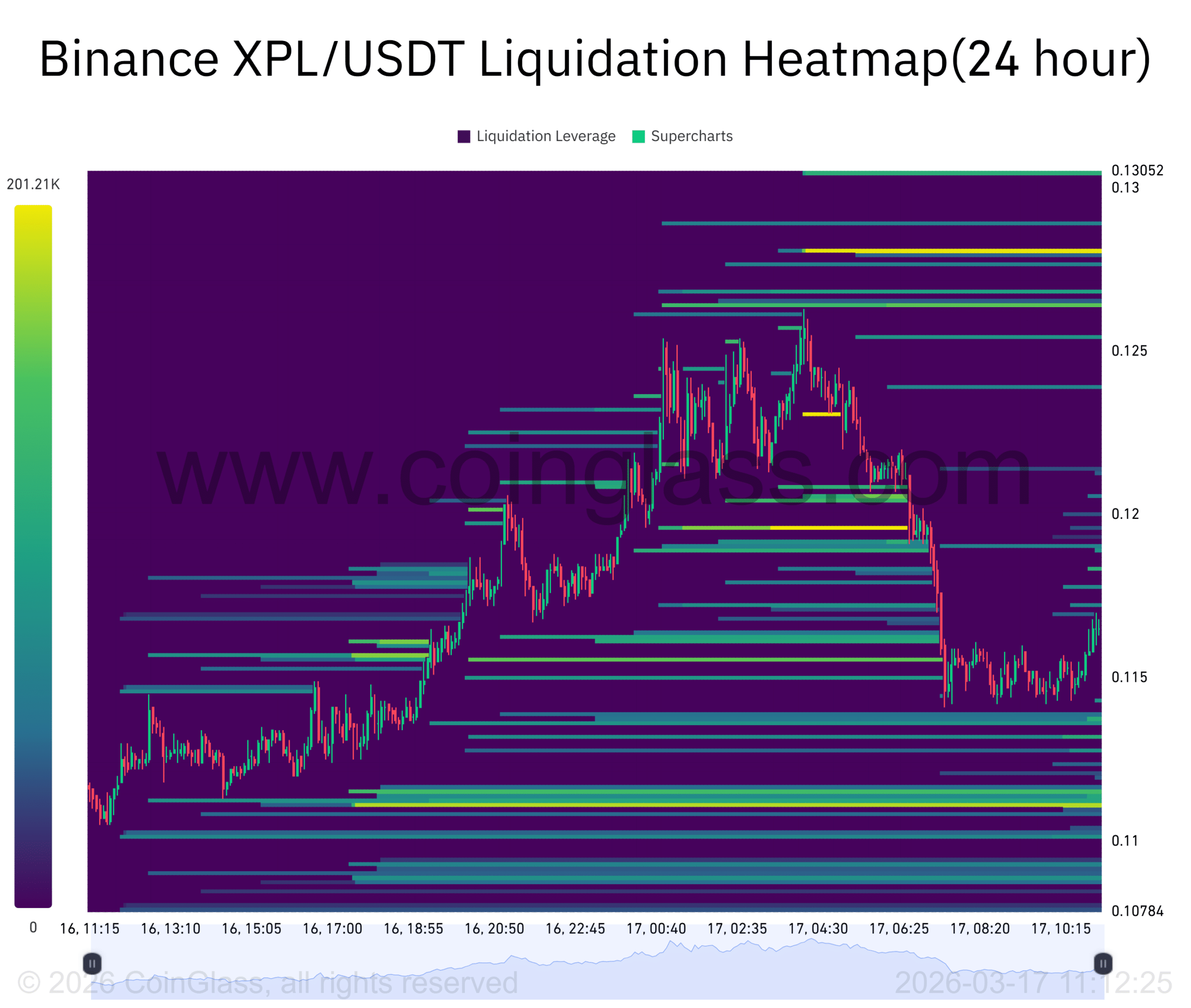
Peta Panas Likuiditas (Liquidation Heatmap) telah mengungkapkan kluster likuiditas padat yang berada di atas harga saat ini, khususnya di sekitar wilayah $0,128.

Zona-zona ini mewakili area di mana posisi short dapat menghadapi penutupan paksa jika harga bergerak lebih tinggi. Saat XPL mendekati level-level ini, tekanan naik dapat dipercepat karena likuidasi beruntun.

Namun, harga harus terlebih dahulu menembus resistensi terdekat untuk memicu efek ini.

Kehadiran likuiditas yang bertumpuk di atas level saat ini menciptakan efek seperti magnet, menarik harga ke arah zona-zona tersebut.
Sumber: CoinGlass

XPL tampaknya diposisikan untuk kelanjutan seiring dengan penguatan struktur, peningkatan permintaan, dan pengencangan pasokan yang selaras dengan tekanan bullish.

Langkah tegas di atas $0,1259 kemungkinan akan membuka likuiditas di sekitar $0,128, mempercepat reli.

Namun, kekuatan yang berkelanjutan bergantung pada pertahanan support $0,1045. Selama pembeli mempertahankan basis ini, setup saat ini mendukung ekspansi lebih lanjut ke atas.


Ringkasan Akhir

  • Struktur XPL menunjukkan pembeli masuk lebih awal, membangun tekanan yang dapat mendorong kelanjutan melampaui level resistensi terdekat.
  • Likuiditas yang berada di atas harga Plasma [XPL] menciptakan jalur untuk ekspansi naik yang cepat jika kekuatan bullish tetap bertahan di sini.


Trending Cryptos

Related Questions

QApa yang menyebabkan harga Plasma (XPL) mengalami kenaikan 12,89% pada 17 Maret?

AHarga XPL naik 12,89% didorong oleh lonjakan volume perdagangan lebih dari 155%, yang mencerminkan peningkatan partisipasi dan minat yang kembali muncul setelah fase pendinginan yang lama. Pembeli juga masuk secara agresif dalam sesi terbaru.

QTingkat resistensi kunci apa yang harus ditembus XPL untuk melanjutkan rally-nya?

AXPL perlu menembus level resistensi kunci di $0,1259 untuk melanjutkan rally. Level ini sebelumnya telah menjadi titik penolakan, dan keberhasilannya menembus level ini dapat membuka likuiditas di sekitar $0,128 dan mempercepat kenaikan harga.

QApa yang ditunjukkan oleh arus keluar bersih (Netflows) dari bursa sebesar $664K untuk XPL?

AArus keluar bersih sebesar $664K dari bursa menunjukkan bahwa token sedang dipindahkan dari platform perdagangan, bukan untuk dijual segera. Hal ini mengencangkan pasokan yang tersedia, mengurangi tekanan jual, dan mendukung perilaku akumulasi yang dapat memperkuat reaksi harga saat permintaan kuat.

QBagaimana indikator DMI (Directional Movement Index) menggambarkan kondisi pasar XPL?

AIndikator DMI menunjukkan bahwa garis +DI telah bergerak di atas garis -DI, menandakan bahwa pembeli mulai mendominasi aksi harga terkini. ADX yang berada di sekitar 21 menunjukkan bahwa kekuatan tren mulai terbangun, menandakan transisi dari fase netral ke tren berarah yang sedang berkembang.

QMengapa kluster likuiditas di atas harga saat ini penting untuk pergerakan XPL ke depan?

AKluster likuiditas yang padat di atas harga saat ini, khususnya di sekitar $0,128, penting karena mewakili area di mana posisi short dapat menghadapi penutupan paksa (likuidasi) jika harga naik. Keberadaan likuiditas ini menciptakan efek magnet yang menarik harga ke zona tersebut dan dapat mempercepat tekanan kenaikan.

Related Reads

TechFlow Intelligence Bureau: Anthropic IPO Odds Exceed 80%, Iran Closes Strait of Hormuz Again, Triggering Oil Price Volatility

**Market Digest** **AI & Tech:** Anthropic is widely expected to announce an IPO before November 2026, raising questions about balancing its trillion-dollar valuation ambitions with its core "AI safety" mission. Brands are increasingly adopting AI-generated virtual influencers for marketing. Cloudflare introduced temporary accounts for AI agents to ease automation workflows. **Infrastructure & Hardware:** Google's IPv6 traffic surpassed 50%, marking a major internet milestone. Goldman Sachs warned that massive projected AI capital expenditure ($5.3T) is approaching credit saturation limits, potentially curbing the "AI arms race." **Space & Robotics:** SpaceX's IPO saw a historic $370M retail buying frenzy in three days. Hyundai Motor Group plans to acquire full ownership of Boston Dynamics. Elon Musk speculated about future "septillion-dollar" investments in antimatter for interstellar travel. **Energy & Geopolitics:** Iran's military announced another closure of the strategic Strait of Hormuz, accusing Israel of violating a ceasefire, causing oil market volatility. However, ship-tracking data indicated some traffic continued. Concurrently, Iran resumed crude loadings at Kharg Island, potentially releasing up to 20 million barrels to the market. **Finance & Macro:** A European CLO (collateralized loan obligation) experienced its first post-2008-crisis-era equity tranche default, raising alarms in credit markets. Nomura warned that new Federal Reserve Chair Wash's perceived hawkish debut speech could signal a significant policy shift. **The Undercurrent:** Seemingly disparate events—the Strait of Hormuz tension, the European CLO default, and warnings on AI spending—point to a tightening of global liquidity and rising marginal costs across energy, credit, and tech investment. Meanwhile, capital continues chasing grand narratives like space exploration and advanced AI, highlighting a divergence where old-world leverage frays as new-world stories grow more ambitious.

marsbit4h ago

TechFlow Intelligence Bureau: Anthropic IPO Odds Exceed 80%, Iran Closes Strait of Hormuz Again, Triggering Oil Price Volatility

marsbit4h ago

Trading

Spot
Futures

Hot Articles

What is PLASMA

Plasma: A Cutting-Edge Solution for Blockchain Scalability Introduction to Plasma As the cryptocurrency landscape evolves, so too does the need for enhanced efficiency within blockchain networks. Plasma, a Layer 2 scaling solution, emerges as a pioneering player in this sphere, particularly in the realm of Web3 development. By strategically shifting a substantial portion of tasks from the main chain to a series of smaller chains, Plasma vows to significantly boost the scalability and performance of Ethereum—a widely-used blockchain platform at the forefront of decentralised applications. What is Plasma? Plasma is an innovative off-chain scaling solution particularly designed for the Ethereum blockchain. It was introduced in August 2017 by Vitalik Buterin, co-founder of Ethereum, and Joseph Poon, a prominent advocate of scaling solutions like the Lightning Network. Plasma serves as a framework that enables the creation of scalable applications by establishing a hierarchical structure of child chains above the main Ethereum chain. At its core, Plasma allows for the development of potentially infinite side chains that can operate independently while still relying on the Ethereum network for security and consensus. This architecture is underpinned by smart contracts and Merkle Trees, which efficiently handle transactions and data storage. Core Objectives of Plasma The primary aim of Plasma is to increase the throughput of the Ethereum network. By diverting a substantial volume of transactions away from the congested main chain, Plasma's architecture offers higher transaction speeds, more efficient data processing, and lower transaction costs. This is particularly vital in an age where demand for decentralised applications—especially in finance, gaming, and supply chain management—is reaching unprecedented levels. Creator of Plasma Plasma is the brainchild of two renowned figures in the blockchain community: Vitalik Buterin and Joseph Poon. Buterin is celebrated primarily for co-founding Ethereum and pushing the boundaries of what blockchain technology can achieve. Poon, on the other hand, is known for advocating scalable solutions, which enable faster and more cost-effective transactions on blockchain networks. Their collaboration on the Plasma framework has greatly contributed to its innovative nature, combining advanced technical insights with practical applications. Investors of Plasma While the specific investment foundations or organizations supporting Plasma remain undisclosed, the project has garnered interest from various prominent figures and players in the blockchain and cryptocurrency space. With its potential for enhancing scalability within Ethereum, it has caught the attention of various entities aiming to push the boundaries of blockchain technology. How Does Plasma Work? Plasma's unique functionality is attributed to its architectural framework that relies on child chains and their interaction with the main Ethereum network. Below are some key factors that contribute to Plasma's innovative approach: Child Chains: Plasma establishes numerous child chains that can execute transactions independently of the main Ethereum chain. Each child chain operates as a separate smart contract with unique features, allowing developers to create tailored solutions based on their specific requirements. Smart Contracts and Merkle Trees: The framework utilises smart contracts, which are self-executing agreements with predefined conditions, paired with Merkle Trees that enable efficient verification of data. This technology allows Plasma to achieve both high scalability and security. Transaction Compression: By batching transactions on the child chains, Plasma reduces the data load on the Ethereum network. This means that fewer transactions need to be recorded on the main chain—thereby freeing up space and reducing congestion. Enhanced Security: Despite being off-chain, Plasma leverages the security measures of the main Ethereum network, ensuring that all transactions on child chains maintain a high level of integrity and security. Timeline of Plasma Understanding the development of Plasma involves tracing its significant milestones: August 2017: Plasma was first introduced by Vitalik Buterin and Joseph Poon as a scalable solution to address Ethereum's performance challenges. 2018: The Plasma framework was officially developed and made available on GitHub, marking a crucial step towards its implementation in practical applications. 2019: As awareness about Plasma grew, it began to attract developers interested in scaling Ethereum applications, thus increasing its adoption. 2020: Plasma continued evolving, with substantial enhancements made to its architecture and functionality—making it even more appealing to developers. Key Features of Plasma Plasma boasts several characteristics that make it a transformative solution in the blockchain space: Scalability: By creating multiple child chains, Plasma can handle a higher volume of transactions without further taxing the main Ethereum chain. Speed: Each child chain can process transactions more swiftly, providing users with better experience and service. Lower Transaction Costs: Plasma's structure effectively reduces the costs associated with transactions by minimizing the burden on the main chain. Interoperability: The architecture allows Plasma to seamlessly interact with multiple blockchains, enhancing cross-network functionality. Security: By harnessing the security of Ethereum’s main chain, Plasma ensures the integrity of its operations while utilising its child chains. Use Cases for Plasma The innovative architecture of Plasma opens the door for various practical applications across different sectors: Decentralized Finance (DeFi): Plasma has the capacity to enhance the scalability and efficiency of DeFi applications, creating smoother and more effective trading processes. Gaming: The framework facilitates the development of quick and cost-efficient gaming experiences, making it appealing to developers in the gaming industry. Supply Chain Management: With the ability to archive efficient transaction processing, Plasma can foster the development of decentralised supply chain management solutions. Conclusion Plasma stands at the forefront of blockchain technology, positioned as a pivotal Layer 2 scaling solution aimed at enhancing the efficiency of the Ethereum network and beyond. Through its unique structure of child chains, smart contracts, and Merkle Trees, Plasma offers a compelling solution to the scalability crisis that has long plagued blockchain networks. As blockchain technology continues to advance, solutions like Plasma promise to reshape how developers approach scalability challenges, potentially revolutionising how decentralised applications function. The ongoing efforts by its creators and the interest of various stakeholders signal a bright future for Plasma as it seeks to elevate blockchain capabilities to new heights in the digital realm.

1.5k Total ViewsPublished 2024.12.03Updated 2024.12.03

What is PLASMA

How to Buy XPL

Welcome to HTX.com! We've made purchasing Plasma (XPL) simple and convenient. Follow our step-by-step guide to embark on your crypto journey.Step 1: Create Your HTX AccountUse your email or phone number to sign up for a free account on HTX. Experience a hassle-free registration journey and unlock all features.Get My AccountStep 2: Go to Buy Crypto and Choose Your Payment MethodCredit/Debit Card: Use your Visa or Mastercard to buy Plasma (XPL) instantly.Balance: Use funds from your HTX account balance to trade seamlessly.Third Parties: We've added popular payment methods such as Google Pay and Apple Pay to enhance convenience.P2P: Trade directly with other users on HTX.Over-the-Counter (OTC): We offer tailor-made services and competitive exchange rates for traders.Step 3: Store Your Plasma (XPL)After purchasing your Plasma (XPL), store it in your HTX account. Alternatively, you can send it elsewhere via blockchain transfer or use it to trade other cryptocurrencies.Step 4: Trade Plasma (XPL)Easily trade Plasma (XPL) on HTX's spot market. Simply access your account, select your trading pair, execute your trades, and monitor in real-time. We offer a user-friendly experience for both beginners and seasoned traders.

2.9k Total ViewsPublished 2025.09.26Updated 2026.06.02

How to Buy XPL

Discussions

Welcome to the HTX Community. Here, you can stay informed about the latest platform developments and gain access to professional market insights. Users' opinions on the price of XPL (XPL) are presented below.

活动图片