Kava EVM创建以太坊与Cosmos的生态枢纽,7.5亿美金生态激励Sushi已加入

巴比特Published on 2022-08-09Last updated on 2022-08-09

Abstract

从2020年Defi爆发至今,币市经历了无数的安全风险事件,各种各样令人心惊肉跳的爆雷,然而有这样一个项目——Kava一如既往的维持着平稳而持续的发展。

从2020年Defi爆发至今,币市经历了无数的安全风险事件,各种各样令人心惊肉跳的爆雷,然而有这样一个项目——Kava一如既往的维持着平稳而持续的发展。

不知不觉,Kava主网已经经历了10个版本的升级,即将迎来Kava 11。回顾最初的Defi生态,Kava已经开始向Web3.0过渡。

最近的升级是Kava 10,主网已于北京时间2022年5月26日成功推出。Kava10是一个重要的里程碑,其核心是Kava EVM……

❖Kava Cosmos-EVM共链网络❖

➤以太坊 EVM

以太坊EVM即以太坊虚拟机。简单的理解一下,它是在以太坊区块链上模拟出来的一个环境,这个环境是智能合约运行的地方,当然它是去中心化。

以太坊EVM是以太坊区别于比特币区块链的内容之一。正因为EVM的存在,以太坊区块链才不仅仅是一个账本,而是成为一个可以运行DAPP的区块链。

➤Kava EVM共链

Kava是使用Cosmos SDK开发的独立公链。但是,作为一个由40多人组成的团队,Kava在技术上并没有停止努力,而是推出了Cosmos-EVM共链的概念,将Cosmos SDK的速度和互操作性与以太坊虚拟机(即EVM)的灵活性和开发者支持特性相结合。

2022年5月26日,Kava主网已经升级到第10个版本。

Kava10技术上的重大突破是,推出了Kava EVM共链网络。

Kava EVM共链的意义是重大的。

一方面, Kava作为使用Cosmos SDK开发的独立公链,使用 Cosmos IBC接入Cosmos生态。

另一方面,Kava EVM共链的问世,使Kava网络可以兼容以太坊智能合约,以太坊智能合约可以在Kava EVM共链中运行。通过使用翻译模块,这两条链能够无缝协作,将两个最常用的Web 3生态整合到一个单一的网络中。

➤以太坊与Cosmos的生态枢纽

自此,Kava网络成为拥有以太坊开发者支持特性及Cosmos速度和互操作性,Kava 成为Cosmos生态和以太坊生态的枢纽。自此,Kava将成为一个更庞大、包含以太坊、Cosmos等的公链的大生态体系的Layer1。

第一,ETH可以转移到Kava生态中,甚至可以通过扩展参与Cosmos生态。

第二,ERC-20代币也有机会像ETH一样被转移到Kava生态中,并参与Cosmos生态。

第三,Kava可以被封装成ERC-20资产,参与以太坊生态。

第四,Kava未来将添的IBC跨链资产也可以像Kava一样,被封装成ERC-20资产,参与以太坊生态。

第五,以太坊智能合约可以不费吹灰之力,便可以迁移或复刻到Kava EVM共链中运行。
➤从Defi到Web3.0

以太坊智能合约最典型用例之一是预言机Chainlink,Chainlink预言机可以为部署在Kava EVM的协议解锁访问大量关键的跨链数据。

Chainlink是为区块链获取链外数据的,而The Graph是索引协议,用于查询以太坊和 IPFS 等网络的数据。Kava EVM共链将同时解锁Chainlink和The Graph。如果说Chainlink是 Kava Defi生态必不可少的组件,那么The Graph将为Kava Web3.0基础设施的构建添砖加瓦。

正是因为Kava EVM生态具有吸引力,在Kava 10主网启动前,Kava先锋计划为Kava Network带来了超过35个以上的Web3协议。其中,在主网启动后准备部署的协议包括Beefy Finance、Multichain、Ren Protocol和Autofarm。

❖7.5亿美元的链上激励计划❖

5月末,Kava推出了Kava Rise计划,该计划旨在激励开发者参与Kava生态,推进Defi、NFT、GameFi、Web3.0应用在Kava生态中的发展。该计划提供了7.5亿美元的资金支持。

这个计划很简单,每个区块产生的Kava将被分配如下:62.5%分配给开发者,37.5%分配给质押者,分配不包含团队和战略储备。所有奖励都归BUIDLers(区块链建设者)所有。
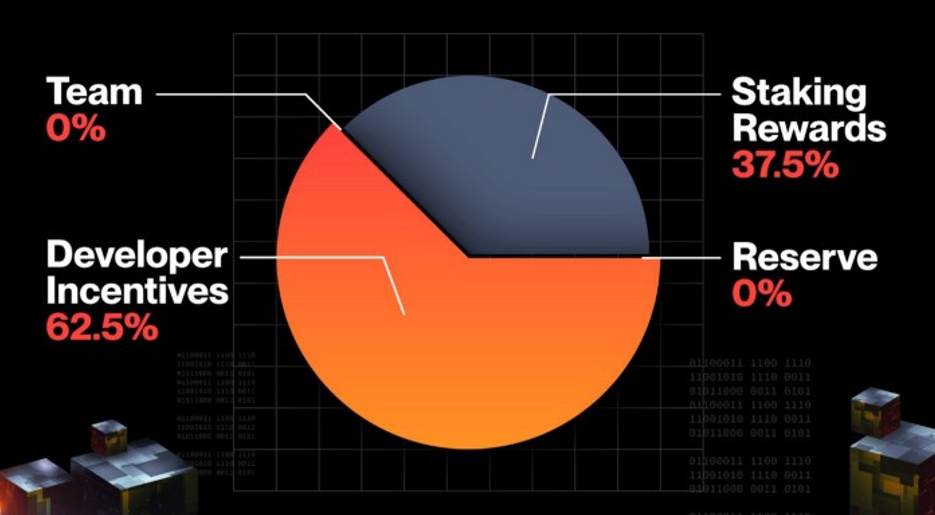
Kava Rise计划在4年内向在Kava以太坊和Cosmos共链上部署的优质项目分配2亿枚Kava奖励。

Kava Rise是一个链上激励计划,透明且公平。每月的奖励分配将加权平均TVL(按时间加权)前100名的协议。

Kava Rise每年为以太坊共链上的DeFi协议提供3000万枚KAVA奖励。

每年为Cosmos共链上的DeFi协议提供1500万枚KAVA奖励。

此外,每年为两个共链上的NFT和GameFi项目提供500万枚KAVA奖励。

虽然Kava Rise计划将在未来4年内,持续向开发者和质押者分发KAVA。但是,开发者需要在Kava生态中带来足够的资金规模(参与活动的协议门槛是10,000美元的TVL,只有达到门槛的协议才可以具有瓜分奖励的资格。),质押者更是需要质押资金。因此,Kava Rise计划本质上是一种经济循环,通过分发KAVA吸引资金流向Kava。

❖Sushi加入Kava,1400万美元流动性挖矿即将启动❖

Kava Rise激励计划推出以后,以太坊头部DEX,Sushi宣布加入,并将在Kava生态中部署一套全新的DeFi产品,将为用户提供快捷高效的高收益挖矿服务。

Sushi和Kava生态基金首期Ignition Fund将在90天内各自提供高达700万美元,共计1400万美元的流动性挖矿奖励,并采取Sushi和Kava奖励的形式平均分配。

Sushi是一个非常了解不起的Defi项目,从2020年至今,Sushi的发展是市场有目共睹的。SushiSwap DEX已经部署在超过13个不同的区块链上,拥有超过21亿美元的TVL,超过3万名月活用户和14740多个资产交易对。

Sushi最大的特色是强大的社区和信仰人群,Sushi的加入,意味着市场上将有大量的投资者关注、参与Kava的新生态。

❖写在最后❖

Kava 11主网计划于9月9日凌晨1点上线。

回顾最初的Kava,仅仅是由铸币、借贷产品构成的Defi生态,Kava11已经走向了焕然一新的新高度。

与最初的Kava相似,Kava有条不紊的迭代产品,不急于求成,扎扎实实的做好产品和生态。

与最初的Kava相似,Kava团队做事的逻辑非常清晰的。最初的Kava是从中央银行(铸币)+商业银行(借贷产品)+证券交易(DEX)开始的Defi生态。
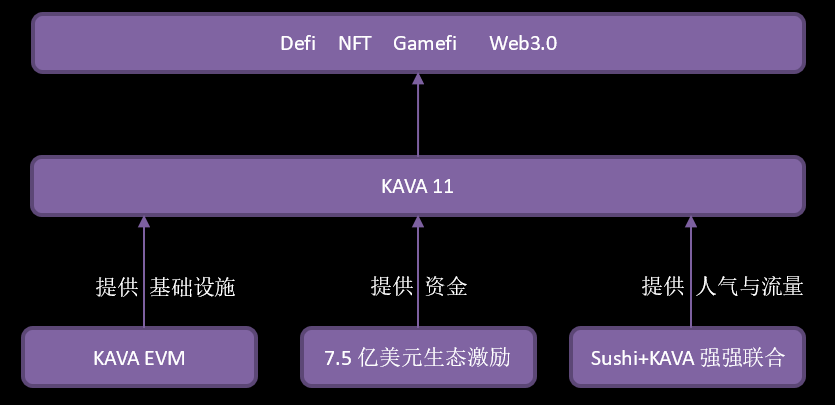
不难看出,Kava的目标是在原有Defi的基础上,发展NFT、Gamefi应用,向下一波热点Web3.0进军。

Kava 10首先上线了EVM,并且在Kava EVM中即将兼容Chainlink预言机和The Graph,首先为生态发展建立了足够的基础设施。

其次,Kava 11即将推出了价值7.5亿美元的激励计划,并且生态激励侧重于DeFi、NFT、Gamefi等,为生态发展、产品拓展提供了资金支持。

而Sushi的加入,除了丰富Kava 11的产品生态,同时也为Kava带来了资金,最主要的是Sushi庞大的全球社区将为Kava带来影响力、人气和流量。

从基础设施到资金,从资金激励之下的产品到人气和流量。Kava做事风格和规划,是币圈少见的稳健和智慧。

Kava有哪些可以期待:

第一,Kava EVM使其成为以太坊和Cosmos的生态新枢纽。截止本文写作时,这两个生态的链上资产总量超过3000亿美元,Defi产品总TVL超过800亿美元。Kava作为连接这两个庞大生态的桥梁和枢纽,生态产品和TVL可以具有不小的想象空间。

第二,Kava EVM上线以后,Kava资产可以作为ERC-20进行封装或解除封装。这意味着,用户可以使用最常见的MetaMask(小狐狸)钱包,参与Kava生态,这为用户参与提供了极大的便利条件,这意味着Kava生态的用户数量可能也会有可观的增长。

第三,Sushi和Kava强强联合即将推出的流动性挖矿激励,或许值得期待。1400万美元在90天内进行分配,约每日15.5万美元的激励,通过这样的推算,如果Sushi在Kava EVM共链中的TVL达到1亿美元,那么折合整体APR在56.4%,如果达到2亿美元,则折合整体APR在28.2%。

但由于是AMM模型双币流动性挖矿,这里存在外部风险,因为行情的趋势存在较大的不确定性因素,如果行情单边下跌或上涨,都有一定概率在流动性挖矿中形成无常损失。如果行情继续震荡,这对于流动性挖矿是有益的。考虑到Sushi和Kava双方的实力,对这个激励上线的时间节点可以保持关注一下。
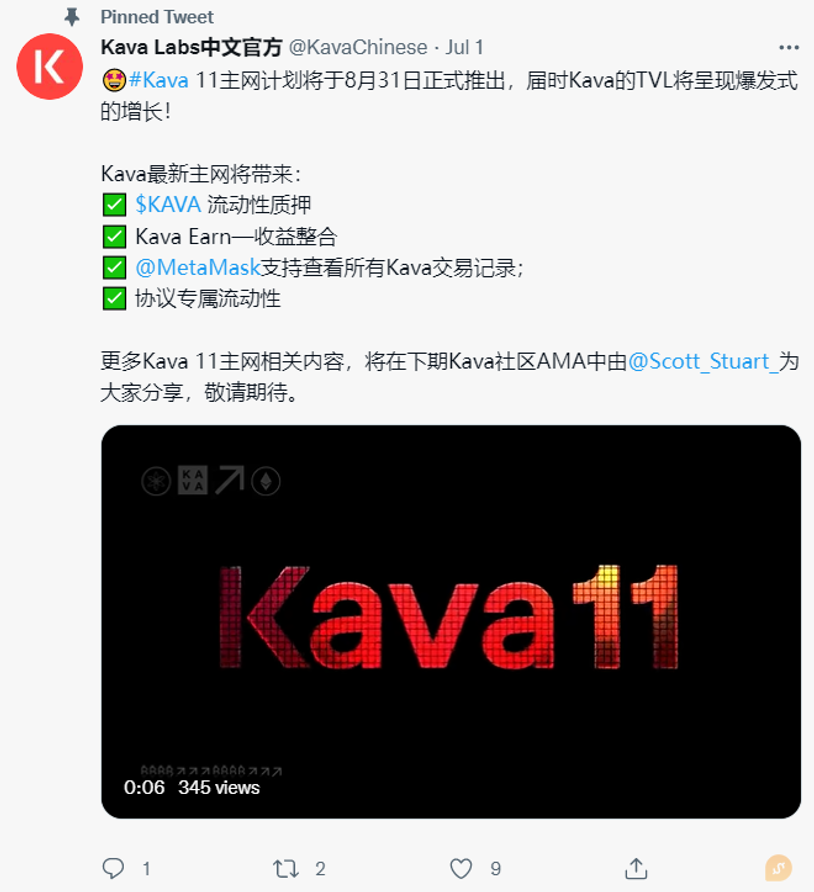
第四,根据Kava官方信息透露,Kava11升级将会有KAVA流动性衍生品落地。ETH2.0的质押本质上是一种流动性衍生品,Ankr月初也推出了BNB的流动性质押衍生品,Stader和Pstake两个在Coinlist公募过的项目现在也在做BNB的流动性质押衍生品。Kava的流动性衍生品会为生态带来哪些爆发,也是值得关注的。


Related Reads

Claude Requires ID Verification and Facial Recognition? The Facial Recognition Requirement is an Old Story from Two Months Ago, and "Sharing Data with Police" is a Misinterpretation

Anthropic's updated privacy policy, effective July 8th, has sparked misinterpretations in Chinese social media, primarily concerning new identity verification and data sharing with law enforcement. A detailed comparison reveals these claims are largely unfounded. First, identity verification (including submitting government ID and a live selfie via third-party provider Persona) is not a new July policy. This mechanism was actually implemented in mid-April 2026 for certain high-use or flagged accounts, particularly Claude Max subscribers. The July update merely formally documents this existing practice in the policy text under a new "Verification Data" section. Second, the widespread claim that the new policy lowers the threshold for sharing user data with law enforcement is incorrect. Comparing the new text with the old version (dated September 28, 2025) shows no substantive tightening. While the new policy more clearly structures the conditions for disclosure—including having a "good-faith belief" it's necessary for legal compliance, preventing harm, fraud detection, or enforcing terms—the old policy already allowed Anthropic to disclose data based on its judgment for similar reasons (e.g., protecting safety, preventing fraud, or complying with law). The term "good-faith belief" acts as a limiting standard, not a lowered barrier. A 2025 court case where Anthropic resisted disclosing user data in a copyright lawsuit further demonstrates the complexity of such standards. The policy's actual substantial changes address data flows for Claude's Agent capabilities. New clauses clarify that when users connect third-party services or instruct Claude to perform multi-step tasks (reading files, sending messages), their inputs, outputs, and instructions are shared with those third parties, governed by the third parties' own policies. This update fills a compliance gap for Claude's evolving functionality beyond simple Q&A. Other additions include a "Research Participation Data" section and refined marketing legal bases. Anthropic reaffirms core commitments: not selling user data, keeping Claude ad-free, and allowing users to control if chats are used for model training. Overall, this update is primarily a compliance catch-up to existing product features, not a significant new privacy tightening. The heightened concern stems from conflating April's verification rollout, standard legal clauses, and the genuine new provisions regarding Agent tasks.

marsbit8m ago

Claude Requires ID Verification and Facial Recognition? The Facial Recognition Requirement is an Old Story from Two Months Ago, and "Sharing Data with Police" is a Misinterpretation

marsbit8m ago

The World Cup Has Only Just Begun, But AI Predictions Already Have Models Hailed as 'Godly' and Others Flipping Over

After only a few days of the World Cup, AI models are being widely used for match predictions, with mixed early results. These models analyze details like scores, upsets, red cards, and key players, offering users in prediction markets an extra layer of analysis beyond odds and news. Qwen gained early attention for its remarkably accurate calls on the opening day, correctly predicting Mexico's 2-0 win over South Africa and Korea's 2-1 victory over the Czech Republic, while also highlighting red card risks and match flow. Copilot had its own highlights, accurately forecasting the Mexico 2-0 result, the Korea 2-1 win, and a surprising 1-1 draw between Brazil and Morocco. However, it also misjudged several matches, like predicting a Swiss win that ended in a draw with Qatar and missing Australia's upset over Turkey. ChatGPT provided detailed pre-match analysis and correctly called the Mexico 2-0 score, explaining factors like home-field advantage. Yet, it struggled to anticipate upsets, often siding with the stronger team on paper, as seen in its missed calls for the Australia-Turkey and Japan-Netherlands matches. Social media tests pitted models like Gemini, Grok, and Claude against each other for the same games, revealing different predictive "scripts" even for the same fixture. Overall, while AI models like Qwen and Copilot have shown promising, high-profile successes in early matches, their consistency and ability to predict genuine upsets remain in question. As the tournament progresses, more data will be needed to determine which models offer the most reliable insights for prediction markets.

Odaily星球日报13m ago

The World Cup Has Only Just Begun, But AI Predictions Already Have Models Hailed as 'Godly' and Others Flipping Over

Odaily星球日报13m ago

The Unfinished Tale of Jueying, DaXiao Robotics Swiftly "Raises Funds"

Following a major fundraising round involving several prominent investment institutions, DaXiao Robotics, a company backed by SenseTime, has secured hundreds of millions of US dollars in financing for the first half of 2026. This move signals SenseTime's renewed and substantial bet on "Physical AI" through embodied intelligence, following the relative underperformance of its autonomous driving unit, Jueying. While Jueying achieved mass production partnerships in the smart vehicle sector, it failed to become a pivotal player in the high-level autonomous driving landscape, leading to its gradual independence from SenseTime's core financials. DaXiao Robotics now emerges as SenseTime's next major venture into the physical world. The new funding will focus on developing a "world model" and integrated hardware-software solutions for commercial applications like retail, security, and hospitality. This ambition is significantly more complex and capital-intensive than previous projects. A world model requires understanding spatial relationships, physics, and causality to guide robots in long-term tasks, demanding immense computational resources, data, and engineering. The article highlights several challenges. First, the massive funding, while substantial, may still be strained by the high costs of R&D, data collection, and commercial deployment. Second, SenseTime itself, despite narrowing losses, continues its high-investment growth model and cannot solely bankroll this new, expensive endeavor. Third, DaXiao Robotics, led by SenseTime co-founder Wang Xiaogang, carries the technical heritage and resources of its parent company but also potentially its organizational inertia. It operates in a field increasingly dominated by agile, young technical founders. Ultimately, DaXiao Robotics represents SenseTime's attempt to secure a leading industrial position in embodied intelligence—a goal its Jueying unit did not fully achieve in autonomous driving. The new venture starts with strong capital backing, but faces the critical task of rapidly transitioning from technological narrative to sustainable commercial delivery in an early-stage, costly, and highly competitive arena.

marsbit22m ago

The Unfinished Tale of Jueying, DaXiao Robotics Swiftly "Raises Funds"

marsbit22m ago

Crypto 2029: The Ultimate Forecast for the Four-Year Cycle of the Cryptocurrency Industry

Title: Crypto 2029: The Ultimate Four-Year Cycle Prediction for the Encryption Industry This article outlines a detailed, stage-by-stage prediction for the crypto industry from the present to 2029, focusing on tangible shifts rather than abstract theory. Key predictions include: **2026 Mid-Year:** The market shifts focus from traditional tokens to synthetic perpetual contracts for private company shares (e.g., SpaceX on Hyperliquid), which become primary price discovery tools for pre-IPO assets. Most altcoins languish as the market seeks assets with real underlying value. **2026 Year-End:** The "AI + crypto" narrative fades as the AI industry itself does not require crypto infrastructure, except for prediction markets betting on model performance. Concurrently, a quiet institutional adoption of asset tokenization (e.g., money market funds) begins under new regulations like the CLARITY Act, creating a dual economy. **2027:** Major public blockchain foundations pivot decisively to serve institutional clients with compliance tools and enterprise sales, while quietly building infrastructure for a future wave of accredited retail investors. Three sectors hit growth ceilings: private perpetual contracts (due to legal restrictions on marketing), stablecoins (due to political uncertainty ahead of the 2028 US election), and tokenized assets (due to cautious institutional scaling). **2028:** Speculative trading diminishes as market efficiency drains liquidity. A major liquidation cascade in synthetic perpetual contracts exposes the flaw of lacking a legally enforceable underlying asset. In response, regulations are revised to allow marketing of private security secondary sales to accredited investors. This creates a legal, direct market for private company equity, absorbing much of the demand previously met by synthetic derivatives. **2029:** A new bull market emerges, driven not by tokens but by tradable equity in innovative private companies (biotech, robotics, AI). Tokens without legally enforceable claims to real assets lose all liquidity. Successful blockchains become invisible settlement infrastructure. Stablecoins grow steadily at a policy-capped rate. Speculation becomes a niche. Core Questions Answered: 1. **Token Value:** Determined solely by legally enforceable claims to real-world assets. 2. **Tech Adoption:** Achieved through blockchain-based primary/secondary markets for private equity, not through forcing tokens onto tech firms. 3. **Crypto as Infrastructure:** The transition happens silently; the technology becomes a mundane, unseen utility like traditional settlement systems. The entire thesis hinges on one testable variable: by late 2028, whether accredited retail investors gain legal, direct access to private asset markets. If not, the core premise—that legal frameworks, not technology, are the main bottleneck—fails.

Foresight News30m ago

Crypto 2029: The Ultimate Forecast for the Four-Year Cycle of the Cryptocurrency Industry

Foresight News30m ago

Trading

Spot
Futures

Hot Articles

How to Buy KAVA

Welcome to HTX.com! We've made purchasing Kava (KAVA) simple and convenient. Follow our step-by-step guide to embark on your crypto journey.Step 1: Create Your HTX AccountUse your email or phone number to sign up for a free account on HTX. Experience a hassle-free registration journey and unlock all features.Get My AccountStep 2: Go to Buy Crypto and Choose Your Payment MethodCredit/Debit Card: Use your Visa or Mastercard to buy Kava (KAVA) instantly.Balance: Use funds from your HTX account balance to trade seamlessly.Third Parties: We've added popular payment methods such as Google Pay and Apple Pay to enhance convenience.P2P: Trade directly with other users on HTX.Over-the-Counter (OTC): We offer tailor-made services and competitive exchange rates for traders.Step 3: Store Your Kava (KAVA)After purchasing your Kava (KAVA), store it in your HTX account. Alternatively, you can send it elsewhere via blockchain transfer or use it to trade other cryptocurrencies.Step 4: Trade Kava (KAVA)Easily trade Kava (KAVA) on HTX's spot market. Simply access your account, select your trading pair, execute your trades, and monitor in real-time. We offer a user-friendly experience for both beginners and seasoned traders.

1.7k Total ViewsPublished 2024.03.29Updated 2026.06.02

How to Buy KAVA

Discussions

Welcome to the HTX Community. Here, you can stay informed about the latest platform developments and gain access to professional market insights. Users' opinions on the price of KAVA (KAVA) are presented below.

活动图片












