Could A Stablecoin Fund Gaza Relief? Trump’s Board Of Peace Is Considering It

bitcoinistPublished on 2026-02-24Last updated on 2026-02-24

Abstract

President Donald Trump's advisory group, the Board of Peace, is exploring a plan to issue a US dollar-backed stablecoin to address severe cash shortages and broken banking services in Gaza. The proposal, still in an exploratory phase, aims to facilitate aid distribution and basic trade by allowing people and aid groups to use a digital token for essential purchases like food, medicine, and fuel. Membership on the board reportedly requires a $1 billion contribution, raising concerns over influence. Supporters argue a stablecoin could reduce transaction friction and enable faster aid delivery with fewer intermediaries. However, critics warn of risks including political isolation, patchy internet access, potential manipulation, and unresolved questions about reserve management, auditing, and legal enforcement. No issuing authority has been chosen, and the plan remains preliminary.

US President Donald Trump’s advisory group is looking at a plan to issue a US dollar-backed stablecoin to help people in Gaza who face severe cash shortages and broken banking services.

The plan is being talked about by the Board of Peace and a handful of outside advisers. Based on reports by the Financial Times, the pitch aims to let aid and basic trade carry on even when ATMs and regular banks are offline.

$1 Billion Membership

Membership in the board requires a $1 billion contribution, according to reports, a condition that has fueled debate over influence and oversight. Trump announced the assembly of the board in January.
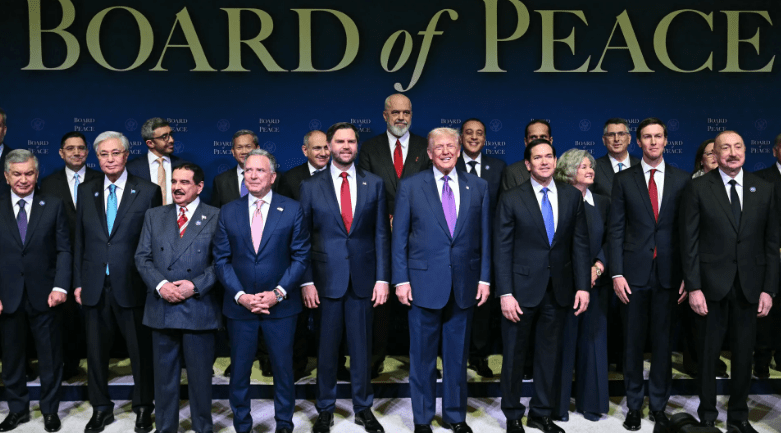
The inaugural Board of Peace meeting in D.C. Image credit: Saul Loeb/AFP via Getty

The effort has technical backers. One name tied to early planning is Liran Tancman, who has been linked to discussions with the territory’s technocratic team, the National Committee For The Administration Of Gaza.

They have talked about a currency token that would be pegged to the dollar, with reserves and systems that would allow people and aid groups to buy food, medicine, and fuel without needing functioning local banks.

Stablecoin Support For Transactions

Supporters say a token could cut some friction. When cash runs low and banks are down, people cannot get what they need. A simple digital token held on phones could move value quickly between traders and charities.

It might also let international donors send help with fewer middlemen. There are questions about how to store the reserves, who would audit them, and what legal system would enforce payments. None of those issues has been solved.

BTCUSD trading at $63,123 on the 24-hour chart: TradingView

Concerns About Control And Isolation

Critics warn of political and practical risks. Some worry that a special token for the strip could deepen separation from nearby markets and make coordination with the West Bank harder.

Others point to patchy internet access and the risk that a digital system could be shut down or manipulated during fighting. There is also debate over which institutions would hold the funds and who would be allowed to issue or burn tokens if things go wrong.
Image: iQoncept/Shutterstock

How It Would Work In Practice

Reports say the plan is still preliminary and that no issuing authority has been chosen. Proposals vary. One model uses a trusted third party outside the region to hold dollar reserves and run the ledger. Another relies on local partners to manage day-to-day distribution.

In both cases, safeguards have been suggested: independent audits, multi-party control of reserves, and strict rules for spending on essential goods only. These are ideas on paper more than firm plans.

Featured image from Crypto Valley Journal, chart from TradingView

Related Questions

QWhat is the proposed solution to help people in Gaza facing cash shortages and broken banking services?

AThe proposed solution is to issue a US dollar-backed stablecoin to facilitate aid and basic trade.

QWhat is the name of the advisory group considering this stablecoin plan for Gaza?

AThe advisory group is called the Board of Peace.

QWhat is the financial requirement for membership on the Board of Peace?

AMembership requires a $1 billion contribution.

QWhat are some of the main concerns critics have raised about the stablecoin plan?

ACritics warn it could deepen Gaza's separation from nearby markets, be difficult to coordinate with the West Bank, and is vulnerable to internet outages or manipulation during conflict.

QWhat is one of the key technical challenges mentioned for implementing the stablecoin?

AKey challenges include determining how to store the dollar reserves, who would audit them, and what legal system would enforce payments.

Related Reads

Founder's 'Emergency Guide': Globally Renowned Accelerator Programs to Apply for in 2026

Founder's Guide to Top Global Accelerator Programs for 2026 This guide outlines over 20 active startup accelerator programs for founders facing fundraising challenges or growth bottlenecks. Key programs include: - **Y Combinator**: Offers $500K for 7% equity (post-money SAFE) + $375K uncapped MFN SAFE. 3-month program, remote/SF-based. Accepts early-stage teams (even ideas). Notable alumni: Airbnb, Coinbase. - **a16z Speedrun**: $500K for 10% equity (SAFE) + potential $500K follow-on. 12 weeks in SF. Provides extensive operational support and credits. - **Sequoia Arc**: $1M investment (terms vary). 4-5 week hybrid program focused on company building. - **South Park Commons**: $400K for 7% equity + $600K guaranteed follow-on. Flexible, no-demo timeline. For technical founders. - **Techstars**: $220K for 5% equity. Global programs across cities/verticals. - **500 Global**: $150K for 6% equity (net $112.5K after fees). Focuses on growth/marketing. - **Entrepreneur First / Antler**: For founders without ideas/co-founders. Provides funding and co-founder matching. - **Others**: Includes Boost VC (deep tech), OpenAI Converge (AI-focused), and regional options like Seedcamp (Europe). Selection advice: Apply broadly but strategically. Consider factors like location, sector focus (e.g., AI, deep tech), funding needs, and stage (idea vs. MVP). Programs like EF/Antler suit those without ideas, while YC/a16z offer strong networks. Remote options available (e.g., Techstars, Antler). Most applications are free.

marsbit33m ago

Founder's 'Emergency Guide': Globally Renowned Accelerator Programs to Apply for in 2026

marsbit33m ago

Trading

Spot
Futures

Hot Articles

Discussions

Welcome to the HTX Community. Here, you can stay informed about the latest platform developments and gain access to professional market insights. Users' opinions on the price of S (S) are presented below.

活动图片