[Key interpretation] BTC is brewing a short-term decline, and eth loan lock up volume has shrunk by 64% to US $17.89 billion

Huobi ResearchPubblicato 2022-08-04Pubblicato ultima volta 2022-08-08

Introduzione

The short-term weakness of BTC and Ethereum further prompted the adjustment of expectations.

1. BTC currency holding cost down

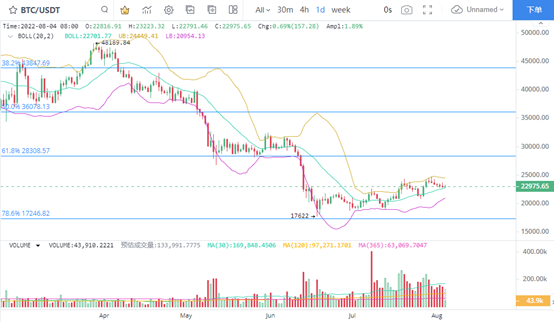
In the daily K-line chart, the trading volume of BTC is relatively stable, and the volume and price performance in the past month is relatively active, during which a large number of BTCs have changed hands. Based on this, BTC is already at a very concentrated price. Although there are still many hold ups at the high price, the number of hold ups continues to decrease with the adjustment. At present, the daily trading volume of BTC is not strong enough, and the continuous decline of prices may further indicate the decline expectation. Therefore, around the price range below $25000, low absorption is more likely to reduce the risk of holding currency.
2. Stable currency prompts capital flight

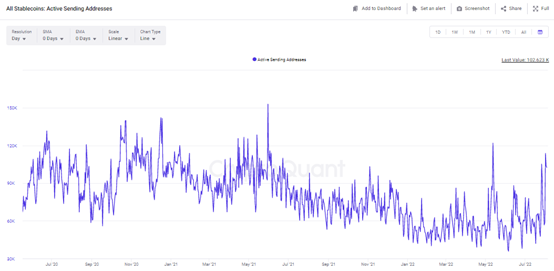
The number of active addresses of stable coins has increased significantly. Among them, the number of active addresses sending stable coins increased rapidly, reaching a high of 103000 on August 3. Recently, the peak value of the stable currency rose, and the peak performance continued on July 12 and August 1, with the corresponding values reaching 122000 and 114000 respectively. This shows that the overall investors are not confident in the current transaction, and sending a stable currency may be a signal of capital flight.
3. The proportion of stable currency sending addresses increased

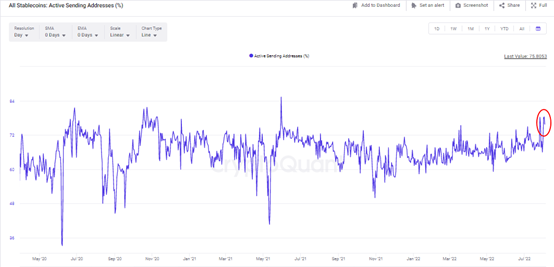
The proportion of sending addresses of stable currency has effectively rebounded, and its short-term peak has reached around 79%, indicating that the number of sending addresses still has a large share. The proportion of actively sending stable coins decreases, while the proportion of receiving stable coins is very low. This shows that the number of addresses receiving stable currency remains at a low level, and few investors actively buy stable currency, which may limit market performance.
4. Eth trading volume remained low

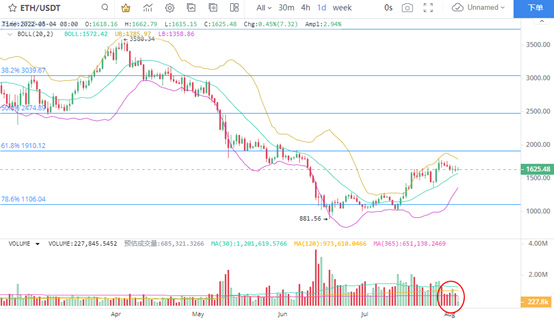
The trading volume performance of eth is obviously lower, and the shrinking trend of trading volume in the short-term six trading days is very significant. In terms of price, ETH began to callback after reaching $1784 in the short term, and the volatility was obviously at a low level. The shrinking trading volume and the low intensity of price fluctuations mean that there are more opportunities for eth to decline sideways.

At present, the middle rail of brin line can support eth horizontal consolidation, but there is obviously insufficient space to continue downward. Therefore, ETH only needs a small pullback at present, which may expand the adjustment space after falling below the brin line medium rail. There is a large downward space from around $1600, so we should pay attention to tracking risks in the short term.
5. Eth mortgage loan project TVL low level operation

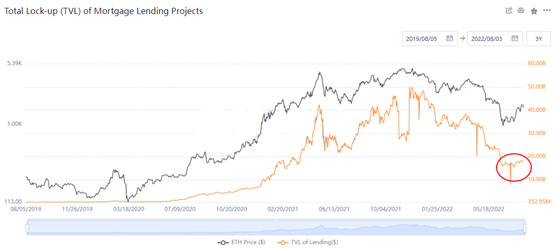
Used to judge the utilization rate of eth chain, the total lock up (TVL) value of mortgage lending projects on eth chain is relatively low, especially the relative historical high has significantly shrunk by 64%, indicating that the current data on the chain has limited support for eth price. On August 3, the total lock up volume of its on chain lending reached US $17.89 billion, a significant decrease from the historical high of nearly US $50billion.

After entering the adjustment state, the ETH chain lock volume data showed signs of continuous stabilization, but the short-term rebound space is not high. This also shows that the rapid rebound of eth short-term price has deviated from the fundamentals, and the pressure of price adjustment may appear in the short term.
Letture associate

NVIDIA CPU Advances, China's RISC-V Responds: Semiconductor Deep Dive - Part Four

NVIDIA is set to launch its new Vera AI data center CPU in China as early as August, with high pricing. While this move offers a new option, it highlights China's continued dependence on foreign-controlled Arm architecture. In response, the Chinese semiconductor industry is increasingly turning to RISC-V as a strategic alternative for achieving high-performance computing autonomy. The article explores the concept of the "impossible triangle" in CPU development—balancing prosperity, control, and autonomy—and posits that RISC-V's open-source, modular nature offers a unique path to achieving all three. While RISC-V is already dominant in embedded systems, the focus is now shifting to data centers and AI workloads. China has become a global hotspot for RISC-V development, driven by AI-driven compute demand, supply chain concerns from export controls, cost benefits of open-source, and strong policy support. Multiple Chinese companies have reportedly crossed the key performance threshold of 15 SPECint per GHz, a benchmark for entering the high-performance CPU club. Progress extends beyond single-core benchmarks. Companies are developing complete computing subsystems, including commercial-grade coherent network-on-chip (NoC) technology and server processors with up to 40 cores that strictly adhere to the RVA23 standard to ensure software compatibility. Real-world applications are emerging in areas like video transcoding and edge AI. However, significant challenges remain. The RISC-V ecosystem faces fragmentation, immature toolchains and verification processes, and gaps in single-core performance and energy efficiency compared to mature x86 and Arm architectures. The formidable software moat, epitomized by NVIDIA's CUDA, is a long-term hurdle. In conclusion, while RISC-V cannot immediately replace offerings like NVIDIA's Vera, it represents a viable long-term path for China to develop a self-sufficient, high-performance CPU ecosystem. The journey is acknowledged to be long and arduous, requiring sustained effort to overcome technical and ecosystem challenges.

marsbit4 h fa

NVIDIA CPU Advances, China's RISC-V Responds: Semiconductor Deep Dive - Part Four

marsbit4 h fa

My Coding Betting Dashboard is Profiting, but Polymarket is Truly Not a Good Place for 'Arbitrage'

The author built a custom monitoring dashboard for Polymarket, a prediction market platform, and tested it with $1,600, achieving over 30% returns. However, the core argument is that Polymarket is not a good venue for traditional arbitrage. The dashboard has two main sections: a "Portfolio Dashboard" for tracking active positions with key metrics like total capital, P&L, and a risk-control module using a tier system (T1, T2, T3), and an "Opportunity Watchlist" for monitoring markets. The article details a critical structural trap in binary markets: a bet with a high perceived probability of success still carries a 100% loss risk if wrong. The author's T1/T2/T3 system is designed to manage this by limiting position sizes based on conviction and time horizon, emphasizing that high confidence should not equal high concentration. A key insight is the danger of "pseudo-diversification"—betting on different markets driven by the same underlying variable. The author concludes that Polymarket offers few true low-risk, arbitrage opportunities. It is instead a high-risk environment where wins can create a false sense of mastery, leading to large losses. The platform is better viewed as a training ground for honing judgment through disciplined, framework-driven betting rather than a reliable income source. The tools help transform intuition into structured, rule-based decisions to mitigate the risk of catastrophic errors.

marsbit7 h fa

My Coding Betting Dashboard is Profiting, but Polymarket is Truly Not a Good Place for 'Arbitrage'

marsbit7 h fa

WeChat AI Card Hands-On Guide: Has the AI Shopping Era Arrived?

**"WeChat AI Card" Practical Test Guide: Has the Era of AI Shopping Arrived?** WeChat has officially launched the "AI Exclusive Card," a feature integrated into its Workbuddy AI assistant. This card is designed to handle payments for AI-initiated purchases. Our hands-on test reveals it's not yet a tool for fully autonomous AI shopping, but rather a controlled payment layer for AI agents. The AI Card functions as an isolated sub-wallet within WeChat Pay. Users must bind the card and transfer funds into it from their main wallet. Crucially, every transaction requires explicit user confirmation via smartphone scan; AI cannot spend autonomously. Currently accessible through the Workbuddy agent, the card targets specific digital consumption scenarios: purchasing paid content (reports, data), calling paid APIs/tools, and subscribing to services. Its design prioritizes security and control by separating funds and mandating approval for each payment. We tested a real-world scenario: ordering bubble tea via Workbuddy using a "Meituan Life Assistant" skill. The process encountered multiple hurdles: high "skill" usage costs (exceeding daily free credits), and most importantly, while a payment was successfully initiated, the AI purchased an incorrect product (a mismatched group-buy coupon instead of the desired drink). This highlights the current limitation: the **AI Card only solves the payment step**. The broader challenge lies in the **AI agent's execution chain**—accurately understanding intent, navigating third-party platforms, selecting the right product, and ensuring proper fulfillment. The payment succeeded, but the purchase failed to meet the user's need. In conclusion, the WeChat AI Exclusive Card is a cautious, early-step experiment in AI commerce. It provides a secure, user-controlled payment method for agent interactions but is not yet capable of reliable, end-to-end complex purchases. For now, it's best used for low-value, low-risk digital services with careful user verification at each step. The vision of AI handling complete shopping tasks remains a work in progress.

marsbit10 h fa

WeChat AI Card Hands-On Guide: Has the AI Shopping Era Arrived?

marsbit10 h fa

Trading

Spot
Futures
活动图片