Ripple Rejoint le Top 10 des Entreprises Privées Mondiales Avec une Valorisation de 50 Milliards de Dollars

bitcoinistPubblicato 2026-02-10Pubblicato ultima volta 2026-02-10

Introduzione

Ripple figure désormais parmi les 10 plus grandes entreprises privées au monde, avec une valorisation estimée à 50 milliards de dollars selon un classement largement partagé sur X. Cette évaluation place la société de paiement aux côtés de géants comme OpenAI et SpaceX, la repositionnant comme une infrastructure de paiement à grande échelle plutôt qu'une simple entreprise centrée sur la cryptomonnaie. Cette valorisation, en hausse d'environ 25% par rapport au financement de fin 2025, reflète une réévaluation progressive via des rachats d'actions et des transactions secondaires plutôt que par le marché public. Bien que Ripple n'envisage pas une introduction en bourse imminente, cette valorisation renforce sa crédibilité en tant qu'entreprise d'infrastructure financière à l'échelle mondiale, influençant potentiellement sa capacité de levée de fonds et de partenariats institutionnels. Au moment de la publication, le XRP se négociait à 1,40 $.

Ripple a été classée dans le top 10 mondial des entreprises privées les plus valorisées avec une estimation de 50 milliards de dollars, selon un tableau largement partagé de "licornes" circulant sur X.

Ce classement est important car il présente Ripple moins comme un récit centré sur un seul jeton et davantage comme une franchise à grande échelle sur le marché privé : une entreprise d'infrastructure de paiement qui, du moins en termes de valorisation secondaire, est désormais discutée au même titre que les plus grandes "super-licornes" de l'IA et de la fintech.

Ripple Se Classe #9 Parmi les Plus Grandes Entreprises Privées Mondiales

L'image qui a été largement republiée sur X présente une "Liste des entreprises licornes" avec Ripple mis en avant à une valorisation de 50 milliards de dollars. Sur cette capture, Ripple apparaît aux côtés d'une cohorte dominée par l'IA, la fintech et les plateformes grand public, incluant OpenAI (500 Md$), ByteDance (480 Md$), SpaceX (400 Md$), Anthropic (350 Md$), xAI (230 Md$), Databricks (100 Md$), Revolut (75 Md$), Stripe (70 Md$) et Shein (66 Md$).
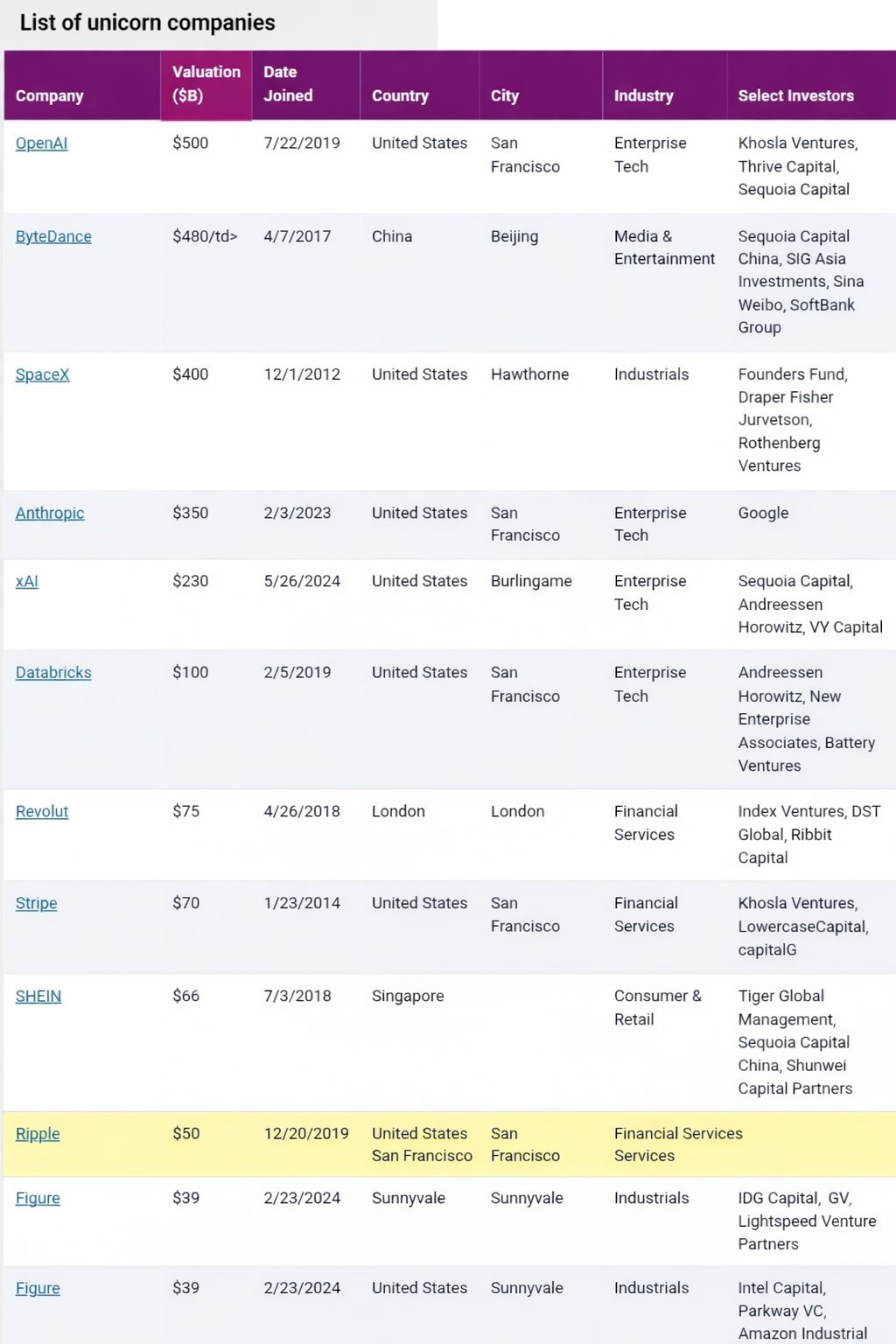
La valorisation de Ripple entre dans le top 10 | Source : X @Xaif_Crypto

Une étiquette de 50 milliards de dollars implique une augmentation par rapport à une valorisation post-financement de 40 milliards associée à un financement en actions fin 2025. En prenant ces deux marques pour argent comptant, le passage à 50 milliards représente une augmentation d'environ 25 % de la valeur d'entreprise implicite dans un court laps de temps, un changement exceptionnellement marqué pour une entreprise privée à un stade avancé, à moins que les marchés secondaires ne se reprixent agressivement ou qu'une nouvelle transaction n'ait redéfini les attentes.

L'historique de valorisation privée de Ripple a également été façonné par des événements de liquidité dirigés par l'entreprise. La firme a précédemment procédé à des rachats d'actions qui ont effectivement créé des points de référence de valorisation pour les employés et les premiers investisseurs, incluant des rachats à une valorisation implicite de 15 milliards de dollars en 2022 et de 11,3 milliards début 2024. Dans ce contexte, le saut fin 2025 à 40 milliards et le chiffre actuel de 50 milliards dépeignent une entreprise dont la valeur sur le marché privé a été revalorisée à la hausse par paliers distincts plutôt que par la boucle de rétroaction continue des marchés publics.

Ce contexte est également important pour la façon dont les traders et les allocateurs interprètent le titre. Les valorisations privées ne sont pas la même chose que les prix de marché liquides, et elles peuvent refléter la structure des transactions, des conditions préférentielles ou la dynamique du flottant limité autant qu'un consensus large des investisseurs. Pourtant, lorsqu'une entreprise commence à apparaître dans les listes du top 10 des entreprises privées dominées par l'IA et la méga-fintech, cela signale que le marché la considère de plus en plus comme une entreprise à l'échelle d'une infrastructure plutôt que comme une histoire de niche adjacente à la crypto.

Le récit de valorisation entre également en collision avec les attentes d'introduction en bourse et la position constante de Ripple selon laquelle une cotation n'est pas imminente. Sans plan ou calendrier à court terme pour devenir publique, la découverte du prix de Ripple reste ancrée à des financements épisodiques et des offres de rachat, ce qui signifie que le prochain point de données significatif pourrait provenir d'un autre tour de table privé, d'un nouveau rachat ou de transactions secondaires qui fuient sur le marché.

Pour les marchés crypto, l'implication immédiate n'est pas tant un catalyseur direct pour le jeton qu'un recadrage de l'empreinte corporative de Ripple. Si la valorisation de 50 milliards de dollars est vraie, elle établit une barre plus haute pour la façon dont les investisseurs modélisent l'optionalité de l'entreprise : que ce soit pour les futures levées de fonds, la capacité de fusions-acquisitions ou le levier dans les partenariats institutionnels. Si ce n'est pas le cas, l'épisode aura tout de même démontré la rapidité avec laquelle les récits des marchés privés peuvent se figer en un "consensus" une fois qu'un seul chiffre, facile à partager, apparaît dans le fil d'actualité.

Au moment de la rédaction, le XRP se négociait à 1,40 $.
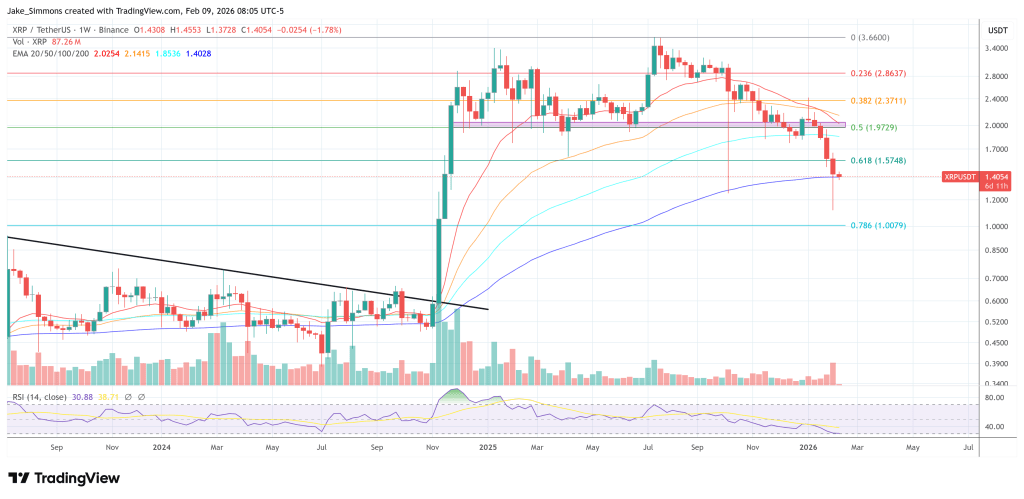
Le XRP se maintient au-dessus de la MME sur 200 semaines, graphique hebdomadaire | Source : XRPUSDT sur TradingView.com

Domande pertinenti

QQuelle est la valorisation estimée de Ripple qui lui a valu une place dans le top 10 des entreprises privées mondiales ?

ARipple a une valorisation estimée à 50 milliards de dollars.

QDans quel secteur d'activité principal Ripple désormais considérée comme une entreprise d'infrastructure, et non plus comme une simple entreprise de crypto-monnaie ?

ARipple est désormais considérée comme une entreprise d'infrastructure de paiement.

QQuel événement auparavant organisé par Ripple a servi à établir des points de référence pour sa valorisation ?

ARipple a précédemment organisé des rachats d'actions, comme ceux à une valorisation implicite de 15 milliards de dollars en 2022 et de 11,3 milliards de dollars début 2024.

QQuelle est la position de Ripple concernant une introduction en bourse (IPO) dans un avenir proche ?

ARipple maintient une position constante selon laquelle une introduction en bourse n'est pas imminente et qu'il n'y a pas de plan ou de calendrier à court terme pour devenir publique.

QÀ quel prix le token XRP se négociait-il au moment de la publication de l'article ?

AAu moment de la publication de l'article, le XRP se négociait à 1,40 dollar.

Letture associate

The Trillion-Yuan Market Cap 'Yi Zhong Tian': Who is the True Value King?

The article analyzes the three leading Chinese optical module companies, collectively nicknamed "Yi Zhong Tian": Xinyisheng, Zhongji Innolight, and TFC Optical Communication. It evaluates their "cost-performance" not by current stock price, but through three lenses: PEG ratio (growth vs. valuation), earnings quality, and premium/discount for certainty. Xinyisheng shows the most attractive PEG ratio and high profitability, but its valuation reflects discounts for risks like high customer concentration and reliance on overseas markets. Zhongji Innolight, the most expensive, commands a premium for its market leadership, dominant share in key products like 800G/1.6T modules, and higher earnings certainty, though it faces geopolitical risks. TFC Optical, as an upstream component supplier ("water seller"), has the highest gross margin and bets on the long-term CPO/NPO architecture trend, but trades at a high valuation with more stable, less explosive growth. The core argument is that while these companies dominate module assembly, the true profit pool and technological moat lie upstream in laser and switch chips, currently controlled by U.S. firms like Lumentum and Coherent. The long-term "cost-performance" for these Chinese leaders hinges on whether the domestic industry, exemplified by companies like Yuanjie Technology, can successfully move up the value chain into high-power laser chips. Otherwise, their high growth may remain confined to the lower-margin assembly segment.

marsbit2 min fa

The Trillion-Yuan Market Cap 'Yi Zhong Tian': Who is the True Value King?

marsbit2 min fa

Has the Crypto Market Bottomed? Here's What Institutions Think

The crypto market is in a period of significant debate, with leading institutions offering differing views on whether a bottom has been reached. Three prominent firms have published detailed analyses: * **Galaxy Digital** argues Bitcoin has **not yet bottomed**. Their analysis of 13 historical indicators across six dimensions (valuation, profit-taking, miner pressure, etc.) shows only four are fully met. They project a potential bottom range between $30k and $54k. * **NYDIG** states a bottom is **possible but not likely**. While metrics are close to historic bear market extremes, they note the absence of a classic panic-selling event. They also suggest increased institutional adoption may have structurally altered the market cycle, potentially leading to a shallower downturn. * **Standard Chartered Bank** asserts the **bottom has already occurred** at around $59k. They cite two key factors: potential US-Iran diplomatic progress and the anticipated SpaceX IPO, which they believe absorbed capital and caused ETF selling pressure that is now subsiding. They forecast a year-end price target of $100k. Despite the surface-level disagreement, the reports share critical common ground more valuable for long-term investors: 1. All three believe the market bottom will form **within this year**. 2. All agree the current price is **closer to the bottom than to previous highs**. 3. All maintain a **bullish long-term outlook** for Bitcoin and a new cycle. The core takeaway is that while the exact bottom price ($40k, $50k, or $60k) is debated, the consensus is that a bottom is imminent. For long-term holders, the primary focus should not be pinpointing the absolute low, but on the future potential for prices to reach $100k, $200k, or higher. The fundamental thesis for Bitcoin—sovereign debt accumulation, inflation, declining trust in centralized institutions, global digitization, and improved accessibility—remains intact and is arguably strengthening. The overall landscape is viewed as more favorable than in previous crypto winters.

marsbit13 min fa

Has the Crypto Market Bottomed? Here's What Institutions Think

marsbit13 min fa

The 'Chip' Challenge and Breakthroughs in China's Optical Industry Chain

China's Photonics Industry: Bottlenecks and Breakthroughs In the global AI race, computing chips dominate the narrative, but the underlying bottleneck increasingly defining the scale of AI clusters is light—or more specifically, optical connectivity. Optical modules, which translate electrical signals to light and vice versa, are crucial for connecting thousands of GPUs in AI data centers, preventing data congestion and ensuring efficient model training. High-speed modules (800G, 1.6T) are now standard, with performance hinging on advanced DSP (Digital Signal Processor) chips. This is where a critical dependency lies. Two US giants—Marvell and Broadcom—collectively dominate over 90% of the high-end DSP chip market. Chinese optical module leaders like Zhongji Innolight and Eoptolink rely on these chips to manufacture modules for overseas AI customers, primarily in North America. While this creates a supply chain vulnerability, complete decoupling is difficult. Marvell derives over half its revenue from Greater China, and the US firms depend on Chinese partners for chip packaging and optical components. The risk from laser chips (e.g., from Lumentum), another key component, is considered more manageable due to multiple global suppliers and faster progress in domestic alternatives from companies like YOFC and Accelink. To mitigate risks, China's industry is pursuing a multi-pronged strategy: diversifying supply chains and locking in long-term orders; fostering a domestic market ecosystem to adopt homegrown DSPs from firms like Huawei HiSilicon and CETC; accelerating R&D in high-speed DSPs and advanced packaging; and investing in next-gen technologies like silicon photonics and Co-Packaged Optics (CPO) to reduce reliance on discrete DSPs. The ultimate solution lies not in short-term博弈 but in persistent advancement of domestic high-end chip R&D and manufacturing. While challenges remain in performance, certification, and ecosystem building, China's vast domestic market and manufacturing base provide a crucial buffer, buying time for the industry to achieve greater technological independence.

marsbit26 min fa

The 'Chip' Challenge and Breakthroughs in China's Optical Industry Chain

marsbit26 min fa

Behind SpaceX's $2 Trillion Market Cap: Why Does Musk Always Have the Next Move Planned?

On June 12th, SpaceX debuted on the Nasdaq, reaching a valuation that briefly touched $2 trillion. This marked the culmination of a 24-year journey from its founding in 2002, driven by Elon Musk's frustration at the high cost of buying rockets. The company's path was defined by early failures, with its first three Falcon 1 launches ending in explosions before a successful 2008 flight opened the era of commercial spaceflight. Key to its model was a fixed-price NASA contract, incentivizing cost reduction. SpaceX mastered rocket reusability, first achieving a Falcon 9 landing in 2015, which drastically cut launch costs. This enabled its profitable Starlink satellite internet constellation, envisioned years before reusability was proven, to create an internal market for frequent launches. Similarly, the next-generation Starship rocket was in development long before its first flight, with its business case evolving from Mars colonization to supporting the emerging concept of in-orbit data centers for AI—a story now central to its valuation. The company's recent IPO, a reversal of its long-standing "no IPO" stance, is funding this ambitious "space-based compute" vision. While major tech players like Google, Blue Origin, and others are investing heavily, significant technical and cost hurdles remain. Ultimately, SpaceX's history is one of creating its own demand: first with Starlink and now with space-based AI compute, betting that its next rocket will enable its next giant market.

marsbit29 min fa

Behind SpaceX's $2 Trillion Market Cap: Why Does Musk Always Have the Next Move Planned?

marsbit29 min fa

Trading

Spot
Futures

Articoli Popolari

Come comprare COMP

Benvenuto in HTX.com! Abbiamo reso l'acquisto di Compound (COMP) semplice e conveniente. Segui la nostra guida passo passo per intraprendere il tuo viaggio nel mondo delle criptovalute.Step 1: Crea il tuo Account HTXUsa la tua email o numero di telefono per registrarti il tuo account gratuito su HTX. Vivi un'esperienza facile e sblocca tutte le funzionalità,Crea il mio accountStep 2: Vai in Acquista crypto e seleziona il tuo metodo di pagamentoCarta di credito/debito: utilizza la tua Visa o Mastercard per acquistare immediatamente CompoundCOMP.Bilancio: Usa i fondi dal bilancio del tuo account HTX per fare trading senza problemi.Terze parti: abbiamo aggiunto metodi di pagamento molto utilizzati come Google Pay e Apple Pay per maggiore comodità.P2P: Fai trading direttamente con altri utenti HTX.Over-the-Counter (OTC): Offriamo servizi su misura e tassi di cambio competitivi per i trader.Step 3: Conserva Compound (COMP)Dopo aver acquistato Compound (COMP), conserva nel tuo account HTX. In alternativa, puoi inviare tramite trasferimento blockchain o scambiare per altre criptovalute.Step 4: Scambia Compound (COMP)Scambia facilmente Compound (COMP) nel mercato spot di HTX. Accedi al tuo account, seleziona la tua coppia di trading, esegui le tue operazioni e monitora in tempo reale. Offriamo un'esperienza user-friendly sia per chi ha appena iniziato che per i trader più esperti.

207 Totale visualizzazioniPubblicato il 2024.12.13Aggiornato il 2026.06.02

Come comprare COMP

Discussioni

Benvenuto nella Community HTX. Qui puoi rimanere informato sugli ultimi sviluppi della piattaforma e accedere ad approfondimenti esperti sul mercato. Le opinioni degli utenti sul prezzo di COMP COMP sono presentate come di seguito.

活动图片