加密早报:虚拟货币新规出台,本周 AVAX、APT、STRK 等代币将迎来大额解锁

marsbitPublicado a 2026-02-09Actualizado a 2026-02-09

Resumen

中国人民银行等八部门联合发布新规,全面禁止虚拟货币交易及RWA代币化业务,相关活动定性为非法金融活动。美国伊利诺伊州提出《社区比特币储备法案》,拟建立州政府运营的比特币储备。白宫将于下周举行稳定币收益讨论会议。 市场方面,日经225指数大涨4%。Bithumb交易所因误发62万枚BTC事故承诺全额赔偿并加强风控。易理华链上地址ETH近乎清仓,李林澄清未减持BTC和ETH。Michael Saylor或将于下周增持比特币。 本周多个代币将迎来大额解锁,包括AVAX(约1520万美元)、APT(约1230万美元)、STRK(约630万美元)等。FWDI首席信息官表示若行业资金紧张将采取进攻策略并整合其他SOL财库公司。 推荐阅读内容涵盖市场趋势、比特币与全球经济关系、流动性危机分析及抄底策略建议。

作者:深潮 TechFlow

昨日市场动态

日经 225 指数日内大涨 4.00%,现报 56437.40 点

日经 225 指数日内大涨 4.00%,现报 56437.40 点。

加密记者:白宫下一轮稳定币收益讨论会议将于下周二举行

据加密记者 Eleanor Terrett 报道,有知情人士称,白宫关于稳定币收益的下一轮讨论会议已定于下周二举行。此次会议仍将在工作人员层面进行,这次银行代表本身将出席,同时还有行业协会代表。

美国伊利诺伊州本周提出《社区比特币储备法案》,拟建立由州政府运营的比特币储备计划

据 Bitcoincom News 报道,美国伊利诺伊州本周提出《社区比特币储备法案》(Community Bitcoin Reserve Act),拟建立由州政府运营的比特币储备计划,采用多签冷钱包托管,首个储备名为 Altgeld Bitcoin Reserve。法案规定,储备中的 BTC 仅可在经新的立法授权后方可交易或出售。

央行等八部门联合发文:全面禁止虚拟货币交易和RWA代币化业务

中国人民银行联合七部门今日发布《关于进一步防范和处置虚拟货币等相关风险的通知》(银发〔2026〕42 号),明确虚拟货币不具有法定货币地位,相关业务活动属非法金融活动。

通知禁止境内开展虚拟货币交易及现实世界资产 (RWA) 代币化活动,未经相关部门批准,境内主体不得在境外发行虚拟货币或开展代币化业务。

金融机构不得为相关活动提供服务,互联网企业不得提供网络场所和宣传推广。通知要求加强风险监测和行业监管,严厉打击相关违法犯罪活动。本通知自发布之日起施行,同时废止 2021 年相关规定。

彭博分析师:21Shares 已提交 Ondo ETF 申请

彭博高级 ETF 分析师 Eric Balchunas 发文披露,21Shares 已提交 Ondo ETF 申请文件。

易理华链上地址中的 ETH 已彻底清仓

据 Arkham 数据显示,易理华相关的链上地址向币安转入了最后的 534 枚 ETH,其链上地址中的 ETH 已彻底清仓,目前仅剩 0.165 ETH。

Bithumb:将为“误发 62 万枚 BTC ”事故受影响客户提供全额赔偿

据官方公告,韩国加密货币交易所 Bithumb 针对 2 月 6 日发生的“误发 62 万枚 BTC ”事故发布全面赔偿方案。Bithumb 承诺为受影响客户提供 110% 的特别赔偿,预计损失约 10 亿韩元。

公告表示,Bithumb 将加强内部控制系统,包括升级资产验证系统、完善多级审批流程、强化异常交易检测与自动阻断 AI 系统,并通过全球安全专业机构进行系统审计。

此外,Bithumb 还将为事故期间登录的所有用户提供 2 万韩元补偿,为全体用户提供 7 天零手续费交易,并设立 1000 亿韩元规模的"客户保护基金",确保客户资产安全。

李林回应传言:非 LD 或 Garrett Gin 投资人,本轮行情未减持 BTC 或 ETH

火币创始人李林发文表示,“自己并非 LD 或 Garrett Gin 的投资人,本轮行情中也未减仓比特币或以太坊,已休息多年,但几乎每年仍需就相关传言进行澄清。”

FWDI CIO:若行业陷入资金紧张,将采取进攻策略并整合其他 SOL 财库公司

据 Coindesk 报道,最大 Solana 财库公司 Forward Industries (FWDI) 首席信息官 Ryan Navi 表示,市场的错误定价正在创造机会,Forward 没有债务,如果行业陷入资金紧张,将采取进攻策略并整合其他 SOL 财库公司。

FWDI 拥有近 700 万 SOL,是上市 SOL 储备量最大的公司,比其后三个竞争对手的总和还要多。

Ryan Navi 重申,「无杠杆资产负债表是加密财库市场真正的优势。当别人都在防守时,Forward Industries 将维持增持。未来也将不杠杆,不负债,并将 Solana 视为战略基础设施的长期投资,而不是短期投机。」

Michael Saylor 再次发布比特币 Tracker 信息,或将于下周增持比特

Strategy 创始人兼执行主席 Michael Saylor 在 X 平台再次发布比特币 Tracker 相关信息并写道“Orange Dots Matter.”。

根据此前规律,Strategy 总是在相关消息发布之后的第二天披露增持比特币信息。

本周 AVAX、APT、STRK 等代币将迎来大额解锁

Token Unlocks 数据显示,本周多个加密货币项目将迎来代币解锁。

CONX 将于 2 月 15 日解锁 132 万代币,价值约 1560 万美元,占流通量 1.56%;

AVAX 将于 2 月 11 日解锁 167 万代币,价值约 1520 万美元,占流通量 0.32%;

APT 将于 2 月 10 日解锁 1131 万代币,价值约 1230 万美元,占流通量 0.69%;

STRK 将于 2 月 15 日解锁 1.27 亿代币,价值约 630 万美元,占流通量 4.61%;

SEI 将于 2 月 15 日解锁 5556 万代币,价值约 420 万美元,占流通量 1.03%;

MOVE 将于 2 月 9 日解锁 1.64 亿代币,价值约 380 万美元,占流通量 5.46%;

ME 将于 2 月 9 日解锁约 148 万代币,价值约 148 万美元,占流通量 2.32%;

LINEA 将于 2 月 10 日解锁约 438 万代币,价值约 438 万美元,占流通量 5.96%。

行情动态
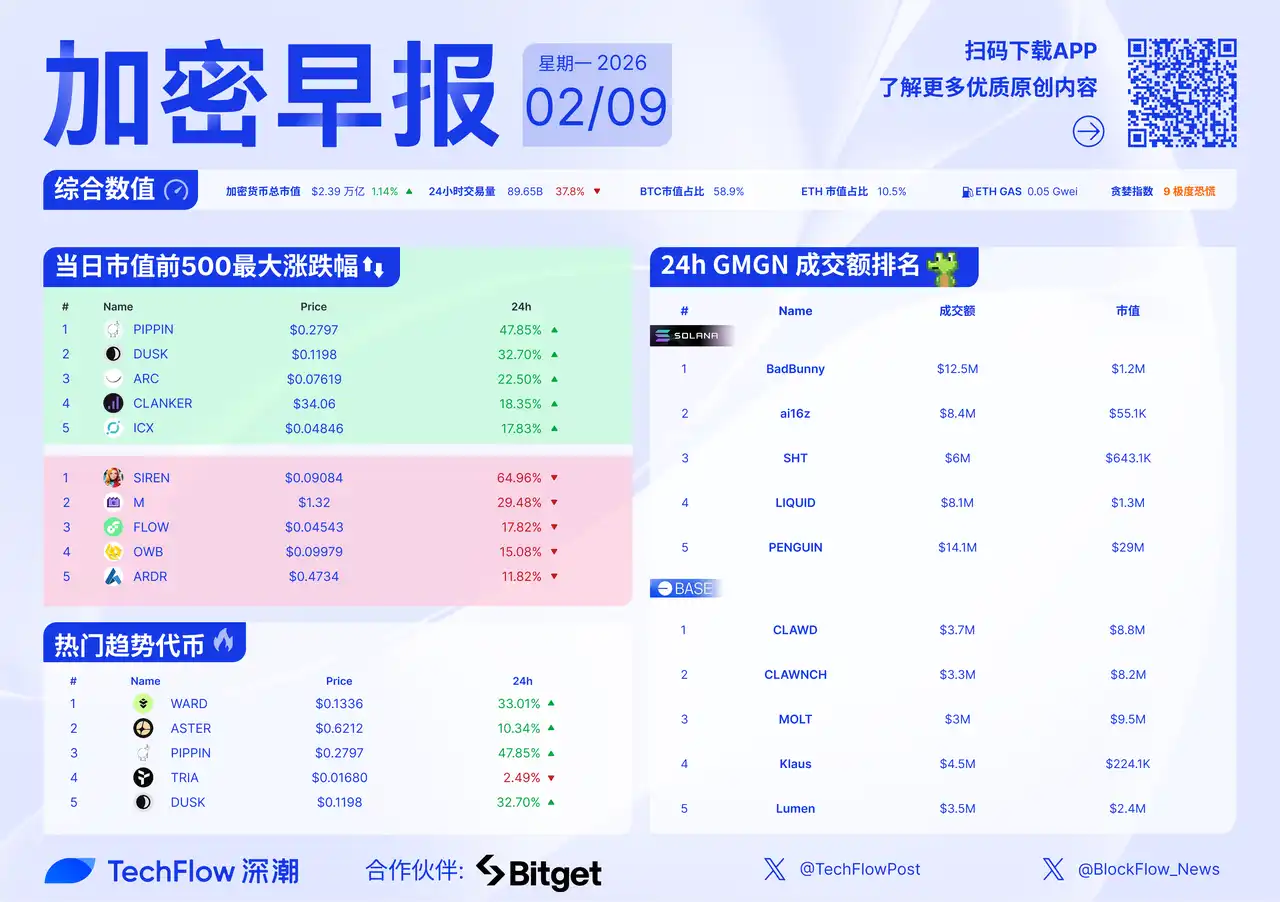
推荐阅读

对话 Jeff Park:我们处于熊市之中,量化宽松不再有效,白银像山寨币会崩盘

本文探讨了比特币当前市场的变化趋势、贵金属市场的波动以及美联储与财政政策的未来走向。文章通过对话形式深入分析了比特币与全球经济环境的关系,并提出了“正相关比特币”的概念。同时,文章还讨论了Kevin Warsh作为美联储主席的潜力以及白银市场的现状与未来。

解读Strategy最新财报:亏损124亿美元后,比特币飞轮还能转多久?

本文分析了Strategy公司与比特币的紧密关系,财报显示其经营状况严重依赖比特币价格波动。尽管其资本运作表现出色,但长期来看,比特币价格的持续下跌可能对其运作模式构成威胁。

福布斯编辑部,币圈最准的做空信号?

本文探讨了加密货币市场与福布斯杂志封面人物之间的关系,指出市场热潮往往在主流媒体关注时达到顶峰,并通过多个案例分析了这一现象的背后逻辑,包括CZ、SBF和Michael Saylor等加密领域人物的经历。

美股,比特币与白银遭血洗:一场诡异的全球资产大屠杀

本文探讨了2月6日全球市场经历了一场“流动性黑洞”式的资产大屠杀,包括美股、白银和加密货币在内的多种资产类别在同一时间大幅下跌。尽管没有明显的外部黑天鹅事件,但流动性危机成为了此次市场崩盘的核心原因。文章从美股、白银、加密货币以及日本国债市场的变化等方面详细分析了这场全球市场动荡的成因。

加密至暗时刻,Real Vision 创始人:坚定持有,大胆抄底

本文讲述了当前市场处于低迷状态,投资者普遍感到恐慌和迷茫,但作者强调应坚定持有并大胆抄底。强调长期持有和分批加仓的优势,指出市场的高波动性是必须接受的代价。作者对未来市场持乐观态度,认为当前的市场低迷是牛市中的恐慌性下跌,并计划继续抄底加密资产。


Preguntas relacionadas

Q中国人民银行等八部门联合发布的新规,对虚拟货币交易和RWA代币化业务做出了哪些主要限制?

A新规明确虚拟货币不具有法定货币地位,相关业务活动属非法金融活动。禁止境内开展虚拟货币交易及现实世界资产(RWA)代币化活动,未经批准境内主体不得在境外发行虚拟货币或开展代币化业务。金融机构不得为相关活动提供服务,互联网企业不得提供网络场所和宣传推广。

Q本周哪些代币将迎来大额解锁?其中解锁数量占流通量比例最高的是哪个代币?

A本周将迎来大额解锁的代币包括CONX、AVAX、APT、STRK、SEI、MOVE、ME和LINEA。其中,解锁数量占流通量比例最高的是MOVE代币,解锁比例为5.46%。

Q美国伊利诺伊州提出的《社区比特币储备法案》主要内容是什么?

A美国伊利诺伊州提出的《社区比特币储备法案》拟建立由州政府运营的比特币储备计划,采用多签冷钱包托管,首个储备名为Altgeld Bitcoin Reserve。法案规定,储备中的BTC仅可在经新的立法授权后方可交易或出售。

Q韩国交易所Bithumb为‘误发62万枚BTC’事故提供了哪些赔偿和补偿措施?

ABithumb承诺为受影响客户提供110%的特别赔偿,预计损失约10亿韩元。此外,还为事故期间登录的所有用户提供2万韩元补偿,为全体用户提供7天零手续费交易,并设立1000亿韩元规模的'客户保护基金'以确保客户资产安全。

QForward Industries (FWDI) 的首席信息官Ryan Navi对当前市场环境下的策略是什么?

ARyan Navi表示,市场的错误定价正在创造机会,Forward没有债务,如果行业陷入资金紧张,将采取进攻策略并整合其他SOL财库公司。公司重申将维持增持,不杠杆,不负债,并将Solana视为战略基础设施的长期投资,而不是短期投机。

Lecturas Relacionadas

Fed's Internal Doves Flock to Hawkish Stance, Warsh's Debut "Between a Rock and a Hard Place"

U.S. Federal Reserve officials who previously advocated for rate cuts, including Governor Christopher Waller, have recently shifted their stance, with many now not ruling out the possibility of future rate hikes. This sets a challenging stage for new Fed Chair Kevin Warsh's first policy meeting. Appointed by President Trump based on his dovish views, Warsh now faces a committee where the debate has pivoted from "when to cut" to "whether to hike," driven by persistent inflation above 3%, a strong labor market, and supply-side pressures from AI infrastructure demands and geopolitical tensions. Key figures illustrate the shift. Governor Waller, once concerned about employment, now says data has pushed him toward considering rate increases. Even moderate voices like Governor Lisa Cook, while expecting inflation to ease, have indicated readiness to hike if it fails to do so. Long-time hawks such as regional Fed presidents Beth Hammack, Lorie Logan, and Neel Kashkari have grown more vocal, arguing that the real policy rate is effectively falling and that action may soon be needed. The upcoming Fed meeting is expected to keep rates steady but will likely remove the "easing bias" from its statement, signaling a neutral stance between cuts and hikes. The quarterly "dot plot" is anticipated to show most officials projecting no cuts this year, with some potentially indicating hikes. Chair Warsh, a critic of the Fed's reliance on forward guidance like the dot plot, must navigate communicating this pivot using tools he has questioned, all while steering policy in a direction counter to the preferences of the president who appointed him. The consensus suggests the Fed's next move could well be a rate increase.

marsbitHace 8 min(s)

Fed's Internal Doves Flock to Hawkish Stance, Warsh's Debut "Between a Rock and a Hard Place"

marsbitHace 8 min(s)

The Trillion-Yuan Market Cap 'Yi Zhong Tian': Who is the True Value King?

The article analyzes the three leading Chinese optical module companies, collectively nicknamed "Yi Zhong Tian": Xinyisheng, Zhongji Innolight, and TFC Optical Communication. It evaluates their "cost-performance" not by current stock price, but through three lenses: PEG ratio (growth vs. valuation), earnings quality, and premium/discount for certainty. Xinyisheng shows the most attractive PEG ratio and high profitability, but its valuation reflects discounts for risks like high customer concentration and reliance on overseas markets. Zhongji Innolight, the most expensive, commands a premium for its market leadership, dominant share in key products like 800G/1.6T modules, and higher earnings certainty, though it faces geopolitical risks. TFC Optical, as an upstream component supplier ("water seller"), has the highest gross margin and bets on the long-term CPO/NPO architecture trend, but trades at a high valuation with more stable, less explosive growth. The core argument is that while these companies dominate module assembly, the true profit pool and technological moat lie upstream in laser and switch chips, currently controlled by U.S. firms like Lumentum and Coherent. The long-term "cost-performance" for these Chinese leaders hinges on whether the domestic industry, exemplified by companies like Yuanjie Technology, can successfully move up the value chain into high-power laser chips. Otherwise, their high growth may remain confined to the lower-margin assembly segment.

marsbitHace 18 min(s)

The Trillion-Yuan Market Cap 'Yi Zhong Tian': Who is the True Value King?

marsbitHace 18 min(s)

Has the Crypto Market Bottomed? Here's What Institutions Think

The crypto market is in a period of significant debate, with leading institutions offering differing views on whether a bottom has been reached. Three prominent firms have published detailed analyses: * **Galaxy Digital** argues Bitcoin has **not yet bottomed**. Their analysis of 13 historical indicators across six dimensions (valuation, profit-taking, miner pressure, etc.) shows only four are fully met. They project a potential bottom range between $30k and $54k. * **NYDIG** states a bottom is **possible but not likely**. While metrics are close to historic bear market extremes, they note the absence of a classic panic-selling event. They also suggest increased institutional adoption may have structurally altered the market cycle, potentially leading to a shallower downturn. * **Standard Chartered Bank** asserts the **bottom has already occurred** at around $59k. They cite two key factors: potential US-Iran diplomatic progress and the anticipated SpaceX IPO, which they believe absorbed capital and caused ETF selling pressure that is now subsiding. They forecast a year-end price target of $100k. Despite the surface-level disagreement, the reports share critical common ground more valuable for long-term investors: 1. All three believe the market bottom will form **within this year**. 2. All agree the current price is **closer to the bottom than to previous highs**. 3. All maintain a **bullish long-term outlook** for Bitcoin and a new cycle. The core takeaway is that while the exact bottom price ($40k, $50k, or $60k) is debated, the consensus is that a bottom is imminent. For long-term holders, the primary focus should not be pinpointing the absolute low, but on the future potential for prices to reach $100k, $200k, or higher. The fundamental thesis for Bitcoin—sovereign debt accumulation, inflation, declining trust in centralized institutions, global digitization, and improved accessibility—remains intact and is arguably strengthening. The overall landscape is viewed as more favorable than in previous crypto winters.

marsbitHace 28 min(s)

Has the Crypto Market Bottomed? Here's What Institutions Think

marsbitHace 28 min(s)

The 'Chip' Challenge and Breakthroughs in China's Optical Industry Chain

China's Photonics Industry: Bottlenecks and Breakthroughs In the global AI race, computing chips dominate the narrative, but the underlying bottleneck increasingly defining the scale of AI clusters is light—or more specifically, optical connectivity. Optical modules, which translate electrical signals to light and vice versa, are crucial for connecting thousands of GPUs in AI data centers, preventing data congestion and ensuring efficient model training. High-speed modules (800G, 1.6T) are now standard, with performance hinging on advanced DSP (Digital Signal Processor) chips. This is where a critical dependency lies. Two US giants—Marvell and Broadcom—collectively dominate over 90% of the high-end DSP chip market. Chinese optical module leaders like Zhongji Innolight and Eoptolink rely on these chips to manufacture modules for overseas AI customers, primarily in North America. While this creates a supply chain vulnerability, complete decoupling is difficult. Marvell derives over half its revenue from Greater China, and the US firms depend on Chinese partners for chip packaging and optical components. The risk from laser chips (e.g., from Lumentum), another key component, is considered more manageable due to multiple global suppliers and faster progress in domestic alternatives from companies like YOFC and Accelink. To mitigate risks, China's industry is pursuing a multi-pronged strategy: diversifying supply chains and locking in long-term orders; fostering a domestic market ecosystem to adopt homegrown DSPs from firms like Huawei HiSilicon and CETC; accelerating R&D in high-speed DSPs and advanced packaging; and investing in next-gen technologies like silicon photonics and Co-Packaged Optics (CPO) to reduce reliance on discrete DSPs. The ultimate solution lies not in short-term博弈 but in persistent advancement of domestic high-end chip R&D and manufacturing. While challenges remain in performance, certification, and ecosystem building, China's vast domestic market and manufacturing base provide a crucial buffer, buying time for the industry to achieve greater technological independence.

marsbitHace 42 min(s)

The 'Chip' Challenge and Breakthroughs in China's Optical Industry Chain

marsbitHace 42 min(s)

Behind SpaceX's $2 Trillion Market Cap: Why Does Musk Always Have the Next Move Planned?

On June 12th, SpaceX debuted on the Nasdaq, reaching a valuation that briefly touched $2 trillion. This marked the culmination of a 24-year journey from its founding in 2002, driven by Elon Musk's frustration at the high cost of buying rockets. The company's path was defined by early failures, with its first three Falcon 1 launches ending in explosions before a successful 2008 flight opened the era of commercial spaceflight. Key to its model was a fixed-price NASA contract, incentivizing cost reduction. SpaceX mastered rocket reusability, first achieving a Falcon 9 landing in 2015, which drastically cut launch costs. This enabled its profitable Starlink satellite internet constellation, envisioned years before reusability was proven, to create an internal market for frequent launches. Similarly, the next-generation Starship rocket was in development long before its first flight, with its business case evolving from Mars colonization to supporting the emerging concept of in-orbit data centers for AI—a story now central to its valuation. The company's recent IPO, a reversal of its long-standing "no IPO" stance, is funding this ambitious "space-based compute" vision. While major tech players like Google, Blue Origin, and others are investing heavily, significant technical and cost hurdles remain. Ultimately, SpaceX's history is one of creating its own demand: first with Starlink and now with space-based AI compute, betting that its next rocket will enable its next giant market.

marsbitHace 45 min(s)

Behind SpaceX's $2 Trillion Market Cap: Why Does Musk Always Have the Next Move Planned?

marsbitHace 45 min(s)

Trading

Spot
Futuros

Artículos destacados

Cómo comprar APT

¡Bienvenido a HTX.com! Hemos hecho que comprar Aptos (APT) sea simple y conveniente. Sigue nuestra guía paso a paso para iniciar tu viaje de criptos.Paso 1: crea tu cuenta HTXUtiliza tu correo electrónico o número de teléfono para registrarte y obtener una cuenta gratuita en HTX. Experimenta un proceso de registro sin complicaciones y desbloquea todas las funciones.Obtener mi cuentaPaso 2: ve a Comprar cripto y elige tu método de pagoTarjeta de crédito/débito: usa tu Visa o Mastercard para comprar Aptos (APT) al instante.Saldo: utiliza fondos del saldo de tu cuenta HTX para tradear sin problemas.Terceros: hemos agregado métodos de pago populares como Google Pay y Apple Pay para mejorar la comodidad.P2P: tradear directamente con otros usuarios en HTX.Over-the-Counter (OTC): ofrecemos servicios personalizados y tipos de cambio competitivos para los traders.Paso 3: guarda tu Aptos (APT)Después de comprar tu Aptos (APT), guárdalo en tu cuenta HTX. Alternativamente, puedes enviarlo a otro lugar mediante transferencia blockchain o utilizarlo para tradear otras criptomonedas.Paso 4: tradear Aptos (APT)Tradear fácilmente con Aptos (APT) en HTX's mercado spot. Simplemente accede a tu cuenta, selecciona tu par de trading, ejecuta tus trades y monitorea en tiempo real. Ofrecemos una experiencia fácil de usar tanto para principiantes como para traders experimentados.

171 Vistas totalesPublicado en 2024.12.11Actualizado en 2026.06.02

Cómo comprar APT

Discusiones

Bienvenido a la comunidad de HTX. Aquí puedes mantenerte informado sobre los últimos desarrollos de la plataforma y acceder a análisis profesionales del mercado. A continuación se presentan las opiniones de los usuarios sobre el precio de APT (APT).

活动图片












