What You Missed From EthCC 🇫🇷

Bankless2022-07-27 tarihinde yayınlandı2022-07-27 tarihinde güncellendi

Özet

A quick review of the important content of the next EthCC5 conference.

EthCC happened last week in Paris.

There were free macaroons, tons of POAPs, and a sweltering heat wave (the organizers airdropped fans to all attendees).

There was a lot going on, but if you missed it, here’s a quick taste of what was going on.
Infrastructure

1. Ethereum is only 55% complete

Vitalik wrapped up the conference on the last day with some big-picture thoughts on the long-term future of Ethereum. The goal of Ethereum is to optimize for being a robustly secure foundational base, while the complex functionalities are left to the Layer-2, referred to as “functionality escape velocity”.

This requires a lot of rapid change in the short-term, which creates volatility for the market and general building, but the rate of change will slow down in the long run.

On how far towards completion Ethereum is:

"The difference between Bitcoin and Ethereum is that Bitcoiners consider Bitcoin to be 80% complete, but Ethereans consider Ethereum to be 40% complete… I'd say Ethereum would be 55% complete after The Merge, so we're getting close and are in the second half of this big, long vision."

2. Zk-Rollups are coming

On that note, DeFi is betting big on zk-rollup technology.

Polygon, along with zkSync and Scroll, announced the launch of zkEVM, a scaling solution that combines zk-rollups with EVM compatibility. This is huge and it shouldn’t be understated.

Zk-rollups are technically complex, and until now, it was difficult for developers to build on. With the launch of zkEVMs, developers can more easily launch smart contracts on this new, emerging technology.

3. DeFi UX needs to improve

While Layer-2s are scaling transaction speed, a whole host of other builders are working in tandem to scale the DeFi user experience in a world of multiple wallets, chains, and assets.

Co-founder of rhino.fi, Daniel Yanev, spoke on the importance of the DeFi user experience in a multi-chain world. DeFi is complicated to use because its plumbing is still undergoing rapid innovation and yet to reach the point where simplicity is its focus: “Users are not stupid, the user experiences were just bad”.

That places the onus on builders to simplify the decentralized finance experience into a one-stop platform, in particular DeFi aggregators like rhino.fi and deBridge, the latter of which launched a cross-chain composability feature at ETH CC.

For a nifty intro to the topic, Paraswap founder Mounir Benchemled takes the mainstage to talk about how aggregators are helping scaling the DeFi user experience.

DeFi

1. VeTokens get supercharged
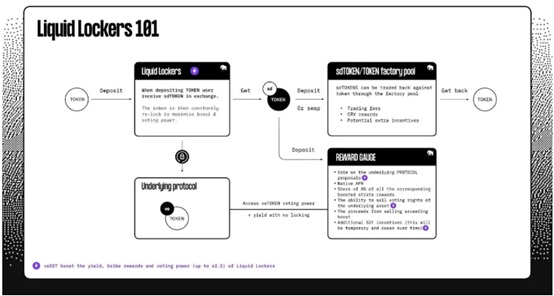
The Curve wars inspired a new paradigm of “metagovernance” veTokenomics that made governance tokens valuable by letting users lock them up for boosted yield and governance power, but at the cost of sacrificing liquidity.

Stake DAO, a seminal player in the Curve wars announced this week Liquid Lockers, which lets users supercharge their veTokenomics by leveraging their veTokens for yield, SDT incentives, and governance voting power without the same restrictions.

The feature is live and currently caters to CRV, FXS, ANGLE and BAL.

2. Cosmos DeFi gains traction

It’s ETH CC but it’s not always about Ethereum. Cosmonauts, this one is for you.

Osmos co-founder Sunny Aggarwal explains why builders (i.e. dYdX) are finding interchain DeFi like Cosmos increasingly attractive, for reasons like customized fee parameters (e.g. being able to pay fees in any token, charging higher fees for different types of transactions), custom execution models (e.g. experimenting with different virtual machines, multi-asset shielded pools), self-executing code (e.g. batched AMMs), custom transaction ordering and more.

Sebastien Couture, founder of Interop Ventures, also made the bull case for the Cosmos interchain with a focus on many top players in the ecosystem like Osmosis, Evmo, Kava and more.

DAOs

1. The Regen opportunity is here

How do you create Web3 systems and projects that are anti-fragile to shock events?

Kevin Owocki takes the mainstage on this important question (see also Kevin’s last week published Bankless piece Front-running The Regen Opportunity).

2. RetroPGF takes center stage

Karl Floresch, CTO of Optimism gave a lively talk on retroactive public goods funding where he shared how Optimism vision aligns positive impact to Web3 broadly with a profit reward to the individual.

That way, the creation of public goods becomes profitable to create. 🌱

3 Likes

3. DAO governance is hard

Stablenode’s Doo Wan Nam talks about some of the biggest challenges and best practices in DAO governance, while Aragon DAO’s Head of Ecosystem Ivan Fartunov dives into how infrastructural tooling can make up for these shortfalls.

The unsexy truth about running a DAO is that you’re operating in a highly uncertain space with a whole bunch of risks.

Culture

1. The Era of Web3 Social

Stani Kulechov, Founder and CEO of Aave and Lens, is leading the charge on decentralized social media. Lens lowers the barrier to build what we traditionally think of as “social media” on one, unified composable social graph protocol so user experience becomes the priority, rather than user acquisition and curating a moated network effect like in Web2.

If you scanned the POAP at the Lens booth, remember to collect your Lens handle!

2. Ethereum goes to Hollywood

Camila Russo, author of The Infinite Machine is producing Ethereum’s first Hollywood full feature film. Russo’s co-producer Alejandro Miranda confirmed that they were in the process of writing the script. And because this is a film about Web3, the production of the film itself is interwoven with Web3 aspects, for example letting you appear in the film if you mint an Infinite Machine Movie NFT.

See Camila on the Bankless podcast on Ethereum’s Hollywood Moment.

3. NFTs are the key to distribute community ownership

Finally, 3mint Founder Tom Borgers, talked about how NFTs started out as a luxury speculative good but will evolve into a credible way for commercial brands and content creators to acquire customers and fans, by giving real ownership to (loyal) users, tap into new communities through complementary partnerships and leverage new channels of distribution.

If you can’t tell, the week was jam-packed.

It was nearly impossible to cover everything.

But we do know that crypto is moving forward and progressing as fast as ever.

Bear markets are for building after all.

İlgili Okumalar

My Coding Betting Dashboard is Profiting, but Polymarket is Truly Not a Good Place for 'Arbitrage'

The author built a custom monitoring dashboard for Polymarket, a prediction market platform, and tested it with $1,600, achieving over 30% returns. However, the core argument is that Polymarket is not a good venue for traditional arbitrage. The dashboard has two main sections: a "Portfolio Dashboard" for tracking active positions with key metrics like total capital, P&L, and a risk-control module using a tier system (T1, T2, T3), and an "Opportunity Watchlist" for monitoring markets. The article details a critical structural trap in binary markets: a bet with a high perceived probability of success still carries a 100% loss risk if wrong. The author's T1/T2/T3 system is designed to manage this by limiting position sizes based on conviction and time horizon, emphasizing that high confidence should not equal high concentration. A key insight is the danger of "pseudo-diversification"—betting on different markets driven by the same underlying variable. The author concludes that Polymarket offers few true low-risk, arbitrage opportunities. It is instead a high-risk environment where wins can create a false sense of mastery, leading to large losses. The platform is better viewed as a training ground for honing judgment through disciplined, framework-driven betting rather than a reliable income source. The tools help transform intuition into structured, rule-based decisions to mitigate the risk of catastrophic errors.

marsbit55 dk önce

My Coding Betting Dashboard is Profiting, but Polymarket is Truly Not a Good Place for 'Arbitrage'

marsbit55 dk önce

WeChat AI Card Hands-On Guide: Has the AI Shopping Era Arrived?

**"WeChat AI Card" Practical Test Guide: Has the Era of AI Shopping Arrived?** WeChat has officially launched the "AI Exclusive Card," a feature integrated into its Workbuddy AI assistant. This card is designed to handle payments for AI-initiated purchases. Our hands-on test reveals it's not yet a tool for fully autonomous AI shopping, but rather a controlled payment layer for AI agents. The AI Card functions as an isolated sub-wallet within WeChat Pay. Users must bind the card and transfer funds into it from their main wallet. Crucially, every transaction requires explicit user confirmation via smartphone scan; AI cannot spend autonomously. Currently accessible through the Workbuddy agent, the card targets specific digital consumption scenarios: purchasing paid content (reports, data), calling paid APIs/tools, and subscribing to services. Its design prioritizes security and control by separating funds and mandating approval for each payment. We tested a real-world scenario: ordering bubble tea via Workbuddy using a "Meituan Life Assistant" skill. The process encountered multiple hurdles: high "skill" usage costs (exceeding daily free credits), and most importantly, while a payment was successfully initiated, the AI purchased an incorrect product (a mismatched group-buy coupon instead of the desired drink). This highlights the current limitation: the **AI Card only solves the payment step**. The broader challenge lies in the **AI agent's execution chain**—accurately understanding intent, navigating third-party platforms, selecting the right product, and ensuring proper fulfillment. The payment succeeded, but the purchase failed to meet the user's need. In conclusion, the WeChat AI Exclusive Card is a cautious, early-step experiment in AI commerce. It provides a secure, user-controlled payment method for agent interactions but is not yet capable of reliable, end-to-end complex purchases. For now, it's best used for low-value, low-risk digital services with careful user verification at each step. The vision of AI handling complete shopping tasks remains a work in progress.

marsbit3 saat önce

WeChat AI Card Hands-On Guide: Has the AI Shopping Era Arrived?

marsbit3 saat önce

Deconstructing Notion's Growth: From a Note-taking Tool to 100 Million Users—How Notion Built a Triple Growth Flywheel Through Product, Templates, and Community

Notion's growth from a niche note-taking tool to a platform with 100 million users is powered by three interconnected flywheels: Product-Led Growth (PLG), a Template Economy, and Community-Driven Growth. First, Notion's PLG strategy relies on a highly flexible, "plastic" product that users can adapt to countless personal and team workflows. Its freemium model lowers the barrier to entry, while features like page sharing and collaboration drive organic, usage-based viral growth as users naturally invite others. Second, the Template Economy solves the "blank page" problem. Templates, created by both Notion and its community, transform abstract product capabilities into concrete, copyable solutions for specific scenarios (e.g., project management, content calendars). This dramatically lowers activation costs for new users and fuels SEO-driven discovery. Third, a vibrant Community acts as a distributed growth engine. Users and official Ambassadors create tutorials, share use cases, and host local events. This community not only educates users but also fosters a sense of identity around pursuing "better ways of working," strengthening loyalty and enabling global, low-cost expansion. Together, these flywheels create a self-reinforcing ecosystem: a great product attracts users who create templates and community content, which in turn attracts more users and deepens engagement. This system allowed Notion to scale from individuals to teams and enterprises through a bottom-up adoption path. Looking ahead, AI integration promises to accelerate these flywheels further by making templates smarter and the platform a potential AI-native work operating system. Ultimately, Notion's defensible advantage is not just its features, but this deeply entrenched network of user assets, creators, and community trust.

marsbit3 saat önce

Deconstructing Notion's Growth: From a Note-taking Tool to 100 Million Users—How Notion Built a Triple Growth Flywheel Through Product, Templates, and Community

marsbit3 saat önce

$10 Billion, Qualcomm to Acquire Chip Legend Jim Keller's Company

Global mobile chip giant Qualcomm is in advanced talks to acquire AI chip startup Tenstorrent in a deal valued between $8-10 billion, according to media reports. This potential acquisition would be one of the largest in the AI chip sector in recent years. Tenstorrent, led by legendary chip architect Jim Keller, has gained prominence for its RISC-V architecture and AI accelerator designs. The move highlights Qualcomm's strategic push to diversify beyond its core smartphone chip business. As the smartphone market matures, Qualcomm is aggressively targeting growth in automotive, data center, and cloud AI. Acquiring Tenstorrent would allow Qualcomm to rapidly enter the high-end AI computing market, bypassing lengthy in-house development cycles. Tenstorrent's cost-effective system architecture, which avoids expensive HBM memory and relies on standard Ethernet for clustering, offers a potential alternative to Nvidia's costly solutions. Furthermore, Tenstorrent's high-performance RISC-V CPU technology and its focus on the automotive and edge computing segments align with Qualcomm's strategic goals, including its "Snapdragon Digital Chassis" platform. Despite the strategic rationale, the high valuation has sparked some investor caution. The successful integration of Tenstorrent's open-source culture and independent team into Qualcomm's organization, along with the commercialization of its technology, remains a key challenge.

marsbit4 saat önce

$10 Billion, Qualcomm to Acquire Chip Legend Jim Keller's Company

marsbit4 saat önce

İşlemler

Spot
Futures
活动图片