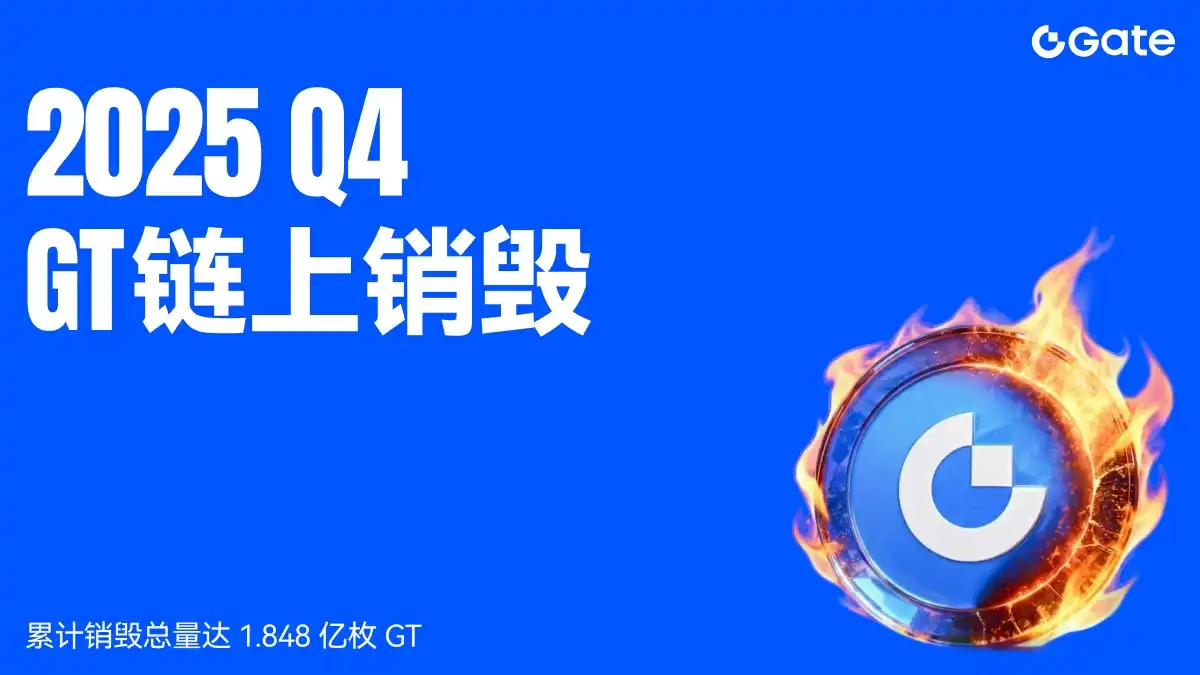
GateToken (GT) Menghancurkan 2,163,900 Koin pada Kuartal Keempat 2025, Membangun Struktur Ekonomi Token yang Lebih Kuat dalam Ekspansi Ekosistem

marsbitPubblicato 2026-01-08Pubblicato ultima volta 2026-01-08

Introduzione

Token Gate (GT) telah membakar 2.163.900 GT pada kuartal keempat 2025, dengan nilai lebih dari $26,92 juta. Total GT yang telah dihancurkan hingga saat ini mencapai 184.819.426, senilai lebih dari $1,9 miliar. Sejak peluncuran mainnet GateChain pada 2019, total pasokan GT telah berkurang sekitar 61,61% melalui mekanisme pembakaran berkelanjutan. Sebagai aset inti ekosistem Gate, GT berfungsi sebagai token utilitas dan gas fee di GateChain. Dengan pengembangan ekosistem Web3 seperti Gate Perp DEX, Gate Fun, dan Gate Swap, penggunaan GT dalam transaksi dan interaksi on-chain terus meningkat. Gate terus memperkuat model ekonomi token melalui mekanisme deflasi yang berkelanjutan, sejalan dengan strategi "All in Web3" mereka untuk membangun infrastruktur yang matang dan berkelanjutan. Didirikan pada 2013, Gate adalah salah satu platform perdagangan crypto terkemuka dengan lebih dari 47 juta pengguna dan mendukung 4.200+ aset kripto.

Menurut pengumuman resmi, penghancuran on-chain GateToken (GT) untuk Q4 2025 telah selesai dilakukan. Sebanyak 2,163,900.48229 GT telah ditransfer ke alamat penghancuran, dengan nilai penghancuran melebihi $26.92 juta. Hingga saat ini, total GT yang telah dihancurkan mencapai 184,819,426 koin, dengan total nilai penghancuran melebihi $1.901 miliar (dihitung berdasarkan harga saat ini).

Detail transaksi on-chain dapat dilihat di: https://etherscan.io/tx/0x03773d485c05dc26a541f5d74e15097d02e010dea34c5cc4f6d3a127ac0126ce

GT (GateToken) adalah token platform utama Gate dan aset native GateChain. Sebagai Utility Token dan token pembayaran Gas Fee di GateChain, GT mendukung sistem transfer dasar GateChain. Sejak peluncuran mainnet GateChain pada 2019, GT telah menerapkan mekanisme penghancuran berkelanjutan, dengan total suplai token telah berkurang sekitar 61.61% dari jumlah awal 300 juta koin.

Seiring dengan Gate Layer dan produk ekosistem Web3-nya memasuki tahap operasi stabil dan pengembangan skala besar, posisi fundamental GT di seluruh ekosistem Gate terus diperkuat. Berpusat pada aplikasi inti seperti Gate Perp DEX, Gate Fun, Meme Go, dan Gate Swap, Gate telah membangun sistem aplikasi Web3 yang lengkap yang mencakup perdagangan, penerbitan, likuiditas, dan interaksi on-chain, dengan aktivitas on-chain dan kebutuhan penggunaan nyata yang terus meningkat. Sebagai satu-satunya token Gas di Gate Layer, GT telah terintegrasi secara mendalam dalam operasi jaringan, eksekusi transaksi, dan interaksi aplikasi, dengan konsumsi on-chain dan skenario penggunaan yang terus berkembang seiring dengan ekspansi ekosistem.

Gate selalu berkomitmen untuk menjalankan rencana penghancuran GT, secara stabil memajukan proses deflasi dalam kerangka hukum dan kepatuhan. Melalui mekanisme penghancuran yang jangka panjang, stabil, dan berkelanjutan, Gate terus memperkuat atribut kelangkaan dan dasar nilai GT, menciptakan siklus positif yang lebih erat antara model ekonomi token dengan kebutuhan penggunaan on-chain yang nyata dan pertumbuhan ekosistem.

Pada saat yang sama, Gate tetap berpegang pada strategi All in Web3, terus memperdalam pembangunan infrastruktur dasar, memperluas skenario aplikasi perdagangan terdesentralisasi dan multi-rantai, serta memberikan pengalaman Web3 yang lebih aman, efisien, dan kaya bagi pengguna. Melalui sinergi antara mekanisme deflasi dan pembangunan ekosistem, Gate, sebagai pembangun jangka panjang, mendorong infrastruktur Web3 menuju jalur perkembangan yang lebih matang dan berkelanjutan.

Tentang Gate

Gate didirikan pada 2013 oleh Dr. Han sebagai CEO, dan merupakan salah satu platform perdagangan cryptocurrency terkemuka di dunia. Platform ini melayani lebih dari 47 juta pengguna dan mendukung perdagangan lebih dari 4.200 aset kripto. Sebagai tolok ukur industri, Gate merupakan yang pertama mencapai Proof of Reserves 100%, dengan ekosistem yang mencakup layanan diversifikasi seperti Gate Wallet dan Gate Ventures.

Untuk informasi lebih lanjut, kunjungi: Website | X | Telegram | LinkedIn | Instagram | YouTube

Penyangkalan:

Konten ini tidak构成构成任何邀约、招揽、或建议。Sebelum membuat keputusan investasi apa pun, Anda harus mencari saran profesional independen. Harap diperhatikan bahwa Gate dapat membatasi atau melarang semua atau sebagian layanan dari wilayah yang dibatasi. Silakan baca Perjanjian Pengguna untuk informasi lebih lanjut, tautan: https://www.gate.com/zh/user-agreement 。


Domande pertinenti

QBerapa jumlah GT yang dihancurkan oleh GateToken pada Q4 2025?

AGateToken menghancurkan total 2,163,900.48229 GT pada kuartal keempat tahun 2025.

QBerapa total nilai penghancuran GT hingga saat ini berdasarkan harga saat ini?

ATotal nilai penghancuran GT telah melebihi $1.901 miliar USD berdasarkan harga saat ini, dengan 184,819,426 GT yang telah dihancurkan secara kumulatif.

QApa peran utama GT (GateToken) dalam ekosistem GateChain?

AGT berfungsi sebagai Utility Token dan aset native GateChain, serta digunakan untuk membayar biaya gas dan mendukung sistem transfer dasar jaringan.

QBagaimana mekanisme penghancuran GT mempengaruhi model ekonomi token?

AMekanisme penghancuran yang konsisten memperkuat kelangkaan dan nilai dasar GT, menciptakan siklus positif dengan kebutuhan penggunaan on-chain dan pertumbuhan ekosistem.

QApa strategi utama Gate dalam pengembangan ekosistem Web3?

AGate menerapkan strategi All in Web3 dengan memperdalam infrastruktur dasar, memperluas skenario aplikasi on-chain terdesentralisasi, dan menyediakan pengalaman Web3 yang aman dan efisien.

Letture associate

The Trillion-Yuan Market Cap 'Yi Zhong Tian': Who is the True Value King?

The article analyzes the three leading Chinese optical module companies, collectively nicknamed "Yi Zhong Tian": Xinyisheng, Zhongji Innolight, and TFC Optical Communication. It evaluates their "cost-performance" not by current stock price, but through three lenses: PEG ratio (growth vs. valuation), earnings quality, and premium/discount for certainty. Xinyisheng shows the most attractive PEG ratio and high profitability, but its valuation reflects discounts for risks like high customer concentration and reliance on overseas markets. Zhongji Innolight, the most expensive, commands a premium for its market leadership, dominant share in key products like 800G/1.6T modules, and higher earnings certainty, though it faces geopolitical risks. TFC Optical, as an upstream component supplier ("water seller"), has the highest gross margin and bets on the long-term CPO/NPO architecture trend, but trades at a high valuation with more stable, less explosive growth. The core argument is that while these companies dominate module assembly, the true profit pool and technological moat lie upstream in laser and switch chips, currently controlled by U.S. firms like Lumentum and Coherent. The long-term "cost-performance" for these Chinese leaders hinges on whether the domestic industry, exemplified by companies like Yuanjie Technology, can successfully move up the value chain into high-power laser chips. Otherwise, their high growth may remain confined to the lower-margin assembly segment.

marsbit9 min fa

The Trillion-Yuan Market Cap 'Yi Zhong Tian': Who is the True Value King?

marsbit9 min fa

Has the Crypto Market Bottomed? Here's What Institutions Think

The crypto market is in a period of significant debate, with leading institutions offering differing views on whether a bottom has been reached. Three prominent firms have published detailed analyses: * **Galaxy Digital** argues Bitcoin has **not yet bottomed**. Their analysis of 13 historical indicators across six dimensions (valuation, profit-taking, miner pressure, etc.) shows only four are fully met. They project a potential bottom range between $30k and $54k. * **NYDIG** states a bottom is **possible but not likely**. While metrics are close to historic bear market extremes, they note the absence of a classic panic-selling event. They also suggest increased institutional adoption may have structurally altered the market cycle, potentially leading to a shallower downturn. * **Standard Chartered Bank** asserts the **bottom has already occurred** at around $59k. They cite two key factors: potential US-Iran diplomatic progress and the anticipated SpaceX IPO, which they believe absorbed capital and caused ETF selling pressure that is now subsiding. They forecast a year-end price target of $100k. Despite the surface-level disagreement, the reports share critical common ground more valuable for long-term investors: 1. All three believe the market bottom will form **within this year**. 2. All agree the current price is **closer to the bottom than to previous highs**. 3. All maintain a **bullish long-term outlook** for Bitcoin and a new cycle. The core takeaway is that while the exact bottom price ($40k, $50k, or $60k) is debated, the consensus is that a bottom is imminent. For long-term holders, the primary focus should not be pinpointing the absolute low, but on the future potential for prices to reach $100k, $200k, or higher. The fundamental thesis for Bitcoin—sovereign debt accumulation, inflation, declining trust in centralized institutions, global digitization, and improved accessibility—remains intact and is arguably strengthening. The overall landscape is viewed as more favorable than in previous crypto winters.

marsbit20 min fa

Has the Crypto Market Bottomed? Here's What Institutions Think

marsbit20 min fa

The 'Chip' Challenge and Breakthroughs in China's Optical Industry Chain

China's Photonics Industry: Bottlenecks and Breakthroughs In the global AI race, computing chips dominate the narrative, but the underlying bottleneck increasingly defining the scale of AI clusters is light—or more specifically, optical connectivity. Optical modules, which translate electrical signals to light and vice versa, are crucial for connecting thousands of GPUs in AI data centers, preventing data congestion and ensuring efficient model training. High-speed modules (800G, 1.6T) are now standard, with performance hinging on advanced DSP (Digital Signal Processor) chips. This is where a critical dependency lies. Two US giants—Marvell and Broadcom—collectively dominate over 90% of the high-end DSP chip market. Chinese optical module leaders like Zhongji Innolight and Eoptolink rely on these chips to manufacture modules for overseas AI customers, primarily in North America. While this creates a supply chain vulnerability, complete decoupling is difficult. Marvell derives over half its revenue from Greater China, and the US firms depend on Chinese partners for chip packaging and optical components. The risk from laser chips (e.g., from Lumentum), another key component, is considered more manageable due to multiple global suppliers and faster progress in domestic alternatives from companies like YOFC and Accelink. To mitigate risks, China's industry is pursuing a multi-pronged strategy: diversifying supply chains and locking in long-term orders; fostering a domestic market ecosystem to adopt homegrown DSPs from firms like Huawei HiSilicon and CETC; accelerating R&D in high-speed DSPs and advanced packaging; and investing in next-gen technologies like silicon photonics and Co-Packaged Optics (CPO) to reduce reliance on discrete DSPs. The ultimate solution lies not in short-term博弈 but in persistent advancement of domestic high-end chip R&D and manufacturing. While challenges remain in performance, certification, and ecosystem building, China's vast domestic market and manufacturing base provide a crucial buffer, buying time for the industry to achieve greater technological independence.

marsbit33 min fa

The 'Chip' Challenge and Breakthroughs in China's Optical Industry Chain

marsbit33 min fa

Behind SpaceX's $2 Trillion Market Cap: Why Does Musk Always Have the Next Move Planned?

On June 12th, SpaceX debuted on the Nasdaq, reaching a valuation that briefly touched $2 trillion. This marked the culmination of a 24-year journey from its founding in 2002, driven by Elon Musk's frustration at the high cost of buying rockets. The company's path was defined by early failures, with its first three Falcon 1 launches ending in explosions before a successful 2008 flight opened the era of commercial spaceflight. Key to its model was a fixed-price NASA contract, incentivizing cost reduction. SpaceX mastered rocket reusability, first achieving a Falcon 9 landing in 2015, which drastically cut launch costs. This enabled its profitable Starlink satellite internet constellation, envisioned years before reusability was proven, to create an internal market for frequent launches. Similarly, the next-generation Starship rocket was in development long before its first flight, with its business case evolving from Mars colonization to supporting the emerging concept of in-orbit data centers for AI—a story now central to its valuation. The company's recent IPO, a reversal of its long-standing "no IPO" stance, is funding this ambitious "space-based compute" vision. While major tech players like Google, Blue Origin, and others are investing heavily, significant technical and cost hurdles remain. Ultimately, SpaceX's history is one of creating its own demand: first with Starlink and now with space-based AI compute, betting that its next rocket will enable its next giant market.

marsbit36 min fa

Behind SpaceX's $2 Trillion Market Cap: Why Does Musk Always Have the Next Move Planned?

marsbit36 min fa

Trading

Spot
Futures

Articoli Popolari

Come comprare GT

Benvenuto in HTX.com! Abbiamo reso l'acquisto di Gatechain (GT) semplice e conveniente. Segui la nostra guida passo passo per intraprendere il tuo viaggio nel mondo delle criptovalute.Step 1: Crea il tuo Account HTXUsa la tua email o numero di telefono per registrarti il tuo account gratuito su HTX. Vivi un'esperienza facile e sblocca tutte le funzionalità,Crea il mio accountStep 2: Vai in Acquista crypto e seleziona il tuo metodo di pagamentoCarta di credito/debito: utilizza la tua Visa o Mastercard per acquistare immediatamente GatechainGT.Bilancio: Usa i fondi dal bilancio del tuo account HTX per fare trading senza problemi.Terze parti: abbiamo aggiunto metodi di pagamento molto utilizzati come Google Pay e Apple Pay per maggiore comodità.P2P: Fai trading direttamente con altri utenti HTX.Over-the-Counter (OTC): Offriamo servizi su misura e tassi di cambio competitivi per i trader.Step 3: Conserva Gatechain (GT)Dopo aver acquistato Gatechain (GT), conserva nel tuo account HTX. In alternativa, puoi inviare tramite trasferimento blockchain o scambiare per altre criptovalute.Step 4: Scambia Gatechain (GT)Scambia facilmente Gatechain (GT) nel mercato spot di HTX. Accedi al tuo account, seleziona la tua coppia di trading, esegui le tue operazioni e monitora in tempo reale. Offriamo un'esperienza user-friendly sia per chi ha appena iniziato che per i trader più esperti.

89 Totale visualizzazioniPubblicato il 2024.12.12Aggiornato il 2026.06.02

Come comprare GT

Discussioni

Benvenuto nella Community HTX. Qui puoi rimanere informato sugli ultimi sviluppi della piattaforma e accedere ad approfondimenti esperti sul mercato. Le opinioni degli utenti sul prezzo di GT GT sono presentate come di seguito.

活动图片












