Descifrando el repunte semanal del 35% de IOTA y los RIESGOS que aún persisten

ambcryptoPublished on 2026-01-06Last updated on 2026-01-06

Abstract

La criptomoneda IOTA mantiene una trayectoria alcista, con una subida del 35% en la semana y un 12% en las últimas 24 horas. Este impulso se debe al aumento de la actividad de desarrollo, las asociaciones estratégicas y las iniciativas de adopción empresarial, especialmente en comercio africano. El sentimiento de la comunidad es abrumadoramente alcista (96% de votos positivos), respaldado por indicadores técnicos como el MACD, que ha girado a positivo por primera vez desde octubre. Aunque el mercado de derivados muestra un fuerte interés comprador, hay ventas modestas en el mercado spot. La resistencia clave se sitúa en 0,19 dólares. El seguimiento comprador será crucial para sostener la tendencia.

La criptomoneda IOTA se ha mantenido en una trayectoria alcista, respaldada por una mayor actividad de desarrollo y la expansión de asociaciones.

La red ha continuado impulsando la adopción empresarial y regional, incluyendo iniciativas vinculadas al comercio africano y la infraestructura digital, lo que ha ayudado a fortalecer la confianza de los inversores.

La acumulación se refleja claramente en la acción del precio. Iota [IOTA] ha ganado un 12% en las últimas 24 horas, extendiendo su avance semanal al 35%.

El sentimiento del mercado se mantiene firmemente alcista, respaldado tanto por indicadores técnicos como por la participación de la comunidad.

El repunte está respaldado por la fortaleza de la comunidad

El rally coincidió con una clara mejora en el sentimiento de la comunidad. El seguimiento de datos de votación alcista y bajista mostró un aumento del 25% en los votos alcistas, lo que refleja una creciente confianza en la dirección a corto plazo de IOTA.

Al cierre de esta edición, el 96% de los votos de la comunidad se inclinaban hacia la tendencia alcista.

Ese panorama de sentimiento ayudó a reforzar las expectativas alcistas a medida que el precio probaba niveles más altos.

IOTA rompió por encima de un canal de resistencia descendente que había limitado las subidas desde octubre.

En el gráfico, la siguiente resistencia importante se situaba cerca de los 0,19 dólares, el nivel más alto de IOTA desde octubre de 2024. Un movimiento sostenido hacia ese nivel confirmaría la fortaleza tras la ruptura del canal.

Aun así, las compras de seguimiento seguían siendo esenciales para evitar un regreso al rango anterior.

Los indicadores apuntan a más subidas

Los indicadores técnicos también muestran claros signos de un momentum fortalecido. Los traders están posicionándose cada vez más para precios más altos a medida que aumenta la presión compradora.

La Convergencia y Divergencia de Medias Móviles (MACD) se ha vuelto positiva por primera vez desde octubre. La línea MACD ha cruzado por encima de la línea de señal, un movimiento que normalmente indica un momentum alcista creciente y el potencial de un movimiento alcista más fuerte.

El indicador de Acumulación/Distribución también se mantiene en territorio positivo. El volumen total de acumulación ha alcanzado los 32 mil millones, lo que refleja una actividad de compra sostenida en el mercado.

Estos niveles de acumulación sugieren que los inversores continúan construyendo posiciones en lugar de salir, aumentando la probabilidad de que IOTA pueda extender su rally en el corto plazo.

Sentimiento divergente entre los participantes del mercado

Sin embargo, el sentimiento divergió entre los segmentos del mercado.

En los mercados de derivados, las Tasas de Financiamiento y el Interés Abierto aumentaron conjuntamente, señalando una mayor demanda de exposición larga. La Tasa de Financiamiento Ponderada por el Interés Abierto se volvió positiva cerca del 0,0084%, reforzando el posicionamiento alcista entre los traders de perpetuos.

Por el contrario, la actividad en el mercado spot mostró ventas modestas. En las últimas dos semanas, las ventas en spot totalizaron aproximadamente 344.000 dólares, una cifra relativamente pequeña.

Ese desequilibrio dejó a la demanda de derivados y la acumulación como las fuerzas dominantes que moldean la tendencia a corto plazo de IOTA.


Reflexiones finales

  • La ruptura de IOTA ganó credibilidad gracias a la mejora del momentum y al fuerte posicionamiento en derivados, incluso cuando la demanda spot se quedó rezagada.
  • Si los compradores pueden mantener el seguimiento cerca de la resistencia clave podría decidir si este movimiento se convierte en una tendencia más amplia.


Trending Cryptos

Related Questions

Q¿Qué factores han apoyado la trayectoria alcista de IOTA según el artículo?

AEl aumento de la actividad de desarrollo y la expansión de asociaciones, incluidas iniciativas vinculadas al comercio africano y la infraestructura digital, han apoyado la trayectoria alcista de IOTA.

Q¿Cuánto ha ganado IOTA en la última semana y qué indica la acción del precio?

AIOTA ha ganado un 35% en la última semana, y la acción del precio refleja una acumulación clara por parte de los inversores.

Q¿Qué muestra el indicador Accumulation/Distribution y qué sugiere para el rally?

AEl indicador Accumulation/Distribution se mantiene en territorio positivo con un volumen de acumulación total de 32 mil millones, lo que sugiere que los inversores continúan acumulando posiciones y aumenta la probabilidad de que el rally se extienda a corto plazo.

Q¿Cómo divergió el sentimiento entre los mercados de derivados y el mercado spot?

AEn los mercados de derivados, las tasas de financiamiento y el interés abierto aumentaron, señalando una mayor demanda de exposición larga. Por el contrario, el mercado spot mostró ventas modestas, con liquidaciones de aproximadamente $344,000 en dos semanas.

Q¿Cuál es el nivel de resistencia clave que IOTA debe superar para confirmar su fortaleza?

AEl próximo nivel de resistencia clave se sitúa cerca de $0.19, que es el nivel más alto de IOTA desde octubre de 2024. Un movimiento sostenido hacia ese nivel confirmaría la fortaleza tras la ruptura del canal.

Related Reads

Gate Research Institute: Analysis of Chart Patterns and Breakout Trading Strategies

Gate Research Institute: Chart Pattern Analysis and Breakout Trading Strategies Chart patterns are crucial tools in technical analysis for observing market supply and demand shifts, trend continuations, and reversals. This analysis involves a comprehensive evaluation of trend, volume, support/resistance, time cycles, and breakout validity, not just rote pattern recognition. Patterns are broadly categorized into reversal patterns (e.g., Double Tops/Bottoms, Head and Shoulders) and continuation patterns (e.g., Flags, Triangles, Rectangles). An effective breakout, key for trading, requires clear support/resistance, prolonged consolidation, a prevailing trend backdrop, and volume confirmation. However, breakouts are not guaranteed, as false breakouts are common. Risk must be managed through position sizing, stop-loss orders, pullback confirmations, and profit-taking in stages. Key pattern types discussed include: * **Rectangle Patterns:** Indicate market indecision within parallel support and resistance, with breakouts projecting a move equal to the pattern's width. * **Flag & Pennant Patterns:** Short-term continuation patterns following sharp price moves ("flagpoles"). * **Triangle Patterns:** Symmetrical, Ascending (bullish bias), and Descending (bearish bias) triangles, representing consolidation before a directional move. * **Head and Shoulders Patterns:** Major reversal patterns signaling trend exhaustion. The article details breakout trading strategies, defining valid breakouts by price closing beyond a key level with increased volume and minimal immediate re-entry into the prior range. It contrasts range trading with breakout trading and outlines entry methods (immediate entry, pullback entry, scaling in), stop-loss placement (based on pattern failure), and profit-taking techniques (target-based, structure-based, trend-following). It further classifies breakout outcomes: 1. **Valid Breakouts:** Strong, sustained moves in the breakout direction. 2. **Pullback Breakouts:** Price breaks out, retests the breakout level as support/resistance, then resumes the trend—offering a lower-risk entry. 3. **False Breakouts:** Price briefly breaches a level but quickly reverses back into the prior range, a common risk managed by strict stop-losses. Key validation tools for breakouts include volume analysis, the principle of support/resistance role reversal, and momentum indicators like ATR, Moving Averages, Bollinger Bands, and RSI. In conclusion, while chart patterns and breakout analysis provide a structured framework, their effectiveness relies on multiple confirming factors—trend context, volume, and proper risk management. They should be integrated into a broader trading system rather than used as standalone signals.

marsbit15m ago

Gate Research Institute: Analysis of Chart Patterns and Breakout Trading Strategies

marsbit15m ago

Joseph Chalom: Ethereum is Becoming the "Settlement Layer of Trust" for Global Finance

In a speech titled "The Industrialization of Trust," Sharplink CEO Joseph Chalom (former BlackRock digital assets head) discussed the future transformation of global finance. Drawing from 20 years at BlackRock, where he led the launch of Bitcoin/ETH ETFs and tokenized funds, Chalom highlighted the immense hidden costs of establishing trust in traditional finance—estimated at over $9.3 trillion annually in the US alone due to fragmented systems, multi-day settlements, and countless reconciliations. He argued that Ethereum is emerging as the global financial "settlement layer for trust," with its robust, decentralized infrastructure securing over $300 billion in on-chain assets and most stablecoins and tokenized assets. The future, he stated, will be driven by three accelerating pillars: stablecoins (evolving beyond crypto gateways to become efficient cross-border payment rails), tokenized assets (enabling 24/7 trading and reshaping capital markets), and DeFi (providing automated, accessible financial services). A potential game-changer, Chalom added, is the fourth pillar: "Agentic Finance," where AI agents autonomously execute programmable financial transactions via smart contracts and stablecoins. He envisions individuals soon having AI-powered "CFOs in their pockets" to optimize idle capital and manage tokenized portfolios. This shift, facilitated by Ethereum's trustless settlement, could multiply on-chain transaction volume 1000x within a year, moving finance toward a seamless, digitized future.

marsbit15m ago

Joseph Chalom: Ethereum is Becoming the "Settlement Layer of Trust" for Global Finance

marsbit15m ago

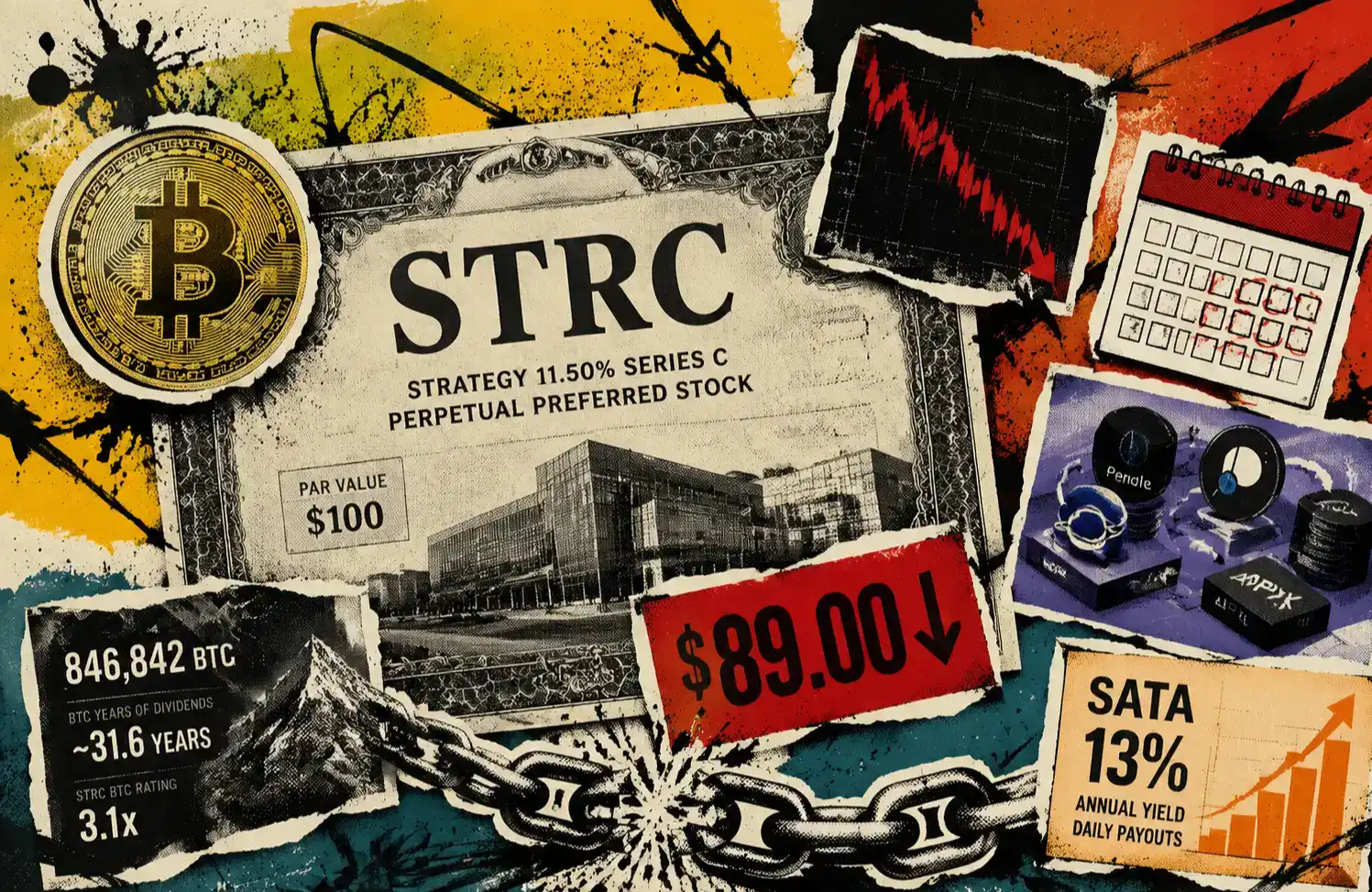
STRC Severely Unpegged, What Risks Is the Market Pricing In?

The article analyzes the recent significant de-pegging of Strategy's perpetual preferred stock, STRC, whose price fell to approximately $89, far below its $100 face value. This discount has pushed its simple yield to around 12.9%, creating a paradox. The stock was designed as a high-yield instrument trading near par, and Strategy maintains an 11.5% annual dividend, even recently switching to semi-monthly payments to support the price. The author explores several reasons why the high yield hasn't attracted enough buying pressure to restore the par value. A key factor is potential reverse deleveraging from carry trades, where leveraged investors may be forced to sell due to margin calls as the price falls, creating a self-reinforcing downward spiral. Additionally, the tokenization and integration of STRC into DeFi protocols (like Apyx, Saturn, Pendle) have introduced faster, more transparent, and potentially more volatile price adjustment mechanisms through leverage and yield-splitting products. The emergence of a competing product, Strive's SATA, offering a 13% yield with daily dividends, has also changed the yield benchmark, challenging STRC's unique high-yield narrative. Furthermore, the market is questioning the distinction between Strategy's substantial Bitcoin reserves, which provide long-term balance sheet coverage, and the certainty of stable near-term cash flow for dividends. Ultimately, the price dip represents a stress test for this type of BTC-backed, high-yield financing tool. The future path of STRC depends on whether Strategy acts to reinforce the $100 peg (e.g., by adjusting dividends), whether DeFi-related leverage unwinds further, and how investors ultimately price the risks of leverage, competition, and cash flow uncertainty against the offered yield.

marsbit26m ago

STRC Severely Unpegged, What Risks Is the Market Pricing In?

marsbit26m ago

LIT Token Hits Six-Month High: How Long Can the Buyback Flywheel Keep Burning Fuel?

The LIT token of decentralized perpetual exchange Lighter surged to a six-month high above $1.90 on June 18th, with a market cap of $425 million. After a price correction earlier this year, the recent rebound is attributed to its core "buyback flywheel" mechanism. All protocol fee revenue is used for programmatic, hourly market buybacks of LIT. Since its TGE in December 2025, approximately 15 million LIT (6% of circulating supply) has been repurchased for around $21 million. Additional price support comes from the LLP (Lighter Liquidity Pool), where providers must stake LIT worth 10% of their deposited USDC, locking significant token supply. However, challenges persist. Trading volume has declined amidst a sluggish market, with total volume at $1.68 trillion, significantly lower than leading competitor Hyperliquid's $4.37 trillion. While Lighter focuses on perpetual contracts, RWA, and Pre-IPO markets, Hyperliquid has expanded into prediction markets and boasts a U.S. spot ETF, attracting institutional investment and influencer endorsements like from Arthur Hayes. In contrast, LIT currently lacks similar high-profile backing. With 75% of LIT's total 1 billion supply still locked (team and investor tokens begin a 3-year linear unlock in December 2026), there is no immediate unlock selling pressure. The token's future performance hinges on sustaining trading volume growth, successful product iteration, and executing its transparent buyback strategy against a dominant competitor.

Foresight News46m ago

LIT Token Hits Six-Month High: How Long Can the Buyback Flywheel Keep Burning Fuel?

Foresight News46m ago

Trading

Spot
Futures

Hot Articles

How to Buy IOTA

Welcome to HTX.com! We've made purchasing IOTA (IOTA) simple and convenient. Follow our step-by-step guide to embark on your crypto journey.Step 1: Create Your HTX AccountUse your email or phone number to sign up for a free account on HTX. Experience a hassle-free registration journey and unlock all features.Get My AccountStep 2: Go to Buy Crypto and Choose Your Payment MethodCredit/Debit Card: Use your Visa or Mastercard to buy IOTA (IOTA) instantly.Balance: Use funds from your HTX account balance to trade seamlessly.Third Parties: We've added popular payment methods such as Google Pay and Apple Pay to enhance convenience.P2P: Trade directly with other users on HTX.Over-the-Counter (OTC): We offer tailor-made services and competitive exchange rates for traders.Step 3: Store Your IOTA (IOTA)After purchasing your IOTA (IOTA), store it in your HTX account. Alternatively, you can send it elsewhere via blockchain transfer or use it to trade other cryptocurrencies.Step 4: Trade IOTA (IOTA)Easily trade IOTA (IOTA) on HTX's spot market. Simply access your account, select your trading pair, execute your trades, and monitor in real-time. We offer a user-friendly experience for both beginners and seasoned traders.

1.9k Total ViewsPublished 2024.03.29Updated 2026.06.02

How to Buy IOTA

Discussions

Welcome to the HTX Community. Here, you can stay informed about the latest platform developments and gain access to professional market insights. Users' opinions on the price of IOTA (IOTA) are presented below.

活动图片