Bitcoin Price To Crash Another 50% As Analyst Marks $40,000 Bottom Target

bitcoinistPubblicato 2026-01-06Pubblicato ultima volta 2026-01-06

Introduzione

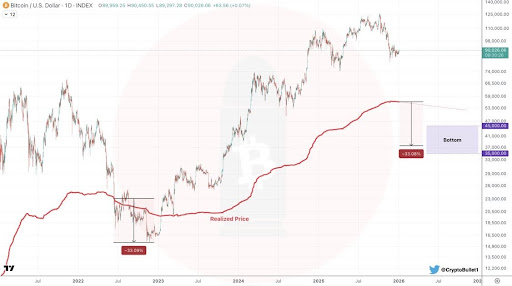
Bitcoin has declined over 32.5% from its all-time high above $126,000 and is currently trading above $90,000. However, analyst CryptoBullet predicts a further 50% crash in 2026, potentially driving the price down to around $40,000. This forecast is based on Bitcoin’s Realized Price—the average price at which all coins last moved—which has historically been breached during bear markets. Past cycles saw drawdowns of up to 66% below this level. Due to declining volatility, the analyst expects a less severe drop this cycle, estimating a 24–31% decline below the Realized Price, placing the bottom between $40,000 and $43,000. In an extreme scenario mirroring 2022’s 33% drop, Bitcoin could fall to $37,400 or even $35,000 by late 2026.

The Bitcoin price has already crashed by more than 32.5% from last year’s all-time high above $126,000, toward the $85,000 region. Although the cryptocurrency has recovered slightly and is now trading above $90,000, a crypto analyst has forecast another major price crash in 2026. According to the forecast, Bitcoin could decline by 50%, following trends observed in previous cycles, potentially hitting a bottom near $40,000.

Bitcoin Price Set For 50% Crash

Bitcoin could face another price correction as technical indicators continue to signal a strong bear market. Market expert CryptoBullet warns that Bitcoin’s bear market behavior is not over, with a deeper pullback aligning with long-term on-chain trends.

CryptoBullet bases his outlook on Bitcoin’s Realized Price, a metric that reflects the average price at which all circulating coins last moved. He explained that this level acts as a key reference during bear markets and has historically marked zones where price eventually breaks down before forming a bottom.

Looking at past cycles, he noted that Bitcoin has consistently fallen below its Realized Price during bear markets. The drawdowns reached 66% in 2011, 48% in 2015, 35% in 2018, and 33% in 2022, indicating a consistent tendency for prices to fall below this level. Due to this repeated decline, the analyst believes the next bear-market crash will follow the same pattern, triggering a 50% drop to $40,000 for Bitcoin this year.
Source: Chart from CryptoBullet on X

Another major factor supporting CryptoBullet’s analysis is Bitcoin’s declining volatility over time. He noted that the gap between market price and Realized Price has steadily narrowed, shrinking from a 66% deviation in 2011 to roughly 33% in 2022.

Because of this trend, the analyst does not expect the bear market this year to be as severe as the downside observed in past cycles. Instead, he estimates Bitcoin could fall by 24% to 31% below Realized Price, placing its likely bottom in the $40,000 to $43,000 range.

Extreme Bear Market Scenario

With the Realized Price currently near $56,000, CryptoBullet has also cautioned that Bitcoin could decline even further to below $40,000 this year. The analyst noted that if the market repeats the 2022 bear market, a 33% drop below Realized Price would place Bitcoin near $37,400.

He added that by the third quarter or fourth quarter of 2026, Realized Price could fall deeper to $53,000 or $54,000, which could result in a similar 33% crash, pushing Bitcoin closer to $35,000. The analyst has stated that $35,000 represents the most extreme downside he can reasonably see this year based on historical behavior. The accompanying chart also reflects this view by highlighting previous bear-market crashes that occurred after the price slipped well below the Realized Price line.

BTC trading at $93,079 on the 1D chart | Source: BTCUSDT on Tradingview.com

Domande pertinenti

QAccording to the analyst CryptoBullet, what is the main reason for predicting a 50% Bitcoin price crash to $40,000?

AThe prediction is based on Bitcoin's historical behavior of consistently falling below its Realized Price during bear markets, with the gap between market price and Realized Price having narrowed over time.

QWhat is the 'Realized Price' metric and why is it significant in this analysis?

AThe Realized Price is a metric that reflects the average price at which all circulating Bitcoin last moved. It acts as a key reference during bear markets and has historically marked zones where the price eventually breaks down before forming a bottom.

QWhat are the historical drawdown percentages below the Realized Price that the analyst cites for previous bear markets?

AThe historical drawdowns were 66% in 2011, 48% in 2015, 35% in 2018, and 33% in 2022.

QWhat is the most extreme downside price target for Bitcoin mentioned in the article, and under what scenario could it occur?

AThe most extreme downside target is $35,000. This could occur if the 2026 bear market repeats the 33% drop below the Realized Price seen in 2022, especially if the Realized Price itself falls to around $53,000-$54,000 by late 2026.

QHow does the analyst explain the decreasing severity of Bitcoin's bear market crashes over time?

AThe analyst notes that Bitcoin's declining volatility over time has caused the gap between its market price and Realized Price to steadily narrow, shrinking from a 66% deviation in 2011 to roughly 33% in 2022, making severe crashes less likely.

Letture associate

Why is Ethereum Urgently Needing ZK-ification?

The article discusses the urgent need for Ethereum to adopt zero-knowledge (ZK) technology as a core narrative for its future development. While Ethereum previously focused on ICOs, DeFi, and being a global financial settlement layer, it now lacks a compelling new narrative. ZK technology is highlighted as a critical solution, with Ethereum being the blockchain most invested in its development. ZK-EVM has reached the Alpha stage, a milestone celebrated by Vitalik Buterin. The primary motivation for ZK integration is to maintain Ethereum’s decentralization while improving scalability. Currently, increasing the Gas limit boosts TPS but raises node operation costs, potentially centralizing the network. ZK proofs allow nodes to verify transactions efficiently without expensive hardware upgrades, similar to automated exam grading versus manual checking. ZK itself doesn’t directly increase TPS but enables future Gas limit hikes with minimal node cost increases. The recent Fusaka upgrade, including PeerDAS, advances this goal. A ZK-powered Ethereum could achieve over 1000 TPS, strengthening its narrative. The article also addresses the role of third-party ZK teams (e.g., Polygon, Scroll, ZKsync, Taiko), which remain crucial for innovation and testing different ZK-EVM types (Type 1 to 4). ZK-VMs, like Brevis, are noted for higher performance and diversity, as they aren’t constrained by EVM compatibility. While ZK L1 may attract some L2 users, it also benefits L2s by reducing costs and improving foundational infrastructure. In summary, Ethereum’s ZK transformation, after years of development, is entering a critical phase, driven by collaborative efforts between Ethereum and external ZK projects.

marsbit10 min fa

Why is Ethereum Urgently Needing ZK-ification?

marsbit10 min fa

BSC Pop-up Store Style Memes: How Can They Compete with Solana?

The crypto market's high-beta phase has reignited the meme coin frenzy, with Solana and Binance Smart Chain (BSC) emerging as two dominant but divergent ecosystems. Solana leverages its high-speed, low-cost infrastructure (0.4s transaction time, ~$0.005 fees) and culture-first approach, epitomized by platforms like pump.fun, where memes evolve from community-driven narratives and often face rapid failure—over 98% of projects eventually collapse. Its top meme tokens, like BONK and WIF, thrive on viral momentum and decentralized innovation, but the ecosystem is highly competitive and transient. BSC, in contrast, relies heavily on central figures like CZ and He Yi, and its EVM compatibility attracts event-driven, sentiment-heavy trading—particularly within Chinese-speaking communities. While BSC memes can achieve rapid, concentrated pumps, they often lack longevity without ongoing influencer support. Data from Dexscreener (as of Jan 12, 2026) highlights key differences: Solana recorded 26.92M transactions ($8.65B volume) vs. BSC’s 5.9M ($7.80B), reflecting Solana’s retail-heavy, high-frequency trading versus BSC’s大户-dominated, narrative-centric rallies. Ultimately, Solana’s strength lies in its resilient, tool-rich culture, while BSC excels in short-term, liquidity-injected opportunities. The choice between chains depends on risk appetite: probability and algorithms on Solana, versus community sentiment and timing on BSC.

比推12 min fa

BSC Pop-up Store Style Memes: How Can They Compete with Solana?

比推12 min fa

Trading

Spot
Futures

Discussioni

Benvenuto nella Community HTX. Qui puoi rimanere informato sugli ultimi sviluppi della piattaforma e accedere ad approfondimenti esperti sul mercato. Le opinioni degli utenti sul prezzo di BTC BTC sono presentate come di seguito.

活动图片