Un OG Bitcoin déplace 100 000 Ethereum vers Binance, soulevant des questions sur son positionnement

bitcoinistPublished on 2025-12-25Last updated on 2025-12-25

Abstract

Un OG de Bitcoin a transféré 100 000 Ethereum (valant 292 millions de dollars) sur Binance, suscitant des interrogations sur ses intentions. Cette transaction intervient dans un contexte où l'ETH peine à retrouver des niveaux de prix plus élevés, face à une résistance persistante et à une incertitude générale sur le marché des cryptomonnaies. Plusieurs interprétations sont avancées : une gestion des risques face à la volatilité, une couverture de position, ou une réallocation tactique. Bien que le transfert ne confirme pas une vente immédiate, il indique une gestion active du portefeuille par ce trader influent, dont les mouvements antérieurs ont marqué le marché. La communauté surveille désormais si cette action annonce une pression vendeuse accrue ou s'inscrit dans une stratégie plus complexe, alors que le sentiment marché reste tendu et que les perspectives à moyen terme pour l'Ethereum pourraient se jouer dans les prochaines sessions.

Ethereum peine à retrouver des niveaux de prix plus élevés alors qu'une résistance persistante continue de freiner l'élan haussier. Après plusieurs tentatives de récupération infructueuses, l'ETH reste enfermé dans une structure fragile qui reflète l'incertitude plus large du marché des crypto-monnaies. Si les avis des analystes restent partagés sur les perspectives à court terme, une majorité croissante s'exprime de plus en plus sur le risque d'un marché baissier plus large émergeant en 2026, citant l'affaiblissement de l'élan, la détérioration du sentiment et la diminution de la liquidité comme signes avant-coureurs clés.

Dans ce contexte peu rassurant, l'activité on-chain a retenu une attention renouvelée. Les données suivies par Arkham montrent qu'un OG Bitcoin de premier plan — connu pour avoir correctement shorté le marché lors de la forte vente du 10 octobre — a effectué un mouvement significatif impliquant une position substantielle en Ethereum. L'ampleur et le timing de cette activité n'ont pas passé inaperçus, surtout compte tenu des antécédents du trader et de son influence sur le sentiment du marché.

La transaction a alimenté les spéculations sur l'intention. Certains participants au marché interprètent ce mouvement comme un repositionnement défensif face à un risque baissier croissant, tandis que d'autres y voient un ajustement calculé avant une volatilité accrue. Quelle que soit l'interprétation, les gros transferts d'entités bien connues ont tendance à avoir une valeur de signal, surtout lorsqu'ils se produisent pendant des périodes de fragilité technique.

Alors qu'Ethereum reste bloqué sous des niveaux de résistance clés, le marché surveille désormais de près pour voir si ce développement on-chain présage une nouvelle pression de vente ou signale un changement plus complexe dans le positionnement. Le sentiment étant déjà tendu, les prochaines séances pourraient s'avérer déterminantes pour la direction à moyen terme d'Ethereum.

Le transfert d'une baleine Ethereum déclenche des spéculations sur le positionnement

Les données on-chain partagées par Lookonchain ont signalé un mouvement important du soi-disant Bitcoin OG, un trader connu pour gérer une exposition longue massive de 717 millions de dollars sur Bitcoin, Ethereum et Solana. Le portefeuille associé à cette entité a déposé 100 000 ETH, d'une valeur d'environ 292 millions de dollars, sur Binance, attirant immédiatement l'attention des investisseurs et des analystes.

Compte tenu de la taille du transfert et de l'influence antérieure du trader sur le marché, la transaction est largement considérée comme un signal potentiel plutôt que comme une activité de routine.
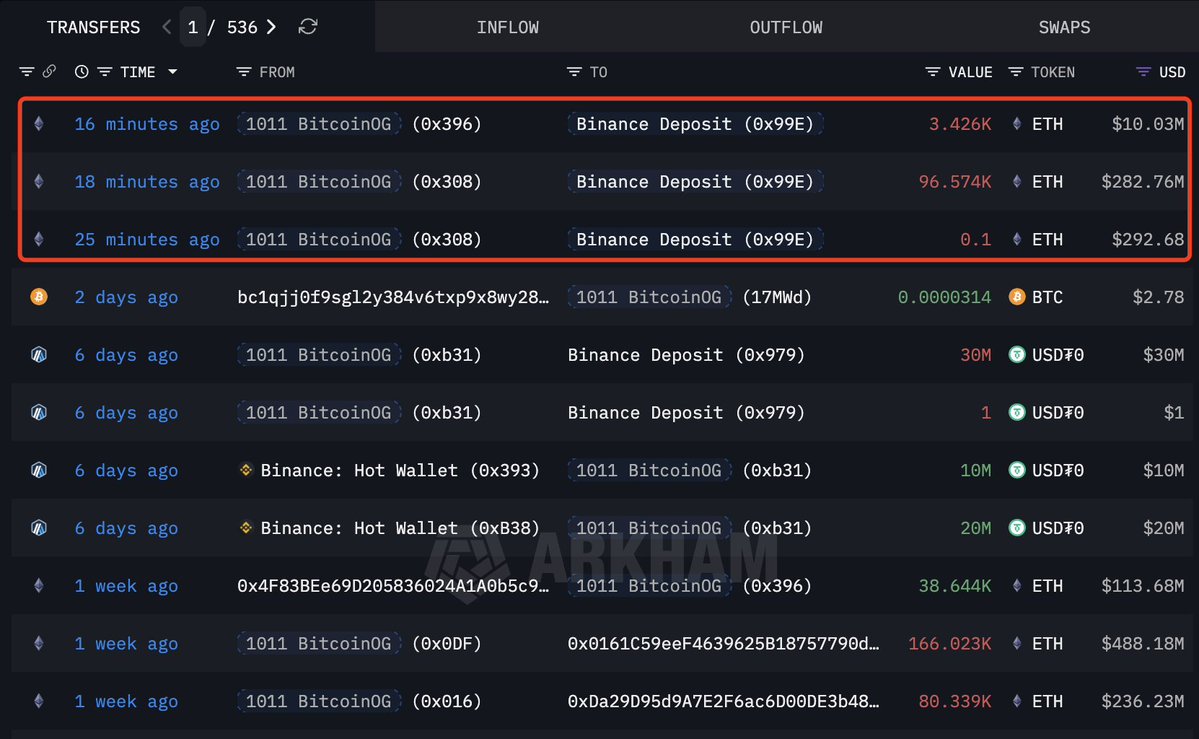
Transferts d'Ethereum du Bitcoin OG | Source : Arkham

Plusieurs scénarios se distinguent comme les explications les plus plausibles. Le plus simple est la gestion des risques. Déplacer des ETH vers un exchange permet au détenteur de réduire son exposition, soit en vendant des ETH au comptant, soit en ouvrant des couvertures via des produits dérivés pour protéger un portefeuille long existant en période de volatilité accrue. Une autre possibilité est la gestion des collatéraux. Les gros traders transfèrent souvent des actifs vers des exchanges pour soutenir les exigences de marge ou rééquilibrer l'effet de levier, surtout pendant les périodes de baisse des prix.

Des interprétations moins baissières restent également possibles. Le dépôt pourrait faire partie d'une opération tactique à court terme, permettant une exécution rapide sans signaler l'intention de dénouer complètement la position. Dans certains cas, les gros détenteurs déplacent des actifs entre dépositaires ou exchanges pour des raisons opérationnelles, bien que le timing rende cela moins probable.

En fin de compte, le dépôt ne confirme pas une vente pure et simple. Cependant, il suggère que le trader gère activement le risque. Alors qu'Ethereum reste sous pression technique, les marchés surveilleront de près pour voir si ce transfert d'ETH précède une distribution supplémentaire ou s'avère être un ajustement temporaire dans le cadre d'une stratégie à plus long terme plus large.


Trending Cryptos

Related Questions

QQui a transféré 100 000 Ethereum vers Binance et pourquoi cette transaction est-elle significative ?

AUn trader connu sous le nom de 'Bitcoin OG', réputé pour avoir correctement shorté le marché lors de la forte vente du 10 octobre, a transféré 100 000 ETH (d'une valeur d'environ 292 millions de dollars) sur Binance. Cette transaction est significative en raison de l'importance de la somme, de la réputation du trader et du timing dans un contexte de fragilité technique du marché.

QQuelles sont les interprétations possibles de ce transfert d'Ethereum vers Binance ?

ALes interprétations incluent : une gestion des risques pour réduire l'exposition ou couvrir un portefeuille long, une gestion des collatéraux pour ajuster un effet de levier, une manœuvre tactique à court terme, ou simplement des raisons opérationnelles. Le transfert ne confirme pas nécessairement une vente immédiate.

QQuel est le contexte actuel du marché d'Ethereum mentionné dans l'article ?

AEthereum peine à retrouver des niveaux de prix plus élevés en raison d'une résistance persistante qui freine son élan haussier. Le marché est caractérisé par une structure fragile, une incertitude généralisée, un momentum qui s'affaiblit, un sentiment qui se dégrade et une liquidité qui diminue, avec des risques croissants d'un marché baissier en 2026.

QQuelle est la taille du portefeuille géré par le trader 'Bitcoin OG' et quels actifs détient-il ?

ALe trader 'Bitcoin OG' gère une exposition longue massive de 717 millions de dollars répartis sur Bitcoin, Ethereum et Solana.

QComment le marché réagit-il à ce transfert et que surveillent les investisseurs pour la suite ?

ALe marché surveille de près ce développement on-chain pour voir s'il annonce une pression de vente renouvelée ou s'il s'agit d'un ajustement temporaire dans une stratégie à long terme. Les prochaines séances de trading pourraient être déterminantes pour la direction à moyen terme d'Ethereum, d'autant plus que le sentiment est déjà tendu.

Related Reads

CPU Makes a Comeback to the Table, A $170 Billion "Power Seizure" Drama Begins

A new era is dawning for the server CPU (Central Processing Unit), driven by the shift from AI model training to large-scale reasoning and the rise of Agentic AI. This article explores how the CPU is reclaiming a central role in the AI data center. For years, the focus has been on the GPU (Graphics Processing Unit) for AI training. However, as AI moves to the inference and Agent phase—where tasks involve complex, multi-step reasoning, tool calls, and data management—the workload balance is flipping. Studies show CPUs now handle over 70% of the workload in Agentic AI, up from 10-30% in training. This is because Agent tasks generate massive intermediate data (KV Cache) that exceeds GPU memory, forcing it to be offloaded to the CPU's larger, more scalable memory pools. This increased importance is translating into market changes. Major players are taking note: NVIDIA launched its first standalone CPU line, Vera, based on ARM architecture and optimized for Agent performance. AMD doubled its server CPU market forecast to over $1200 billion by 2030. Analyst reports project the total server CPU market could reach $1700 billion by 2030, with AI-driven demand being a primary driver. Furthermore, the classic ratio of CPUs to GPUs in AI servers is rapidly changing, converging from 1:8 toward 1:1 for Agent deployments. This surge in demand has led to a rare industry-wide price increase of 10-15% for server CPUs from Intel and AMD, breaking a decade-long trend of "more performance for the same price." Demand is bifurcating into high-core-count CPUs for in-rack GPU support and moderate-core CPUs for standalone Agent task orchestration. In China, this global trend presents an opportunity for domestic CPU manufacturers like Hygon (海光信息) and Huawei Kunpeng, who are bolstered by both growing AI infrastructure needs and national policies promoting technological self-reliance ("xin chuang"). The maturity of their software ecosystems is also accelerating, evidenced by faster adaptation to new AI models. In conclusion, the narrative is shifting from a GPU-centric view to one where CPU-GPU synergy is critical. The CPU is no longer a peripheral component but a performance-defining bottleneck and a key growth driver in the AI hardware stack, opening a massive new market estimated in the hundreds of billions of dollars.

marsbit9h ago

CPU Makes a Comeback to the Table, A $170 Billion "Power Seizure" Drama Begins

marsbit9h ago

TechFlow Intelligence: AMD AI Director Publicly Criticizes Claude Code for "Becoming Dumber and Lazier", Trump Claims Full Ceasefire in Hormuz But Strait Still Has 80 Unexploded Mines

TechFlow Intelligence Report: This daily digest covers key developments in AI, crypto, hardware, and geopolitics. In AI, SK Telecom faces US export control scrutiny over its partnership with Anthropic, while a Gemini user reports being misled in a scam scenario, sparking safety debates. China's Z.AI launches the GLM-5.2 model, rivaling Claude Opus without NVIDIA chips. In crypto, Bithumb lists ReProtocol, and Upbit delists KernelDAO. On the hardware front, MIT researchers build a custom OS to study chips, ASML denies US claims its advanced lithography machines are in China, and Amazon considers selling its in-house AI chips. Apple's future A21 Pro chip may use TSMC's latest N2P process. Major tech issues include 10,000 GitHub repositories distributing malware and Apple patching a critical eavesdropping flaw in Beats earbuds. US stocks rise, led by semiconductors, with Intel surging 10.6%, while SpaceX falls 3.5%. Geopolitically, despite a US-Iran deal, the Strait of Hormuz remains risky with ~80 uncleared mines, stalling 80M barrels of oil on standby tankers. Iran postpones Switzerland talks, and Trump calls the agreement an "unconditional surrender." The report highlights a contrast: temporary geopolitical calm versus the ongoing, fundamental restructuring of tech supply chains and chip independence.

marsbit9h ago

TechFlow Intelligence: AMD AI Director Publicly Criticizes Claude Code for "Becoming Dumber and Lazier", Trump Claims Full Ceasefire in Hormuz But Strait Still Has 80 Unexploded Mines

marsbit9h ago

Trading

Spot
Futures

Hot Articles

What is $BITCOIN

DIGITAL GOLD ($BITCOIN): A Comprehensive Analysis Introduction to DIGITAL GOLD ($BITCOIN) DIGITAL GOLD ($BITCOIN) is a blockchain-based project operating on the Solana network, which aims to combine the characteristics of traditional precious metals with the innovation of decentralized technologies. While it shares a name with Bitcoin, often referred to as “digital gold” due to its perception as a store of value, DIGITAL GOLD is a separate token designed to create a unique ecosystem within the Web3 landscape. Its goal is to position itself as a viable alternative digital asset, although specifics regarding its applications and functionalities are still developing. What is DIGITAL GOLD ($BITCOIN)? DIGITAL GOLD ($BITCOIN) is a cryptocurrency token explicitly designed for use on the Solana blockchain. In contrast to Bitcoin, which provides a widely recognized value storage role, this token appears to focus on broader applications and characteristics. Notable aspects include: Blockchain Infrastructure: The token is built on the Solana blockchain, known for its capacity to handle high-speed and low-cost transactions. Supply Dynamics: DIGITAL GOLD has a maximum supply capped at 100 quadrillion tokens (100P $BITCOIN), although details regarding its circulating supply are currently undisclosed. Utility: While precise functionalities are not explicitly outlined, there are indications that the token could be utilized for various applications, potentially involving decentralized applications (dApps) or asset tokenization strategies. Who is the Creator of DIGITAL GOLD ($BITCOIN)? At present, the identity of the creators and development team behind DIGITAL GOLD ($BITCOIN) remains unknown. This situation is typical among many innovative projects within the blockchain space, particularly those aligning with decentralized finance and meme coin phenomena. While such anonymity may foster a community-driven culture, it intensifies concerns about governance and accountability. Who are the Investors of DIGITAL GOLD ($BITCOIN)? The available information indicates that DIGITAL GOLD ($BITCOIN) does not have any known institutional backers or prominent venture capital investments. The project seems to operate on a peer-to-peer model focused on community support and adoption rather than traditional funding routes. Its activity and liquidity are primarily situated on decentralized exchanges (DEXs), such as PumpSwap, rather than established centralized trading platforms, further highlighting its grassroots approach. How DIGITAL GOLD ($BITCOIN) Works The operational mechanics of DIGITAL GOLD ($BITCOIN) can be elaborated on based on its blockchain design and network attributes: Consensus Mechanism: By leveraging Solana’s unique proof-of-history (PoH) combined with a proof-of-stake (PoS) model, the project ensures efficient transaction validation contributing to the network's high performance. Tokenomics: While specific deflationary mechanisms have not been extensively detailed, the vast maximum token supply implies that it may cater to microtransactions or niche use cases that are still to be defined. Interoperability: There exists the potential for integration with Solana’s broader ecosystem, including various decentralized finance (DeFi) platforms. However, the details regarding specific integrations remain unspecified. Timeline of Key Events Here is a timeline that highlights significant milestones concerning DIGITAL GOLD ($BITCOIN): 2023: The initial deployment of the token occurs on the Solana blockchain, marked by its contract address. 2024: DIGITAL GOLD gains visibility as it becomes available for trading on decentralized exchanges like PumpSwap, allowing users to trade it against SOL. 2025: The project witnesses sporadic trading activity and potential interest in community-led engagements, although no noteworthy partnerships or technical advancements have been documented as of yet. Critical Analysis Strengths Scalability: The underlying Solana infrastructure supports high transaction volumes, which could enhance the utility of $BITCOIN in various transaction scenarios. Accessibility: The potential low trading price per token could attract retail investors, facilitating wider participation due to fractional ownership opportunities. Risks Lack of Transparency: The absence of publicly known backers, developers, or an audit process may yield skepticism regarding the project's sustainability and trustworthiness. Market Volatility: The trading activity is heavily reliant on speculative behavior, which can result in significant price volatility and uncertainty for investors. Conclusion DIGITAL GOLD ($BITCOIN) emerges as an intriguing yet ambiguous project within the rapidly evolving Solana ecosystem. While it attempts to leverage the “digital gold” narrative, its departure from Bitcoin's established role as a store of value underscores the need for a clearer differentiation of its intended utility and governance structure. Future acceptance and adoption will likely depend on addressing the current opacity and defining its operational and economic strategies more explicitly. Note: This report encompasses synthesised information available as of October 2023, and developments may have transpired beyond the research period.

399 Total ViewsPublished 2025.05.13Updated 2025.05.13

What is $BITCOIN

Discussions

Welcome to the HTX Community. Here, you can stay informed about the latest platform developments and gain access to professional market insights. Users' opinions on the price of BTC (BTC) are presented below.

活动图片