HBAR se consolida cerca de mínimos mientras los expertos trazan posibles escenarios de rebote a corto plazo

bitcoinist2025-12-17 tarihinde yayınlandı2025-12-17 tarihinde güncellendi

Özet

El token HBAR de Hedera cotiza cerca de sus niveles más bajos en más de un año, reflejando la debilidad general del mercado y desafíos específicos del proyecto. Tras una caída constante, se consolida en un rango estrecho, con traders debatiendo si es una base para un rebote o una continuación de la tendencia bajista. El precio cayó a $0.11–$0.12 tras no mantener el soporte de $0.125, con volumen elevado en intentos fallidos de superar $0.119–$0.120. Los indicadores de momentum siguen bajistas, y los datos on-chain muestran una reducción en el valor total bloqueado y en la supply de stablecoins. Los analistas están divididos: algunos prevén un rebote por condiciones de sobreventa hacia $0.12–$0.14, mientras otros advierten riesgo de caída a $0.10 si no se mantienen los soportes actuales.

El token HBAR de Hedera cotiza cerca de sus niveles más bajos en más de un año, reflejando tanto la debilidad general del mercado de criptomonedas como factores adversos específicos del proyecto.

Tras una caída constante durante noviembre y diciembre, HBAR ha entrado en un estrecho rango de consolidación, y los traders debaten si la pausa actual marca una base para un rebote a corto plazo o una continuación de la tendencia bajista.

La acción del precio reciente indica una creciente actividad en torno a niveles técnicos clave, a pesar de indicadores fundamentales mixtos.
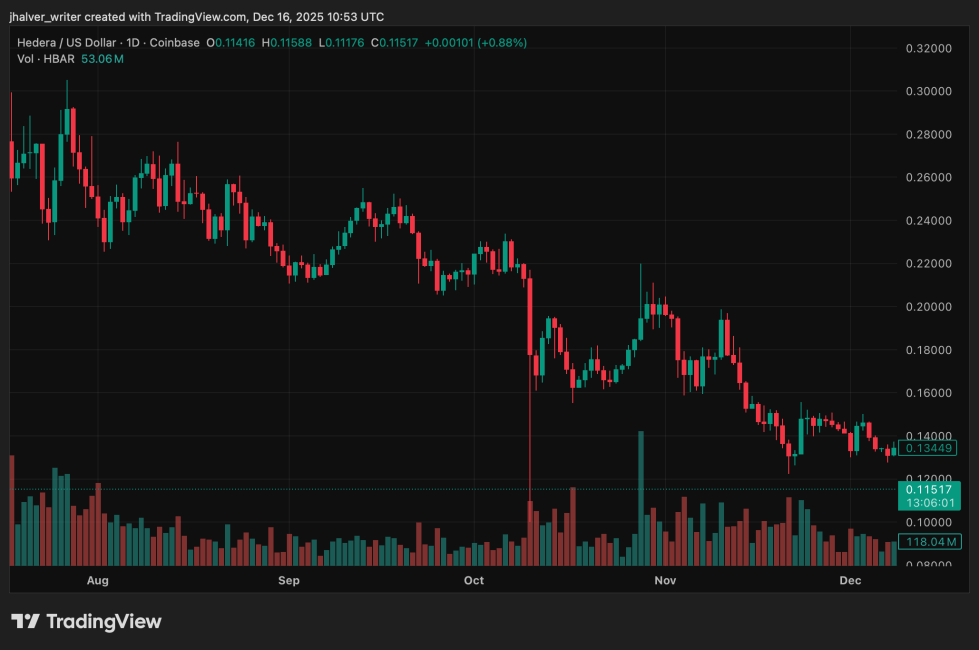
La tendencia del precio de HBAR es a la baja en el gráfico diario. Fuente: Gráfico HBARUSD en Tradingview

HBAR cae a mínimos de varios meses mientras aumenta la presión de venta

HBAR cayó a alrededor de $0.11–$0.12 esta semana después de no poder mantenerse por encima de la zona de soporte de $0.125, un nivel que había actuado como suelo varias veces a principios de año. La caída coincidió con un retroceso más amplio del mercado, ya que Bitcoin y las principales altcoins se debilitaron ante eventos macro globales, incluidas las decisiones del Senado de EE. UU.

Los datos de trading muestran que el volumen aumentó bruscamente durante los intentos de recuperar la resistencia cerca de $0.119–$0.120, lo que sugiere una distribución activa en lugar de una acumulación sostenida.

La estructura del mercado se ha vuelto decididamente bajista en las sesiones recientes. HBAR ahora cotiza por debajo de las medias móviles clave, e indicadores de momentum como el RSI y el MACD continúan apuntando a la baja.

Los datos on-chain y del ecosistema también han pesado sobre el sentimiento, con el valor total bloqueado (TVL) de Hedera disminuyendo significativamente desde máximos anteriores y la oferta de stablecoins en la red reduciéndose en los últimos meses.

Los picos de volumen muestran zonas clave de soporte y resistencia

A pesar de la tendencia bajista general, los patrones de volumen recientes han llamado la atención de los traders a corto plazo. Durante una sesión, el volumen de HBAR aumentó más del 80% por encima de su promedio diario cuando el precio probó la resistencia cerca de $0.119.

El rechazo desencadenó otra ola de ventas, pero la actividad al final de la sesión mostró un renovado interés de compra cuando el precio se acercó al área de $0.112–$0.113. Esta zona ahora se considera un soporte inmediato, con un nivel psicológico más profundo alrededor de $0.10 actuando como la siguiente referencia a la baja si las ventas se reanudan.

Al alza, los analistas observan la banda de $0.119–$0.122 como una resistencia crítica. Se necesitaría una ruptura clara por encima de este rango para cambiar la estructura a corto plazo y abrir la puerta a un movimiento hacia máximos anteriores cerca de $0.13.

Los analistas se dividen entre un rebote por sobreventa y un mayor riesgo a la baja

Algunos analistas técnicos argumentan que HBAR se acerca a condiciones de sobreventa, señalando un momentum bajista debilitado y signos de rupturas de líneas de tendencia en timeframes más bajos. Estas señales han alimentado escenarios de rebote a corto plazo que apuntan al rango de $0.12 a $0.14, siempre que el soporte continúe manteniéndose.

Otros permanecen cautelosos, señalando una demanda estancada para los productos de inversión recientes vinculados a Hedera y una desaceleración del crecimiento del ecosistema. Desde esta perspectiva, no poder defender los niveles actuales podría exponer a HBAR a una repetición de la prueba de $0.10, un nivel visto por última vez durante eventos de liquidación anteriores.

Imagen de portada de ChatGPT, gráfico de HBARUSD de Tradingview

Trend Kriptolar

İlgili Sorular

Q¿Cerca de qué niveles clave se está consolidando HBAR según el artículo?

AHBAR se está consolidando cerca de los niveles de soporte clave de $0.11–$0.12, tras no poder mantenerse por encima de la zona de soporte de $0.125.

Q¿Qué factores, además de la debilidad general del mercado, han presionado a la baja el precio de HBAR?

AAdemás de la debilidad general del mercado, los vientos en contra específicos del proyecto, como la disminución del valor total bloqueado (TVL) de Hedera y la reducción de la oferta de stablecoins en la red, han pesado sobre el sentimiento.

QSegún los datos de trading, ¿qué indicó el aumento de volumen cerca de la resistencia de $0.119–$0.120?

AEl aumento de volumen cerca de la resistencia de $0.119–$0.120 sugirió una distribución activa por parte de los vendedores, en lugar de una acumulación sostenida por parte de los compradores.

Q¿Qué dos niveles son cruciales para el movimiento futuro del precio según el análisis técnico presentado?

ALos dos niveles cruciales son el soporte inmediato en la zona de $0.112–$0.113 (y un nivel psicológico más profundo en $0.10) y la resistencia crítica en la banda de $0.119–$0.122.

Q¿Cuáles son los dos escenarios principales que los analistas están considerando para HBAR a corto plazo?

ALos analistas están divididos entre un posible rebote debido a condiciones de sobreventa, con objetivos en el rango de $0.12 a $0.14, o un mayor riesgo a la baja que podría llevar el precio a probar el nivel de $0.10.

İlgili Okumalar

Weekly Editor's Picks (0725-0731)

Weekly Editor's Picks (0725-0731) provides a curated selection of deep analysis, filtering out market noise. Key themes from this week include: **Macro & Policy:** The Federal Reserve's upcoming meeting is marked by high uncertainty, balancing cooling inflation data against persistent price pressures. Meanwhile, the U.S. crypto regulatory Clarity Act faces critical political hurdles, with its 2026 passage probability seen as low. **Investing & Crypto:** Analysis suggests long-term crypto success depends on conviction through volatile cycles, focusing on assets like Bitcoin and core smart contract platforms. A trend noted is the increasing similarity between global equity markets (especially tech) and crypto, driven by narrative and leverage. Several major crypto protocols show strong revenue growth, but this isn't always translating to token price appreciation due to sell pressure and structural factors. **AI & Semiconductors:** Nvidia's rising credit default swap rates signal market concern over AI infrastructure financing risks. The storage sector experienced volatility as markets began pricing in potential 2027 oversupply. Despite a record profitable quarter, SK Hynix's results were deemed "below expectations," reflecting heightened investor demands for future growth visibility. **Markets & DeFi:** TradeXYZ demonstrated remarkable accuracy in pre-market pricing for a major A股 listing. The token ONDO saw gains, linked to its growing role in the on-chain tokenized stock ecosystem. **Ethereum:** Post-Pectra upgrade, a major structural shift is underway as Lido begins migrating millions of ETH to new validator architectures designed for capital efficiency. **Also Highlighted:** Butian's bullish stock market move; OpenAI's Altman promising major advances; Samsung and SK Hynix securing large AI chip deals; Apple reaching a $5T market cap; and ongoing discussions around exchange security following Poolin's bankruptcy case.

marsbit32 dk önce

Weekly Editor's Picks (0725-0731)

marsbit32 dk önce

Low Investment Isn't Apple's Immunity Pass

While Meta and Google face investor scrutiny over ballooning AI capital expenditures, Apple's minimal AI investment has paradoxically become a strength. Its market cap recently reclaimed the global top spot, surpassing $5 trillion. The irony is deep: Apple's own AI efforts have lagged, with "Apple Intelligence" delayed and core talent lost, forcing reliance on partners like Google Gemini and Alibaba's Qianwen. Its Q3 FY2026 (Q2 CY) earnings initially seemed stellar. Revenue hit $109.4B (up 16% YoY), with iPhone and Mac sales, growing 22% and 29% respectively, driving most of the growth. However, the stock fell over 8% post-earnings. The primary concern was a weaker Q4 revenue growth forecast of 9-11%, below expectations, due to looming supply chain constraints. Apple is feeling the indirect cost of the AI boom. Soaring memory and chip prices, fueled by massive data center investments from Microsoft, Amazon, and others, are forcing Apple to raise Mac and iPad prices significantly. The upcoming iPhone launch is also expected to see substantial price hikes. Despite avoiding heavy AI infrastructure spending—its capital expenditures are actually down 28%—Apple cannot escape the industry-wide supply and cost pressures. While Apple's operating cash flow remains robust, its substantial R&D spending (up 32% YoY) has yet to yield major AI breakthroughs. As Tim Cook prepares to step down as CEO, Apple faces a challenging transition: balancing its premium hardware success against the strategic and cost pressures of the AI era it has so far cautiously navigated.

marsbit1 saat önce

Low Investment Isn't Apple's Immunity Pass

marsbit1 saat önce

PA Graphics Explanation | One Chart to Understand the Major Web3 Events in August 2026

**PANews Crypto Calendar: Key Web3 Events in August 2026** PANews introduces its revamped crypto calendar, featuring comprehensive coverage, flexible filtering, and easy export options. The market in August will be shaped by multiple key events across macroeconomics, regulation, tokenomics, and project developments: * **Macro & Policy:** Key US economic data releases (July Non-Farm Payrolls, CPI), the Federal Reserve meeting minutes, and the Jackson Hole Economic Symposium will be in focus. On the regulatory front, the US Senate plans to release a new draft of the *CLARITY Act*, while the EU's expanded crypto ban against Belarus comes into effect. * **Token Unlocks:** Significant token unlocks are scheduled for assets including ENA, AVAX, CONX, ZRO, and KAITO, which may influence market volatility. * **Project Updates & Shutdowns:** Several services, including Exchange Art, Ctrl Wallet, Zapper, NFTfi, and Summer.fi, are set to cease operations or undergo major adjustments. Users are advised to manage their assets accordingly. * **Corporate Activity:** Q2 earnings reports from companies like SpaceX, Circle, and Nvidia are due. Unitree Robotics will initiate its IPO subscription on the STAR Market, and Moonshot AI plans to begin a Pre-IPO financing round. * **Industry Events:** Major conferences such as Bitcoin Asia 2026 and the 2026 Digital Expo will take place. The overarching market narrative for August will revolve around macroeconomic expectations, regulatory developments, token unlock schedules, and ongoing industry consolidation.

marsbit1 saat önce

PA Graphics Explanation | One Chart to Understand the Major Web3 Events in August 2026

marsbit1 saat önce

Wall Street's Most Famous 'Cassandra' Now Has His Sights Set on Nvidia

Michael Burry, the famed "Big Short" investor, has once again captured Wall Street's attention with a series of short positions against major tech and semiconductor stocks, most notably Nvidia. In late June and July, through his "Cassandra Unchained" newsletter, Burry disclosed short bets against Nvidia, Tesla, Applied Materials, Caterpillar, the SOXX semiconductor ETF, and later, Micron Technology. His core thesis revolves around potential distortions in the AI infrastructure boom, specifically questioning whether extended depreciation schedules (e.g., 6 years vs. a realistic 2-3 years for AI chips) by cloud giants like Microsoft and Google artificially inflate profits. He also raises concerns about possible "off-balance-sheet circular financing," where chip demand might be propped up by vendor-backed funding to clients. Nvidia's stock experienced volatility following these disclosures, briefly dipping but largely holding near Burry's reported entry points, leaving his positions roughly flat or slightly underwater as of late July. This move is part of a pattern for Burry, whose track record since his legendary 2008 bet is mixed. He has faced notable losses, such as on Tesla in 2021, while scoring on broader market turns like the 2020 pandemic crash. His methodology focuses intensely on free cash flow and scrutinizing original financial documents to spot overvaluation and structural risks, but it often struggles with timing the market. The article contrasts Burry's stance with other prominent investors. Steve Eisman, another "Big Short" figure, is not shorting Nvidia, citing strong fundamentals but expressing nervousness about sustainability. Jim Chanos agrees with the broad "accounting mismatch" concern—comparing it to the dot-com bubble—but targets financial leverage in private equity firms rather than the chip stocks themselves. While Nvidia's short interest remains relatively low at 1.3-1.4% of float, the massive stock size means absolute short losses have been significant, exceeding $5 billion earlier this year. The piece concludes that for ordinary investors, the key takeaway is not replicating specific short bets but learning from the critical frameworks these investors use: questioning rosy accounting, identifying structural vulnerabilities, and maintaining skepticism during market euphoria, even if pinpointing the exact catalyst for a downturn remains elusive.

marsbit1 saat önce

Wall Street's Most Famous 'Cassandra' Now Has His Sights Set on Nvidia

marsbit1 saat önce

İşlemler

Spot

Popüler Makaleler

HBAR Nasıl Satın Alınır

HTX.com’a hoş geldiniz! Hedera Hashgraph (HBAR) satın alma işlemlerini basit ve kullanışlı bir hâle getirdik. Adım adım açıkladığımız rehberimizi takip ederek kripto yolculuğunuza başlayın. 1. Adım: HTX Hesabınızı OluşturunHTX'te ücretsiz bir hesap açmak için e-posta adresinizi veya telefon numaranızı kullanın. Sorunsuzca kaydolun ve tüm özelliklerin kilidini açın. Hesabımı Aç2. Adım: Kripto Satın Al Bölümüne Gidin ve Ödeme Yönteminizi SeçinKredi/Banka Kartı: Visa veya Mastercard'ınızı kullanarak anında Hedera Hashgraph (HBAR) satın alın.Bakiye: Sorunsuz bir şekilde işlem yapmak için HTX hesap bakiyenizdeki fonları kullanın.Üçüncü Taraflar: Kullanımı kolaylaştırmak için Google Pay ve Apple Pay gibi popüler ödeme yöntemlerini ekledik.P2P: HTX'teki diğer kullanıcılarla doğrudan işlem yapın.Borsa Dışı (OTC): Yatırımcılar için kişiye özel hizmetler ve rekabetçi döviz kurları sunuyoruz.3. Adım: Hedera Hashgraph (HBAR) Varlıklarınızı SaklayınHedera Hashgraph (HBAR) satın aldıktan sonra HTX hesabınızda saklayın. Alternatif olarak, blok zinciri transferi yoluyla başka bir yere gönderebilir veya diğer kripto para birimlerini takas etmek için kullanabilirsiniz.4. Adım: Hedera Hashgraph (HBAR) Varlıklarınızla İşlem YapınHTX'in spot piyasasında Hedera Hashgraph (HBAR) ile kolayca işlemler yapın.Hesabınıza erişin, işlem çiftinizi seçin, işlemlerinizi gerçekleştirin ve gerçek zamanlı olarak izleyin. Hem yeni başlayanlar hem de deneyimli yatırımcılar için kullanıcı dostu bir deneyim sunuyoruz.

353 Toplam GörüntülenmeYayınlanma 2024.12.11Güncellenme 2026.06.02

HBAR Nasıl Satın Alınır

Tartışmalar

HTX Topluluğuna hoş geldiniz. Burada, en son platform gelişmeleri hakkında bilgi sahibi olabilir ve profesyonel piyasa görüşlerine erişebilirsiniz. Kullanıcıların HBAR (HBAR) fiyatı hakkındaki görüşleri aşağıda sunulmaktadır.

活动图片













