YouTube active les paiements en stablecoin PYUSD pour les créateurs américains : Rapport

cointelegraphPublished on 2025-12-12Last updated on 2025-12-12

Abstract

YouTube permet désormais aux créateurs basés aux États-Unis de recevoir leurs paiements en PYUSD, le stablecoin de PayPal, selon un rapport. Cette fonctionnalité, confirmée par la responsable crypto de PayPal, May Zabaneh, simplifie l'adoption des cryptomonnaies pour YouTube, qui n'a pas à gérer directement les actifs numériques. Le PYUSD, lancé en 2023, a connu une croissance significative, passant de 500 millions de dollars en janvier à 3,9 milliards de dollars aujourd'hui. Cette décision marque un virage pour YouTube, qui avait précédemment restreint le contenu crypto, et pourrait booster l'adoption des stablecoins grâce à l'énorme audience de la plateforme.

Le géant du partage de vidéos YouTube aurait activé pour les créateurs basés aux États-Unis la possibilité de recevoir des paiements en stablecoin PYUSD de PayPal.

Fortune a rapporté jeudi que la responsable crypto de PayPal, May Zabaneh, a déclaré que cette fonctionnalité est active, mais uniquement pour les utilisateurs aux États-Unis. L'entreprise a intégré la capacité pour les bénéficiaires d'accepter des paiements en PYUSD plus tôt cette année, et YouTube a finalement choisi d'offrir cette option à ses créateurs.

« La beauté de ce que nous avons construit est que YouTube n'a pas à toucher aux cryptomonnaies, nous pouvons donc aider à supprimer cette complexité », a-t-elle déclaré.

PayPal entretient une relation de longue date avec YouTube, la plateforme permettant depuis de nombreuses années aux utilisateurs de payer via ses services, tout en l'utilisant pour les paiements AdSense des créateurs.

YouTube pourrait se réchauffer à la cryptomonnaie, après son historique d'ombreportage du contenu crypto, alors que les actifs numériques se frayent un chemin dans le grand public. Cette mesure pourrait également être un avantage potentiel pour l'adoption des stablecoins, compte tenu de la taille de la plateforme YouTube.

En relation : Visa teste des paiements en stablecoin financés en fiat pour les entreprises américaines

Le marché des stablecoins a explosé au cours de l'année écoulée alors que les entreprises grand public, les institutions et les gouvernements ont commencé à intégrer ces actifs à la finance traditionnelle.

PYUSD a été lancé mi-2023 et a une capitalisation boursière actuelle de 3,9 milliards de dollars selon les données de CoinGecko. Sa valeur marchande a grimpé en flèche depuis le début de l'année, passant d'environ 500 millions de dollars en janvier.
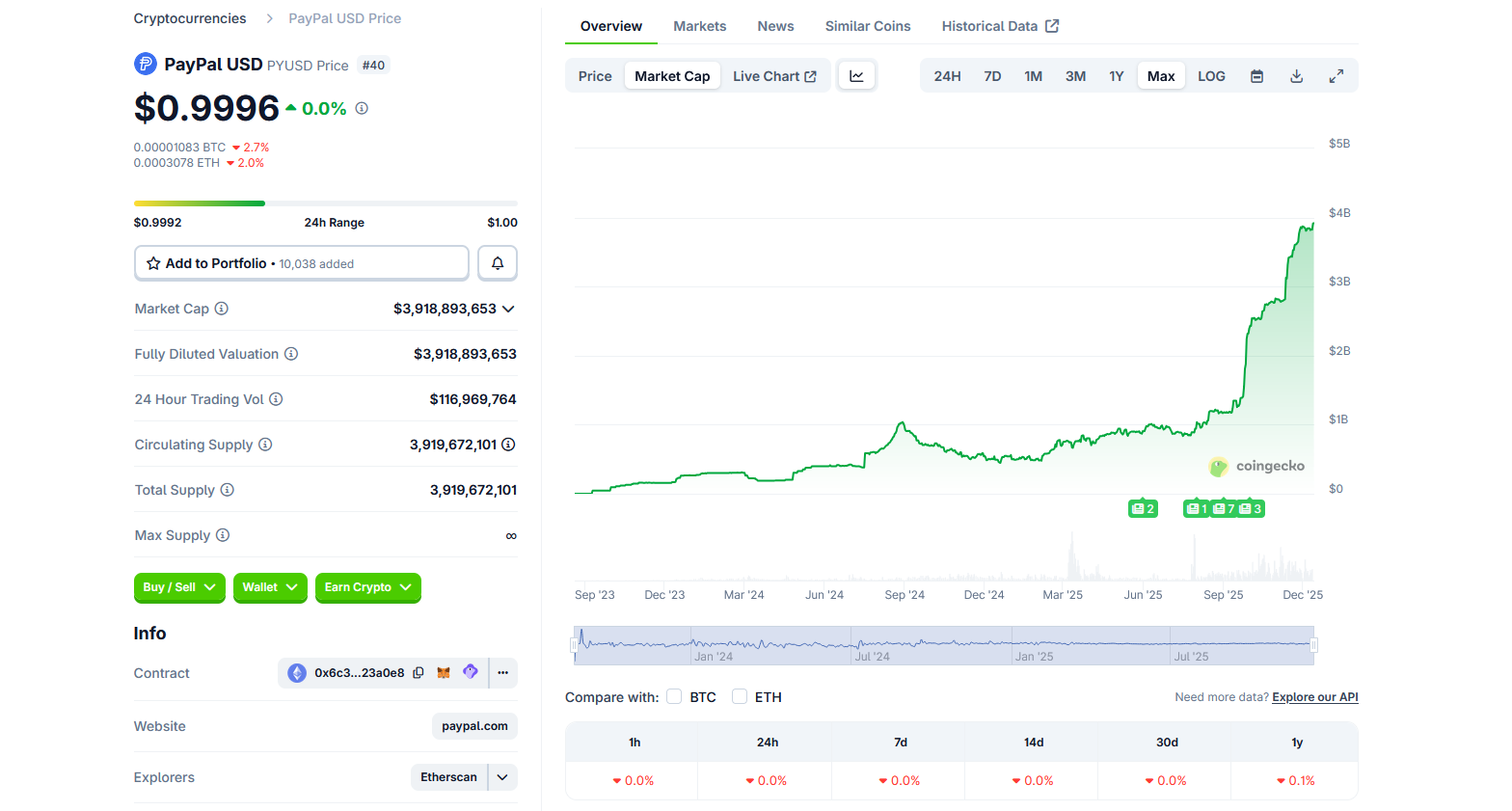
Capitalisation boursière de PYUSD. Source : CoinGecko

Une part importante de la croissance de PYUSD est intervenue depuis le début du mois de septembre, lorsque la capitalisation boursière était d'environ 1 milliard de dollars. Au cours de ce mois, PYUSD a été intégré aux marchés de prêt de Spark et à Stable de Bitfinex, une blockchain de stablecoin de qualité institutionnelle.
Magazine : Les stablecoins connaîtront une croissance explosive en 2025 alors que le monde adopte cette classe d'actifs


Related Questions

QQuelle est la nouvelle fonctionnalité offerte par YouTube aux créateurs américains selon l'article ?

AYouTube permet désormais aux créateurs basés aux États-Unis de recevoir leurs paiements en PYUSD, la stablecoin de PayPal.

QQui a annoncé cette intégration et quelle est son avantage principal pour YouTube ?

AMay Zabaneh, responsable crypto de PayPal, a annoncé cette fonctionnalité. L'avantage principal est que YouTube n'a pas à manipuler directement les cryptomonnaies, PayPal gérant toute la complexité technique.

QQuel est le montant de la capitalisation boursière actuelle du PYUSD selon CoinGecko ?

ALa capitalisation boursière actuelle du PYUSD est de 3,9 milliards de dollars selon les données de CoinGecko.

QPourquoi ce mouvement de YouTube est-il significatif pour l'adoption des cryptomonnaies ?

ACe mouvement est significatif car YouTube, après avoir historiquement restreint les contenus liés à la crypto, adopte maintenant une stablecoin, ce qui pourrait booster son adoption grâce à l'énorme audience de la plateforme.

QQuels événements ont contribué à la croissance du PYUSD depuis septembre ?

ALa croissance du PYUSD depuis septembre est attribuée à son intégration sur les marchés de prêt de Spark et sur Stable, la blockchain de stablecoin institutionnelle de Bitfinex.

Related Reads

What Wall Street Really Wants After the Crypto Story Recedes

The tide of speculative crypto narratives has receded, revealing Wall Street's true objective: building a controlled, yield-generating, and compliant financial pipeline on distributed ledgers. They are migrating core functions onto blockchains, not for decentralization, but for efficiency and new revenue streams. Key developments include BlackRock's BUIDL fund, a tokenized treasury fund acting as a foundational reserve asset, and the rise of Securitize, which is going public and partnering with the NYSE to build a 24/7 digital securities trading and settlement system. This signals a major shift of securities clearing to blockchain technology. To make volatile assets like Bitcoin palatable for institutional investors, firms like BlackRock and Goldman Sachs are creating "covered call" ETFs (e.g., BITA). These products systematically sell options on Bitcoin holdings, transforming price volatility into stable monthly income, effectively repackaging crypto as a yield-bearing asset. Stablecoins are being positioned not as speculative tools but as efficient payment rails. Companies like Stripe and Mastercard are integrating them for instant, low-cost merchant settlements and cross-border card payments, respectively. Critically, new legislation like the GENIUS Act shapes them as non-interest-bearing, heavily regulated extensions of the US dollar system. In summary, Wall Street is quietly constructing a parallel, blockchain-based financial infrastructure featuring tokenized traditional assets, structured crypto yields, and programmable dollar pipelines—all under its control and fully integrated with existing regulatory and credit frameworks.

marsbit11m ago

What Wall Street Really Wants After the Crypto Story Recedes

marsbit11m ago

Tying Itself to SpaceX: Cursor's $60 Billion Rise

This article recounts the rapid rise of AI-powered coding startup Cursor and its 25-year-old MIT graduate CEO, Michael Truell. Launched in 2023, Cursor achieved explosive growth, reaching over 10 billion USD in revenue by late 2025. However, its journey highlights a central dilemma for AI application companies: dependence on foundational model providers. Cursor initially relied heavily on Anthropic's models but faced an existential threat when Anthropic launched its own competing coding tool, Claude Code. In response, Cursor declared an internal emergency in early 2026 and accelerated development of its own model, Composer. To secure the immense computing power needed, Truell struck a pivotal deal with Elon Musk's SpaceX in April 2026. The collaboration grants Cursor access to SpaceX's supercomputing resources for Composer, while SpaceX's Grok model benefits from Cursor's programming data. The agreement includes a potential 600 billion USD acquisition of Cursor by SpaceX later in the year, though a substantial termination fee is in place if the deal falls through. The story explores Cursor's intense, sometimes controversial hiring practices involving lengthy unpaid "work trials," its complex partnership-turned-rivalry with Anthropic, and its high-stakes gamble to ensure independence through the SpaceX alliance. The core question remains: will Cursor evolve into a defining, independent "generational" software company, or become a key piece in a tech giant's AI arsenal?

marsbit15m ago

Tying Itself to SpaceX: Cursor's $60 Billion Rise

marsbit15m ago

Warsh's Debut: Will the FED Chair Who Knows Crypto Best Bring Surprises or Shocks to the Market?

Kevin Warsh, the new Federal Reserve Chairman, prepares for his inaugural press conference amidst a challenging macroeconomic landscape: resurgent inflation, a bond market sell-off, and political pressure from President Trump for rate cuts. Uniquely, Warsh holds indirect investments in over 20 crypto and Web3 entities (e.g., Solana, dYdX), making him the first Fed Chair with disclosed crypto exposure. His stance may combine a hawkish, inflation-focused monetary policy with a crypto-friendly regulatory philosophy that shifts from Powell’s “same risk, same rule” approach toward a framework acknowledging blockchain’s productivity value. Warsh’s leadership could impact crypto markets across three dimensions: a paradigm shift in regulation (potentially accelerating pro-innovation legislation and stable币 rules), a re-pricing of risk premiums based on clearer communication and his view of AI as a structural disinflationary force, and a long-term reallocation of global institutional capital driven by increased legitimacy. Two potential scenarios for the press conference are outlined. A “positive surprise” would involve a dovish-leaning tone on rates coupled with signals of regulatory openness, potentially boosting crypto asset valuations. Conversely, a “negative shock” would see a more hawkish-than-expected stance on inflation and rates, triggering a broad risk-asset selloff that crypto markets would not escape. While ethics rules required Warsh to divest his crypto holdings upon confirmation, his deep understanding of the technology may fundamentally lower policy uncertainty and build a more receptive long-term foundation for digital assets’ integration into the mainstream financial system.

marsbit10h ago

Warsh's Debut: Will the FED Chair Who Knows Crypto Best Bring Surprises or Shocks to the Market?

marsbit10h ago

Trading

Spot
Futures

Hot Articles

How to Buy US

Welcome to HTX.com! We've made purchasing Talus Network (US) simple and convenient. Follow our step-by-step guide to embark on your crypto journey.Step 1: Create Your HTX AccountUse your email or phone number to sign up for a free account on HTX. Experience a hassle-free registration journey and unlock all features.Get My AccountStep 2: Go to Buy Crypto and Choose Your Payment MethodCredit/Debit Card: Use your Visa or Mastercard to buy Talus Network (US) instantly.Balance: Use funds from your HTX account balance to trade seamlessly.Third Parties: We've added popular payment methods such as Google Pay and Apple Pay to enhance convenience.P2P: Trade directly with other users on HTX.Over-the-Counter (OTC): We offer tailor-made services and competitive exchange rates for traders.Step 3: Store Your Talus Network (US)After purchasing your Talus Network (US), store it in your HTX account. Alternatively, you can send it elsewhere via blockchain transfer or use it to trade other cryptocurrencies.Step 4: Trade Talus Network (US)Easily trade Talus Network (US) on HTX's spot market. Simply access your account, select your trading pair, execute your trades, and monitor in real-time. We offer a user-friendly experience for both beginners and seasoned traders.

4.9k Total ViewsPublished 2025.12.11Updated 2026.06.02

How to Buy US

Discussions

Welcome to the HTX Community. Here, you can stay informed about the latest platform developments and gain access to professional market insights. Users' opinions on the price of US (US) are presented below.

活动图片