In-Depth Research Report on Prediction Markets: The Liquidity Paradigm, Industry Leap, and the New Primitives Revolution

HTX LearnPubblicato 2025-12-04Pubblicato ultima volta 2025-12-04

Introduzione

Prediction markets began with academic and betting-exchange experiments such as the Iowa Electronic Markets (IEM) and platforms like Betfair, then evolved into Ethereum-based on-chain experiments such as Augur, and more recently matured into today's duopoly structure dominated by, on one side, the decentralized route represented by Polymarket and, on the other, the regulated financial route represented by Kalshi, while in vertical domains like sports, crypto-assets and creator economy, new platforms such as Opinion, Limitless and PMX Trade have emerged. The innovation with real potential is shifting from “building another platform” toward the primitive-level commoditization and infrastructure construction of event contracts — encompassing perpetuals, options, indices, lending, and “smart AMMs” built around YES/NO shares; as well as the so-called “pickaxe business" such as data terminals, aggregation routing, bots, middleware, and compliance-tech. In the future, prediction markets may evolve into the “information-pricing layer” embedded in social media, news platforms, and financial terminals — with entrepreneurial and investment opportunities concentrated in key infrastructure directions like oracles and contract­ governance, liquidity and capital efficiency, distribution and interaction, as well as compliance and AI integration.

I. Historical Evolution & Industry Landscape of Prediction Markets

Prediction markets are mechanisms for pricing future events and have evolved from academic experiments and gray betting exchanges to independently recognized asset-class markets combining informational value, liquidity scale, and financial attributes in the past more than three decades. Their core structure is “price as probability" — using real money to reflect the aggregate judgment of market participants about the likelihood of a given event. A binary contract settled by 1 U.S. dollar or 0 U.S. dollar, traded between 0 and 1 U.S. dollar, directly reflects the market consensus. For example, a contract priced at 0.62 U.S. dollar implies the market estimates roughly a 62% chance the event will occur. Such markets — which aggregate the views of decentralized participants using real money — effectively create a quantifiable, verifiable, and real-time public information good. Unlike purely recreational gambling or house-structured binary options, they serve as hybrid information financial infrastructure, combining market efficiency, collective intelligence, and dynamic trading capabilities. Rather than a zero-sum gambling game, prediction markets generate “positive-sum information output”: Platforms typically collect only small fees while the core value comes from the aggregated probability signal produced by the market. That signal can be referenced by media, used by research institutions, leveraged by enterprises for risk management, or directly embedded in other financial derivatives or Web3 protocols as pricing nodes, giving it strong externalities and societal value.

The roots of modern prediction markets trace back to the Iowa Electronic Markets (IEM), launched in 1988 at the University of Iowa. This was an early experiment led by academic institutions, allowing participants to trade small-stake contracts that represented a candidate’s winning probability or vote-share, with a clear aim to enhance the accuracy of prediction. Numerous studies show that between 1988 and 2004, the Iowa Electronic Markets (IEM) outperformed most conventional polls in predicting U.S. presidential elections, with its probability signals often showing real trends earlier.
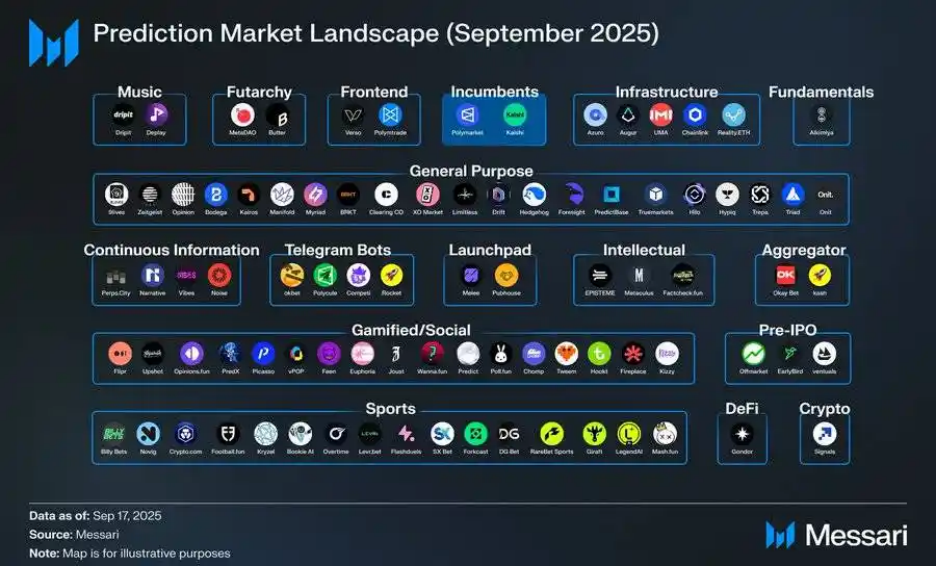
The real industrial-scale leap for prediction markets was driven by a new generation of platforms emerging under the maturity of Layer-2, stablecoins, and cross-chain infrastructure after 2020, epitomized by the “duopoly structure” formed by Polymarket and Kalshi in 2024–2025. Polymarket marks the full maturity of the decentralized route: Built on Polygon and multi-chain expansions, it adopts an order-book (CLOB) model, enables low-friction deposits, gas-free trades, and uses UMA-style optimistic oracles to deliver a user experience that is both seamless and censorship-resistant. During the 2024 U.S. Presidential Election, its monthly trading volume reportedly reached as high as $2.6 billion, and yearly aggregate trades surpassed tens of billions of dollars. Its viral impact across media and social-network channels created a flywheel featuring “opinion → position → dissemination”, making Polymarket the go-to platform for Web3 users entering prediction markets. Even after regulatory pressure from the CFTC, Polymarket repositioned itself for the U.S. market by acquiring the licensed exchange QCEX, further underscoring that compliance has become a core direction for the sector. In parallel, Kalshi represents a completely different path: a compliance-first approach, regulatory certainty, and deep penetration into mainstream finance channels. In 2021, Kalshi was designated as a Designated Contract Market (DCM) by the Commodity Futures Trading Commission (CFTC), and subsequently secured a Derivatives Clearing Organization (DCO) license, thus becoming an event-contract exchange fully compliant under U.S. federal regulation. Its centralized matching structure resembles that of traditional exchanges: It supports USD and USDC deposits and offers event contracts directly on mainstream investor interfaces through partnerships with brokers like Robinhood. After the 2025 surge in sports and macroeconomic event contracts, Kalshi’s weekly trading volume reportedly climbed to $800-900 million, with market share reaching 55–60%, cementing its role as the de facto domestic infrastructure for U.S. prediction markets. Unlike Polymarket's on-chain openness, Kalshi's strength lies in compliance certainty, which attracts institutional participation, builds brand trust, and enables distribution via traditional channels. However, Polymarket and Kalshi together form an orthogonal dual core of "on-chain composability‘’ and ”compliant usability”.

Beyond the duopoly, a wave of new platforms and vertical-market experiments has rapidly emerged, further expanding the market boundaries. For instance, leveraging BSC-ecosystem traffic and airdrop incentives, Opinion reportedly reached hundreds of millions of dollars in volume within its first week of launch; Limitless (on Base chain) uses short-cycle price-prediction markets to meet the demand of crypto traders for volatility exposure; in the Solana ecosystem, PMX Trade tokenizes Yes/No contracts, exploring a deep integration between prediction markets and DEX liquidity. Vertical-specific platforms with sports-oriented networks like SX Network, BetDEX and Frontrunner, have become major niches thanks to high frequency and high user stickiness; and “creator-economy prediction markets” represetned by Kash, Melee and XO Market are turning influencers’ opinions directly into tradeable assets. Meanwhile, TG bots and aggregation tools represented by Flipr, Polycule, and okbet are emerging as another fast-growing frontier. They compress complex prediction-market interactions into chat interfaces and provide cross-platform price tracking, arbitrage, and fund-flow monitoring, forming a “1inch + Meme-Bot”–style new ecosystem for prediction.

Overall, over thirty years of evolution, prediction markets have completed three major leaps: from academic experiments to commercial betting exchanges, and from on-chain experiments to a dual-core structure combining regulatory compliance and scale, and ultimately to a richly diversified ecosystem across vertical scenarios such as sports, crypto markets, creator economy. The window of opportunity for general-purpose platforms is narrowing, while the real incremental growth is more likely to come from deep verticalization, data & tooling layers around the ecosystem, and the extent to which prediction-market signals integrate with other financial systems. In short, prediction markets are rapidly moving from a “gray toy market” toward becoming “key infrastructure for global information and finance systems".


II. Structural Challenges Facing Prediction Markets

After more than three decades of iterations, prediction markets have evolved from experimental products into financial-grade infrastructure gradually adopted by global users and institutions. Yet their development to date still confronts three structural bottlenecks that cannot be bypassed: regulation, liquidity, and oracle governance. These three factors are not independent; instead, they interact with, and constrain each other. Together they determine whether prediction markets can evolve from “gray innovation” into a “compliant, transparent global information and derivatives system". Regulatory uncertainty limits institutional capital entry; insufficient liquidity undermines the validity of probability signals; and if oracle governance cannot provide reliable and credible resolution mechanisms, the entire system risks descending into manipulation and disputed outcomes, failing to become a trusted external source of information.

Regulation represents the foremost bottleneck — particularly pronounced in the United States. Prediction markets may be classified variously as commodity derivatives, gambling, or security-style investment contracts. Each classification triggers a distinct regulatory pathway. If deemed commodities/derivatives, such platforms fall under the supervision of the CFTC and must obtain DCM (Designated Contract Market) and DCO (Derivatives Clearing Organization) licenses — a high-bar, costly process, but passing this regulatory hurdle affords them legitimate federal status, as exemplified by Kalshi. If treated as gambling, platforms must secure licenses in each of the 50 states, raising compliance costs exponentially and effectively blocking the possibility of becoming a nationwide platform. If regarded as securities, they trigger stringent regulation by the securities regulator, posing severe legal risks for DeFi prediction protocols that integrate token designs or yield promises. The fragmented and overlapping regulatory framework in the U.S. leaves prediction markets trapped in a recurring gray area of debate. For example, the litigation between Kalshi and the the New York State Gaming Commission hinges on whether CFTC has exclusive regulatory authority over event contracts. The ruling decides whether Kalshi can operate smoothly across U.S. and the regulation path for U.S. prediction markets over the next decade. Moreover, the enforcement against Polymarket and the classification of event-contracts on Crypto.com’s sports markets by CFTC demonstrate that regardless of whether a platform’s front end appears decentralized, as long as it offers access to U.S. users and facilitates trades, it will be considered unregistered derivatives or binary-options activity, and be subject to legal liability under U.S. regulations.

Outside the U.S., most jurisdictions continue to apply a “binary framework” where prediction markets are either regulated under gambling laws or under financial derivatives legislation. But very few have enacted laws specifically tailored to prediction markets. In countries such as the U.K. and France, online event betting may be permitted under gambling regulation, but regulatory tools such as geo-blocking, payment restrictions and ISP filtering make it difficult for unauthorized platforms to reach mainstream users. For entrepreneurs, claiming “technical neutrality” no longer suffices to evade regulation. Besides, offshore companies, DAOs, or decentralized front ends cannot guarantee immunity from regulatory oversight either. Consequently, the long-term survival strategies are limited: either (1) secure licensing like Kalshi; or (2) remain entirely offshore, fully open-source, decentralized and accept the tradeoff of being excluded from mainstream markets; or (3) pivot to providing techinical services such as KYC, risk control, prediction-data APIs to licensed institutions. The prevailing regulatory uncertainty constrains institutional capital inflows, limits connections with traditional finance, and impedes the true scaling of prediction markets globally.


III. Value Innovation and Future Opportunities of Prediction Markets

After multiple rounds of reshuffling under the constraints of regulation, liquidity, and oracle governance, the truly valuable innovation in prediction markets is now shifting from “competition among individual platforms” toward the “primitive layer” and the “infrastructure layer". In simple terms, over the past decade, the industry focused on “building new prediction-market websites”. However, over the next decade, incremental value is likely to come from “abstracting event contracts into informational derivatives, and embedding them into the broader DeFi and financial system", turning prediction markets from a standalone application into modular, composable “DeFi-Lego blocks". The binary event contracts are only the beginning. Once such contracts become standardized, composable, and collateralizable asset units, an entire layer of derivatives, including perpetuals, options, indices, structured products, lending and leverage, can naturally emerge around the prediciton markets. The “event-markets” explored by D8X, Aura and even parts of dYdX v4 essentially project “whether an event occurs” into a 0–1 price space, and allow high-leverage trading, enabling traders to not only bet on event direction, but also trade volatility and sentiment. Gondor-style protocols go further. By allowing users to collateralize YES/NO shares from Polymarket to borrow stablecoins, they transform previously static long-term event positions into reusable collateral assets; the protocols then dynamically adjust LTV and liquidation logic based on market probabilities, thereby financializing “opinions” into reusable capital instruments. On top of that, index or structured-product mechanisms like PolyIndex bundle a basket of events into an ERC-20 index token. Users can thereby obtain a comprehensive exposure to a themed set of events with one click such as a “U.S. Macro-Policy Uncertainty Index” or a “Basket of AI Regulation and Subsidy Implementation Events". In an asset-management context, prediction markets thus evolve from isolated individual markets into a new asset class that can be incorporated into portfolios.

From a medium-to-long-term value perspective, the most promising “pickaxe-style opportunities” concentrate across four layers: 1) Truth & Rule Layer — Oracles and Arbitration Protocols. How to avoid a recurrence of controversies like those of UMA in terms of economic incentives and governance structure, and how to provide standardized, modular tools that allow common users to create “event markets with clear rules and arbitrable outcomes”, will directly determine the extent to which prediction markets earn acceptance and trust from institutions and public-sector entities. 2) Liquidity & Capital-Efficiency Layer: Custom AMMs for prediction markets, unified liquidity pools, collateralized lending and yield-aggregation protocols could turn dormant event positions into reusable collateral assets, bringing a new asset into DeFi and offering platforms stronger economic moats. 3) Distribution & Interaction Layer: Future paths such as social-embedded SDKs/APIs, media-plug-in components, professional terminals and strategy tools determine the “on-ramp form” for prediction markets, and decide who could capture continuous fees and technology-service revenues at the intersection of information flow and trading flow. 4) Compliance Tech & Security Layer: Fine-grained geo-fencing, KYC/AML, risk-monitoring and multi-jurisdiction automated reporting could enable licensed institutions to safely integrate prediction-market data within regulatory boundaries, so that event prices can genuinely feed into asset management, investment research and risk-management workflows. Finally, the rise of AI may provide a new feedback loop binding prediction markets with capital markets. On one hand, AI models could act as “super traders", using superior information processing and pattern recognition to trade on prediction markets, thereby improving market pricing efficiency. On the other hand, prediction markets can serve as a “real-world scoring ground” for AI capabilities. By evaluating AI performance in terms of actual P&L and long-term calibration accuracy, they can provide external, hard-constraint metrics for “AI research reports, AI advisory services and AI strategies". For investors, projects that understand the design of derivatives, can safely operate within regulatory boundaries, and successfully bridge AI with traditional finance are likely to become key infrastructure assets for the next cycle of the “informational derivatives” sector.


IV. Conclusion

From betting pools of pope elections in the 16th century, to president-predicting bets on the Wall Street in the 20th century, to early academic experiments like Iowa Electronic Markets (IEM), betting exchanges like Betfair, and now to modern platforms such as Polymarket and Kalshi — the evolution of prediction markets is, in essence, a human attempt to approximate “true probabilities” more closely via institutions and incentives. Today, as the trustworthiness of mainstream media declines and social-platform signals become more noisy, prediction markets concretize the “cost of wrong remarks”: They compress dispersed global information and judgments into a quantifiable, verifiable probability curve. The curve is not a perfect “truth machine”, but it provides a public signal that is more verifiable than slogans or emotions. Looking ahead, the ultimate outcome of prediction markets may not be the emergence of a single platform larger than Polymarket, but rather their evolution into an “information and opinion interaction layer” embedded across social media, news websites, financial terminals, games, and creator tools — as ubiquitous as the “like” button — where every opinion can naturally correspond to a tradable probability. In a world where both humans and AI participate, prediction markets could continuously produce incentivized, constrained “collective forecasts”, feeding back into decision-making and governance. To reach that stage, the sector must first cross three thresholds: regulation, liquidity, and oracle governance. It is those thresholds that serve the stage for next-generation infrastructure and emerging primitives. For entrepreneurs and investors, the prediction market is by no means a “completed market". On the contrary, it has just finished its first phase evolving from a concept to an early industrial prototype. Whether it becomes a “Web3-level information infrastructure” depends on the next 5–10 years of continued innovation and institutional adaptation in rules, liquidity designs, and oracle mechanisms. In this multibillion-dollar information war, winners will often not be those who shout the loudest, but those who quietly build the “pickaxes” and pave the “roads” most solidly.


Letture associate

Rhythm X Zhihu Hong Kong Event Skills Recruitment, Sign Up Now for a Chance to Showcase On-Site

Six months ago, "how to write good prompts" was the hottest topic in group chats. Now, that question is clearly outdated. It has been replaced by Skills. The shift was largely triggered by the emergence of OpenClaw, which brought the concept of AI agents into the mainstream. Unlike a smart search engine that answers questions in isolated interactions, an agent can plan, remember, and complete entire tasks autonomously, creating the novel feeling that it is genuinely working for you. This has led to the rise of Skills—specialized capabilities that equip agents to handle specific domains efficiently. Without Skills, an agent is like a smart but untrained newcomer; with them, it can execute complex, precision-sensitive workflows without constant guidance. Popular Skills currently spreading within communities focus on areas like workflow automation, domain-specific rule injection (e.g., for law, finance, or medicine), personalization, and even financial operations such as identifying arbitrage opportunities on Polymarket or executing quantitative trading strategies. This shifts the门槛 from requiring programming and financial expertise to simply installing a Skill. The underlying change is that people are starting to view agents as long-term collaborators, not just disposable tools. Now, with vibe coding, turning an idea into a functional Skill no longer requires a technical team, code, or infrastructure—it can be done over a weekend. The gap between a good idea and a working product has dramatically narrowed.

marsbit11 min fa

Rhythm X Zhihu Hong Kong Event Skills Recruitment, Sign Up Now for a Chance to Showcase On-Site

marsbit11 min fa

Bitcoin Mining Companies Flee for the Nth Time

Since late last year, major publicly traded Bitcoin mining companies have initiated a significant wave of Bitcoin (BTC) sell-offs. Cango sold about 60% of its holdings (4,451 BTC) in February, Bitdeer liquidated its entire Bitcoin inventory in January, Riot Platforms sold 3,778 BTC in the first quarter, and Core Scientific planned to sell approximately 2,500 BTC. Notably, Marathon Digital (MARA) sold 15,133 BTC in just three weeks in March, cashing out over $1 billion, while also cutting 15% of its workforce as part of a strategic shift toward becoming an energy and digital infrastructure company. This collective divestment is driven by three primary motives. First, mining has become unprofitable for many; the average cash cost to mine one BTC is approximately $79,995, while BTC trades around $68,000–70,000, resulting in an average loss of about $19,000 per coin. Second, AI data centers offer a more stable and lucrative alternative, with tech giants like Google, Microsoft, and financial institutions like Morgan Stanley providing substantial backing and contracts. Mining companies are repurposing their existing infrastructure—cheap power contracts, data centers, and cooling systems—toward AI, which promises higher, predictable margins. Third, some firms are using BTC sales to optimize their balance sheets, such as repurchasing convertible debt at a discount to reduce liabilities and avoid equity dilution. The industry is diverging into three paths: some, like CleanSpark and HIVE, are坚守 (holding fast) to mining, betting on a cyclical recovery; others, like MARA and Riot, are pursuing a dual strategy of maintaining BTC holdings while expanding into AI; and a third group, including Core Scientific and TeraWulf, is undergoing a full pivot to AI, where mining may become a secondary operation. The future of these companies heavily depends on Bitcoin’s price trajectory. If BTC surpasses $100,000 by late 2026, mining profitability could recover. If it remains below $80,000, high-cost miners may continue to exit. If it breaks all-time highs, the industry could see another expansion cycle. Ultimately, this shift raises a broader question about Bitcoin’s security budget, as miners redirect resources to AI, the long-term cost of securing the Bitcoin network may become a growing concern. However, historically, the network has emerged stronger after each mining shake-out, though this time the transition is structural and could have lasting implications.

marsbit21 min fa

Bitcoin Mining Companies Flee for the Nth Time

marsbit21 min fa

Trading

Spot
Futures

Articoli Popolari

Cosa è ETH 3.0

ETH3.0 e $eth 3.0: Un'Analisi Approfondita del Futuro di Ethereum Introduzione Nel panorama in rapida evoluzione delle criptovalute e della tecnologia blockchain, ETH3.0, spesso indicato come $eth 3.0, è emerso come un argomento di considerevole interesse e speculazione. Il termine comprende due concetti principali che warrantono chiarimenti: Ethereum 3.0: Questo rappresenta un potenziale futuro aggiornamento volto ad aumentare le capacità dell'attuale blockchain di Ethereum, concentrandosi principalmente sul miglioramento della scalabilità e delle prestazioni. ETH3.0 Meme Token: Questo progetto di criptovaluta distinto cerca di sfruttare la blockchain di Ethereum per creare un ecosistema incentrato sui meme, promuovendo il coinvolgimento all'interno della comunità delle criptovalute. Comprendere questi aspetti di ETH3.0 è essenziale non solo per gli appassionati di criptovalute, ma anche per coloro che osservano tendenze tecnologiche più ampie nello spazio digitale. Che cos'è ETH3.0? Ethereum 3.0 Ethereum 3.0 è pubblicizzato come un aggiornamento proposto per la rete Ethereum già stabilita, che è stata la spina dorsale di molte applicazioni decentralizzate (dApps) e contratti smart sin dalla sua nascita. I miglioramenti previsti si concentrano principalmente sulla scalabilità, integrando tecnologie avanzate come lo sharding e le prove a conoscenza zero (zk-proofs). Queste innovazioni tecnologiche mirano a facilitare un numero senza precedenti di transazioni al secondo (TPS), potenzialmente raggiungendo milioni, affrontando così una delle limitazioni più significative della tecnologia blockchain attuale. Il miglioramento non è meramente tecnico, ma anche strategico; è volto a preparare la rete Ethereum per un'adozione e un'utilità diffuse in un futuro contrassegnato da un aumento della domanda di soluzioni decentralizzate. ETH3.0 Meme Token Al contrario di Ethereum 3.0, l'ETH3.0 Meme Token si avventura in un dominio più leggero e giocoso, combinando la cultura dei meme di internet con la dinamica delle criptovalute. Questo progetto consente agli utenti di acquistare, vendere e scambiare meme sulla blockchain di Ethereum, fornendo una piattaforma che promuove il coinvolgimento della comunità attraverso la creatività e interessi condivisi. L'ETH3.0 Meme Token mira a dimostrare come la tecnologia blockchain possa intersecarsi con la cultura digitale, creando casi d'uso che siano sia divertenti che finanziariamente praticabili. Chi è il Creatore di ETH3.0? Ethereum 3.0 L'iniziativa verso Ethereum 3.0 è principalmente propulsa da un consorzio di sviluppatori e ricercatori all'interno della comunità di Ethereum, tra cui Justin Drake. Conosciuto per le sue intuizioni e contributi all'evoluzione di Ethereum, Drake è stato una figura di spicco nelle discussioni riguardanti la transizione di Ethereum verso un nuovo livello di consenso, chiamato “Beam Chain.” Questo approccio collaborativo allo sviluppo significa che Ethereum 3.0 non è il prodotto di un creatore singolo, ma piuttosto una manifestazione di ingegno collettivo focalizzato sul progresso della tecnologia blockchain. ETH3.0 Meme Token I dettagli riguardanti il creatore dell'ETH3.0 Meme Token sono attualmente non rintracciabili. La natura dei token meme conduce spesso a una struttura più decentralizzata e guidata dalla comunità, il che potrebbe spiegare la mancanza di attribuzione specifica. Questo si allinea con l'etica della comunità crypto più ampia, dove l'innovazione spesso nasce da sforzi collaborativi piuttosto che individuali. Chi sono gli Investitori di ETH3.0? Ethereum 3.0 Il supporto per Ethereum 3.0 proviene principalmente dalla Ethereum Foundation insieme a una comunità entusiasta di sviluppatori e investitori. Questa associazione fondamentale fornisce un considerevole grado di legittimità e migliora le prospettive di implementazione di successo poiché sfrutta la fiducia e la credibilità costruite nel corso degli anni di operazioni della rete. Nel clima in rapida evoluzione delle criptovalute, il supporto della comunità gioca un ruolo cruciale nello sviluppo e nell'adozione, posizionando Ethereum 3.0 come un serio contenditore per i futuri progressi della blockchain. ETH3.0 Meme Token Sebbene le fonti attualmente disponibili non forniscano informazioni esplicite riguardo ai fondamenti o alle organizzazioni di investimento che sostengono l'ETH3.0 Meme Token, ciò è indicativo del modello di finanziamento tipico per i token meme, che spesso si basa sul supporto di base e sul coinvolgimento della comunità. Gli investitori in tali progetti sono tipicamente individui motivati dal potenziale per innovazioni guidate dalla comunità e dallo spirito di cooperazione trovato all'interno della comunità crypto. Come Funziona ETH3.0? Ethereum 3.0 Le caratteristiche distintive dell'Ethereum 3.0 risiedono nella sua proposta di implementazione della tecnologia di sharding e zk-proof. Lo sharding è un metodo di partizionamento della blockchain in pezzi più piccoli e gestibili o “shard,” che possono elaborare transazioni in modo concorrente piuttosto che sequenziale. Questa decentralizzazione dell'elaborazione aiuta a prevenire la congestione e garantisce che la rete rimanga reattiva anche sotto un carico pesante. La tecnologia delle prove a conoscenza zero (zk-proof) contribuisce con un ulteriore livello di sofisticazione consentendo la validazione delle transazioni senza rivelare i dati sottostanti coinvolti. Questo aspetto non solo migliora la privacy, ma aumenta anche l'efficienza complessiva della rete. Si parla anche di incorporare una macchina virtuale Ethereum a conoscenza zero (zkEVM) in questo aggiornamento, amplificando ulteriormente le capacità e l'utilità della rete. ETH3.0 Meme Token L'ETH3.0 Meme Token si distingue capitalizzando sulla popolarità della cultura dei meme. Stabilisce un mercato per gli utenti che desiderano partecipare al trading di meme, non solo per divertimento, ma anche per potenziale guadagno economico. Integrando funzioni come lo staking, la fornitura di liquidità e meccanismi di governance, il progetto promuove un ambiente che incentiva l'interazione e la partecipazione della comunità. Offrendo una miscela unica di intrattenimento e opportunità economica, l'ETH3.0 Meme Token mira ad attrarre un pubblico variegato, che va dagli appassionati di crypto ai semplici intenditori di meme. Timeline di ETH3.0 Ethereum 3.0 11 Novembre 2024: Justin Drake accenna al prossimo aggiornamento ETH 3.0, incentrato sui miglioramenti della scalabilità. Questo annuncio segna l'inizio delle discussioni formali riguardo l'architettura futura di Ethereum. 12 Novembre 2024: La proposta attesa per Ethereum 3.0 dovrebbe essere svelata a Devcon a Bangkok, preparando il terreno per un feedback più ampio della comunità e potenziali passi successivi nello sviluppo. ETH3.0 Meme Token 21 Marzo 2024: L'ETH3.0 Meme Token viene ufficialmente elencato su CoinMarketCap, segnando il suo ingresso nel dominio pubblico delle criptovalute e aumentando la visibilità per il suo ecosistema basato sui meme. Punti Chiave In conclusione, Ethereum 3.0 rappresenta una significativa evoluzione all'interno della rete Ethereum, concentrandosi sul superamento delle limitazioni riguardanti scalabilità e prestazioni attraverso tecnologie avanzate. I suoi aggiornamenti proposti riflettono un approccio proattivo alle future esigenze e usabilità. D'altra parte, l'ETH3.0 Meme Token incarna l'essenza della cultura guidata dalla comunità nello spazio delle criptovalute, sfruttando la cultura dei meme per creare piattaforme coinvolgenti che incoraggiano la creatività e la partecipazione degli utenti. Comprendere gli scopi e le funzionalità distinte di ETH3.0 e $eth 3.0 è fondamentale per chiunque sia interessato ai continui sviluppi nello spazio crypto. Con entrambe le iniziative che tracciano percorsi unici, esse sottolineano collettivamente la natura dinamica e multifacetica dell'innovazione blockchain.

170 Totale visualizzazioniPubblicato il 2024.04.04Aggiornato il 2024.12.03

Cosa è ETH 3.0

Cosa è ETHEREUM

HarryPotterTrumpHomerSimpson777Inu: Panoramica di un Progetto Crypto Web3 Introduzione Nel mondo in rapida evoluzione delle criptovalute e della finanza decentralizzata, progetti innovativi emergono frequentemente, catturando l'interesse della comunità degli investitori e degli appassionati di crypto. Uno di questi progetti è HarryPotterTrumpHomerSimpson777Inu, una criptovaluta che si trova all'incrocio tra cultura popolare e tecnologia blockchain. Questo token guidato dalla comunità mescola personaggi e figure politiche ben noti, con l'obiettivo di creare una piattaforma coinvolgente e promuovere un'adozione diffusa. Che cos'è HarryPotterTrumpHomerSimpson777Inu? HarryPotterTrumpHomerSimpson777Inu è un token costruito sulla blockchain di Ethereum, progettato per essere accessibile e divertente per un pubblico diversificato. L'unicità di questo progetto deriva dal suo approccio tematico, che intreccia elementi di fantasia, politica e intrattenimento. Sfruttando il fascino nostalgico di personaggi amati, il progetto cerca di creare un'esperienza di criptovaluta coinvolgente, incoraggiando il coinvolgimento e la partecipazione della comunità. L'obiettivo principale di HarryPotterTrumpHomerSimpson777Inu è stabilire un token che risuoni con gli utenti a livello personale, promuovendo sia il divertimento che il coinvolgimento nell'ambito crypto. Questo branding distintivo mira ad attrarre individui che in precedenza potrebbero non essersi interessati alle criptovalute, facilitando un nuovo punto di ingresso per utenti potenziali. Creatore di HarryPotterTrumpHomerSimpson777Inu L'identità del creatore dietro HarryPotterTrumpHomerSimpson777Inu rimane sconosciuta. Questa non è una pratica rara nel dominio delle criptovalute, dove l'anonimato è spesso preferito dai fondatori come mezzo di protezione della privacy e promozione di un ethos decentralizzato. Questa oscurità non diminuisce il valore del progetto; al contrario, riflette una tendenza più ampia all'interno del settore, dove molti progetti di successo sono emersi da origini anonime. Investitori di HarryPotterTrumpHomerSimpson777Inu Le informazioni pubbliche riguardo agli investitori di HarryPotterTrumpHomerSimpson777Inu sono limitate. La natura del progetto, incentrata sul coinvolgimento della comunità, suggerisce una dipendenza da investimenti di piccole dimensioni da parte di singoli appassionati piuttosto che da sostegni sostanziali da fondazioni di investimento consolidate o corporation. Questo livello di trasparenza nel finanziamento è tipico di molti progetti di criptovaluta guidati dalla comunità, dove il supporto spesso proviene da movimenti di base piuttosto che da investitori istituzionali. Come Funziona HarryPotterTrumpHomerSimpson777Inu? Operando sulla blockchain di Ethereum, HarryPotterTrumpHomerSimpson777Inu sfrutta la sua solida infrastruttura per facilitare transazioni e promuovere interazioni tra gli utenti all'interno della comunità. Ciò che distingue questo progetto è il suo posizionamento tematico: canalizzando il carisma di personaggi iconici provenienti da diversi ambiti culturali, crea un'identità di marca distintiva. Questo approccio non solo attrae gli utenti, ma coltiva anche una comunità fedele attorno al token. Le meccaniche operative del progetto si concentrano sul coinvolgimento della comunità. Adotta un modello decentralizzato che incoraggia la partecipazione, consentendo agli utenti di interagire attraverso vari canali mentre promuovono lo scambio di idee e esperienze. Inoltre, il progetto abbraccia i principi del Web3, privilegiando la sovranità degli utenti e la decentralizzazione, che sono i pilastri del futuro di Internet. Timeline di HarryPotterTrumpHomerSimpson777Inu La storia di HarryPotterTrumpHomerSimpson777Inu è segnata da diversi eventi decisivi: 12 agosto 2023: L'inizio di HarryPotterTrumpHomerSimpson777Inu, segnando il suo ingresso nell'ecosistema delle criptovalute. Fase di Sviluppo: Un periodo focalizzato sulla costruzione di una strategia completa per stimolare la crescita guidata dalla comunità e il coinvolgimento degli utenti. Listing sugli Scambi: Sebbene i dettagli specifici di listing non siano stati divulgati, il progetto è stato reso accessibile su vari scambi di criptovalute, migliorando la sua visibilità nel mercato. Coinvolgimento della Comunità: Sforzi continui per coinvolgere attivamente la comunità, stabilendo canali di dialogo e promuovendo la partecipazione attraverso varie attività, tra cui concorsi, discussioni e votazioni comunitarie. Aspetti Chiave di HarryPotterTrumpHomerSimpson777Inu Focus sulla Comunità Un tratto distintivo di HarryPotterTrumpHomerSimpson777Inu è la sua forte enfasi sul coinvolgimento della comunità. Il progetto incoraggia attivamente gli utenti a partecipare a discussioni, condividere idee e contribuire all'evoluzione del progetto. Questa interazione coltiva un senso di appartenenza e di ownership tra i membri della comunità, essenziale per la sostenibilità a lungo termine del token. Utilizzo della Blockchain di Ethereum La scelta di costruire sulla blockchain di Ethereum consente a HarryPotterTrumpHomerSimpson777Inu di sfruttare le sue caratteristiche di sicurezza ben consolidate e architettura decentralizzata. Questa base garantisce affidabilità per le transazioni e fornisce un framework affidabile su cui sviluppare varie funzionalità. Approccio Tematico Unico Fusione di elementi della cultura pop nella sua identità, HarryPotterTrumpHomerSimpson777Inu crea una narrazione coinvolgente che lo differenzia da altre criptovalute. L'amalgama di personaggi e temi genera riconoscimento e intrigo immediati, rendendo il token relazionabile a un'ampia gamma di utenti potenziali. Anonimato nello Sviluppo Il creatore anonimo del progetto rimane una caratteristica ricorrente in molte iniziative di criptovaluta. Questo aspetto evidenzia un ethos di decentralizzazione, introducendo anche un livello di mistero che potrebbe affascinare un segmento della comunità crypto, attirando l'attenzione sul progetto e invitando l'impegno da parte di utenti che supportano l'idea di un'iniziativa decentralizzata e gestita dalla comunità. Conclusione HarryPotterTrumpHomerSimpson777Inu si presenta come un'aggiunta distintiva al panorama delle criptovalute, combinando il fascino della cultura popolare con le meccaniche innovative della tecnologia blockchain. Sebbene i dettagli riguardanti il creatore e gli investitori specifici rimangano non divulgati, il focus del progetto sulla comunità e il suo approccio tematico lo contraddistinguono come un potenziale attore influente nel contesto del Web3 e delle criptovalute. Man mano che l'ecosistema delle criptovalute continua ad espandersi, iniziative come HarryPotterTrumpHomerSimpson777Inu ci ricordano le molteplici modalità in cui la blockchain può connettere le comunità globali attraverso narrazioni e valori condivisi.

637 Totale visualizzazioniPubblicato il 2024.04.06Aggiornato il 2024.12.03

Cosa è ETHEREUM

Come comprare ETH

Benvenuto in HTX.com! Abbiamo reso l'acquisto di Ethereum (ETH) semplice e conveniente. Segui la nostra guida passo passo per intraprendere il tuo viaggio nel mondo delle criptovalute.Step 1: Crea il tuo Account HTXUsa la tua email o numero di telefono per registrarti il tuo account gratuito su HTX. Vivi un'esperienza facile e sblocca tutte le funzionalità,Crea il mio accountStep 2: Vai in Acquista crypto e seleziona il tuo metodo di pagamentoCarta di credito/debito: utilizza la tua Visa o Mastercard per acquistare immediatamente EthereumETH.Bilancio: Usa i fondi dal bilancio del tuo account HTX per fare trading senza problemi.Terze parti: abbiamo aggiunto metodi di pagamento molto utilizzati come Google Pay e Apple Pay per maggiore comodità.P2P: Fai trading direttamente con altri utenti HTX.Over-the-Counter (OTC): Offriamo servizi su misura e tassi di cambio competitivi per i trader.Step 3: Conserva Ethereum (ETH)Dopo aver acquistato Ethereum (ETH), conserva nel tuo account HTX. In alternativa, puoi inviare tramite trasferimento blockchain o scambiare per altre criptovalute.Step 4: Scambia Ethereum (ETH)Scambia facilmente Ethereum (ETH) nel mercato spot di HTX. Accedi al tuo account, seleziona la tua coppia di trading, esegui le tue operazioni e monitora in tempo reale. Offriamo un'esperienza user-friendly sia per chi ha appena iniziato che per i trader più esperti.

2.6k Totale visualizzazioniPubblicato il 2024.12.10Aggiornato il 2025.03.21

Come comprare ETH

Discussioni

Benvenuto nella Community HTX. Qui puoi rimanere informato sugli ultimi sviluppi della piattaforma e accedere ad approfondimenti esperti sul mercato. Le opinioni degli utenti sul prezzo di ETH ETH sono presentate come di seguito.

活动图片