Bitcoin Mining Back In China Despite Ban: Hash Share Climbs To 14%

bitcoinist2025-11-25 tarihinde yayınlandı2025-11-25 tarihinde güncellendi

Özet

Bitcoin mining has seen a resurgence in China despite being banned since 2021, with miners quietly starting operations to use...

Trusted Editorial content, reviewed by leading industry experts and seasoned editors. Ad Disclosure

Bitcoin mining has seen a resurgence in China despite being banned since 2021, with miners quietly starting operations to use cheap electricity.

China Now Accounts For 14% Of The Global Bitcoin Hashrate

Back in 2021, China enforced its infamous Bitcoin trading and mining ban, triggering a bearish slump for the market and resulting in a global Hashrate crash. At the time, the country made up the largest share of BTC mining in the world.

The crackdown meant that the nation’s miners had to relocate elsewhere, which was a slow process, and it wasn’t until many months later that the cryptocurrency’s Hashrate, a measure of the total amount of computing power connected to the network, was able to recover.

As data from Blockchain.com shows, the 7-day Hashrate witnessed a decline of more than 50% between May and July 2021.

Bitcoin Hashrate

How the 7-day average BTC Hashrate has changed over the years | Source: Blockchain.com

The metric gradually recovered after the July bottom and reached the same levels as pre-China ban by December of that year. Since then, the network has seen rapid expansion, and today, the Hashrate is so huge that the China ban only appears like a blip on the chart.

Interestingly, though, part of the latest expansion in the metric has been coming from a source few would expect. As reported by Reuters, mining in China is quietly observing a resurgence.

Major Bitcoin mining machine maker Canaan has seen a significant rebound in sales in China, with 30.3% of its global revenues coming from the country last year. “China’s contribution to Canaan’s sales jumped further to more than 50% during the second quarter this year,” noted Reuters, citing an unnamed source with direct knowledge.

Bitcoin mining data provider Hashrate Index also shows growth in China, putting the country’s latest share of global mining at 14%.
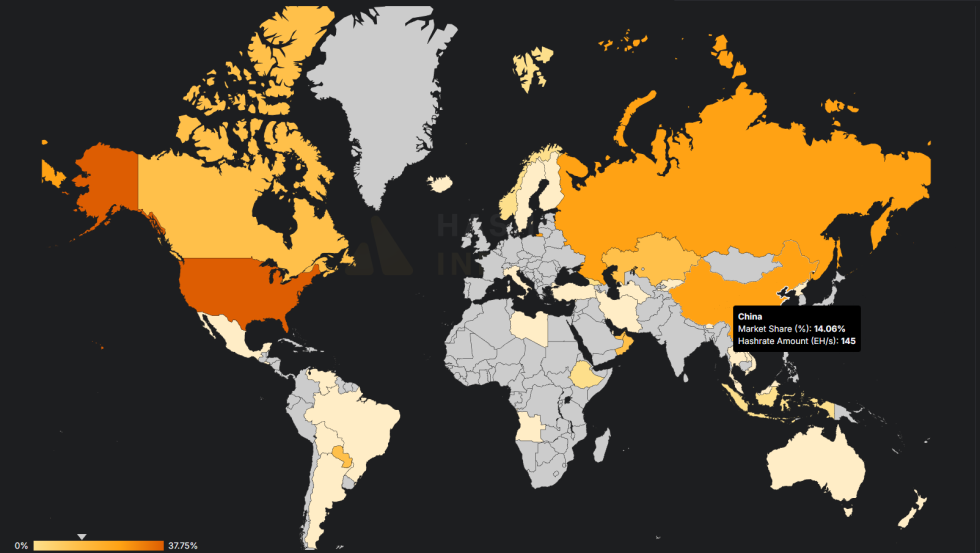
Bitcoin Hashrate Map

The global BTC mining heatmap | Source: Hashrate Index

Only Russia (15.5%) and the US (37.7%) host a larger share of the world Hashrate. Thus, it seems the country has quickly grown back into dominance. As for what’s behind the growth, the answer seems to be a mix of the cryptocurrency’s bull run, availability of cheap electricity in some provinces, and a subtle shift in the nation’s stance toward the sector.

Earlier in the year, Beijing was weighing a plan to allow the use of yuan-pegged stablecoins more widely outside of China. In September, the first such class of assets was launched in Kazakhstan.

Hong Kong approved its stablecoin bill in August, allowing private companies to apply for an issuer license in the Chinese city. As of yet, though, no licenses have been handed out.

BTC Price

Bitcoin saw a brief fall below $81,000 on Friday, but its price has since bounced back as it’s now floating around $86,000.

Bitcoin Price Chart

Looks like the price of the coin has recovered a bit since its latest plunge | Source: BTCUSDT on TradingView
Featured image from Dall-E, HashrateIndex.com, Blockchain.com, chart from TradingView.com
Editorial Process for bitcoinist is centered on delivering thoroughly researched, accurate, and unbiased content. We uphold strict sourcing standards, and each page undergoes diligent review by our team of top technology experts and seasoned editors. This process ensures the integrity, relevance, and value of our content for our readers.

Keshav is a Physics graduate who has been employed as a writer with Bitcoinist since June 2021. He is passionate about writing and through the years, he has gained experience working in a variety of niches. Keshav holds an active interest in the cryptocurrency market, with on-chain analysis being an area he particularly likes to research and write about.

Trend Kriptolar

İlgili Okumalar

AI Boosting Efficiency and Cutting Costs Makes VC Increasingly Expensive

"AI for Cost Reduction Makes VC Funding More Expensive" Despite the "cost-reduction and efficiency" narrative of AI, venture capital (VC) investment in the AI sector is becoming increasingly costly. While AI tools lower the initial costs for many startups—with team sizes shrinking across funding stages—the market is polarizing. For top-tier AI teams, especially those from leading companies like Google and OpenAI, funding rounds are now larger and valuations are higher than ever at the seed and early stages. For example, new ventures by prominent researchers are securing billions in funding with valuations reaching tens of billions before having a mature product. This creates a "barbell" market: lightweight startups need less capital, while elite AI firms attract massive investments early on. This dynamic raises the cost for VCs to acquire and maintain meaningful ownership stakes. As valuations soar early, securing the same equity percentage requires significantly larger capital commitments. VCs must now invest more upfront and reserve substantial funds for follow-on rounds to avoid dilution, prompting large firms like Accel and a16z to raise massive new funds. Consequently, capital is concentrating intensely in a few perceived winners like OpenAI and Anthropic, widening the gap between large and small VC funds. While high valuations bake in future growth expectations, they also compress potential returns, demanding that portfolio companies achieve unprecedented scale. For major VCs, the core strategy is clear: secure early positions in potential winners and maintain the capital to keep investing as valuations rapidly escalate.

marsbit22 dk önce

AI Boosting Efficiency and Cutting Costs Makes VC Increasingly Expensive

marsbit22 dk önce

An Eight-Year Investment Takes a Sharp Turn: Why Did Ethereum Suddenly Abandon Poseidon?

On August 13, Ethereum researcher Justin Drake announced a significant shift in Ethereum's Layer-1 cryptographic roadmap: abandoning the SNARK-friendly hash function Poseidon in favor of traditional functions like SHA2 or BLAKE2. This decision ends eight years of research and investment, marking a major revision to the post-quantum security strategy. Poseidon, introduced in 2019, was highly efficient for zkRollups and zkVMs within SNARK circuits. However, its need for prolonged cryptanalysis and the pressing timeline for quantum resistance revealed limitations. Recent breakthroughs in SNARK design, specifically using binary fields, now enable traditional, battle-tested hash functions to perform as efficiently as Poseidon within SNARKs. Benchmarks show modern laptops can now verify over a million traditional hash calls per second. This change is partly driven by accelerated concerns over quantum computing threats. Reports warn that "Cryptographically Relevant Quantum Computers" could break current blockchain signatures like ECDSA by the early 2030s, risking trillions in assets. Ethereum's response focuses on hash-based post-quantum signature schemes, deemed more quantum-resistant than some lattice-based alternatives under pressure from AI cryptanalysis. Ethereum's updated post-quantum roadmap targets a production-ready "leanVM" for signature aggregation by 2027, with full deployment across consensus, execution, and data layers by 2028. The shift to mature hash functions like SHA2 reduces reliance on newer algorithms and aligns with the goal of using widely analyzed cryptographic primitives. Other major blockchains are also preparing. Solana's core teams have independently chosen the NIST-standardized Falcon signature scheme for its compact size. Starknet plans a phased migration, starting with replacing its Pedersen hash with BLAKE2. Ethereum's move signifies a strategic pivot towards proven security foundations for the quantum era.

marsbit1 saat önce

An Eight-Year Investment Takes a Sharp Turn: Why Did Ethereum Suddenly Abandon Poseidon?

marsbit1 saat önce

Programmers Worldwide Are Wasting Money on Anthropic! The Company Can't Stand It Anymore

Anthropic recently published guidelines to help developers using Claude Code reduce unnecessary token costs. The key recommendations include: 1) Clear (/clear) conversations after completing a task to avoid carrying irrelevant file reads and command outputs into the next task. 2) Set the model and reasoning effort level at the start of a session, as switching mid-session invalidates the prompt cache, requiring a full-price recalculation of the entire dialog history. 3) Attach files using @ references instead of typing paths manually to avoid extra tool calls and searches that bloat the context. 4) Add quiet flags to verbose commands (e.g., in CLAUDE.md) to minimize lengthy output in the dialog history. 5) Use /compact while the session cache is still warm (before breaks) to compress the dialog at one-tenth the cost. 6) Offload large-output tasks to a sub-agent, which runs in an isolated context and only returns conclusions, preventing intermediate outputs from polluting the main dialog. The article explains token pricing: input tokens (prefill) are processed in parallel, while output tokens (decode) are generated serially, making output tokens five times more expensive. Caching is crucial for savings—if a request's prefix (system prompt, CLAUDE.md, dialog history) matches the previous one byte-for-byte, reading it costs only 10% of the standard input price. However, cache invalidation occurs when changing models, effort levels, fast mode, compressing dialogs, after cache expiration, or when resuming old sessions. Dialog history also grows quadratically (O(n²)) as file contents and command outputs accumulate, increasing costs per round. Proactive context management—like isolating noisy tasks, using /rewind to trim unproductive turns, and task-based session clearing—is becoming an essential skill for cost-effective AI-assisted development.

marsbit3 saat önce

Programmers Worldwide Are Wasting Money on Anthropic! The Company Can't Stand It Anymore

marsbit3 saat önce

Pax Silica vs. WAICO: The US Wants to Prohibit Europe from Using Chinese Artificial Intelligence

The United States is preparing to demand that European and other partners abandon Chinese artificial intelligence initiatives, threatening exclusion from the American-led "Pax Silica" coalition, according to a leaked U.S. State Department document. This ultimatum forces signatories of the "AI Opportunity Statement" to choose between the Western technological ecosystem and alternative frameworks, with China not explicitly named but clearly targeted. Pax Silica is a U.S. strategy for AI and semiconductor hegemony, launched in late 2025. Its European presence expanded significantly in mid-2026. Concurrently, China, Russia, and 27 other nations established the World AI Cooperation Organization (WAICO) in July 2026 as an independent intergovernmental platform promoting AI governance based on UN principles. This situation creates a difficult choice, especially for European nations balancing strategic autonomy with dependence on U.S. tech and security. It also pressures Global South countries with pragmatic ties to both Washington and Beijing. The formation of competing blocks risks fragmenting the global tech landscape, forcing companies to split supply chains, increasing costs, and potentially leading to incompatible standards and protocols. The era of open globalization in AI may be ending, replaced by geopolitical confrontation where technological sovereignty trumps economic efficiency. The decisions made will shape the global digital economy for decades.

cryptonews.ru5 saat önce

Pax Silica vs. WAICO: The US Wants to Prohibit Europe from Using Chinese Artificial Intelligence

cryptonews.ru5 saat önce

İşlemler

Spot

Popüler Makaleler

BAN Nasıl Satın Alınır

HTX.com’a hoş geldiniz! Comedian (BAN) satın alma işlemlerini basit ve kullanışlı bir hâle getirdik. Adım adım açıkladığımız rehberimizi takip ederek kripto yolculuğunuza başlayın. 1. Adım: HTX Hesabınızı OluşturunHTX'te ücretsiz bir hesap açmak için e-posta adresinizi veya telefon numaranızı kullanın. Sorunsuzca kaydolun ve tüm özelliklerin kilidini açın. Hesabımı Aç2. Adım: Kripto Satın Al Bölümüne Gidin ve Ödeme Yönteminizi SeçinKredi/Banka Kartı: Visa veya Mastercard'ınızı kullanarak anında Comedian (BAN) satın alın.Bakiye: Sorunsuz bir şekilde işlem yapmak için HTX hesap bakiyenizdeki fonları kullanın.Üçüncü Taraflar: Kullanımı kolaylaştırmak için Google Pay ve Apple Pay gibi popüler ödeme yöntemlerini ekledik.P2P: HTX'teki diğer kullanıcılarla doğrudan işlem yapın.Borsa Dışı (OTC): Yatırımcılar için kişiye özel hizmetler ve rekabetçi döviz kurları sunuyoruz.3. Adım: Comedian (BAN) Varlıklarınızı SaklayınComedian (BAN) satın aldıktan sonra HTX hesabınızda saklayın. Alternatif olarak, blok zinciri transferi yoluyla başka bir yere gönderebilir veya diğer kripto para birimlerini takas etmek için kullanabilirsiniz.4. Adım: Comedian (BAN) Varlıklarınızla İşlem YapınHTX'in spot piyasasında Comedian (BAN) ile kolayca işlemler yapın.Hesabınıza erişin, işlem çiftinizi seçin, işlemlerinizi gerçekleştirin ve gerçek zamanlı olarak izleyin. Hem yeni başlayanlar hem de deneyimli yatırımcılar için kullanıcı dostu bir deneyim sunuyoruz.

682 Toplam GörüntülenmeYayınlanma 2024.12.11Güncellenme 2026.06.02

BAN Nasıl Satın Alınır

Tartışmalar

HTX Topluluğuna hoş geldiniz. Burada, en son platform gelişmeleri hakkında bilgi sahibi olabilir ve profesyonel piyasa görüşlerine erişebilirsiniz. Kullanıcıların BAN (BAN) fiyatı hakkındaki görüşleri aşağıda sunulmaktadır.

活动图片