加密早报:灰度 Dogecoin ETF 获批,本周 HYPE、XPL、JUP 等代币将迎来大额解锁

深潮Published on 2025-11-23Last updated on 2025-11-24

美SEC将于12月15日举办加密货币隐私问题圆桌会议。

作者:深潮 TechFlow

昨日市场动态

美联储柯林斯:仍认为有理由对12月降息持谨慎态度

据金十数据报道,美联储柯林斯表示,鉴于通胀和就业双重目标持续面临风险,她仍倾向于反对美联储在下个月降息。柯林斯在一场会议期间表示:“对于在12月FOMC会议上降息,我确实认为需要保持谨慎。在9月和10月累计降息50个基点后,我个人认为当前政策正处于适度紧缩区间,这对当前经济状况是合适的。”

美国财长贝森特:整个经济并未面临衰退风险

美国财长贝森特:利率敏感行业正处于衰退期,但对(此类行业)2026年的增长前景充满信心。整个经济并未面临衰退风险。

SEC将于12月15日举办加密货币隐私问题圆桌会议

据 Cryptopolitan 报道,美国证券交易委员会(SEC)加密货币特别工作组宣布将于12月15日举办圆桌会议,专门讨论加密货币生态系统中日益突出的隐私和金融监控问题。会议将邀请加密行业领导者与SEC官员共同探讨行业面临的挑战及可能的解决方案。

此次会议背景是近期加密行业隐私问题引发广泛关注,包括Tornado Cash开发者Roman Storm部分有罪判决、Samourai Wallet开发者被判刑,以及隐私币价格在过去两个月大幅上涨。

值得注意的是,美国司法部刑事司代理助理检察长Matthew Galeotti已于8月发表声明,表示将停止仅因编写开源代码而起诉开发者的做法,强调在没有恶意的情况下,编写代码本身不构成犯罪。

彭博 ETF 分析师:灰度 Dogecoin ETF 获批,预计周一在 NYSE 开始交易

彭博 ETF 分析师 Eric Balchunas 在社交媒体发文称,灰度的 Dogecoin ETF(GDOG)已获批准在 NYSE 上市,预计将于周一开始交易;其 XRP 现货 ETF 也预计将于同日上线,GLNK 也预计在下周推出。

PancakeSwap:即将发布利好消息

PancakeSwap 在社交媒体发文表示,“即将发布利好消息。”

Aster:因黄金价格数据源错误导致 XAUUSDT 市场价格偏离,将全额补偿受影响用户

据 Aster 披露,该平台在 UTC 时间 22:00-23:00 期间,因黄金价格数据源出现错误,导致 XAUUSDT 市场价格偏离真实价格。

其表示,这是一个全球性错误,影响了包括 Aster DEX 在内的多个平台,以及 goldprice.org 等价格数据网站。目前市场已恢复正常。将全额补偿所有受影响的用户,具体补偿细节将在确认后公布。

Cardano区块链遭遇临时链分裂

据Cointelegraph报道,Cardano区块链网络于周五遭遇临时链分裂,原因是一笔"畸形"的委托交易触发了底层软件库中的旧代码漏洞。据Cardano生态组织Intersect报告,该事件导致网络节点在处理交易时出现分歧。质押池运营商Homer J承认使用AI生成代码推送了这笔交易,引发了社区争议。Cardano创始人Charles Hoskinson称此为对网络的攻击,并表示FBI已介入调查。

BitMine财报:全年净收入达 3.28 亿美元,将派发每股 0.01 美元的年度股息

据 PRNewswire 报道,BitMine Immersion Technologies(NYSE AMERICAN: BMNR)公布 2025 财年业绩,全年净收入达 3.28 亿美元,完全稀释每股收益为 13.39 美元。

该公司宣布每股 0.01 美元的年度股息,成为首家宣布年度股息的大型加密货币公司。股息宣布日期为 11 月 21 日,除息日为 12 月 5 日,登记日为 12 月 8 日,支付日为 12 月 29 日。

BitMine 计划推出"美国制造验证者网络"(Made in America Validator Network),该质押功能预计将于 2026 年第一季度正式上线。Bitmine 将于 2026 年 1 月 15 日在拉斯维加斯永利酒店举行年度股东大会。

Michael Saylor 回应“或遭 MSCI 剔除”:指数分类无法定义Strategy

Strategy 创始人兼执行主席 Michael Saylor 在社交发文回应 MSCI 指数剔除风险问题,他表示,Strategy 作为一家上市运营公司,与基金、信托及控股公司存在本质区别,Strategy 不仅拥有价值 5 亿美元的软件业务,并独特地将比特币作为生产性资本运用于资金管理。指数分类无法定义 Strategy。公司长期战略清晰,对比特币信念坚定,其使命始终是成为基于稳健货币和金融创新的全球首家数字货币机构。

Michael Saylor发文表明「不会屈服」或暗示将继续增持比特币

Strategy(原 MicroStrategy)创始人兼执行主席 Michael Saylor 在 X 平台发文“我不会屈服”,暗示仍会增持比特币,但暂未发布比特币 Tracker 信息。

本周 HYPE、SUI、XPL 等代币将迎来大额代币解锁,总价值超 4 亿美元

Token Unlocks 数据显示,本周 HYPE、XPL、JUP 等代币将迎来大额代币解锁,总价值超 3 亿美元。其中:

  • HYPE 将于 11月29日 解锁 992万枚代币,价值约 3.1505亿美元,占流通量 2.66%;

  • XPL 将于 11月25日 解锁 8889万枚代币,价值约 1730万美元,占流通量 4.74%;

  • JUP 将于 11月28日 解锁 5347万枚代币,价值约 1260万美元,占流通量 1.69%。

行情动态
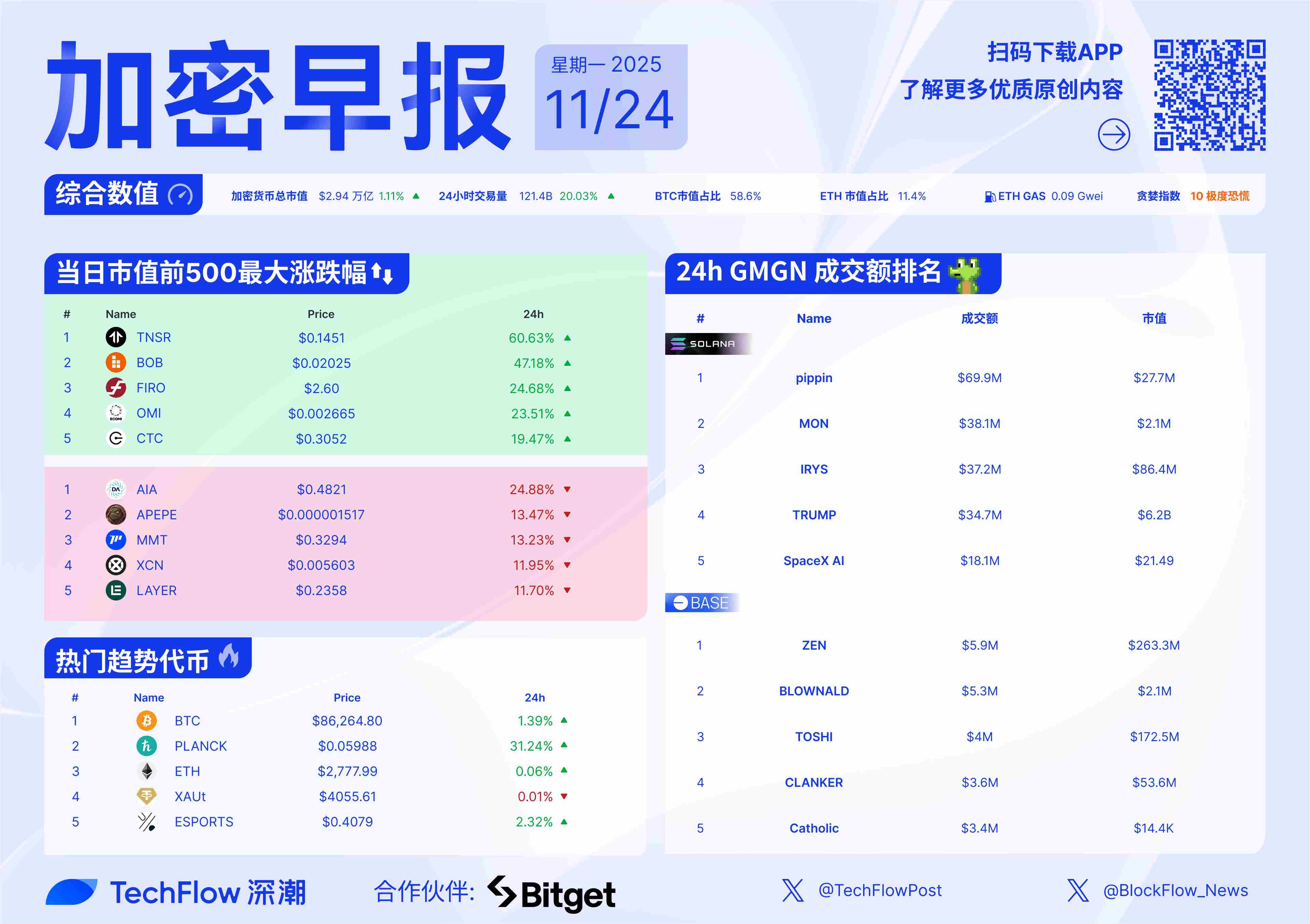
推荐阅读

88亿美元出逃倒计时,MSTR 正在变成全球指数基金的弃子

本文讨论了Strategy(微策略)因其比特币持有策略面临从全球主要股票指数中被剔除的风险,以及这一决定可能对公司、比特币市场和投资者产生的深远影响。

全球大暴跌,究竟发生了什么?

本文讲述了全球市场经历了一次系统性暴跌,包括美股、港股、A股和加密货币市场,主要原因是美联储鹰派转向、市场情绪崩溃及自动化交易引发的连锁反应。比特币和以太坊等加密货币成为风险资产的情绪风向标。市场进入高波动阶段,但尚未真正进入熊市。

对话 Bitwise 投资顾问:流动性紧缩+地缘政治危机,BTC 还有牛吗?

本文探讨了比特币市场的现状、未来趋势以及影响市场的宏观和技术因素,重点分析了流动性紧缩、地缘政治风险、机构资本流入、投资者情绪及量子计算等对比特币价格的潜在影响。

Let's Flow|要不要离开币圈去炒股?周期、机会与出路

本文通过对当前加密市场和股市的表现及未来趋势的分析,探讨了投资者在不同市场环境中的选择与策略。文章还邀请了两位资深投资者分享了他们的经验和见解,讨论了加密市场的周期变化、市场分化、投资逻辑演变以及未来可能的机会和挑战。

币价、口碑双逆势发展的 Aster 有何突围之道?Aster 2026 核心战略

本文详细介绍了Aster项目的核心战略、发展现状以及未来规划。Aster通过链上交易生态重建,在去中心化金融领域开辟了一条独特的道路,并通过技术创新和多种激励机制,持续增强其市场竞争力。

Related Reads

Trading

Spot
Futures

Hot Articles

What is PLASMA

Plasma: A Cutting-Edge Solution for Blockchain Scalability Introduction to Plasma As the cryptocurrency landscape evolves, so too does the need for enhanced efficiency within blockchain networks. Plasma, a Layer 2 scaling solution, emerges as a pioneering player in this sphere, particularly in the realm of Web3 development. By strategically shifting a substantial portion of tasks from the main chain to a series of smaller chains, Plasma vows to significantly boost the scalability and performance of Ethereum—a widely-used blockchain platform at the forefront of decentralised applications. What is Plasma? Plasma is an innovative off-chain scaling solution particularly designed for the Ethereum blockchain. It was introduced in August 2017 by Vitalik Buterin, co-founder of Ethereum, and Joseph Poon, a prominent advocate of scaling solutions like the Lightning Network. Plasma serves as a framework that enables the creation of scalable applications by establishing a hierarchical structure of child chains above the main Ethereum chain. At its core, Plasma allows for the development of potentially infinite side chains that can operate independently while still relying on the Ethereum network for security and consensus. This architecture is underpinned by smart contracts and Merkle Trees, which efficiently handle transactions and data storage. Core Objectives of Plasma The primary aim of Plasma is to increase the throughput of the Ethereum network. By diverting a substantial volume of transactions away from the congested main chain, Plasma's architecture offers higher transaction speeds, more efficient data processing, and lower transaction costs. This is particularly vital in an age where demand for decentralised applications—especially in finance, gaming, and supply chain management—is reaching unprecedented levels. Creator of Plasma Plasma is the brainchild of two renowned figures in the blockchain community: Vitalik Buterin and Joseph Poon. Buterin is celebrated primarily for co-founding Ethereum and pushing the boundaries of what blockchain technology can achieve. Poon, on the other hand, is known for advocating scalable solutions, which enable faster and more cost-effective transactions on blockchain networks. Their collaboration on the Plasma framework has greatly contributed to its innovative nature, combining advanced technical insights with practical applications. Investors of Plasma While the specific investment foundations or organizations supporting Plasma remain undisclosed, the project has garnered interest from various prominent figures and players in the blockchain and cryptocurrency space. With its potential for enhancing scalability within Ethereum, it has caught the attention of various entities aiming to push the boundaries of blockchain technology. How Does Plasma Work? Plasma's unique functionality is attributed to its architectural framework that relies on child chains and their interaction with the main Ethereum network. Below are some key factors that contribute to Plasma's innovative approach: Child Chains: Plasma establishes numerous child chains that can execute transactions independently of the main Ethereum chain. Each child chain operates as a separate smart contract with unique features, allowing developers to create tailored solutions based on their specific requirements. Smart Contracts and Merkle Trees: The framework utilises smart contracts, which are self-executing agreements with predefined conditions, paired with Merkle Trees that enable efficient verification of data. This technology allows Plasma to achieve both high scalability and security. Transaction Compression: By batching transactions on the child chains, Plasma reduces the data load on the Ethereum network. This means that fewer transactions need to be recorded on the main chain—thereby freeing up space and reducing congestion. Enhanced Security: Despite being off-chain, Plasma leverages the security measures of the main Ethereum network, ensuring that all transactions on child chains maintain a high level of integrity and security. Timeline of Plasma Understanding the development of Plasma involves tracing its significant milestones: August 2017: Plasma was first introduced by Vitalik Buterin and Joseph Poon as a scalable solution to address Ethereum's performance challenges. 2018: The Plasma framework was officially developed and made available on GitHub, marking a crucial step towards its implementation in practical applications. 2019: As awareness about Plasma grew, it began to attract developers interested in scaling Ethereum applications, thus increasing its adoption. 2020: Plasma continued evolving, with substantial enhancements made to its architecture and functionality—making it even more appealing to developers. Key Features of Plasma Plasma boasts several characteristics that make it a transformative solution in the blockchain space: Scalability: By creating multiple child chains, Plasma can handle a higher volume of transactions without further taxing the main Ethereum chain. Speed: Each child chain can process transactions more swiftly, providing users with better experience and service. Lower Transaction Costs: Plasma's structure effectively reduces the costs associated with transactions by minimizing the burden on the main chain. Interoperability: The architecture allows Plasma to seamlessly interact with multiple blockchains, enhancing cross-network functionality. Security: By harnessing the security of Ethereum’s main chain, Plasma ensures the integrity of its operations while utilising its child chains. Use Cases for Plasma The innovative architecture of Plasma opens the door for various practical applications across different sectors: Decentralized Finance (DeFi): Plasma has the capacity to enhance the scalability and efficiency of DeFi applications, creating smoother and more effective trading processes. Gaming: The framework facilitates the development of quick and cost-efficient gaming experiences, making it appealing to developers in the gaming industry. Supply Chain Management: With the ability to archive efficient transaction processing, Plasma can foster the development of decentralised supply chain management solutions. Conclusion Plasma stands at the forefront of blockchain technology, positioned as a pivotal Layer 2 scaling solution aimed at enhancing the efficiency of the Ethereum network and beyond. Through its unique structure of child chains, smart contracts, and Merkle Trees, Plasma offers a compelling solution to the scalability crisis that has long plagued blockchain networks. As blockchain technology continues to advance, solutions like Plasma promise to reshape how developers approach scalability challenges, potentially revolutionising how decentralised applications function. The ongoing efforts by its creators and the interest of various stakeholders signal a bright future for Plasma as it seeks to elevate blockchain capabilities to new heights in the digital realm.

1.2k Total ViewsPublished 2024.12.03Updated 2024.12.03

What is PLASMA

How to Buy XPL

Welcome to HTX.com! We've made purchasing Plasma (XPL) simple and convenient. Follow our step-by-step guide to embark on your crypto journey.Step 1: Create Your HTX AccountUse your email or phone number to sign up for a free account on HTX. Experience a hassle-free registration journey and unlock all features.Get My AccountStep 2: Go to Buy Crypto and Choose Your Payment MethodCredit/Debit Card: Use your Visa or Mastercard to buy Plasma (XPL) instantly.Balance: Use funds from your HTX account balance to trade seamlessly.Third Parties: We've added popular payment methods such as Google Pay and Apple Pay to enhance convenience.P2P: Trade directly with other users on HTX.Over-the-Counter (OTC): We offer tailor-made services and competitive exchange rates for traders.Step 3: Store Your Plasma (XPL)After purchasing your Plasma (XPL), store it in your HTX account. Alternatively, you can send it elsewhere via blockchain transfer or use it to trade other cryptocurrencies.Step 4: Trade Plasma (XPL)Easily trade Plasma (XPL) on HTX's spot market. Simply access your account, select your trading pair, execute your trades, and monitor in real-time. We offer a user-friendly experience for both beginners and seasoned traders.

2.6k Total ViewsPublished 2025.09.26Updated 2025.10.09

How to Buy XPL

Discussions

Welcome to the HTX Community. Here, you can stay informed about the latest platform developments and gain access to professional market insights. Users' opinions on the price of XPL (XPL) are presented below.

活动图片