Von der Nische zur Wall Street – Ripple erreicht das große Parkett beim Swell2025

bitcoinistPubblicato 2025-11-10Pubblicato ultima volta 2025-11-11

Introduzione

Ein leitender BlackRock-Manager hat Ripple für seine Rolle bei der Einführung von Blockchain in der Finanzwelt gelobt. Die XRP-Community feiert...

Trusted Editorial content, reviewed by leading industry experts and seasoned editors. Ad Disclosure
  • Ein leitender BlackRock-Manager hat Ripple für seine Rolle bei der Einführung von Blockchain in der Finanzwelt gelobt.
  • Die XRP-Community feiert das als lange erwartete Anerkennung durch die Wall Street.
  • Doch Experten fragen sich, ob die Worte wirklich für das ganze Unternehmen BlackRock gelten.

Was viele Krypto-Fans seit Jahren hoffen, scheint nun Wirklichkeit zu werden: Die großen Finanzhäuser öffnen sich der Blockchain-Technologie. Auf der Ripple Swell 2025 Konferenz sprach ein BlackRock-Manager offen über Ripples Bedeutung – und brachte damit die XRP-Gemeinschaft in Feierlaune. Doch hinter der Euphorie stehen noch einige Fragezeichen.

BlackRock spricht über Ripple und die Zukunft der Blockchain

Die Ripple Swell 2025 Konferenz in New York hat einen Moment geschaffen, der vielen in Erinnerung bleiben wird. Maxwell Stein, Mitglied des Digital-Assets-Teams von BlackRock, sprach auf der Bühne über die Zukunft der Finanzwelt – und über Ripple. Er sagte, der Markt sei nun bereit, Blockchain im großen Stil einzusetzen. Dabei lobte er Ripple als wichtigen Teil dieser Entwicklung.

Stein erklärte, dass Ripple bereits Anleihen, Stablecoins und andere Vermögenswerte auf der Blockchain abgebildet habe. Diese Technologie könne bald Kapitalströme in Billionenhöhe bewegen. Für viele im Publikum klang das wie der Beweis, dass Blockchain nicht mehr nur ein Traum, sondern Realität ist – und Ripple einer der Motoren dieser Bewegung.

XRP-Community feiert den großen Moment

Für die Anhänger von XRP war diese Aussage fast wie ein Ritterschlag. Jahrelang wurde Ripple als Nischenprojekt belächelt. Nun lobt einer der größten Finanzverwalter der Welt öffentlich seine Arbeit. Die Stimmung in der Community war entsprechend ausgelassen.

Auf der Plattform X (früher Twitter) verbreiteten sich begeisterte Posts im Minutentakt. Viele nannten Steins Worte den Beweis, dass XRP endlich ernst genommen wird. Für sie war es ein Symbol: Die Brücke zwischen alter Finanzwelt und neuer Blockchain-Ökonomie ist nicht mehr nur Theorie – sie entsteht gerade.

Von Experiment zu Standard: Blockchain wird ernst genommen

Steins Worte zeigten auch, wie sehr sich die Sicht auf Blockchain verändert hat. Noch vor wenigen Jahren galt sie als riskante Spielerei für Technik-Freaks. Heute sprechen führende Finanzmanager von ihr als kommender Standard. BlackRock hat damit – gewollt oder nicht – eine neue Botschaft gesendet: Die Zeit des Zögerns ist vorbei.

Ripple wird so immer mehr zu einem Symbol für den Wandel. Statt nur Transaktionen in der Krypto-Welt zu ermöglichen, arbeitet das Unternehmen daran, die Finanzinfrastruktur selbst zu verändern. Was früher utopisch klang, könnte bald Alltag sein: globale Geldströme, die über Blockchain laufen.

Rechtliche Fragen bremsen den Jubel

Nicht alle sehen das Lob so unkritisch. Der australische Anwalt und XRP-Fan Bill Morgan fragte öffentlich, ob Stein im Namen von BlackRock oder nur privat gesprochen habe. Diese Frage ist wichtig, denn eine offizielle Stellungnahme von BlackRock wäre ein starkes Signal für die gesamte Branche.

Sollte es sich aber nur um eine persönliche Meinung handeln, bleibt die Bedeutung begrenzt – auch wenn sie symbolisch wichtig ist. Viele Beobachter weisen darauf hin, dass rechtliche Unsicherheit weiterhin eine Hürde bleibt. Zwischen Begeisterung und Realität liegt noch ein weiter Weg.

Regulierung als Schlüssel für die Zukunft

Auch Adena Friedman, die Chefin der Nasdaq, sprach auf der Konferenz über den Reifeprozess des Marktes. Sie sagte, dass die Finanzwelt zwar interessiert sei, aber noch klare Regeln brauche, bevor sie voll einsteigen könne. Banken testen bereits tokenisierte Anleihen und Stablecoins, doch ohne eindeutige Gesetze bleibt das Risiko groß.

Ihre Worte erinnerten daran, dass technologische Fortschritte allein nicht reichen. Vertrauen und Regulierung sind nötig, damit Institutionen wirklich aufspringen. Die Swell 2025 zeigte damit nicht nur Begeisterung, sondern auch die Hürden auf dem Weg zur echten Integration von Blockchain in die Finanzwelt.

Fazit: Ripple steht im Rampenlicht – aber der Weg ist noch lang

Die Swell 2025 machte deutlich, dass Ripple längst kein Außenseiter mehr ist. Mit der Unterstützung eines BlackRock-Managers hat das Unternehmen einen Meilenstein erreicht. Doch der Krypto-Markt bleibt volatil: Der XRP-Preis fiel zuletzt um über vier Prozent auf 2,21 US-Dollar.

Trotzdem scheint der Trend klar. Blockchain ist dabei, die Finanzwelt zu verändern – und Ripple ist mittendrin. Was als Vision begann, wird Schritt für Schritt Wirklichkeit. Vielleicht war die Swell 2025 der Moment, in dem die Finanzelite begriff, dass Blockchain gekommen ist, um zu bleiben.

Bitcoin Hyper: Gewinner einer neuen Phase der Krypto-Adoption

Die zunehmende Institutionalisierung von Ripple (XRP) zeigt, dass Kryptowährungen endgültig in der Finanzwelt angekommen sind. Immer mehr Banken und große Investoren nutzen Ripple, um internationale Zahlungen schneller und günstiger abzuwickeln. Das stärkt das Vertrauen in die gesamte Branche – und besonders in Bitcoin, der für viele weiterhin das sicherste und verlässlichste Krypto-Asset bleibt. Wenn Banken und Institutionen verstärkt auf Blockchain-Technologie setzen, steigt auch die Nachfrage nach Bitcoin als digitales Wertaufbewahrungsmittel.
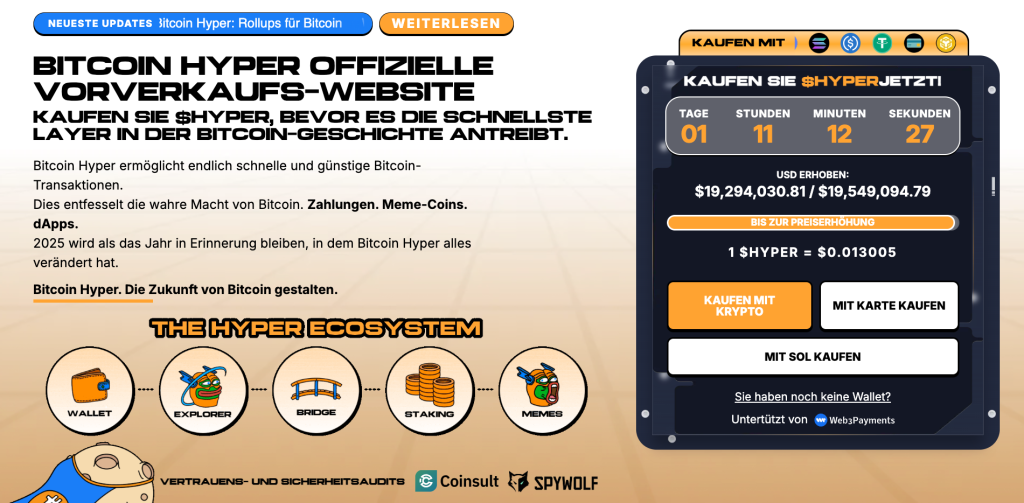
Bitcoin Hyper Presale Oktober 2025 Ripple
Bitcoin Hyper Presale

Lies hier eine langfristige Prognose für Bitcoin Hyper!

Bitcoin Hyper: Aufgebaut auf Vertrauen und Innovation

Bitcoin Hyper ist eng mit Bitcoin verbunden und profitiert von diesem wachsenden Vertrauen. Das Projekt nutzt die Sicherheit des Bitcoin-Netzwerks und kombiniert sie mit der Geschwindigkeit und Flexibilität von Solana. So entsteht eine Erweiterung, die Bitcoin nicht ersetzt, sondern verbessert: schnellere Transaktionen, geringere Gebühren und echte Alltagstauglichkeit. Wenn durch Ripple immer mehr institutionelle Investoren und Banken in den Kryptomarkt einsteigen, wächst auch die Bedeutung von Bitcoin – und damit die Chancen für Bitcoin Hyper, als moderne und praktische Ergänzung mitzuwachsen.

Jetzt rechtzeitig einsteigen und $HYPER im Presale kaufen.

Editorial Process for bitcoinist is centered on delivering thoroughly researched, accurate, and unbiased content. We uphold strict sourcing standards, and each page undergoes diligent review by our team of top technology experts and seasoned editors. This process ensures the integrity, relevance, and value of our content for our readers.

Letture associate

A PPT Dismissed as 'Nonsense' by MIT Professors 5 Years Ago Predicted the Core Ideas of OpenAI o1 and o3

In 2020, AI researcher Giambattista Parascandolo presented his vision for neural network reasoning at an MIT faculty interview, only to have the committee dismiss the direction as "nonsense." He later posted the details online. His talk centered on enabling artificial neural networks to generalize and plan beyond their training data, closer to human capabilities. Parascandolo proposed three key research directions. First was "open-ended reasoning," where models could dedicate more computation time to harder problems, continuously refining answers—a precursor to today's compute-adaptive reasoning models. He noted that simply adding steps (e.g., in RNNs) wasn't enough without learning to use them effectively. Second, he advocated using language as a medium for reasoning within reinforcement learning. By leveraging the world knowledge in models like GPT, agents could better describe environments, decompose tasks, and plan—foreshadowing concepts like chain-of-thought and agent workflows. His third direction involved giving AI systems the ability to manipulate their own learning process: resetting to past states, creating counterfactual scenarios, and even editing their own activations or weights to facilitate deliberate practice. Parascandolo, who earned his PhD focusing on out-of-distribution generalization and had internships at Google X and DeepMind, joined OpenAI in 2021. He contributed to GPT-4 and later became integral to the foundational research behind the reasoning models o1 and o3. His early, criticized ideas remarkably charted a course for advanced AI reasoning systems developed years later.

marsbit3 min fa

A PPT Dismissed as 'Nonsense' by MIT Professors 5 Years Ago Predicted the Core Ideas of OpenAI o1 and o3

marsbit3 min fa

US Debt Approaching $40 Trillion, BofA's Hartnett: Going Long on Gold Is the Optimal Solution Now

U.S. national debt is on the verge of reaching $40 trillion. Bank of America's Chief Investment Strategist Michael Hartnett, in his latest "Flow Show" report, identifies this as the core market narrative and argues that **going long on gold is the optimal solution** currently. He views gold as the best hedge against dollar depreciation, bond market collapse, and asset inflation. Key pressures on the bond market include soaring debt interest payments, nearing $1.4 trillion annually and set to become the federal government's largest expenditure. Simultaneously, a surge in corporate bond issuance, particularly for AI/data center projects (up roughly 12 times historical averages), is structurally steepening the yield curve and crowding out buyers for long-term Treasuries. Hartnett reiterates his asset allocation framework for the 2020s: **ABB (Away From Bonds), ABD (Away From Dollar), and AI (All In AI)**. Within the "ABD" theme, he explicitly recommends going long gold. He suggests policymakers have limited tolerance for significantly higher yields, especially with elections approaching. Under the "ABB" theme, he notes that some previously neglected long-duration assets like REITs, biotech (XBI), regional banks (KRE), and small-cap stocks are quietly outperforming as the market prices in a peak in yields. Conversely, within the "AI" theme, he proposes a counterintuitive trade: **shorting AI-related bonds**, given the sector's massive capital expenditure needs and negative free cash flow. Hartnett outlines key upcoming events (Jackson Hole, CPI data, Fed & BOJ meetings, U.S. elections) that will influence markets. His final outlook is politically contingent: a Republican-held Senate could fuel a further AI-driven market bubble into 2027, while a Democratic victory in November could trigger a >10% decline in stocks, the dollar, and bond yields by year-end.

marsbit7 min fa

US Debt Approaching $40 Trillion, BofA's Hartnett: Going Long on Gold Is the Optimal Solution Now

marsbit7 min fa

Crypto Summit Preview: Trump to Personally Attend, SEC and CFTC Chairs to Share Stage — What New Regulations Will Be Decided?

The White House is convening a major crypto summit on August 19, with President Trump, SEC Chair Atkins, and CFTC Chair Selig expected to attend. Key industry players like Coinbase, Ripple, and a16z, alongside traditional finance giants such as Nasdaq and CME, are invited. Notably, prediction market platforms Kalshi and Polymarket are also on the guest list for the first time. The summit occurs ahead of a crucial September 15 Senate procedural vote for the CLARITY Act, which aims to clarify SEC and CFTC jurisdiction over digital assets. However, market predictions for the bill's passage in 2026 have fallen sharply to around 19%, stalled by political issues including conflicts related to Trump's crypto holdings and debates over stablecoin yields and DeFi regulation. Analysts like Nate Geraci suggest the administration's goal is to signal it will move forward with crypto regulation regardless of the congressional outcome. The SEC and CFTC are expected to advance rules—such as "Reg Crypto" and an "Innovation Exemption"—under existing authorities. The following day, the CFTC's new Innovation Advisory Committee will meet, aligning discussions on crypto, AI, and prediction markets. This summit marks a shift from the March 2025 meeting's focus on broad political support ("ending the war on crypto") to concrete regulatory planning. Despite the high-profile gathering, the market showed little immediate reaction, with Bitcoin prices remaining stable.

marsbit7 min fa

Crypto Summit Preview: Trump to Personally Attend, SEC and CFTC Chairs to Share Stage — What New Regulations Will Be Decided?

marsbit7 min fa

Claude's Watermark Has Been Cracked, Gaining 11k Stars, But Installation Is Refused

The article discusses the controversy surrounding Anthropic's implementation of a hidden watermark in all text generated by its AI, Claude. This policy, based on Google DeepMind's SynthID-Text technique, embeds a statistical signature by making inconsequential word choices. The watermark applies globally, even to human-written text lightly edited by Claude, sparking user backlash over issues of ownership and the creation of an "AI content second-class citizen" status. In response, an open-source tool called "watermarks-remover" (originally "remove-claude-marks") was released on GitHub, quickly gaining 11k stars. It works on three levels: removing invisible Unicode characters, using an agent to rewrite text and break statistical patterns, and stripping metadata from various file formats. Notably, Claude itself refused to install this removal tool as an Agent Skill, a task ultimately completed by another AI model, GLM 5.2. The article points out the irony that the removal code may have been written by Claude. The piece frames this as an ongoing battle between watermarking for traceability against misinformation and the desire for unmarked, owned content from paying users. It questions the practicality of mandatory technical markings when AI-generated text becomes indistinguishable from human writing, suggesting the open-source community's rapid development of countermeasures will continually outpace regulatory efforts.

marsbit1 h fa

Claude's Watermark Has Been Cracked, Gaining 11k Stars, But Installation Is Refused

marsbit1 h fa

SafePal Leaks Data of Nearly 40,000 Hardware Wallet Buyers: Private Keys Intact, Yet Danger Moves Closer to the Physical

Hardware wallet manufacturer SafePal has disclosed a data breach affecting approximately 39,798 customers who placed orders between March 2025 and April 2026. The leak exposed personal information including names, email addresses, phone numbers, physical delivery addresses, and purchase records. The company confirmed that private keys, recovery phrases, wallet passwords, and financial details were not compromised, as the cold storage systems operate in an isolated environment separate from the e-commerce servers. However, the breach poses significant risks beyond digital theft. Attackers now possess a high-value list of confirmed hardware wallet owners, effectively marking them as likely holders of substantial cryptocurrency. This enables highly targeted social engineering attacks, such as phishing emails referencing real order details, fake hardware deliveries, or phone scams impersonating SafePal support. The company has already identified and taken down over 30 related phishing sites. A critical aspect of the incident is the delayed disclosure timeline. SafePal acknowledged receiving initial user reports of phishing attempts in May but treated them as isolated. A full investigation began in July, with a public announcement not made until August, leaving users exposed for approximately three months. Furthermore, a configuration error prevented a data-purge routine from deleting old order information as intended, potentially increasing the scope of the leaked data. The incident highlights a structural paradox in the hardware wallet industry: while the devices are designed to secure private keys offline, the necessary e-commerce process collects sensitive personal data that, if leaked, makes the user a target. This mirrors a similar breach suffered by Ledger in 2020. Affected users are advised to be extremely vigilant. They should verify if they are impacted via SafePal's dedicated page, treat all unsolicited communications (emails, calls, physical mail) referencing SafePal as suspicious, and never share recovery phrases. Users who may have entered sensitive information on a phishing site must create a new wallet immediately. The breach underscores that in cryptocurrency security, the most vulnerable link is often the human user, not the cryptographic technology.

marsbit1 h fa

SafePal Leaks Data of Nearly 40,000 Hardware Wallet Buyers: Private Keys Intact, Yet Danger Moves Closer to the Physical

marsbit1 h fa

Trading

Spot
活动图片