Три альткоина в фокусе: вторая неделя ноября 2025

cryptonews.ruPublished on 2025-11-16Last updated on 2025-11-16

Криптовалютный рынок демонстрирует уверенное восстановление на второй неделе ноября. Биткоин (BTC) торгуется выше отметки $105 000.

Несмотря на зависимость от общей рыночной динамики, некоторые альткоины также ожидают важных корпоративных событий на этой неделе. Аналитики BeInCrypto рассмотрели три таких актива, за которыми инвесторам следует внимательно следить в период высокой волатильности.

Lido DAO (LDO)

Проект Lido DAO готовится к проведению Lido Tokenholder Update 11 ноября. В ходе мероприятия руководство Lido Labs обсудит предстоящие усовершенствования протокола и представит стратегические планы развития на 2026 год. Ожидание этого события уже вызвало оптимизм среди инвесторов.

На момент анализа цена LDO составляет $0.84 и демонстрирует признаки «бычьего» импульса. Индикатор денежного потока Чайкина (CMF) остается выше нулевой отметки, что подтверждает сильный приток капитала в актив.

При сохранении текущей динамики LDO может преодолеть уровни сопротивления $0.86 и $0.92. Следующей целью станет отметка $1.00, что предполагает потенциальный рост на 18%.

Желаете получать больше подобной аналитики по токенам? Подпишитесь на ежедневную криптовалютную рассылку редактора Харша Нотарии
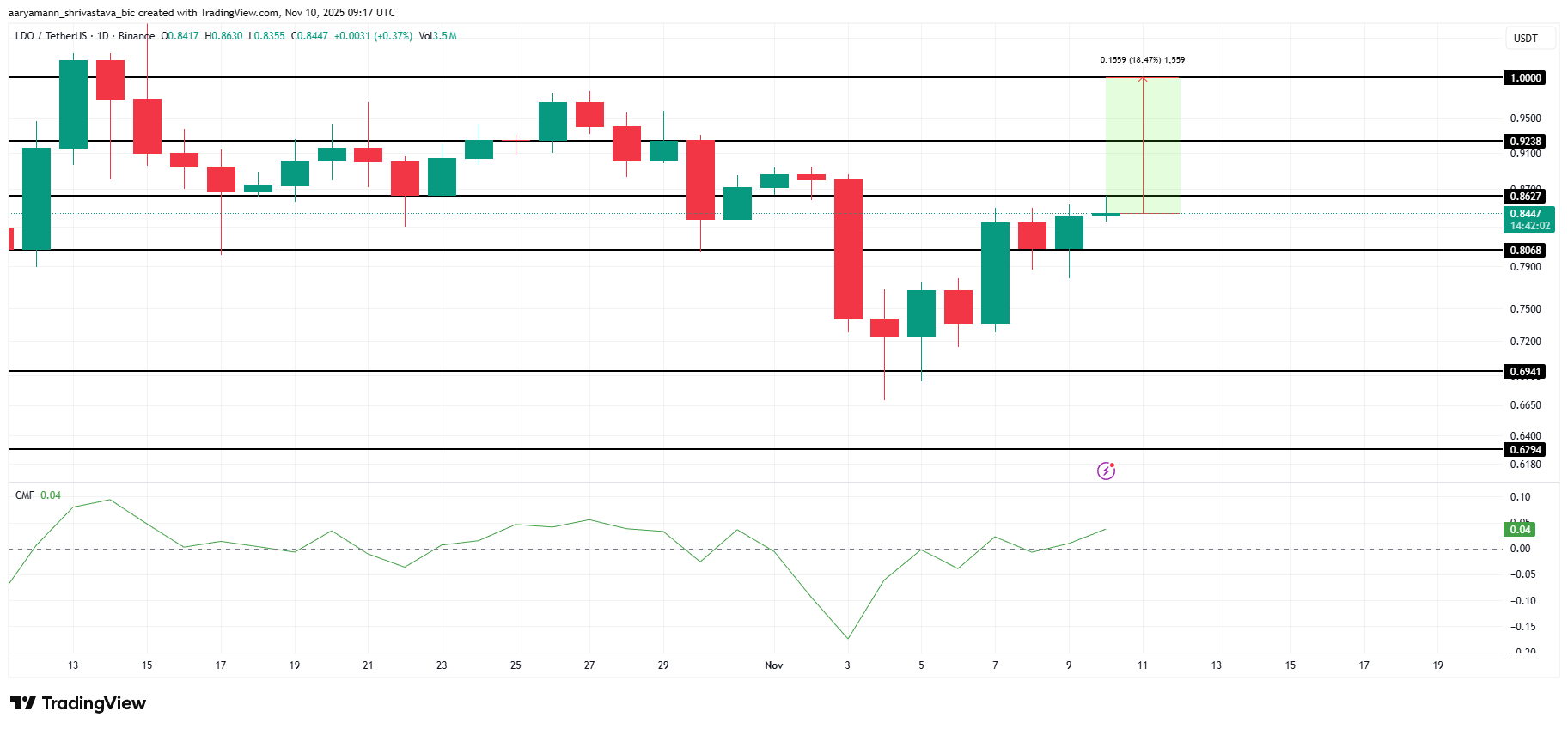
Анализ цены LDO
Анализ цены LDO. Источник: TradingView

Однако, если энтузиазм инвесторов после мероприятия ослабнет, восходящий тренд может прерваться. Отсутствие сильной реакции способно опустить LDO ниже уровня поддержки $0.80 и расширить потери до $0.69. Такое снижение полностью аннулирует текущий «бычий» прогноз.

Injective (INJ)

Injective готовится к одному из самых значительных этапов в своей истории — публичному запуску основной сети (mainnet), запланированному на 12 ноября.

Это долгожданное событие способно привлечь новых инвесторов и свежий приток капитала. Рыночный энтузиазм вокруг развития проекта может спровоцировать резкий рост цены INJ.

Альткоин уже вырос на 24% за последние четыре дня, что сигнализирует о нарастающем «бычьем» импульсе перед запуском. Торгуясь на уровне $7.85, Injective может продолжить ралли. При сохранении позитивного настроя и активного участия инвесторов, актив может преодолеть сопротивление $8.40 и нацелиться на $9.11.
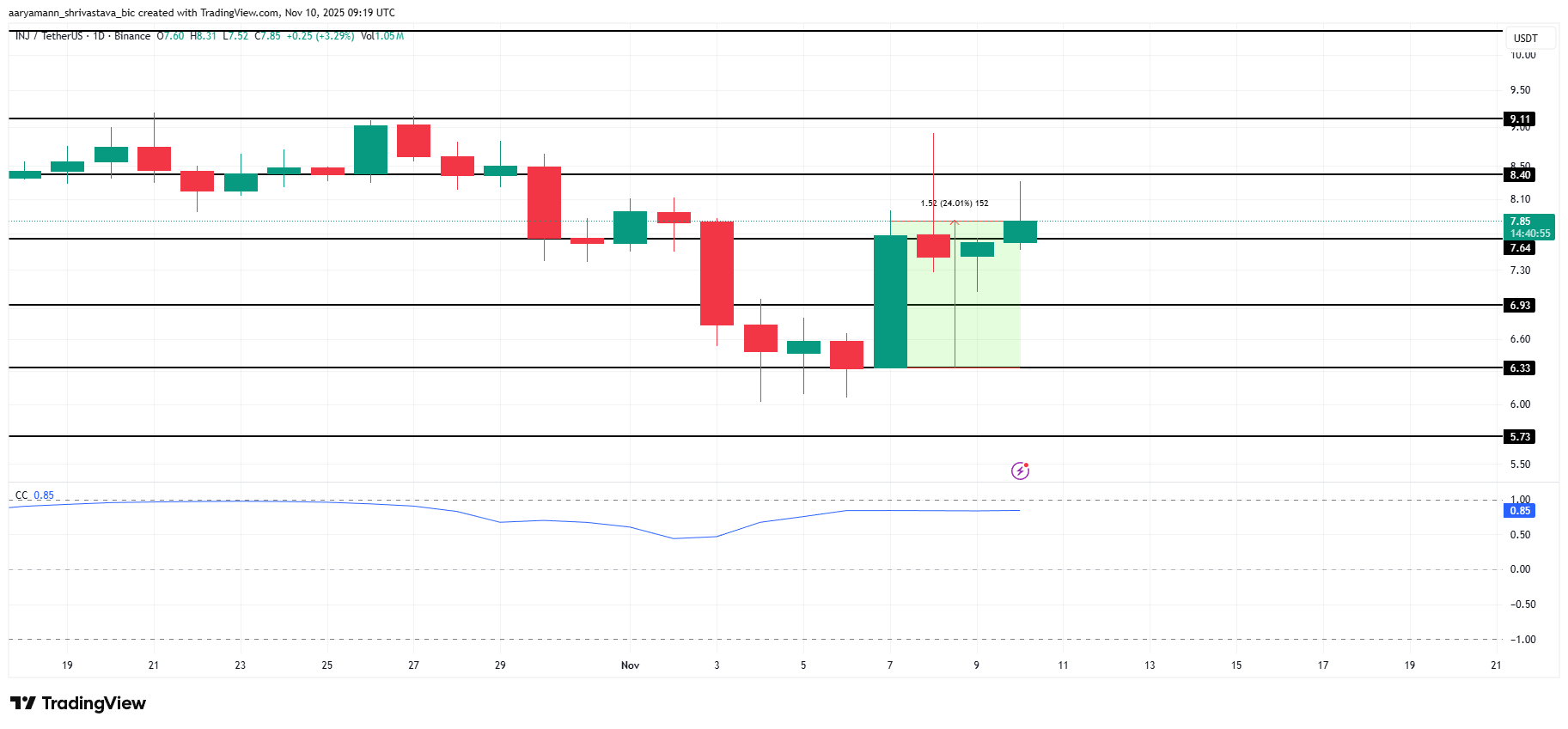
Анализ цены INJ.
Анализ цены INJ. Источник: TradingView

Тем не менее, Injective сохраняет сильную корреляцию с биткоином (0.85). Это означает, что его ценовая динамика часто отражает общие тенденции BTC.

Если цена биткоина начнет разворот с текущих уровней, INJ столкнется с давлением. Актив рискует опуститься ниже поддержки $6.93 и потенциально упасть до $6.33, что аннулирует «бычий» сценарий.

Maple Finance (SYRUP)

Цена SYRUP выросла на 28% за прошедшую неделю. В настоящее время актив торгуется на уровне $0.478, в непосредственной близости от уровня сопротивления $0.500.

Предстоящая конференция Q4 Ecosystem Call от Maple Finance может дополнительно стимулировать оптимизм инвесторов. Внимание рынка будет сосредоточено на растущей экосистеме проекта и планах по дальнейшему расширению протокола.

В ходе мероприятия соучредители Maple обсудят последние достижения платформы, представят новые продукты IV квартала и изложат планы на 2026 год. Эти обновления могут выступить катализатором для SYRUP. Возможен рост цены выше $0.500 с последующей целью на сопротивлении $0.555.
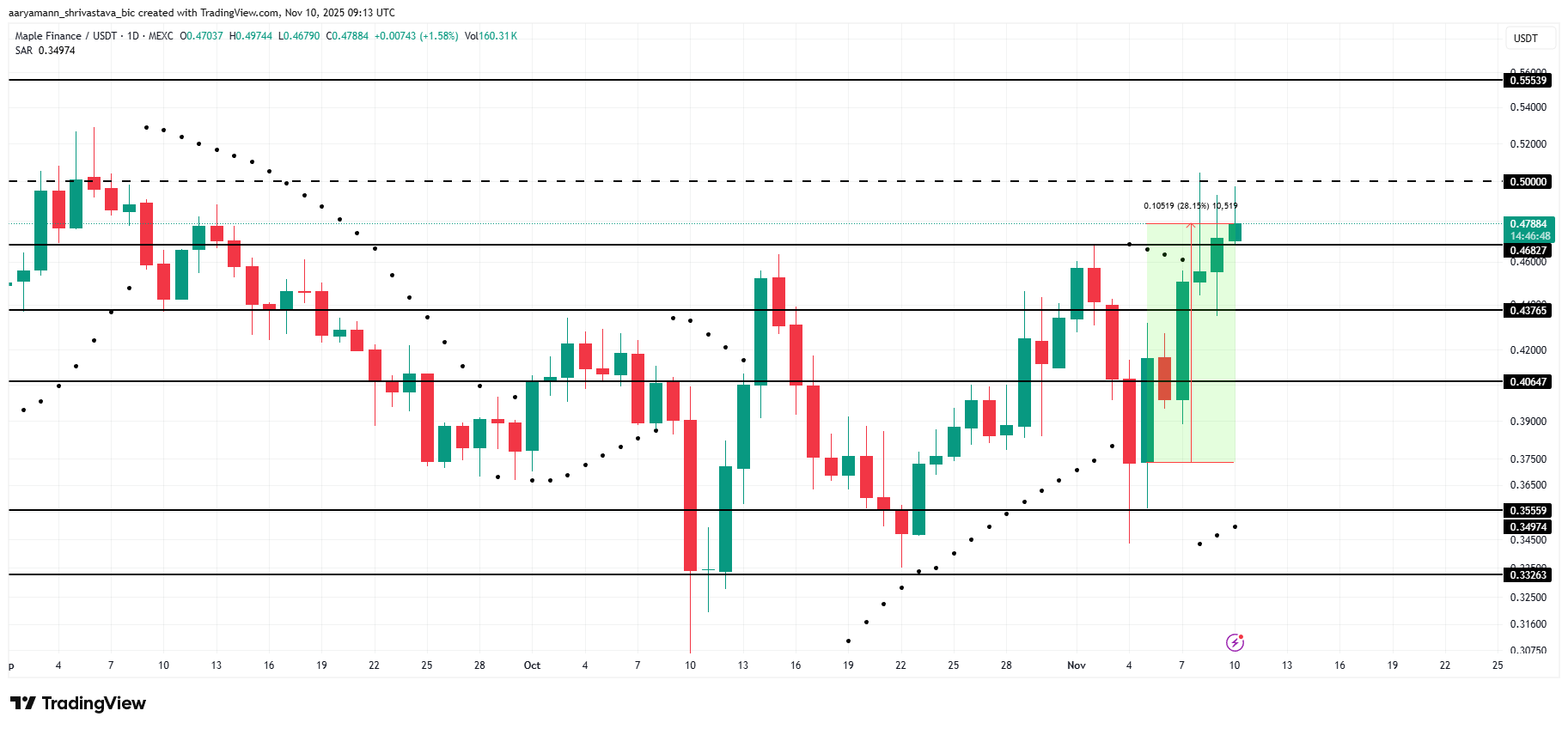
SYRUP Анализ цен.
Анализ цены SYRUP. Источник: TradingView

Однако, если «бычий» импульс не сможет набрать достаточную силу, цена SYRUP окажется под давлением. Снижение ниже $0.468 может отбросить токен к $0.437 или даже протестировать уровень поддержки $0.406. Это полностью аннулирует текущий оптимистичный прогноз.

The post Три альткоина в фокусе: вторая неделя ноября 2025 appeared first on BeInCrypto.

Related Reads

You Use Claude and Codex Every Day, but Meta Has Restricted Internal Use

In May, Meta imposed internal restrictions on its engineers regarding the use of Claude Code and Codex, two widely used AI programming tools. Despite being a major client, Meta's guidelines, still in effect, prohibit these external models from being used for specific tasks to prevent potential "escalations with partners." The core concern is "distillation"—the risk that outputs from Claude or Codex could inadvertently contaminate the training data and evaluation processes for Meta's in-house AI coding assistant, MetaCode. If MetaCode is trained or evaluated using data generated by these external models, it risks learning their capabilities rather than developing its own, blurring the line of intellectual origin. The restrictions are precise: engineers cannot use the external models to generate test questions, debug source code, or suggest test cases. AI-generated content is also barred from environments accessible to MetaCode. However, AI can still assist with peripheral tasks like workflow setup and code organization, provided all outputs are manually reviewed. This caution reflects a broader industry dilemma. While distillation is a common technique, using a competitor's model output for training raises legal and ethical questions about the ownership of derived capabilities. Contractual terms from companies like OpenAI and Anthropic explicitly forbid using their outputs to build competing products, putting enforcement power in the hands of rivals. The move is also financially motivated, as Meta seeks to reduce its hefty internal AI spending, estimated in the billions this year. Meta's policy illustrates the delicate balance companies must strike: leveraging powerful external AI tools while safeguarding the integrity and independence of their own AI development. As AI systems increasingly help build other AIs, distinguishing the origin of capabilities becomes a fundamental challenge for the entire industry.

marsbit30m ago

You Use Claude and Codex Every Day, but Meta Has Restricted Internal Use

marsbit30m ago

Why Do We Need an AI Content Perspective Today?

The article "Why Do We Need an AI Content Perspective Today?" explores the complex and often contentious integration of AI into the cultural and creative industries, particularly film and television. It begins with the cancellation of Amazon's AI-generated animation "Punky Duck," highlighting the ethical debates surrounding AI content. AI's rapid advancement is transforming video production, enabling cost-effective, full-length AI films (e.g., "RAPHAEL," "Dreams of Violets") while sparking industry resistance over issues like "synthetic actors." The core debate has shifted from whether to use AI to how to use it responsibly. The article analyzes why AI's entry into film is uniquely unsettling. It distinguishes between "cultural fast food" (short-form, fast-paced content like micro-dramas) and "cultural main courses" (traditional, long-form film/TV). AI currently excels at the former, matching its fragmented narratives, shallow emotional needs, and free-to-consumer models. However, venturing into the latter challenges the human-centric essence of storytelling—creativity, emotional depth, and the unique value of human labor and experience. While AI can generate massive volumes of content and lower costs, it risks devaluing human creativity, leading to homogenized output, and creating unfair competition through potential intellectual property infringement. Its efficiency also amplifies content safety risks, making preemptive governance crucial. To counter these risks, the article proposes establishing clear boundaries guided by a human-centered AI content perspective. It outlines four principles: 1) Amplify, rather than displace, human creative space; 2) Respect and protect human creative output; 3) Ensure human creative control and responsibility remain paramount; and 4) Guarantee transparency and traceability in AI creation. The conclusion emphasizes that humans must act as the "helmsmen" of technology, steering AI development to enhance, not replace, the core human values at the heart of cultural expression.

marsbit55m ago

Why Do We Need an AI Content Perspective Today?

marsbit55m ago

Planck Retracted? The Father of Quantum Tripped by an Algorithm

The recent discovery that two articles (published in 1940 and 1942) by Max Planck, the Nobel laureate and founder of quantum theory, are marked as "retracted" on Springer's digital platform highlights a curious clash between historical publishing practices and modern automated systems. An investigation suggests these retractions are algorithmic errors, not due to fraud or misconduct. The papers, philosophical reflections on science published in *Die Naturwissenschaften*, were likely flagged by the platform's systems. One article, a republished lecture, may have been mistaken for duplicate publication. Another, sharing a title with a prior article by a different author (a common practice for continuing debates at the time), may have triggered a similar automated check. The digital versions have even been replaced with blank pages, contrary to normal practice of preserving retracted texts. This incident underscores how contemporary digital infrastructure, built around concepts like "self-plagiarism" and strict copyright, can misclassify and obscure legitimate historical scholarly communication. It serves as a warning that digital archives are not neutral mirrors of the past but are filtered by platform rules, potentially distorting the scientific record. As AI systems increasingly rely on such databases, such erroneous metadata could propagate, affecting how future tools interpret and access historical knowledge.

marsbit59m ago

Planck Retracted? The Father of Quantum Tripped by an Algorithm

marsbit59m ago

Refunds! Claude 4.8 Sees Overnight Major 'Dumb-Down', GPT-5.6's Computational Power Reportedly 'Halved'

The AI community is currently alarmed by widespread reports of significant performance degradation in two leading models. This article details a "mass self-testing frenzy" triggered by a mysterious prompt designed to detect a hidden "Juice" value, representing a model's reasoning compute budget. On OpenAI's side, users suspect a covert, limited test of a "GPT-5.6-sol" model is underway. When using a specific XML prompt on the Codex platform, a normal "gpt-5.5 xhigh" model reportedly returns a Juice value of 768. However, some users routed to the suspected GPT-5.6 test receive a drastically reduced value of 128—a six-fold decrease. This has sparked debate on whether it signifies a major efficiency leap or a "watered-down, low-cost version" achieved by slashing reasoning depth to save computational expenses. Simultaneously, Anthropic's Claude models, particularly the flagship Opus 4.8 Max, are facing intense user backlash for a perceived "physical brain cut." Users on platforms like Reddit report a dramatic decline in the model's once-impressive reasoning, with complaints of it becoming "absurdly" weakened, performing worse than older, lighter models like Haiku. Specific criticisms include: losing long-context memory, refusing to think deeply even in high-reasoning modes, providing instant incorrect answers, and engaging in unhelpful, argumentative, or "gaslighting" behavior where it contradicts users unnecessarily. The article speculates these "stealth downgrades" might be a calculated corporate strategy. Companies could initially release models with temporarily boosted compute to create an illusion of a major breakthrough, then silently scale back parameters later to manage unsustainable inference costs. A proposed underlying cause is a tightened funding environment, potentially exacerbated by SpaceX's massive IPO soaking up market liquidity, which could delay AI company IPOs and force cost-cutting measures like model "nerfing." The core issue highlighted is the asymmetry of information: subscribers pay for a service that can be silently and fundamentally altered without notification or explanation. The viral "Juice test" resonates because it represents users' desire for transparency about what they are actually paying for.

marsbit1h ago

Refunds! Claude 4.8 Sees Overnight Major 'Dumb-Down', GPT-5.6's Computational Power Reportedly 'Halved'

marsbit1h ago

Trading

Spot
活动图片