First Spot Dogecoin ETF Set To Go Live On November 26

bitcoinistPubblicato 2025-11-07Pubblicato ultima volta 2025-11-07

Introduzione

Bitwise Asset Management appears to have set the clock for the first US spot Dogecoin ETF to go effective as...

Trusted Editorial content, reviewed by leading industry experts and seasoned editors. Ad Disclosure

Bitwise Asset Management appears to have set the clock for the first US spot Dogecoin ETF to go effective as early as Tuesday, Nov. 26, after invoking Section 8(a) of the Securities Act—an approach that makes a registration statement automatically effective in 20 days unless the Securities and Exchange Commission (SEC) intervenes.

Bloomberg’s senior ETF analyst Eric Balchunas flagged the maneuver on Friday, writing: “Looks like Bitwise is doing the 8(a) move for their spot Dogecoin ETF, which basically means they plan on going effective in 20 days barring an intervention.”

Countdown For A Spot Dogecoin ETF Is Now Ticking

The legal basis rests on the mechanics of Section 8(a). When an issuer removes the standard “delaying amendment” language from its S-1 registration and specifies effectiveness “in accordance with Section 8(a),” the filing is slated to become effective automatically after 20 days—unless the SEC acts to stop, delay, or require further amendments.

Context matters. In September, the SEC adopted generic listing standards that streamline the path for spot digital-asset ETFs on major exchanges, replacing the previous case-by-case 19b-4 gauntlet and compressing timelines. That policy shift has coincided with issuers increasingly leveraging 8(a) to go effective without an explicit “green light” order, as seen during October’s government shutdown when several non-BTC/ETH crypto ETFs launched after dropping their delaying amendments.

The October precedents are the real story behind Dogecoin’s timeline. On October 28, Bitwise’s Solana Staking ETF (ticker: BSOL) began trading on the NYSE, giving investors 100% direct SOL exposure with staking economics in the wrapper; within hours it established orderly primary and secondary market flow and became the reference instrument for US SOL exposure.

In parallel, Canary Capital listed a spot Hedera product on Nasdaq under ticker HBR, opening regulated access to HBAR and demonstrating that smaller-cap networks could also clear the operational bar on day one.

Those launches landed while the SEC’s capacity was constrained, and they arrived precisely because issuers had removed the delaying amendments and allowed their S-1s to go effective after 20 days.

Balchunas’s read on Dogecoin—“plan on going effective in 20 days barring an intervention”—aligns with how those October debuts actually materialized. In each case, there was no splashy, bespoke approval order; instead, the clock simply ran under 8(a) and trading commenced when the window closed without SEC objection.

That is why the implied calendar date matters here: as Bitwise pulled its delaying amendment on November 6, the statutory count points to effectiveness around Tuesday, November 26, assuming the Commission does not intercede with a stop order or a further-amendment request which could as depend on the end of the US government shutdown.

At press time, DOGE traded at $0164.
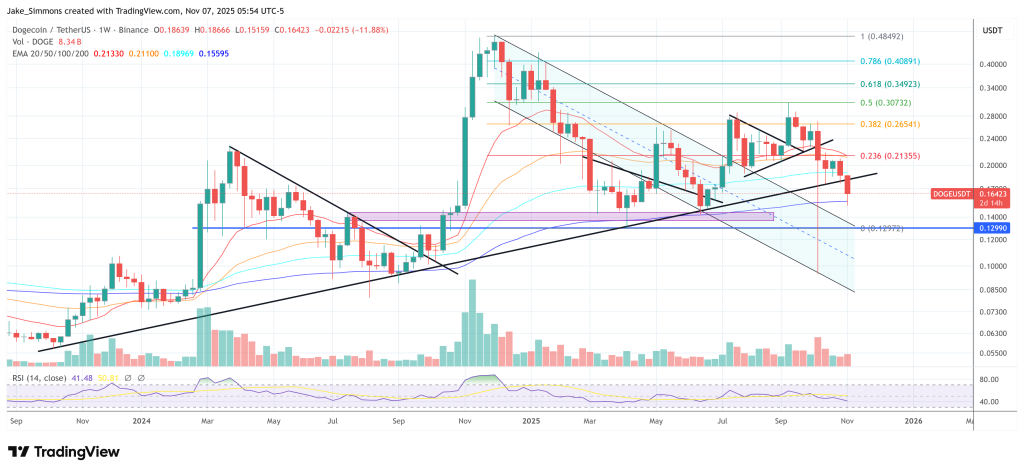
Dogecoin price
DOGE remains above the 200-week EMA, 1-week chart | Source: DOGEUSDT on TradingView.com
Featured image created with DALL.E, chart from TradingView.com
Editorial Process for bitcoinist is centered on delivering thoroughly researched, accurate, and unbiased content. We uphold strict sourcing standards, and each page undergoes diligent review by our team of top technology experts and seasoned editors. This process ensures the integrity, relevance, and value of our content for our readers.

Jake Simmons has been a Bitcoin enthusiast since 2016. Ever since he heard about Bitcoin, he has been studying the topic every day and trying to share his knowledge with others. His goal is to contribute to Bitcoin's financial revolution, which will replace the fiat money system. Besides BTC and crypto, Jake studied Business Informatics at a university. After graduation in 2017, he has been working in the blockchain and crypto sector. You can follow Jake on Twitter at @realJakeSimmons.

Letture associate

HIVE Invests $185 Million in 2016 Blackwell Ultra GPUs to Achieve $200 Million Annual Revenue Target

HIVE Digital Technologies announced that its subsidiary BUZZ HPC has signed a five-year contract worth approximately $350 million with a high investment-grade company to provide cloud computing services using GPUs. The deal is expected to generate around $500,000 in daily revenue from high-performance computing once operational in Q4. This marks the second major GPU supply agreement since June. The contract will increase BUZZ HPC's annual revenue by about $70 million, bringing HIVE's total projected annual revenue to approximately $180 million. About $35 million is recognized immediately, with the remaining $145 million under contract to be deployed by the end of 2026. Under the agreement, BUZZ HPC will deploy a dedicated cluster of 2,016 NVIDIA Blackwell Ultra GPUs hosted in GB300 NVL72 racks, using Quantum-X800 InfiniBand networking and VAST Data storage. The cluster, based on an NVIDIA reference architecture, will be located at Bell AI Fabric's site in Merritt, British Columbia, powered by renewable hydroelectricity. HIVE estimates the capital expenditure for the cluster and related equipment at around $185 million. Funding will come from an upfront client payment, proceeds from a future convertible note issuance, and equipment financing. After the contract term, HIVE will retain ownership of the infrastructure. This move is part of HIVE's strategy to reach a $200 million annual revenue target from its GPU cloud business. Other mining companies like IREN, Hut 8, and TeraWulf have also recently announced major AI/cloud deals.

cryptonews.ru6 min fa

HIVE Invests $185 Million in 2016 Blackwell Ultra GPUs to Achieve $200 Million Annual Revenue Target

cryptonews.ru6 min fa

The AI Boom Faces a Leverage Problem After a Fund with 67% AI Investments Crashes

Situational Awareness AI, a hedge fund founded by a former OpenAI researcher and led by Leopold Aschenbrenner, lost approximately 67% of its value in July 2026. The fund, which had generated a 439% return using roughly 4x leverage on concentrated bets in AI infrastructure and chip stocks, faced margin calls from major brokers as its positions fell 35-47%. Unable to meet the calls, the fund was forced to liquidate its entire public stock portfolio. The collapse highlights the risks of excessive leverage in volatile tech sectors, even when underlying investment theses—like strong demand for AI memory chips from companies like Micron—prove correct. Notably, the fund continues operating, having recently invested $400 million in a chip manufacturing startup. Global regulators, including the Bank of England, had warned of rising leverage in stock markets, particularly around highly valued AI companies, drawing parallels to past blow-ups like Archegos. While AI investment momentum remains strong, with trillions projected for infrastructure, the incident raises questions about how markets will manage risk. Institutional investors may shift toward longer-term, less leveraged structures, as seen in record fundraising for real assets like data centers in 2025. The key uncertainty is whether patient capital or highly leveraged holders will dominate during the next market downturn.

cryptonews.ru6 min fa

The AI Boom Faces a Leverage Problem After a Fund with 67% AI Investments Crashes

cryptonews.ru6 min fa

Trading

Spot
活动图片