Solana, HBAR, and Litecoin ETFs Buck Market Panic as Bitcoin, ETH ETFs Suffer $800M in Outflows

ccn.comPublished on 2025-11-05Last updated on 2025-11-05

Key Takeawayst

  • Solana, HBAR, and Litecoin ETFs buck the market trend with steady inflows.
  • Bitcoin and Ethereum ETFs bleed over $800 million in combined outflows.
  • All three altcoin ETFs have seen net inflows every single trading day so far.

The crypto market was drenched in red on Nov. 4, as Bitcoin (BTC) slipped below the symbolic $100,000 mark and Ethereum (ETH) plunged under $3,150.

The sell-off erased roughly $3.5 trillion from the market’s total capitalization, one of the worst single-day routs in recent months.

Yet amid the bloodbath, something unexpected happened: altcoin ETFs quietly thrived.

While major Bitcoin and Ethereum funds saw money pour out at record levels, newer ETFs tied to Solana (SOL), Hedera (HBAR), and Litecoin (LTC) managed to attract fresh capital, a surprising vote of confidence in the middle of a market-wide meltdown.

Bitcoin ETFs Lead the Sell-Off

Bitcoin ETFs bore the brunt of Monday’s sell-off.

According to SoSoValue data, they recorded $577 million in net outflows on Nov. 4 alone — marking their fifth straight day in the red.

Fidelity’s FBTC led the exodus, with nearly $356 million withdrawn, while Ark & 21Shares’ ARKB saw another $128 million in exits.

Bitcoin ETF flow
Bitcoin ETF flows. | Source: SoSoValue.

Funds from Grayscale, VanEck, and Valkyrie also suffered, each losing between $10 million and $50 million.

The rest of the group, including smaller issuers, saw no new inflows or outflows.

Just a few weeks ago, Bitcoin ETFs were the crown jewel of institutional crypto exposure, attracting more than $2.7 billion in weekly inflows before the mid-October crash.

Now, that enthusiasm has evaporated almost overnight, leaving many wondering if the market’s bull engine has finally run out of fuel.

Ethereum ETFs Follow Suit

Ethereum didn’t fare much better. Spot ETH ETFs recorded $273.5 million in daily outflows on Nov. 4 — marking the fifth straight day of losses, similar to Bitcoin.

The outflows come as ETH’s price plunged below $3,150, wiping out its year-to-date gains after briefly touching a record high above $4,900 earlier this fall.
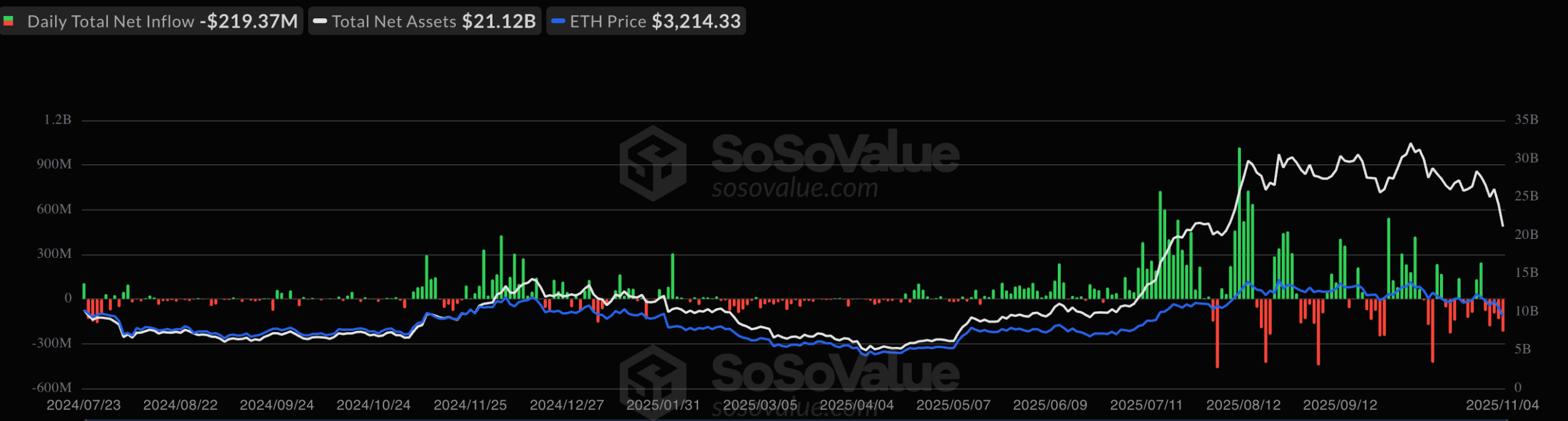
Ethereum ETFs
Ethereum ETF flows. | Source: SoSoValue.

BlackRock’s iShares Ethereum Trust (ETHA) led the pack with $111 million in redemptions, followed by Grayscale, which recorded roughly $90 million in combined outflows across its two Ethereum products.

Fidelity’s FETH wasn’t immune either, shedding another $20 million. Most other issuers ended the session flat, reporting no inflows or outflows.

Just weeks ago, Ethereum ETFs were being hailed as the next big institutional gateway into decentralized finance.

Now, as liquidity tightens and confidence wavers, even the market’s “smart money” seems to be taking a step back.

Altcoin ETFs Quietly Build Momentum

In contrast, the new generation of altcoin ETFs is quietly gaining traction.

Launched in the final week of October, the Solana, HBAR, and Litecoin ETFs were initially met with skepticism after a sluggish debut.

But as larger funds stumbled, these underdogs found their stride.

  • Solana ETFs: +$14.3 million in net inflows

  • HBAR ETF: +$1.7 million in inflows

  • Litecoin ETF: +$200,000 in inflows

Remarkably, all three have logged positive inflows every trading day since launch — a feat even Bitcoin can’t claim right now.

For investors, these small but consistent inflows hint at a growing appetite for diversification beyond the market’s “digital gold” and “digital oil.”


Related Reads

The Veil of Mythos Becomes Anthropic's Lever to Move Trillions

The article discusses Anthropic's reported upcoming $30 billion funding round, which would value the company at over $900 billion. It analyzes how the company has leveraged strategic narratives around its unreleased "Mythos" model, rather than just its publicly available products, to drive this massive valuation. Key points include Google's surprising $40 billion investment in a competitor, suggesting it is buying strategic positioning. Anthropic's "Glasswing" cybersecurity project and the unreleased Mythos model are portrayed not through direct proof, but through carefully crafted narratives of being "too powerful for public release," creating an aura of exclusive, high-level capability. This is bolstered by reports of the White House and NSA seeking access to Claude/Mythos despite previous security concerns, implying indispensable technology. Furthermore, Anthropic's reported rapid revenue growth—from a $1 billion annual run-rate in late 2024 to over $30 billion by April 2026, largely driven by enterprise API and Claude Code—provides a financial story for investors. The article concludes that Anthropic's core business model is effectively converting unverifiable technical potential, government interest, and future revenue projections into a compelling narrative that secures immense capital, using the actions of wealthy investors and powerful institutions as the ultimate validation of its worth.

marsbit1h ago

The Veil of Mythos Becomes Anthropic's Lever to Move Trillions

marsbit1h ago

Google CEO Admits Lagging Behind in Coding

Google CEO Sundar Pichai acknowledged in a recent interview that Google's Gemini AI models are currently "lagging behind" in coding capabilities, particularly for complex, long-horizon tasks requiring advanced developer expertise. He noted the field is advancing at an "unprecedented" pace, where 30-60 days now brings changes equivalent to five years in the past. Pichai expressed that achieving Artificial General Intelligence (AGI) now seems closer than previously imagined due to rapid progress. While highlighting strengths in text, multimodal, and reasoning tasks, Pichai admitted competitors like Anthropic and OpenAI have focused more intently on coding. He emphasized Google's commitment to catching up, citing internal tools like Antigravity 2.0 and the newly released Gemini 3.5 Flash, which aims to address previous shortcomings. Regarding Google Search's AI-driven overhaul, Pichai stated changes will be gradual to align with user needs, not disrupt the core search experience or its advertising model. He addressed public AI anxiety as understandable, given the technology's potential to reshape jobs and society, but remained optimistic about AI augmenting human capabilities and creating new opportunities. Pichai stressed the need for broad societal dialogue and responsible development as AI approaches more advanced, potentially recursive self-improvement stages. He affirmed Google's long-term commitment to leading in AI while navigating its profound implications responsibly.

marsbit3h ago

Google CEO Admits Lagging Behind in Coding

marsbit3h ago

The Paradox of Automation: The Stronger the AI, the Busier Humans Become

The Paradox of Automation: The more powerful AI becomes, the more work humans have to do. This article, based on observations from AI-heavy company Every, argues that while AI agents automate tasks like coding, writing, and customer service, they don't eliminate human jobs. Instead, they transform work and create *more* demand for human expertise. AI commoditizes "yesterday's human capabilities" by cheaply generating code, text, and images from past data. This leads to an abundance of similar, generic outputs. Consequently, what becomes scarce and valuable is human judgment in the present moment: knowing *what* is worth doing, *why*, and *how* to do it well. The article identifies two collaboration models: "Agent employees" for delegated tasks and "human-AI collaboration" within tools like Claude Code for complex work. In both cases, humans are essential to set direction, judge quality, and maintain systems. As AI makes execution cheap, human roles shift from executors to designers, reviewers, and meaning-makers. The author addresses "benchmark anxiety" by explaining that AI excels within specific, human-defined problem "frames." As AI masters one frame (e.g., code rewriting), new, more complex frames emerge (e.g., deciding *when* to rewrite). This creates an ongoing cycle where AI chases the frames, but humans remain the "framers." Even with advanced AGI, this dynamic may persist as long as AI lacks true human-like agency and self-directed purpose. The core paradox holds: automation amplifies the need for the very human judgment it seems to replace.

marsbit4h ago

The Paradox of Automation: The Stronger the AI, the Busier Humans Become

marsbit4h ago

Trading

Spot
Futures

Hot Articles

What is $BITCOIN

DIGITAL GOLD ($BITCOIN): A Comprehensive Analysis Introduction to DIGITAL GOLD ($BITCOIN) DIGITAL GOLD ($BITCOIN) is a blockchain-based project operating on the Solana network, which aims to combine the characteristics of traditional precious metals with the innovation of decentralized technologies. While it shares a name with Bitcoin, often referred to as “digital gold” due to its perception as a store of value, DIGITAL GOLD is a separate token designed to create a unique ecosystem within the Web3 landscape. Its goal is to position itself as a viable alternative digital asset, although specifics regarding its applications and functionalities are still developing. What is DIGITAL GOLD ($BITCOIN)? DIGITAL GOLD ($BITCOIN) is a cryptocurrency token explicitly designed for use on the Solana blockchain. In contrast to Bitcoin, which provides a widely recognized value storage role, this token appears to focus on broader applications and characteristics. Notable aspects include: Blockchain Infrastructure: The token is built on the Solana blockchain, known for its capacity to handle high-speed and low-cost transactions. Supply Dynamics: DIGITAL GOLD has a maximum supply capped at 100 quadrillion tokens (100P $BITCOIN), although details regarding its circulating supply are currently undisclosed. Utility: While precise functionalities are not explicitly outlined, there are indications that the token could be utilized for various applications, potentially involving decentralized applications (dApps) or asset tokenization strategies. Who is the Creator of DIGITAL GOLD ($BITCOIN)? At present, the identity of the creators and development team behind DIGITAL GOLD ($BITCOIN) remains unknown. This situation is typical among many innovative projects within the blockchain space, particularly those aligning with decentralized finance and meme coin phenomena. While such anonymity may foster a community-driven culture, it intensifies concerns about governance and accountability. Who are the Investors of DIGITAL GOLD ($BITCOIN)? The available information indicates that DIGITAL GOLD ($BITCOIN) does not have any known institutional backers or prominent venture capital investments. The project seems to operate on a peer-to-peer model focused on community support and adoption rather than traditional funding routes. Its activity and liquidity are primarily situated on decentralized exchanges (DEXs), such as PumpSwap, rather than established centralized trading platforms, further highlighting its grassroots approach. How DIGITAL GOLD ($BITCOIN) Works The operational mechanics of DIGITAL GOLD ($BITCOIN) can be elaborated on based on its blockchain design and network attributes: Consensus Mechanism: By leveraging Solana’s unique proof-of-history (PoH) combined with a proof-of-stake (PoS) model, the project ensures efficient transaction validation contributing to the network's high performance. Tokenomics: While specific deflationary mechanisms have not been extensively detailed, the vast maximum token supply implies that it may cater to microtransactions or niche use cases that are still to be defined. Interoperability: There exists the potential for integration with Solana’s broader ecosystem, including various decentralized finance (DeFi) platforms. However, the details regarding specific integrations remain unspecified. Timeline of Key Events Here is a timeline that highlights significant milestones concerning DIGITAL GOLD ($BITCOIN): 2023: The initial deployment of the token occurs on the Solana blockchain, marked by its contract address. 2024: DIGITAL GOLD gains visibility as it becomes available for trading on decentralized exchanges like PumpSwap, allowing users to trade it against SOL. 2025: The project witnesses sporadic trading activity and potential interest in community-led engagements, although no noteworthy partnerships or technical advancements have been documented as of yet. Critical Analysis Strengths Scalability: The underlying Solana infrastructure supports high transaction volumes, which could enhance the utility of $BITCOIN in various transaction scenarios. Accessibility: The potential low trading price per token could attract retail investors, facilitating wider participation due to fractional ownership opportunities. Risks Lack of Transparency: The absence of publicly known backers, developers, or an audit process may yield skepticism regarding the project's sustainability and trustworthiness. Market Volatility: The trading activity is heavily reliant on speculative behavior, which can result in significant price volatility and uncertainty for investors. Conclusion DIGITAL GOLD ($BITCOIN) emerges as an intriguing yet ambiguous project within the rapidly evolving Solana ecosystem. While it attempts to leverage the “digital gold” narrative, its departure from Bitcoin's established role as a store of value underscores the need for a clearer differentiation of its intended utility and governance structure. Future acceptance and adoption will likely depend on addressing the current opacity and defining its operational and economic strategies more explicitly. Note: This report encompasses synthesised information available as of October 2023, and developments may have transpired beyond the research period.

363 Total ViewsPublished 2025.05.13Updated 2025.05.13

What is $BITCOIN

Discussions

Welcome to the HTX Community. Here, you can stay informed about the latest platform developments and gain access to professional market insights. Users' opinions on the price of BTC (BTC) are presented below.

活动图片