Bitcoin Poised To Top $1.5 Million, Says Ex-PayPal President

bitcoinistPublished on 2025-10-24Last updated on 2025-10-24

Abstract

In a wide-ranging Coin Stories interview published October 21, David Marcus—co-founder and CEO of Lightspark, former president of PayPal and...

Trusted Editorial content, reviewed by leading industry experts and seasoned editors. Ad Disclosure

In a wide-ranging Coin Stories interview published October 21, David Marcus—co-founder and CEO of Lightspark, former president of PayPal and co-creator of Diem, the cryptocurrency project initiated by Facebook—laid out a thesis that Bitcoin will ultimately surpass gold in value and evolve from a purely “store-of-value” asset into the invisible, neutral settlement layer of the internet for money.

How Bitcoin Could Reach $1.5 Million

“I think Bitcoin will be more valuable than gold,” Marcus told host Natalie Brunell. “At today’s gold price, it’s, you know, $1.3 million a bitcoin that [it] will have a higher market cap than gold.” He emphasized he is “decent at directional predictions” but “terrible at timing,” framing the trajectory as inevitable over a five-to-ten-year horizon rather than a near-dated call. The implication of outgrowing gold’s market capitalization places Bitcoin’s potential value well north of $1.3 million per coin and, at Gold’s recent ATH at $4,381.58/oz, above $1.53 million.

Marcus’s price view is inseparable from his broader contention that BTC must progress beyond a narrow “digital gold” narrative. Echoing a line from analyst Matt Pines that Brunell cited—“if Bitcoin is only a store of value, it has failed”—Marcus agreed “fully,” but added a critical caveat: the savings-asset phase was a necessary precondition for utility.

“We believe that the store-of-value phase is absolutely essential for us to be able to actually build a utility phase of Bitcoin on top of it,” he said, arguing that institutional adoption, ETFs and nation-state accumulation conferred enough legitimacy to begin scaling real-world payments. “Now that every institution… whether it’s BlackRock, Fidelity or others, are actually supporting Bitcoin… we can actually really start building payment utility on top of it.”

That utility vision hinges on using Bitcoin more like TCP/IP—an invisible settlement substrate—than as a volatile unit of account for everyday spending. Marcus was blunt about behavioral and economic constraints: “People don’t want to use Bitcoin for everyday purchases because it’s volatile and people want to actually benefit from appreciation… they don’t want to be the Bitcoin pizza guy.”

Lightspark’s approach is to move fiat end-to-end while using BTC in the middle. “You can send dollars from a US bank account to someone in Mexico receiving Mexican peso… the settlement asset is Bitcoin in between. So you have dollars, Bitcoin, Mexican peso and it’s invisible to people using it.”

Technically, Lightspark is pushing beyond Lightning’s channel model while remaining backward-compatible. Marcus lauded Lightning’s trust model and speed, but highlighted its liquidity and self-custody frictions when scaled to “billions of endpoints.”

The company’s newly launched “Spark” is described as a Lightning-compatible, non-channel payment system that enables spinning up “billions of wallets” with “minimal new trust assumptions.” Crucially, he said, it preserves safety valves: “It’s not as trustless as Lightning, but we believe it’s trustless enough and has unilateral exits to Layer 1… you can pull a rip cord and no one can prevent you from recovering your funds on L1.”

Stablecoins And Adoption

Marcus also argued that stablecoins—despite their centralized issuer model—are an unavoidable component of global payments, and that anchoring them to BTC’s settlement layer enhances resilience. He described a personal “schizophrenic journey” with stablecoins, disliking the “single throat to choke,” yet accepting their ubiquity and attempting to minimize trust by avoiding separate gas tokens and preserving unilateral exits to Bitcoin L1.

On adoption, Marcus pointed to shifting institutional sentiment. Recounting a panel in New York “put together by Citadel Securities,” he said a “majority” of a roughly 450-person room of large traditional-finance investors indicated they own BTC, versus far fewer holding ETH, stablecoins, or any token. “This is a room that traditionally would have been very resistant to Bitcoin… now the times have changed so profoundly.” Yet he still framed retail penetration as early, estimating “low hundreds of millions” of unique holders globally and significant headroom from there.

Overall, Marcus’ thesis returns to first principles: BTC as neutral, scarce, programmable collateral and a credibly decentralized settlement layer. Dismissing critiques that it lacks “intrinsic value,” he argued, “Underlying scarcity of Bitcoin secured by code is the intrinsic value… this is the only thing that’s deflationary by nature.”

That, he contends, is why Bitcoin should outcompete gold over time: “When the first gold ETFs were launched, they started mining more gold. You can’t do that with Bitcoin.” If and when that market-cap crossover arrives, it would validate the structural call embedded in his remarks—and, by extension, the headline-grabbing notion that BTC’s fair value is not just above seven figures, but ultimately “more valuable than gold,” which today maps to $1.5 million.

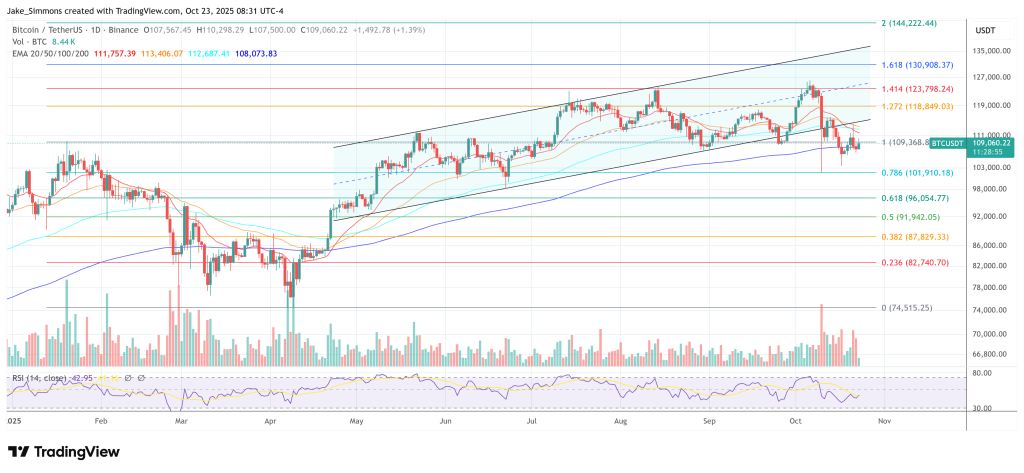
At press time, BTC traded at $109,060.
Bitcoin price
BTC needs to break above the 1.0 Fib, 1-day chart | Source: BTCUSDT on TradingView.com
Featured image created with DALL.E, chart from TradingView.com
Editorial Process for bitcoinist is centered on delivering thoroughly researched, accurate, and unbiased content. We uphold strict sourcing standards, and each page undergoes diligent review by our team of top technology experts and seasoned editors. This process ensures the integrity, relevance, and value of our content for our readers.

Jake Simmons has been a Bitcoin enthusiast since 2016. Ever since he heard about Bitcoin, he has been studying the topic every day and trying to share his knowledge with others. His goal is to contribute to Bitcoin's financial revolution, which will replace the fiat money system. Besides BTC and crypto, Jake studied Business Informatics at a university. After graduation in 2017, he has been working in the blockchain and crypto sector. You can follow Jake on Twitter at @realJakeSimmons.

Related Reads

Just Now, Chinese AI Enters Top 2 in Global Programming, Only Claude Remains Ahead

**China's AI Ranks Second Globally in Programming, Trailing Only Claude** Today, Alibaba's Qwen3.7-Max achieved a score of 1541 on the Code Arena benchmark, securing fourth place globally and surpassing top models like GPT-5.5 and Gemini 3.5 Flash. Among the top positions, it is now the only non-Claude model, placing second overall after Anthropic's Opus models. Before this official ranking, Qwen3.7-Max had already gained recognition overseas. In practical tests, it outperformed rivals on tasks like creating a self-training Tetris AI and generating complex 3D models, often at a significantly lower cost. Developers praised its ability, especially when integrated with tools like Hermes Agent and OpenCode, to effectively replace models such as GPT-5.5. In a hands-on challenge to create a 3D racing game from a detailed prompt, Qwen3.7-Max delivered a fully playable HTML file in the first attempt, requiring only minor bug fixes. It uniquely included a start menu and sound effects—details missed by other models. While competitors like Gemini 3.5 Flash and Claude Opus 4.6 produced less polished or functional versions, and GPT-5.5 had its own quirks, Qwen3.7-Max stood out for its initial completeness and playability. This performance stems from its design as an "Agent Base Model," built for long-duration, autonomous task execution. Internal tests show it can run continuously for 35 hours, making over 1158 tool calls without context degradation or instruction drift. Key technical advancements include "environment expansion" training, which improves adaptability across different frameworks, and "long-horizon autonomous execution" training, enabling sustained strategic decision-making. By entering the top tier of the programming arena, Qwen3.7-Max demonstrates that Chinese AI models are not just catching up but are becoming defining competitors, challenging the long-standing dominance of Silicon Valley in this field.

marsbit51m ago

Just Now, Chinese AI Enters Top 2 in Global Programming, Only Claude Remains Ahead

marsbit51m ago

From a Lunch Table to an Infinite Universe: Fei-Fei Li Bets on AI's Next Dimension

From a Lunch Table Conversation to an Infinite Universe: Fei-Fei Li Bets on AI's Next Frontier - Spatial Intelligence In an era dominated by large language models, AI pioneer Fei-Fei Li argues that true understanding requires spatial intelligence — the ability to perceive, reason, and interact within the physical 3D/4D world. She points to evolutionary history: spatial perception drove the Cambrian explosion 540 million years ago, while language is a far more recent, inherently "lossy" way to encode reality. Current models struggle with basic spatial tasks a child can do, like counting chairs in a video. Her company, World Labs, is pioneering this shift with "Marble," a model that generates navigable, consistent 3D worlds from text, images, or simple 3D inputs—distinct from video generators like Sora. Though smaller than models like GPT-5, due to scarce 3D data and early-stage scaling laws, Marble is already used in gaming, robot training (by NVIDIA), architectural design, and personalized therapy for conditions like OCD and acrophobia. Li envisions this technology enabling "infinite universes" for creativity, social interaction, and more. However, she cautions against utopian or dystopian extremes, advocating for a measured vision where AI enhances human dignity and prosperity, akin to how electricity transformed civilization. The journey is long — as evidenced by the 20-year path to viable autonomous vehicles — but the direction is clear: for AI to move from merely talking about the world to truly understanding and acting within it.

marsbit54m ago

From a Lunch Table to an Infinite Universe: Fei-Fei Li Bets on AI's Next Dimension

marsbit54m ago

X Stock Market Investment & Trading: A 'Noise-Free' List of 50 Key Accounts

Titled "A 'Noise-Reduction' List of 50 Top US Stock Market Influencers on X," this article curates a selection of accounts for investors seeking quality information beyond follower counts. The list prioritizes accounts that have consistently discussed US stocks, ETFs, earnings, macroeconomics, options, and tech/AI/semiconductor topics over the past 90 days. Selection criteria focused on genuine informational value, stable analytical frameworks over mere news aggregation, and a clear relevance to US equity markets, with tighter filtering for crypto-heavy accounts. The final 50 accounts are categorized into three groups: - **Core US Stocks/Trading (31 accounts)**: Covering market trends, individual stocks, earnings, valuation, options, macroeconomics, and trading strategies. - **Tech/AI/Semiconductors (18 accounts)**: Focused on tech stocks, AI supply chains, semiconductor cycles, data centers, and cloud capital expenditure. - **News Source (1 account)**: Useful as a news radar, not for standalone decision-making. Presented alphabetically by handle, the list includes analysts, traders, and researchers such as @amy6tina (options/CFA), @dylan522p (semiconductors/AI infrastructure), @gerberkawasaki (tech stocks), @jimcramer (market commentary), and @tengyanai (semiconductors/AI trends). The article suggests using the list to: 1) complete one's information sources on US markets and specific sectors, 2) observe narrative linkages between AI, semiconductors, earnings, macro liquidity, and stock prices, and 3) "de-noise" and enhance the quality of one's X feed. It clarifies this is not investment advice or an endorsement, but a snapshot of content relevance and informational value for US equity investors.

marsbit1h ago

X Stock Market Investment & Trading: A 'Noise-Free' List of 50 Key Accounts

marsbit1h ago

Trading

Spot
Futures

Hot Articles

What is $BITCOIN

DIGITAL GOLD ($BITCOIN): A Comprehensive Analysis Introduction to DIGITAL GOLD ($BITCOIN) DIGITAL GOLD ($BITCOIN) is a blockchain-based project operating on the Solana network, which aims to combine the characteristics of traditional precious metals with the innovation of decentralized technologies. While it shares a name with Bitcoin, often referred to as “digital gold” due to its perception as a store of value, DIGITAL GOLD is a separate token designed to create a unique ecosystem within the Web3 landscape. Its goal is to position itself as a viable alternative digital asset, although specifics regarding its applications and functionalities are still developing. What is DIGITAL GOLD ($BITCOIN)? DIGITAL GOLD ($BITCOIN) is a cryptocurrency token explicitly designed for use on the Solana blockchain. In contrast to Bitcoin, which provides a widely recognized value storage role, this token appears to focus on broader applications and characteristics. Notable aspects include: Blockchain Infrastructure: The token is built on the Solana blockchain, known for its capacity to handle high-speed and low-cost transactions. Supply Dynamics: DIGITAL GOLD has a maximum supply capped at 100 quadrillion tokens (100P $BITCOIN), although details regarding its circulating supply are currently undisclosed. Utility: While precise functionalities are not explicitly outlined, there are indications that the token could be utilized for various applications, potentially involving decentralized applications (dApps) or asset tokenization strategies. Who is the Creator of DIGITAL GOLD ($BITCOIN)? At present, the identity of the creators and development team behind DIGITAL GOLD ($BITCOIN) remains unknown. This situation is typical among many innovative projects within the blockchain space, particularly those aligning with decentralized finance and meme coin phenomena. While such anonymity may foster a community-driven culture, it intensifies concerns about governance and accountability. Who are the Investors of DIGITAL GOLD ($BITCOIN)? The available information indicates that DIGITAL GOLD ($BITCOIN) does not have any known institutional backers or prominent venture capital investments. The project seems to operate on a peer-to-peer model focused on community support and adoption rather than traditional funding routes. Its activity and liquidity are primarily situated on decentralized exchanges (DEXs), such as PumpSwap, rather than established centralized trading platforms, further highlighting its grassroots approach. How DIGITAL GOLD ($BITCOIN) Works The operational mechanics of DIGITAL GOLD ($BITCOIN) can be elaborated on based on its blockchain design and network attributes: Consensus Mechanism: By leveraging Solana’s unique proof-of-history (PoH) combined with a proof-of-stake (PoS) model, the project ensures efficient transaction validation contributing to the network's high performance. Tokenomics: While specific deflationary mechanisms have not been extensively detailed, the vast maximum token supply implies that it may cater to microtransactions or niche use cases that are still to be defined. Interoperability: There exists the potential for integration with Solana’s broader ecosystem, including various decentralized finance (DeFi) platforms. However, the details regarding specific integrations remain unspecified. Timeline of Key Events Here is a timeline that highlights significant milestones concerning DIGITAL GOLD ($BITCOIN): 2023: The initial deployment of the token occurs on the Solana blockchain, marked by its contract address. 2024: DIGITAL GOLD gains visibility as it becomes available for trading on decentralized exchanges like PumpSwap, allowing users to trade it against SOL. 2025: The project witnesses sporadic trading activity and potential interest in community-led engagements, although no noteworthy partnerships or technical advancements have been documented as of yet. Critical Analysis Strengths Scalability: The underlying Solana infrastructure supports high transaction volumes, which could enhance the utility of $BITCOIN in various transaction scenarios. Accessibility: The potential low trading price per token could attract retail investors, facilitating wider participation due to fractional ownership opportunities. Risks Lack of Transparency: The absence of publicly known backers, developers, or an audit process may yield skepticism regarding the project's sustainability and trustworthiness. Market Volatility: The trading activity is heavily reliant on speculative behavior, which can result in significant price volatility and uncertainty for investors. Conclusion DIGITAL GOLD ($BITCOIN) emerges as an intriguing yet ambiguous project within the rapidly evolving Solana ecosystem. While it attempts to leverage the “digital gold” narrative, its departure from Bitcoin's established role as a store of value underscores the need for a clearer differentiation of its intended utility and governance structure. Future acceptance and adoption will likely depend on addressing the current opacity and defining its operational and economic strategies more explicitly. Note: This report encompasses synthesised information available as of October 2023, and developments may have transpired beyond the research period.

363 Total ViewsPublished 2025.05.13Updated 2025.05.13

What is $BITCOIN

Discussions

Welcome to the HTX Community. Here, you can stay informed about the latest platform developments and gain access to professional market insights. Users' opinions on the price of BTC (BTC) are presented below.

活动图片