Ethereum [ETH] miners’ revenue check amid ‘Merge’ anticipation

AmbcryptoPublished on 2022-07-05Last updated on 2022-07-05

Abstract

Ethereum has continued to enjoy a fair share of dominance among the altcoins. That goes for miners as well. Ether miners in 2021 earned over $3 billion more than their Bitcoin counterparts. However, the positive narrative around ETH miners took a major blow this year.

Ethereum has continued to enjoy a fair share of dominance among the altcoins. That goes for miners as well. Ether miners in 2021 earned over $3 billion more than their Bitcoin counterparts. However, the positive narrative around ETH miners took a major blow this year.

Are miners out?

Well, the first thing is the much-anticipated Merge. The Merge would force Ethereum’s $19 billion mining industry to find a new home. This would shift Ethereum’s consensus mechanism from proof-of-work to proof-of-stake.

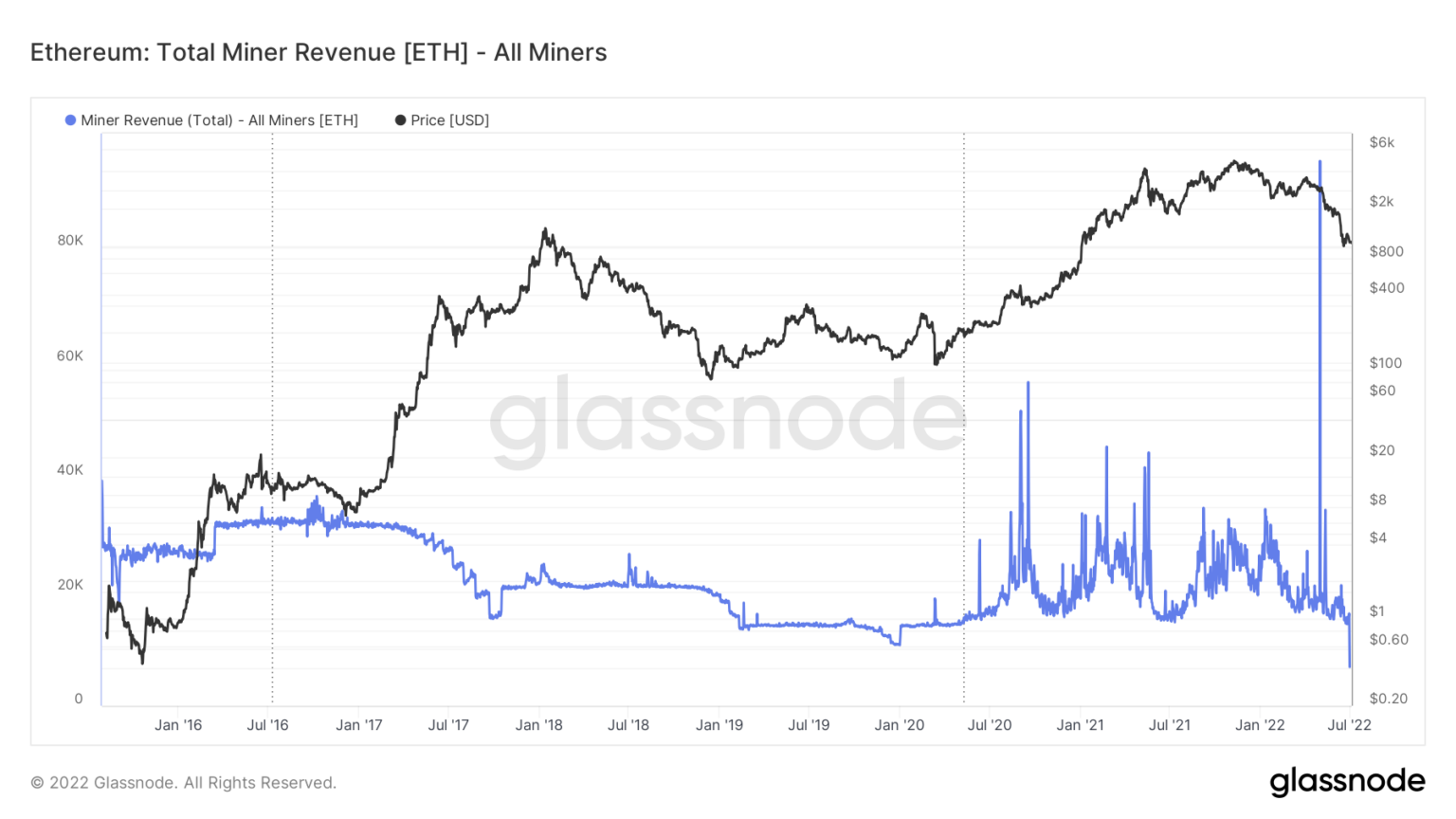
Another reason is the ongoing crypto correction. Ethereum has lost 72% in value, which means miners’ revenues would have taken a significant hit. A blockchain analytics firm Glassnode showed that miner revenue fell to an alarmingly low level.
Source: Glassnode

Ethereum miners’ revenue decreased by 27% from April. Notably, April 2022 saw Ethereum mining bring forth total revenue of $1.39 billion. Ethereum mining also saw a year-over-year monthly decline in May. Well, May 2021 saw approximately $2.4 billion in revenue generated, while 2022’s figure dipped by 57%.

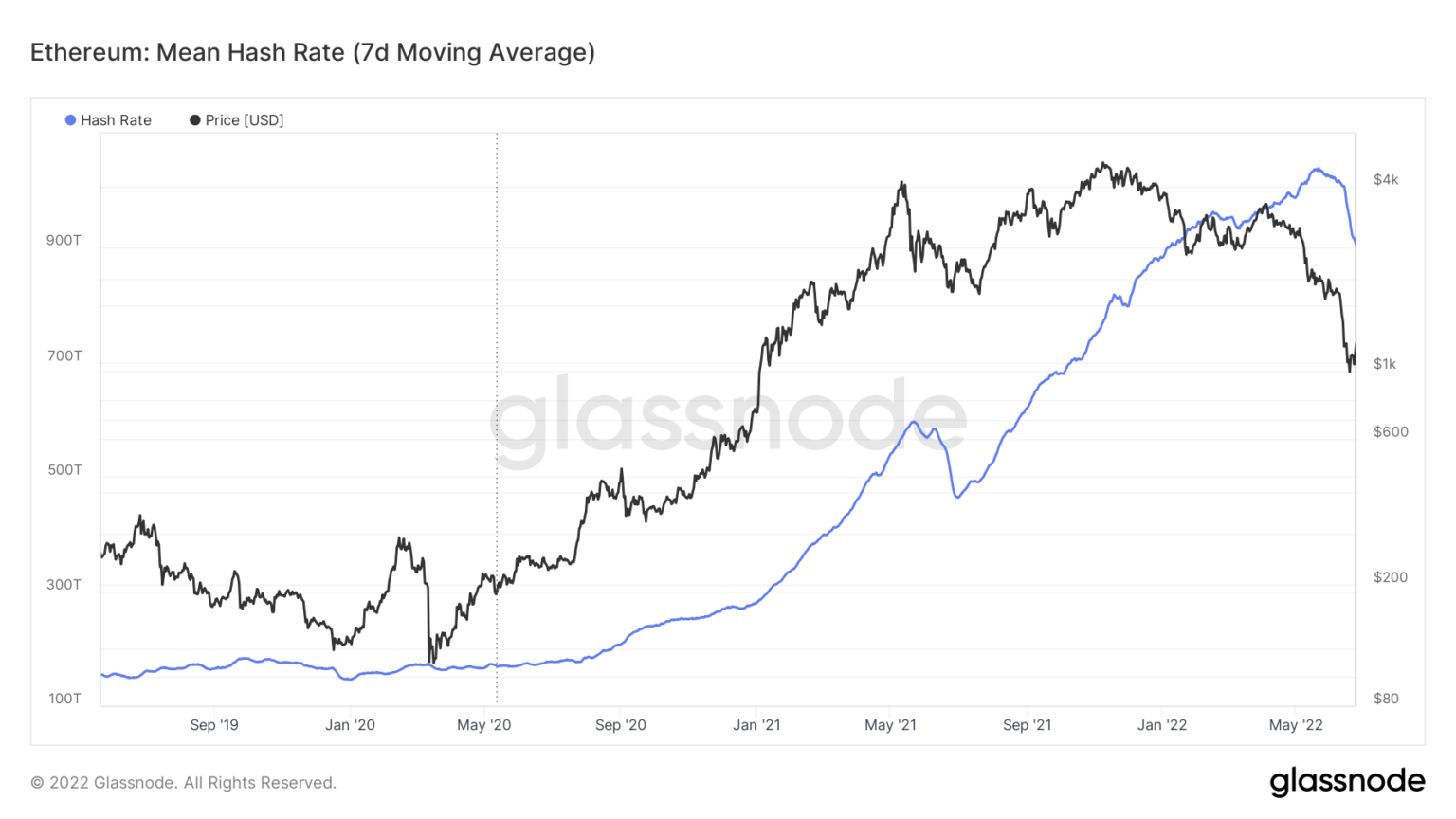
Overall, the declining ETH price and the coming merge forced some miners to disconnect their rigs. The decline in ETH’s network difficulty painted or rather highlighted this fall. This processing power suffered more than a 10% plunge as the value of mining proceeds plummeted due to ETH’s price which has been in freefall lately.

On a year-to-date chart, miners’ activity slopes to about 900 TH/s after peaking above 1,000 TH/s this June.
Source: Glassnode

In addition to this, the ever-rising electricity prices around the world made it worse. Electricity bills usually make up for a big part of the miners’ day-to-day costs, and an increase in power prices would lead to fewer net profits for them.

Naturally, the decline in the Ethereum hashrate and other factors affected miners’ profit margin. Ergo, they disconnected their GPUs (Graphics processing units).

Data from the tech outlet Tom’s Hardware reported that graphics card prices continued their drawdown in June as they plummeted another 14%.


Related Reads

Why Does the Term 'Year of AI Computing Power Realization' Have Pitfalls? —Understanding the Four Hurdles from Policy Signals to Actual Orders in One Article

This article critiques the phrase "The First Year of AI Computing Power Cashing In," arguing it oversimplifies a complex, multi-stage process. It proposes a "Four Gates" framework to assess the true commercialization of domestic AI computing power (like Huawei's Ascend chips): 1. **Policy Procurement:** Widely open in 2026. Significant government funding and large bulk orders from tech giants like Alibaba and Tencent exist. However, purchasing hardware is not the same as deploying it for real use. 2. **Real Deployment:** A crack has opened. The key evidence is DeepSeek V4, a top-tier AI model fully migrating from NVIDIA's CUDA to domestic computing platforms. This proves the capability for real, high-level tasks, but widespread adoption beyond leading tech firms is still nascent. 3. **Mature Software Ecosystem:** A narrow crack has opened. While frameworks like Huawei's CANN are progressing, they lag far behind NVIDIA's vast, established CUDA ecosystem in terms of supported models and developer ease-of-use. Building this middle-to-downstream developer environment is estimated to need 1-2 more years. 4. **Scalable Replication:** Essentially closed. This final gate, where thousands of mid-sized enterprises across various industries can easily adopt the technology without major migration costs, is not expected before 2027-2028. The core risk is conflating these stages. While 2026 marks a real turning point in policy-driven procurement and proving technical viability (Gates 1 & 2), the phrase "cashing in" is premature for the full industry. True, large-scale value realization depends on the later, slower-to-open gates of software maturity and scalable replication to the broader market. DeepSeek V4's shift is identified as the most critical 2026 signal, changing the narrative from "can it work?" to "when will supply meet demand?"

marsbit30m ago

Why Does the Term 'Year of AI Computing Power Realization' Have Pitfalls? —Understanding the Four Hurdles from Policy Signals to Actual Orders in One Article

marsbit30m ago

Trading

Spot
Futures
活动图片