Dogecoin Bullish Fractal Suggests 800% Surge Is Coming Amid Momentum Acceleration

bitcoinistPubblicato 2025-10-22Pubblicato ultima volta 2025-10-22

Introduzione

Dogecoin is still facing a lot of bearish pressure amid the market decline, but with the price still fighting to...

Trusted Editorial content, reviewed by leading industry experts and seasoned editors. Ad Disclosure

Dogecoin is still facing a lot of bearish pressure amid the market decline, but with the price still fighting to hold the $0.2 support level, there is still the possibility of a bounce from here. There is also the fact that the meme coin seems to be following a trend that has been seen in the last two bull cycles, suggesting that it could see a similar bounce. If this happens, then the Dogecoin price could be looking at a bounce that could send it to brand-new all-time highs.

Why Dogecoin Price Could See An 800% Rally

Bitcoinsensus posted an interesting Dogecoin price crash, comparing the current performance to the previous cycle performances. This showed the formation of bullish and bearish fractals that had been formed over the last two years, leading to a similar outcome in price.

The first of these fractals had appeared between 2023 and 2024, with the initial surge leading to a 300% price increase. Once the top was established, there was a steady correction that led the altcoin to lose almost all of its gains. However, this simply led into the formation of the next fractal.

The next time the fractal appeared was toward the end of 2024, and by the time that the rally was done, the Dogecoin price had risen by 500%, leading to its highest levels since 2021. Then, as before, the price correction led to a loss of most, but not all of its gains, suggesting the formation of another bullish fractal is about to follow.

One interesting thing about this fractal formation over time, though, is the fact that there has been a steady acceleration of gains each time. Following the move from 300% to 500%, the analyst believes that the next breakout from this fractal would lead to an 800% price increase.

With the Dogecoin price looking to replicate this cycle breakout, it could be on track to create a new all-time high. An 800% increase would mean eventually beating the coveted $1 level, and the top would be somewhere around the $1.4 level before topping out.
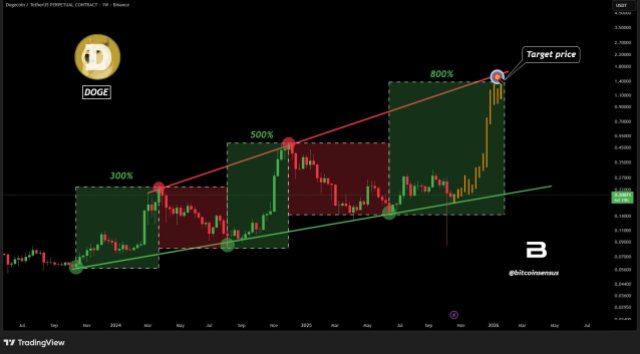
Dogecoin price
Source: X

However, the Dogecoin price is still highly dependent on the performance of the Bitcoin price and the general crypto market. In this case, the Bitcoin price would have to continue to rally, because another crash could send the Dogecoin price spiraling once more along with the altcoin market, and invalidating the bullish thesis.

Dogecoin price chart from Tradingview.com
DOGE bulls try to stage a recovery | Source: DOGEUSDT on Tradingview.com
Featured image from Dall.E, chart from TradingView.com
Editorial Process for bitcoinist is centered on delivering thoroughly researched, accurate, and unbiased content. We uphold strict sourcing standards, and each page undergoes diligent review by our team of top technology experts and seasoned editors. This process ensures the integrity, relevance, and value of our content for our readers.

Scott Matherson is a leading crypto writer at Bitcoinist, who possesses a sharp analytical mind and a deep understanding of the digital currency landscape. Scott has earned a reputation for delivering thought-provoking and well-researched articles that resonate with both newcomers and seasoned crypto enthusiasts. Outside of his writing, Scott is passionate about promoting crypto literacy and often works to educate the public on the potential of blockchain.

Letture associate

Institutions Have Already Bought the Dip: Is Bitcoin at $70,000 the Start of a Bull Run or a Local Top?

Institutional Investors Piled into Bitcoin Ahead of Rally: Is $70K a New Bull Market Start or Local Top? Bitcoin surged past $70,000 following pro-crypto remarks from former U.S. President Donald Trump on August 20. However, institutional investors had been accumulating exposure in Q2 2026, even as the price fell. 13F filings reveal that while total Bitcoin ETF holdings declined, institutional holdings increased by 7.5%, reaching a record 44.2% share of ETF assets. Key institutional moves include Jane Street increasing its Bitcoin ETF and MicroStrategy (MSTR) exposure by over $800 million, BlackRock adding ~$290 million in Bitcoin-related holdings (MSTR, its own IBIT ETF, and ASST), and JPMorgan boosting its IBIT position by $85.6 million. UBS significantly increased its call option exposure on IBIT. Notably, Paul Tudor Jones's fund reversed a multi-quarter selling trend to add IBIT shares. Market opinions are divided post-rally. The "bear market over" camp includes F2Pool's co-founder declaring the bear market ended, Strive's CEO citing a favorable macro backdrop for Bitcoin, and Standard Chartered targeting $100,000 by year-end. Conversely, the "not yet bottomed" camp includes CZ stating the super cycle hasn't arrived, CryptoQuant analysts warning of elevated retail demand often preceding local tops, and analysis from VanEck and Glassnode suggesting on-chain data shows a prolonged "capitulation phase" is still unfolding, indicating current price strength may be a relief rally rather than a definitive trend reversal.

Odaily星球日报13 min fa

Institutions Have Already Bought the Dip: Is Bitcoin at $70,000 the Start of a Bull Run or a Local Top?

Odaily星球日报13 min fa

Viewpoint: A $4 Billion Buyback Can Fix Liquidity, But Not U.S. Fiscal Health

On August 19, the U.S. Treasury announced it would increase its maximum single-operation buyback size for long-term bonds from $2 billion to at least $4 billion, aiming to improve market liquidity. This move initially led to a pullback in long-term yields, such as the 30-year Treasury yield which had recently hit a 2007 high near 5.34%, sparking talk of potential "Treasury support." However, an opposing perspective argues this is merely a temporary fix. While buybacks can enhance trading conditions for older, less-liquid bonds, they do not address the underlying fiscal pressures. The Treasury's actions are a form of debt management, not monetary stimulus like QE; the funds used for buybacks ultimately come from cash balances or new borrowing. They do not reduce the government's overall financing needs. The core issue is growing fiscal supply. With the federal deficit reaching a record $432 billion in July 2026 and cumulative deficits already surpassing the prior fiscal year's total, the market faces a massive wave of new debt issuance. The recent surge in long-term yields may reflect a repricing of this persistent fiscal risk and the associated term premium, rather than just a liquidity shortage. Furthermore, demand-side challenges loom. Foreign holdings of U.S. Treasuries have recently declined, and if official demand weakens, the market will rely more on price-sensitive private investors, potentially requiring higher yields to clear future auctions. In essence, the Treasury can use buybacks to soothe market "trading problems," but it cannot buy away the nation's "fiscal problem." The key factors to watch will be the appetite at long-term bond auctions, the trajectory of the fiscal deficit, and whether higher yields can sustainably attract buyers. Without improvement in these areas, the yield relief provided by the $4 billion buyback expansion is likely just a short-term buffer.

marsbit22 min fa

Viewpoint: A $4 Billion Buyback Can Fix Liquidity, But Not U.S. Fiscal Health

marsbit22 min fa

Trading

Spot
活动图片