Bitmine Adds 63,539 Ethereum Worth $251.6M – Now Controls 2.73% of Supply

bitcoinistPublished on 2025-10-22Last updated on 2025-10-22

Abstract

Ethereum is under selling pressure once again, testing a critical support level as the broader crypto market continues to struggle...

Trusted Editorial content, reviewed by leading industry experts and seasoned editors. Ad Disclosure

Ethereum is under selling pressure once again, testing a critical support level as the broader crypto market continues to struggle for bullish momentum. Altcoins are losing strength across the board, and growing concern among traders has fueled renewed talk of a potential bear market. The recent downturn has pushed Ethereum closer to its key technical levels, with investors closely watching whether it can maintain support or if another leg down is imminent.

However, not everyone is bearish. On-chain data from Lookonchain reveals that Bitmine, one of the largest Ethereum holders, just made a massive purchase — acquiring 63,539 ETH worth approximately $251.6 million. Large, timely purchases during drawdowns don’t guarantee a reversal, but they often reveal where deep-pocketed participants think value sits. At a minimum, it injects fresh demand at a moment when sentiment is fragile and reactive.

From here, the tape matters. If ETH can hold this support and compress into a higher low, the market may start to treat the recent selloff as a shakeout rather than a regime shift. Lose it decisively and the “bear market” calls will likely get louder. For now, Ethereum sits at a crossroads—pressure building, skepticism rising, and one sizable buy hinting that the story isn’t finished yet.

Bitmine Adds Ethereum Amid Market Weakness

According to Lookonchain, Ethereum whale Bitmine made a major move just eight hours ago — three newly created wallets received a total of 63,539 ETH, worth approximately $251.6 million, from Kraken and BitGo. The on-chain activity sparked renewed discussion among analysts, as such large-scale transfers during a period of selling pressure often reflect institutional accumulation rather than routine repositioning.

Bitmine on-chain transactions | Source: Lookonchain

This addition pushes Bitmine’s holdings to 3,299,553 ETH, valued at around $13.07 billion, representing roughly 2.73% of Ethereum’s total circulating supply. The sheer scale of this position places Bitmine among the most influential holders of ETH, capable of impacting both sentiment and liquidity across the network. Analysts often interpret these types of movements as confidence signals, particularly when they occur in periods of heightened volatility.

At a time when Ethereum is struggling to maintain key support levels and broader market confidence is fragile, such accumulation could serve as a stabilizing force — or at least a psychological one. Historically, similar whale activity has preceded local price recoveries as supply tightens and market participants reassess short-term bearish bias.

Still, the broader context cannot be ignored. Ethereum remains vulnerable to macro headwinds, and on-chain flows alone may not offset systemic selling. What’s clear, however, is that Bitmine’s latest accumulation stands out as a show of conviction — an assertive move that suggests some large holders still view current price levels as a long-term opportunity rather than a signal of deeper decline.

Testing A Pivotal Price Level

On the 3-day chart, Ethereum (ETH) is attempting to stabilize after a period of sharp selling pressure, currently trading around $3,871. The broader structure still shows an uptrend, but recent candles reveal a clear slowdown in bullish momentum. After peaking near $4,800, ETH entered a correction that brought price back toward the 50-period moving average (blue line), which now serves as a key short-term support level.
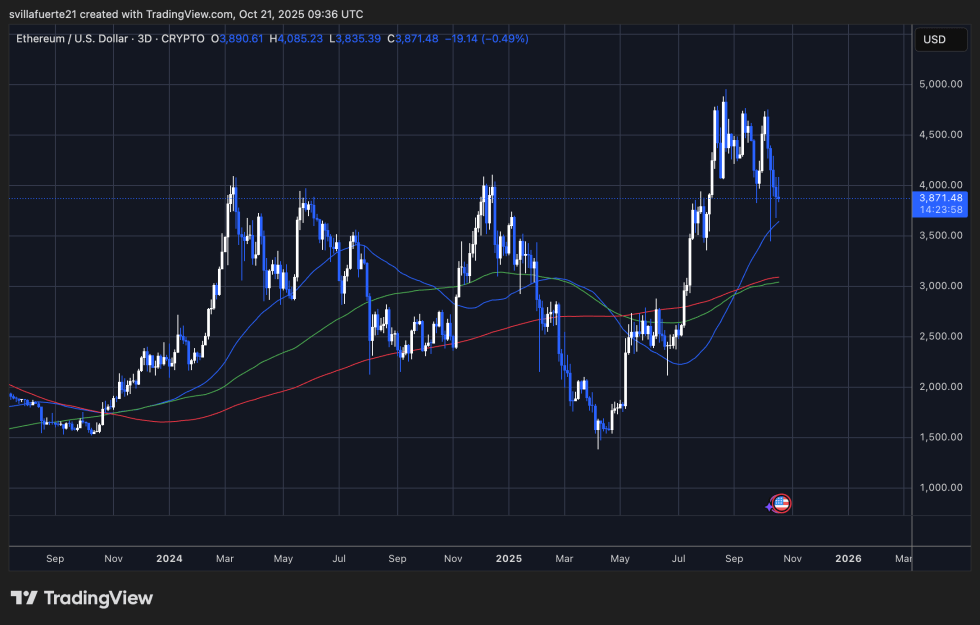
Ethereum consolidates around key level | Source: ETHUSDT chart on TradingView
Ethereum consolidates around a key level | Source: ETHUSDT chart on TradingView

This zone has historically acted as a pivot during mid-cycle consolidations, and holding above it would keep Ethereum within a healthy market structure. However, if ETH loses this level, the next significant support lies between $3,400 and $3,500, where the 100-period (green) and 200-period (red) moving averages converge — an area that often attracts long-term buyers.

To the upside, ETH needs a decisive close above $4,000–$4,200 to regain momentum and potentially retest the $4,500 resistance, which has been a strong rejection level since late September.

Overall, the 3D chart paints a picture of short-term weakness within a broader bullish framework. Ethereum’s ability to defend its mid-range support will determine whether this correction evolves into accumulation or signals the start of a deeper market retrace.

Featured image from ChatGPT, chart from TradingView.com

Editorial Process for bitcoinist is centered on delivering thoroughly researched, accurate, and unbiased content. We uphold strict sourcing standards, and each page undergoes diligent review by our team of top technology experts and seasoned editors. This process ensures the integrity, relevance, and value of our content for our readers.

Sebastian's journey into the world of crypto began four years ago, driven by a fascination with the potential of blockchain technology to revolutionize financial systems. His initial exploration focused on understanding the intricacies of various crypto projects, particularly those focused on building innovative financial solutions. Through countless hours of research and learning, Sebastian developed a deep understanding of the underlying technologies, market dynamics, and potential applications of cryptocurrencies. As his knowledge grew, Sebastian felt compelled to share his insights with others. He began actively contributing to online discussions on platforms like X and LinkedIn, focusing on fintech and crypto-related content. His goal was to expose valuable trends and insights to a wider audience, fostering a deeper understanding of the rapidly evolving crypto landscape. Sebastian's contributions quickly gained recognition, and he became a trusted voice in the online crypto community. To further enhance his expertise, Sebastian pursued a UC Berkeley Fintech: Frameworks, Applications, and Strategies certification. This rigorous program equipped him with valuable skills and knowledge regarding Financial Technology, bridging the gap between traditional finance (TradFi) and decentralized finance (DeFi). The certification deepened his understanding of the broader financial landscape and its intersection with blockchain technology. Sebastian's passion for finance and writing is evident in his work. He enjoys delving into financial research, analyzing market trends, and exploring the latest developments in the crypto space. In his spare time, Sebastian can often be found immersed in charts, studying 10-K forms, or engaging in thought-provoking discussions about the future of finance. Sebastian's journey as a crypto analyst and investor has been marked by a relentless pursuit of knowledge and a dedication to sharing his insights. His ability to navigate the complex world of crypto, combined with his passion for financial research and communication, makes him a valuable asset to the industry. As the crypto landscape continues to evolve, Sebastian remains at the forefront, providing valuable insights and contributing to the growth of this revolutionary technology.

Related Reads

A Trillion-Dollar Frenzy for Memory Sellers, Halved Profits for Memory Buyers

Summary: A stark divide has emerged in the tech industry. While memory chipmaker Micron's stock soared 19% in a single day, pushing its market cap over $1 trillion, smartphone manufacturer Xiaomi reported a 43% plunge in adjusted net profit. The core driver is a severe supply crunch in memory chips, particularly for AI applications. Wall Street analysts, led by UBS and its unprecedented 204% target price hike for Micron, argue that long-term agreements (LTAs) from AI cloud giants are fundamentally ending the sector's notorious boom-and-bust cycles, justifying a re-rating from cyclical to infrastructure-like valuations. However, the "storage" market is now fragmented into three tiers. The first, AI-grade memory like HBM and server DDR5, faces extreme shortages and soaring prices driven by massive cloud capex. The second, mobile memory for smartphones, is also seeing sharp price hikes as manufacturers like Xiaomi are forced to pay more for remaining capacity, severely squeezing their margins. The third, PC retail channels, shows price declines due to existing inventory. The article questions the sustainability of the "supercycle" narrative. It highlights that Micron's revenue surge is driven almost entirely by price increases, not shipment volumes, making it vulnerable to a potential demand slowdown. While LTAs may dampen volatility, history suggests they are often tested during downturns. The current peak earnings, used to justify high valuations, represent a classic cyclical top. The piece concludes with a note of caution: when the entire Street chants "this time is different," it's wise to remember past bubbles, even as it acknowledges AI demand may indeed be structural.

marsbit58m ago

A Trillion-Dollar Frenzy for Memory Sellers, Halved Profits for Memory Buyers

marsbit58m ago

This New Generation of US Stock Trading Gods No Longer Read Financial Reports

The new generation of "stock gods" in the 2026 US AI bull market are not analyzing traditional financial reports. Instead of focusing on giants like NVIDIA, figures like the 22-year-old Leopold Aschenbrenner (who reportedly turned $200M into $14B) and influencers like Serenity on platforms like Reddit's WallStreetBets, X, and Substack are gaining fame and returns by targeting obscure, low-cap "micro-cap" stocks. Their strategy, dubbed "supply chain sniping," involves identifying critical, often monopolistic, bottlenecks in the AI hardware supply chain—such as specific materials or components essential for giants like Google and NVIDIA—that are missed by mainstream Wall Street analysts. Serenity's call on AXTI, a $700M company supplying indium phosphide substrates crucial for photonics and optical interconnects, saw the stock soar from ~$12 to nearly $150. Similarly, accounts like KawzInvests and PhotonCap focus on thematic, supply-chain-driven research in areas like AI infrastructure, optics, and cloud services for SMEs, bypassing traditional valuation metrics. This shift represents a cultural move away from Warren Buffett-style value investing based on deep financial statement analysis. The new approach thrives on low liquidity, early narratives, and strong community propagation on social media, similar to meme stocks or crypto. However, this "attention economy" strategy carries risks: it depends on sustained information gaps, the underlying companies' ability to deliver fundamental results, and the potential for crowded, volatile exits as narratives shift. The trend also shows crypto traders applying their narrative-sensing skills to US micro-caps, marking a significant evolution in trading culture.

marsbit1h ago

This New Generation of US Stock Trading Gods No Longer Read Financial Reports

marsbit1h ago

Trillion-Dollar Euphoria for Memory Sellers, Halved Profits for Memory Buyers

Title: The Trillion-Dollar Memory Seller's Carnival vs. The Buyer's Halved Profits On May 26, a stark contrast unfolded. While memory chipmaker Micron's market cap surged past $1 trillion, smartphone maker Xiaomi reported plummeting profits. Xiaomi's Q1 2026 profits fell 43% year-on-year. Executive Lu Weibing cited memory prices quadrupling from last year, adding roughly $210 to a phone's cost. To survive, Xiaomi is cutting entry-level models, sacrificing volume. Micron's stock, however, skyrocketed over 19% in a day, capping an 8x gain in a year. Major banks like UBS and JPMorgan issued bullish reports, raising price targets drastically. Their core thesis: Long-Term Agreements (LTAs) with AI cloud giants (Microsoft, Google, etc.) are eliminating the memory industry's notorious boom-bust cycle. By locking in fixed-price, multi-year contracts for AI-grade memory (HBM, server DDR5), these deals promise stable, utility-like earnings, justifying a higher valuation (20-30x P/E vs. the historical 8-15x). The article reveals a three-tiered memory market in 2026: 1) **AI Storage (HBM/DDR5/Enterprise SSD)**: Extreme shortage, soaring prices, LTAs. This is Micron's story. 2) **Mobile/Embedded Memory**: Also facing sharp price hikes as AI production crowds out capacity, severely pressuring phone makers like Xiaomi. 3) **PC Retail**: Some spot prices are falling due to channel inventory liquidation, creating a divergence from contract markets. The author questions if LTAs truly end the cycle. It hinges on sustained, hyper-growth AI demand. Micron's current profits are at a cycle peak, driven mostly by price hikes, not volume. If AI capital expenditure growth slows, the massive industry capacity expansion (e.g., Micron's $250B+ CapEx plan) could lead to a glut. Historically, using peak-cycle earnings for valuation is a classic trap. While the AI-driven structural shift might be real, the unanimous Wall Street euphoria warrants caution, echoing past bubbles like Cisco's in 2000. The memory seller's trillion-dollar狂欢 (carnival) continues, but the cycle's shadow remains.

链捕手1h ago

Trillion-Dollar Euphoria for Memory Sellers, Halved Profits for Memory Buyers

链捕手1h ago

Trading

Spot
Futures

Hot Articles

Discussions

Welcome to the HTX Community. Here, you can stay informed about the latest platform developments and gain access to professional market insights. Users' opinions on the price of ETH (ETH) are presented below.

活动图片