Best Crypto to Buy as Shutdown Adds Twist to September CPI Release, Fed Weighs Next Rate Cut

bitcoinistPublished on 2025-10-20Last updated on 2025-10-20

Abstract

Quick Facts: 1️⃣ US government shutdown has frozen key economic data, making the Fed reliant solely on Friday’s CPI data...

Trusted Editorial content, reviewed by leading industry experts and seasoned editors. Ad Disclosure

Quick Facts:

1️⃣ US government shutdown has frozen key economic data, making the Fed reliant solely on Friday’s CPI data release.
2️⃣ The Friday release is unusual – the first since 2018
3️⃣ Markets see a 98.4% chance of a 25 bps rate cut, a smaller chance of a 50 bps cut.
4️⃣ Any cut could fuel momentum in the best crypto to buy – including $HYPER, $MAXI, and $BTC.

The US Federal shutdown is starting to impact key information delivery dates – and the move has major implications for crypto and beyond.

September CPI will be released on Friday, October 24, landing just 5 days before the Oct. 28–29 FOMC meeting.
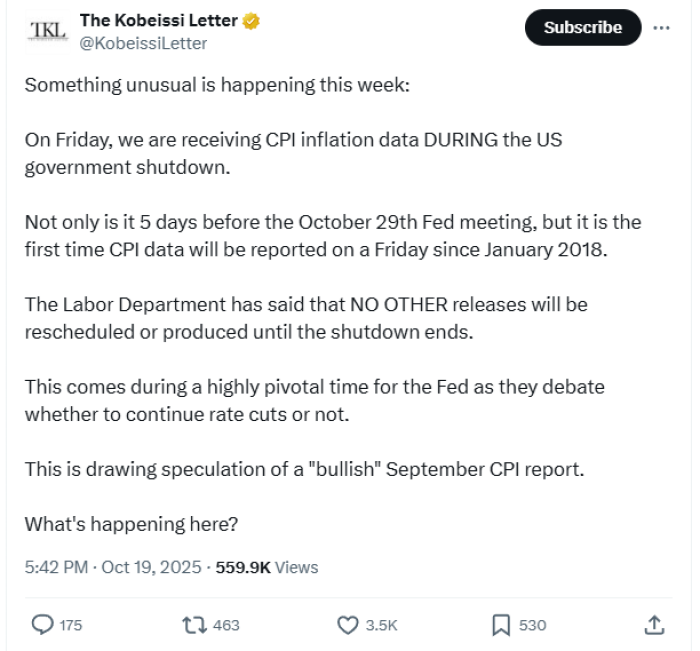
The Kobeissi Letter: Something unusual is happening.

A U.S. federal shutdown has frozen other key data releases, including jobs data and sales info, leaving the Fed unusually reliant on CPI to guide the October decision.
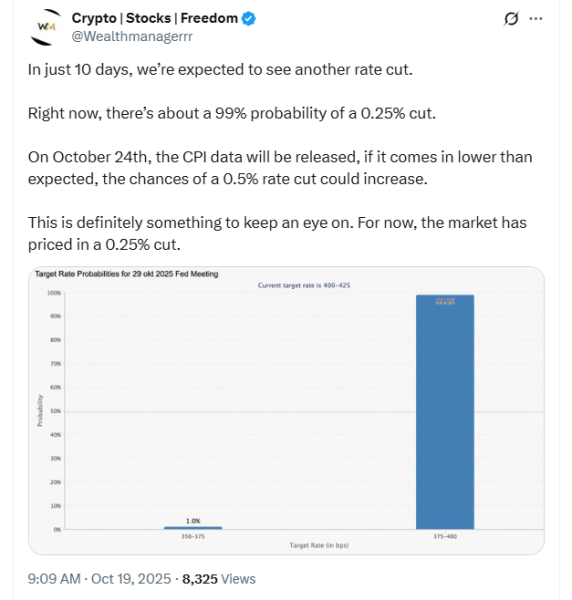
In the meantime, markets broadly price in a 25 bps cut, with chatter that a softer CPI could raise odds of 50 bps. Odds for the former currently stand at 98.4%, with the odds of the latter ticking up to 1.6% from an earlier 1%.

Odds of another rate cut.

Surveys point to slower inflation vs. August, but uncertainty is high without corroborating data, which now won’t be released thanks to the government shutdown.

Two quirks make Friday’s release unusually market-moving: it’s a rare Friday CPI, and it comes amid an ongoing government shutdown that has delayed many other federal statistics. That leaves the Fed with fewer data points than usual, concentrating attention on CPI as the swing factor for October’s decision.

With jobs and retail sales data disrupted, policymakers must triangulate using CPI, private indicators, and high-frequency signals.

Everything’s riding on the CPI data now, making a major last-minute swing possible. A number of scenarios could play out:

  • Soft CPI (below consensus): Strengthens the case for an October 25 bps cut and could nudge discussions toward 50 bps. For crypto, soft CPI would ease financial conditions and provide additional support for $BTC, $ETH, and bigger alts.
  • In-line CPI: Keeps a 25 bps cut baseline intact, fuels $BTC and large-caps..
  • Hot CPI (above consensus): Risks a smaller or delayed easing path; markets may pare back 2025 cut expectations. In the worst-case scenario, the Fed could delay the rate cut entirely and wait for the shutdown to end and more data to become available.

As everyone frantically refreshes the Bureau of Labor Statistics website on Friday, here are the best crypto to buy now, including $MAXI and $HYPER – providing a mix of big-name momentum and presale potential.

Bitcoin Hyper ($HYPER) – Bitcoin Layer 2 Upgrade for Faster, Cheaper Bitcoin Payments

Bitcoin Hyper ($HYPER) aims to solve some of the problems that still plague Bitcoin. Slow payments, limited throughputs, and congestion still make $BTC payments unreliable, particularly for microtransactions.
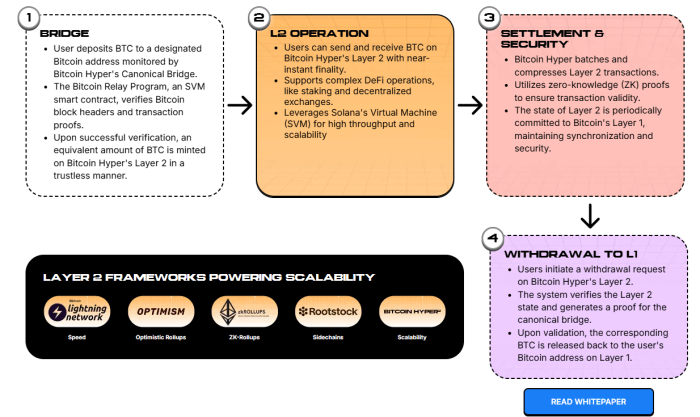
Bitcoin Hyper Architecture

How does Bitcoin Hyper work? By combining a Canonical Bridge on the Solana Virtual Machine with the new Hyper Layer 2. The result provides the flexibility and scalability of the SVM but reserves final transaction settlement for the original Bitcoin Layer 1.

The hybrid architecture makes microtransactions, native staking, and DeFi on Bitcoin Hyper all possible with wrapped $BTC.

The $HYPER token powers the new Layer 2, providing payments for transaction fees, serving as the general utility token. Learn how to buy $HYPER, and see why our price prediction shows it could reach $0.32 by the end of the year, up 2334% from its current $0.013145.

Check out the HYPER presale page today.

Maxi Doge ($MAXI) – Big Doge Aims at Max Gains in Dog-Themed Meme Market

The dog-themed meme coin market currently sits at $37B. And now there’s a new dog in town – one that intends to shake up the entire sector.

Maxi Doge ($MAXI) offers a pure meme coin competitor to Dogecoin ($DOGE). There’s no utility; $MAXI sneers at the recent trend of meme-utility tokens. This is pure momentum and raw hype poured into a single doge-based meme coin.

Maxi Doge, the new doge presale.

The presale, currently at $3.6M, is set to pour 40% of the entire token allocation into marketing. Add in another 25% in the Maxi Fund – reserved for the biggest and best marketing opps – and well over half of all $MAXI tokens are set aside to promote the project.

That factors into our price prediction, which sees $MAXI potentially reaching $0.0024 by the end of the year, up 809% from its current $0.000264.

Learn how to buy $MAXI, and check out the Maxi Doge presale page for the latest.

Bitcoin ($BTC) – Bitcoin Ready for a Post-CPI Surge?

Will Bitcoin surge after the CPI data release on Friday?

‘Uptober’ saw a new all-time high for Bitcoin, but it never sustained those gains, tumbling quickly to spend the last few days trading around $110K.
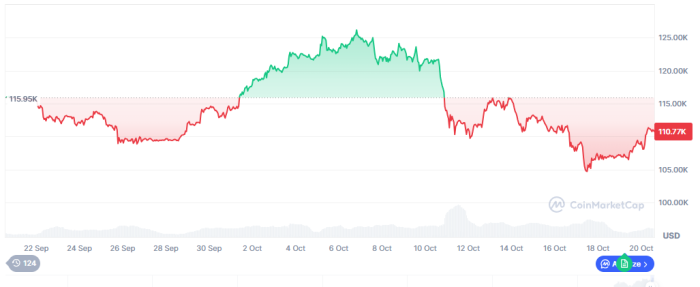
Is Bitcoin ready for a post-CPI surge?
Source: CoinMarketCap

Macroeconomic headwinds account for most of that decline, and the CPI data could be just the thing to kickstart a new Bitcoin surge.

But because of the shutdown, CPI is the single major datapoint heading into the late-October meeting. Markets already lean toward a 25 bps cut; a soft print could open the door to a more aggressive discussion, while a hot print muddies the outlook.

Barring a major shift, even a modest cut could spur $HYPER, $MAXI, and $BTC to a hot start to November.

Authored by Bogdan Patru for Bitcoinist — https://bitcoinist.com/best-crypto-to-buy-as-cpi-data-might-lead-to-rate-cut

Editorial Process for bitcoinist is centered on delivering thoroughly researched, accurate, and unbiased content. We uphold strict sourcing standards, and each page undergoes diligent review by our team of top technology experts and seasoned editors. This process ensures the integrity, relevance, and value of our content for our readers.

As a crypto writer, Bogdan’s responsibilities are split between researching and writing articles and entertaining the team with his humor bordering on the politically incorrect, an aspiring Bill Burr, if you will. Thanks to his 12+ years of writing experience in just as many fields, including tech, cybersecurity, modelling, fitness, crypto, and other topics-that-shall-not-be-named, he's become a genuine asset to the team. While his position as a senior writer at PrivacyAffairs thought him valuable lessons about the power of self-management, his entire writing career was and is an exercise in self-improvement. Now, he's ready to sink his teeth into crypto and teach people how to take control of their own money on the blockchain. With fiat as an eternally devaluing currency, Bitcoin and altcoins seem like the best-fitting alternative for Bogdan. Bogdan’s biggest professional accomplishment, aside from securing a position as a main writer for Bitcoinist, was his 5-year run as a writing manager at Blackwood Productions, where he coordinated a team of four writers. During that time, he learned the value of teamwork and that of creating a working environment that breeds efficiency, positivity, and friendship.

Related Reads

Large Language Models Ace All Exams, Yet Move Farther from AGI: What Does This Paper Reveal?

The article discusses the ongoing challenge of defining and achieving Artificial General Intelligence (AGI). It notes that industry leaders have set vague, often profit- or time-based benchmarks for AGI, while the concept itself lacks a consensus definition—a situation the article compares to a "Rorschach test." It highlights a recent 2025 paper by researcher Michael Timothy Bennett, who proposes a new, measurable definition. Bennett frames AGI not as mimicking human performance on tests, which current large language models (LLMs) have already mastered, but as an "artificial scientist." A true AGI, according to this view, should be able to widely and efficiently adapt to new environments and tasks within real-world constraints (like computational and energy limits), focusing on the *discovery of new knowledge* rather than the replication of existing data. The author contrasts this with the current dominant approach of "scale-maxing"—massively scaling up data, parameters, and compute. While powerful, this method leads to models that fail on out-of-distribution problems and lack core intelligent abilities: they are passive learners, cannot reason causally, and cannot actively experiment or balance exploration with exploitation. The article argues that Bennett's framework offers a crucial shift. It makes AGI a quantifiable engineering problem and proposes new evaluation "adaptation benchmarks" that test an AI's ability to actively learn in novel scenarios. The conclusion is that achieving AGI will require a fundamental reset—a fusion of multiple methodologies beyond simple scaling, moving AI from mimicking patterns to embodying the scientific spirit of inquiry and discovery.

marsbit14m ago

Large Language Models Ace All Exams, Yet Move Farther from AGI: What Does This Paper Reveal?

marsbit14m ago

Pope Issues First AI Encyclical: 40,000 Words, 10 Key Points, Clarifying AI Anxiety

Pope Leo XIV's historic encyclical "Magnifica Humanitas," released in May 2026, marks the Catholic Church's first major document addressing artificial intelligence. The 40,000-word text moves beyond theological abstraction to confront practical AI anxieties affecting society. It argues that AI is no longer a mere tool but an embedded environment influencing daily decisions in areas like employment, healthcare, justice, and information, often without users' awareness. The encyclical presents ten core concerns. It highlights that the central issue isn't just regulation, but who holds the underlying *power*—control over data, compute, and platforms—often concentrated in private entities. It warns that even developers cannot fully explain AI systems, creating accountability gaps. While AI can simulate human interaction and creativity, it cautions against treating it as a moral agent capable of bearing true responsibility or forming genuine relationships. Key risks identified include AI's role in opaque decision-making for jobs or welfare, the amplification of persuasive disinformation, and the potential for education to focus on tool use over critical thinking. The document stresses that work has value beyond efficiency, and AI should enhance human capabilities, not merely replace roles. It firmly states that irreversible decisions, especially involving life and death, must remain under human judgment. Ultimately, the encyclical frames AI's challenge as anthropological, not just technological. As AI simulates uniquely human capacities like judgment and creation, it forces a re-examination of what makes human action meaningful: our capacity for responsibility, vulnerability, and bearing real consequences. The Pope concludes that technology is never neutral; its development and deployment are shaped by human values and choices, making an inclusive, ethically grounded dialogue essential for its future.

marsbit19m ago

Pope Issues First AI Encyclical: 40,000 Words, 10 Key Points, Clarifying AI Anxiety

marsbit19m ago

Trading

Spot
Futures
活动图片