Florida’s Crypto Bill Gets A Second Life—But Will It Work This Time?

bitcoinistPublished on 2025-10-17Last updated on 2025-10-18

Abstract

Florida Representative Webster Barnaby has filed House Bill 183, a reopened attempt to let state officials put public money into...

Trusted Editorial content, reviewed by leading industry experts and seasoned editors. Ad Disclosure

Florida Representative Webster Barnaby has filed House Bill 183, a reopened attempt to let state officials put public money into digital assets, including Bitcoin and crypto exchange-traded products.

According to the Florida Senate bill text, the proposal would let the Chief Financial Officer and the State Board of Administration manage investments in a range of tokenized holdings and set rules for how those holdings must be kept.

What The Bill Would Allow

Based on reports, HB 183 would permit up to 10% of certain public funds to be invested in “digital assets” and exchange-traded products.

The measure names possible sources such as the General Revenue Fund, the Budget Stabilization Fund, and trust funds, and it would allow the Florida Retirement System Trust Fund to allocate a similar share. Reports also say the bill broadens an earlier Bitcoin-only effort to cover tokenized securities, ETFs, and even NFTs.
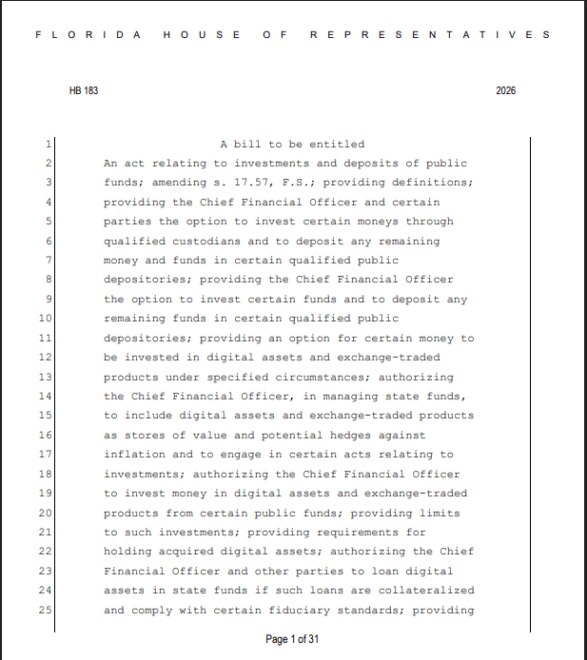
New bill introduced by Florida Rep. Webster Barnaby on Wednesday.

Safeguards And Custody Rules

According to the bill language and summaries, the proposal does not leave custody loose. It lays out specific holding and custody standards, allows assets to be kept by qualified custodians or held through exchange-traded products, and permits lending only when collateralized and consistent with fiduciary duties.

It would also require that any taxes or fees paid in crypto be converted into US currency before being credited to state accounts. Those measures are framed as guardrails to limit direct risk to state coffers.

Where The Bill Came From And What Failed Before

This move follows an earlier effort that focused on Bitcoin and failed to pass committee. Reports have disclosed that the prior proposal collapsed in June, pushing the sponsor to file a broader, rewritten bill this month.

The new text is being read as a softer, more flexible take on the same idea — one that aims to give officials different routes to hold exposure while spelling out limits.

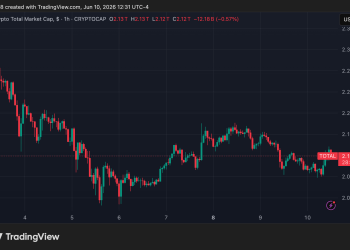
Total crypto market cap currently at $3.5 trillion. Chart: TradingView

Stablecoin Measures Filed Alongside Investment Bill

State filings show Rep. Barnaby also introduced House Bill 175 to clarify rules for stablecoin issuers.

According to the bill page and media summaries, qualifying stablecoin issuers would need full collateral backing in US dollars or Treasury securities and public audits at least once a month, and some licensing requirements could be narrowed for those that meet the standards.

The aim appears to be creating a clear, state-level framework for certain payment-focused stablecoins.

Featured image from Playa Largo Ocean Residences, chart from TradingView

Editorial Process for bitcoinist is centered on delivering thoroughly researched, accurate, and unbiased content. We uphold strict sourcing standards, and each page undergoes diligent review by our team of top technology experts and seasoned editors. This process ensures the integrity, relevance, and value of our content for our readers.

Christian, a journalist and editor with leadership roles in Philippine and Canadian media, is fueled by his love for writing and cryptocurrency. Off-screen, he's a cook and cinephile who's constantly intrigued by the size of the universe.

Related Reads

Consumer Confidence Hits Bottom, Macro Correlations Simultaneously Break Down: How Much Longer Can the U.S. Stock Market's Solo Rally Last?

The U.S. stock market is exhibiting a rare divergence: while consumer confidence hits historic lows and traditional macro asset correlations break down, major indices like the Nasdaq 100 and S&P 500 continue reaching record highs, fueled primarily by AI and semiconductor momentum. The rally is now highly concentrated, with strength rotating from giants like Nvidia to higher-beta plays within semiconductors, particularly memory chips. This surge occurs despite a significant split between pessimistic consumer sentiment and still-resilient actual spending behavior, partially supported by fiscal stimulus. Goldman Sachs traders highlight a critical structural fissure: correlations between the S&P 500 and key macro assets (rates, gold, VIX, oil) have deviated extremely from long-term historical norms. Concurrently, the market is in a negative Gamma regime, making it more sensitive to price moves, and hedge fund positioning in momentum and semiconductors is at crowded levels. The sustainability of this "solo rally" faces three main constraints: 1) Oil price volatility linked to Middle East geopolitical risks, 2) Extreme crowding in semiconductor and momentum trades, increasing vulnerability to disappointments, and 3) The breakdown of traditional macro correlations, suggesting the rally reflects a specific mix of factors rather than broad-based risk appetite. The key question is not if indices can rise further, but which variable—oil, rates, or semiconductor momentum—might trigger a repricing of the current fragile logic.

marsbit25m ago

Consumer Confidence Hits Bottom, Macro Correlations Simultaneously Break Down: How Much Longer Can the U.S. Stock Market's Solo Rally Last?

marsbit25m ago

Will OpenAI Swallow the Application Layer? a16z Says Real Opportunities Lie Outside General Models

As large language models (LLMs) from companies like OpenAI and Anthropic become more powerful, many fear they will dominate the AI application layer, leaving no room for startups. However, this article argues that the real opportunity lies not on the "Yellow Brick Road"—the high-profile, general-purpose tasks like code and text generation that model labs are directly pursuing—but in the "rest of Oz": complex, vertical-specific applications. On the Yellow Brick Road, model companies have inherent advantages: control over the model, better margins, pricing power, and strong distribution. Startups building generic, horizontal "co-pilot" tools for standard tasks are competing directly on this path and are vulnerable. True defensibility and value are found in specialized, vertical applications. These involve deep integration into messy, multi-step business workflows (e.g., sales, insurance, legal), handling legacy systems, data quality issues, compliance, and governance. The "scaffolding" around the model—the specialized tools, automations, workflows, and industry knowledge—becomes more critical than the raw model power itself. Vertical AI companies can build defensible moats through: * **Data & Learning Flywheels:** Capturing unwritten industry practices and specific customer feedback not found in public training data. * **Managing Model Complexity:** Routinely evaluating and routing queries across multiple models (including open-source) to optimize for performance and cost, and absorbing the migration burden of model upgrades for clients. * **Cost Optimization:** Using cheaper, fine-tuned models for specific sub-tasks instead of always calling the most expensive, general-purpose model. * **Governance & Compliance:** Providing the control plane for permissions, auditing, and ensuring compliance with industry-specific regulations (e.g., HIPAA, FINRA). Examples from sales (11x) and insurance (FurtherAI) illustrate that clients pay for systems that drive specific business outcomes (e.g., sales pipeline, policy underwriting), not for generic intelligence. These systems become the "operational memory" of a business, a layer that is hard to replace, even as the underlying LLMs commoditize and improve. To test if a startup is building in the "rest of Oz," it should pass checks like the **Tool & Steps Test** (requires complex, multi-step workflows), the **System Test** (owns the end-to-end workflow, not just a tool on top), and the **Hedge Fund / P&L Test** (measured by client business outcomes, not benchmark scores). Both model labs and vertical application companies will win. The next generation of enterprise software will be built in the specialized, complex, and high-value territory beyond the Yellow Brick Road.

marsbit53m ago

Will OpenAI Swallow the Application Layer? a16z Says Real Opportunities Lie Outside General Models

marsbit53m ago

'ASIC Giant' Marvell Sets Record Quarterly Revenue, Raises Guidance Again, CEO Says Data Center Business Is 'On Fire'

Marvell Technology, a leading player in custom AI chips and data center connectivity, reported record revenue for its fiscal Q1 2027, driven by explosive demand in its data center business. Revenue reached $2.418 billion, slightly surpassing expectations, though GAAP net income fell year-over-year due to acquisition-related costs. Crucially, data center revenue hit $1.83 billion, making up 76% of the total and growing 27% YoY. The company significantly raised its full-year and next-year guidance, citing "exceptionally strong AI-related orders." Revenue is now projected at ~$11.5 billion for FY2027 and ~$16.5 billion for FY2028. CEO Matt Murphy emphasized that growth in the data center segment is accelerating. The AI Interconnect business, now expected to grow over 70% annually, saw its forecast lifted again due to rising network demands in complex AI models. Additionally, Marvell's custom chip (XPU) business is on a steep growth path, with FY2028 revenue anticipated to double and a target of over $10 billion by FY2029. The company also expanded its strategic collaboration with NVIDIA, focusing on silicon photonics, system integration, and AI-RAN solutions. To secure supply for surging demand, Marvell plans about $1 billion in supplier prepayments this fiscal year, highlighting its long-term capacity planning. Despite the strong results, the stock dipped slightly in after-hours trading.

marsbit1h ago

'ASIC Giant' Marvell Sets Record Quarterly Revenue, Raises Guidance Again, CEO Says Data Center Business Is 'On Fire'

marsbit1h ago

Trading

Spot
Futures
活动图片