Did The US Just Stack 127,000 Bitcoin? Senator Lummis Says Hold

bitcoinistPublished on 2025-10-15Last updated on 2025-10-15

Abstract

US Senator Cynthia Lummis (R-WY) on Tuesday praised the Trump administration’s coordinated crackdown on the Prince Group, a Cambodia-based conglomerate...

Trusted Editorial content, reviewed by leading industry experts and seasoned editors. Ad Disclosure

US Senator Cynthia Lummis (R-WY) on Tuesday praised the Trump administration’s coordinated crackdown on the Prince Group, a Cambodia-based conglomerate that US authorities allege ran forced-labor “pig-butchering” cyber-fraud compounds and laundered criminal proceeds through bitcoin at unprecedented scale.

A Win For The US Strategic Bitcoin Reserve?

Federal prosecutors in Brooklyn unsealed an indictment charging Prince Group chairman Chen Zhi with wire-fraud and money-laundering conspiracies, while the Justice Department filed a civil forfeiture complaint against roughly 127,271 BTC—about $14–$15 billion at current prices—now in US government custody. The Treasury Department, in parallel, designated Prince Group a transnational criminal organization and moved to sever the Huione Group from the US financial system.

“Another @POTUS win and a victory for human rights, financial integrity, and American leadership,” Lummis wrote on X. In a thread highlighting the size of the crypto takedown, she added: “The seizure of 127,000 bitcoin underscores two urgent priorities for Congress: first, passing clear digital asset market structure legislation to ensure law enforcement can act decisively against bad actors while protecting innovation… Second, codifying how seized bitcoin is stored, returned to victims, and safeguarded for future generations. Turning criminal proceeds into assets that strengthen America’s Strategic Bitcoin Reserve shows how sound policy can turn wrongdoing into lasting national value.”

The underlying case is sprawling. Prosecutors say Chen directed Prince Group’s network of Cambodian compounds where trafficked workers—detained and abused—were forced to run online investment and romance-bait frauds, siphoning billions from US and global victims. The EDNY filing describes the bitcoin cache as proceeds and instrumentalities of the schemes that Chen previously controlled via unhosted wallets; it calls the action “the largest forfeiture action in the history of the Department of Justice.”

The news ricocheted through crypto-forensics circles. Arkham, which tracks government-linked wallets, stated: “The US Government has submitted today a filing for the forfeiture of 127,271 $BTC… These Bitcoins are now confirmed to be under US Government control. It’s the largest forfeiture case of all time.” While on-chain analytics firms do not determine legal ownership, their confirmation that the assets moved to US-controlled addresses aligns with the Justice Department’s representations to the court and Treasury’s sanctions actions.

Does The US Government Have To Sell?

The immediate policy question for markets is whether the administration will sell—or hold—this bitcoin. Here, the answer is more constrained by law and process than by politics. The Trump White House’s March 6, 2025 executive order (EO 14233), “Establishment of the Strategic Bitcoin Reserve and United States Digital Asset Stockpile,” created a framework under which the reserve is initially capitalized with bitcoin “owned by the Department of the Treasury that was finally forfeited as part of criminal or civil asset forfeiture proceedings or in satisfaction of any civil money penalty.”

Under EO 14233, government BTC placed into the Strategic Bitcoin Reserve “shall not be sold” except when the Treasury exercises its lawful stewardship authority, when a court orders disposal, or when the Attorney General or another agency head determines the assets (or proceeds) should be returned to identifiable victims, used for law-enforcement operations, equitably shared with state and local partners, or released to satisfy statutory requirements

Thus, the legal sequencing matters. Tuesday’s 127,271 BTC is in government custody pending the outcome of the civil forfeiture case. Only after final forfeiture—through settlement or judgment—can the assets be disposed of or allocated under the EO’s hierarchy, which puts victim restitution first.

Politically, Lummis is pushing for Congress to lock in the policy architecture she outlined on X: market-structure legislation that empowers decisive action against illicit finance without kneecapping innovation, and statutes that “codify how seized bitcoin is stored, returned to victims, and safeguarded for future generations.” That second plank is the legislative counterpart to EO 14233’s administrative framework.

As for the market’s operative question—will the US under Trump sell this BTC?—the current signals point to restraint, not immediate liquidation. The DOJ has affirmed the bitcoin is in US custody while the case proceeds; the EO presumes reserve treatment for finally forfeited BTC after victim claims; and senior Republicans like Lummis are explicitly lobbying to embed that approach in statute. Until the court enters a final forfeiture order and victim restitution is addressed, there is nothing to sell. If and when those hurdles are cleared, the default, per the 2025 framework, is to treat the BTC as part of a Strategic Bitcoin Reserve rather than auction it—unless Congress or a court directs otherwise.

At press time, Bitcoin traded at $112,482.
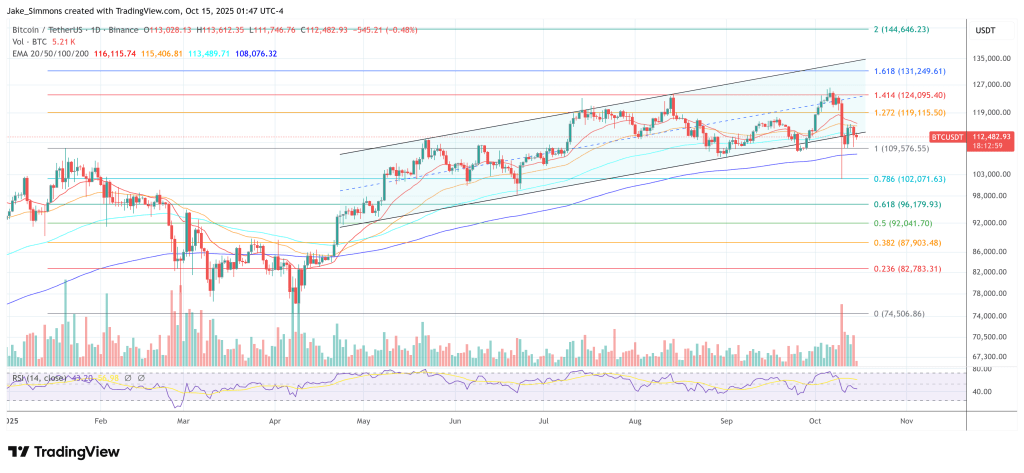
Bitcoin price
Bitcoin dropped outside the channel, 1-day chart | Source: BTCUSDT on TradingView.com
Featured image created with DALL.E, chart from TradingView.com
Editorial Process for bitcoinist is centered on delivering thoroughly researched, accurate, and unbiased content. We uphold strict sourcing standards, and each page undergoes diligent review by our team of top technology experts and seasoned editors. This process ensures the integrity, relevance, and value of our content for our readers.

Jake Simmons has been a Bitcoin enthusiast since 2016. Ever since he heard about Bitcoin, he has been studying the topic every day and trying to share his knowledge with others. His goal is to contribute to Bitcoin's financial revolution, which will replace the fiat money system. Besides BTC and crypto, Jake studied Business Informatics at a university. After graduation in 2017, he has been working in the blockchain and crypto sector. You can follow Jake on Twitter at @realJakeSimmons.

Related Reads

Trading

Spot
Futures

Hot Articles

What is $BITCOIN

DIGITAL GOLD ($BITCOIN): A Comprehensive Analysis Introduction to DIGITAL GOLD ($BITCOIN) DIGITAL GOLD ($BITCOIN) is a blockchain-based project operating on the Solana network, which aims to combine the characteristics of traditional precious metals with the innovation of decentralized technologies. While it shares a name with Bitcoin, often referred to as “digital gold” due to its perception as a store of value, DIGITAL GOLD is a separate token designed to create a unique ecosystem within the Web3 landscape. Its goal is to position itself as a viable alternative digital asset, although specifics regarding its applications and functionalities are still developing. What is DIGITAL GOLD ($BITCOIN)? DIGITAL GOLD ($BITCOIN) is a cryptocurrency token explicitly designed for use on the Solana blockchain. In contrast to Bitcoin, which provides a widely recognized value storage role, this token appears to focus on broader applications and characteristics. Notable aspects include: Blockchain Infrastructure: The token is built on the Solana blockchain, known for its capacity to handle high-speed and low-cost transactions. Supply Dynamics: DIGITAL GOLD has a maximum supply capped at 100 quadrillion tokens (100P $BITCOIN), although details regarding its circulating supply are currently undisclosed. Utility: While precise functionalities are not explicitly outlined, there are indications that the token could be utilized for various applications, potentially involving decentralized applications (dApps) or asset tokenization strategies. Who is the Creator of DIGITAL GOLD ($BITCOIN)? At present, the identity of the creators and development team behind DIGITAL GOLD ($BITCOIN) remains unknown. This situation is typical among many innovative projects within the blockchain space, particularly those aligning with decentralized finance and meme coin phenomena. While such anonymity may foster a community-driven culture, it intensifies concerns about governance and accountability. Who are the Investors of DIGITAL GOLD ($BITCOIN)? The available information indicates that DIGITAL GOLD ($BITCOIN) does not have any known institutional backers or prominent venture capital investments. The project seems to operate on a peer-to-peer model focused on community support and adoption rather than traditional funding routes. Its activity and liquidity are primarily situated on decentralized exchanges (DEXs), such as PumpSwap, rather than established centralized trading platforms, further highlighting its grassroots approach. How DIGITAL GOLD ($BITCOIN) Works The operational mechanics of DIGITAL GOLD ($BITCOIN) can be elaborated on based on its blockchain design and network attributes: Consensus Mechanism: By leveraging Solana’s unique proof-of-history (PoH) combined with a proof-of-stake (PoS) model, the project ensures efficient transaction validation contributing to the network's high performance. Tokenomics: While specific deflationary mechanisms have not been extensively detailed, the vast maximum token supply implies that it may cater to microtransactions or niche use cases that are still to be defined. Interoperability: There exists the potential for integration with Solana’s broader ecosystem, including various decentralized finance (DeFi) platforms. However, the details regarding specific integrations remain unspecified. Timeline of Key Events Here is a timeline that highlights significant milestones concerning DIGITAL GOLD ($BITCOIN): 2023: The initial deployment of the token occurs on the Solana blockchain, marked by its contract address. 2024: DIGITAL GOLD gains visibility as it becomes available for trading on decentralized exchanges like PumpSwap, allowing users to trade it against SOL. 2025: The project witnesses sporadic trading activity and potential interest in community-led engagements, although no noteworthy partnerships or technical advancements have been documented as of yet. Critical Analysis Strengths Scalability: The underlying Solana infrastructure supports high transaction volumes, which could enhance the utility of $BITCOIN in various transaction scenarios. Accessibility: The potential low trading price per token could attract retail investors, facilitating wider participation due to fractional ownership opportunities. Risks Lack of Transparency: The absence of publicly known backers, developers, or an audit process may yield skepticism regarding the project's sustainability and trustworthiness. Market Volatility: The trading activity is heavily reliant on speculative behavior, which can result in significant price volatility and uncertainty for investors. Conclusion DIGITAL GOLD ($BITCOIN) emerges as an intriguing yet ambiguous project within the rapidly evolving Solana ecosystem. While it attempts to leverage the “digital gold” narrative, its departure from Bitcoin's established role as a store of value underscores the need for a clearer differentiation of its intended utility and governance structure. Future acceptance and adoption will likely depend on addressing the current opacity and defining its operational and economic strategies more explicitly. Note: This report encompasses synthesised information available as of October 2023, and developments may have transpired beyond the research period.

363 Total ViewsPublished 2025.05.13Updated 2025.05.13

What is $BITCOIN

Discussions

Welcome to the HTX Community. Here, you can stay informed about the latest platform developments and gain access to professional market insights. Users' opinions on the price of BTC (BTC) are presented below.

活动图片