Strategy Resumes Bitcoin Buying: Another 220 BTC Added

bitcoinistPublished on 2025-10-14Last updated on 2025-10-14

Abstract

Following a week of Bitcoin buying pause, Michael Saylor's Strategy has gone back to accumulation with a fresh acquisition. Strategy...

Trusted Editorial content, reviewed by leading industry experts and seasoned editors. Ad Disclosure

Following a week of Bitcoin buying pause, Michael Saylor’s Strategy has gone back to accumulation with a fresh acquisition.

Strategy Has Bought Another $27.2 Million Worth Of Bitcoin

As announced by Strategy co-founder and chairman Michael Saylor in an X post, the Bitcoin treasury company has just made a new purchase. The buy, which occurred between October 6th and 12th, involved a sum of 220 BTC at an average price of $123,561 per token or a total cost of $27.2 million.

Strategy has been a pretty consistent buyer of the cryptocurrency in recent months, but last week was one of those rare occasions where it took a break from the usual Monday acquisitions.

Although the latest purchase is on the smaller side, it nonetheless signals a return of accumulation for the firm. According to the press release, this buy was funded using sales of STRF, STRK, and STRD at-the-market (ATM) stock offerings.

Strategy now holds 640,250 BTC, with a total acquisition cost of $47.38 billion. At the current exchange rate, the company’s BTC treasury is at a profit of almost 55%.

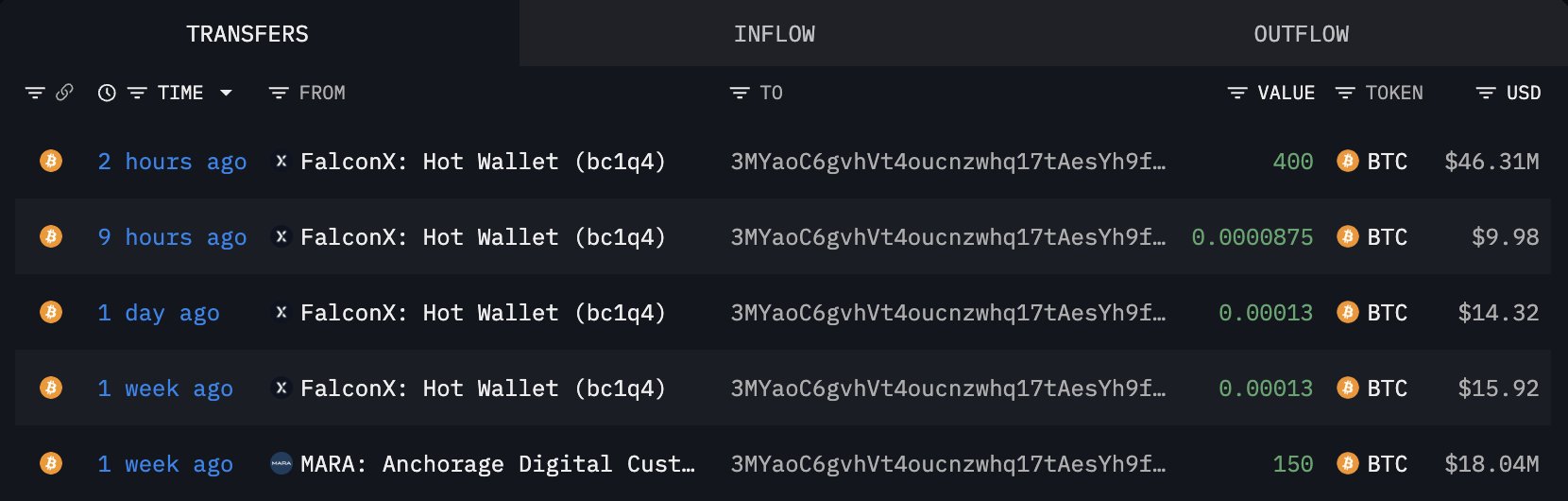
Michael Saylor’s firm isn’t the only Bitcoin treasury company that has recently expanded its reserves. As pointed out by blockchain sleuth Lookonchain in an X post, MARA Holdings has bought another 400 BTC.
MARA Bitcoin

The latest BTC buy made by MARA Holdings | Source: @lookonchain on X

As is visible in the Arkham Intelligence data shared by Lookonchain, MARA received the sum from a wallet attached to FalconX, an institutional digital assets prime brokerage, at a total price of $46.31 million.

Unlike Strategy’s purchase, which took place above $123,000, MARA’s acquisition seems to have occurred to take advantage of the post-crash BTC prices, coming in at about $115,800.

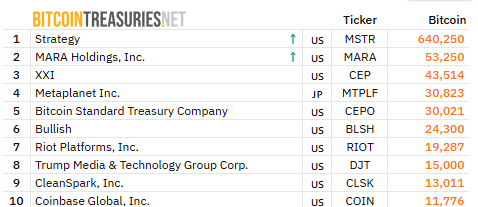
Prior to the buy, the mining company held 52,850 BTC. Now, with the new 400 BTC addition, its treasury has grown to 53,250 BTC. The firm continues to be the second-largest Bitcoin treasury behind Strategy, as data from BitcoinTreasuries.net shows.
Bitcoin Treasury Companies

Looks like there is a wide gulf between the top two firms at the moment | Source: BitcoinTreasuries.net

The acquisition from MARA Holdings suggests that while Bitcoin’s crash was violent and caused massive liquidations, institutional interest in the cryptocurrency still remains.

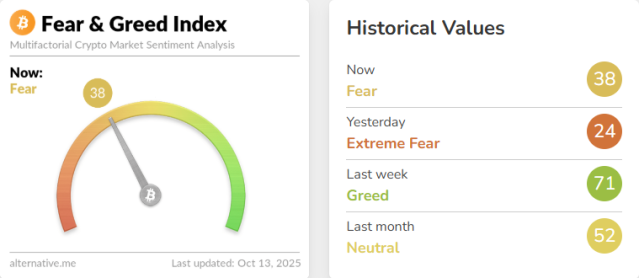
Speaking of the price plunge, investor morale took a huge hit by the latest market volatility. As the Fear & Greed Index created by Alternative shows, the investor sentiment dipped into the extreme fear territory during the weekend.
Bitcoin Extreme Fear

The current value of the Fear & Greed Index | Source: Alternative

Sunday’s value of 24 was the lowest that the indicator had seen since April. With Bitcoin observing some recovery, sentiment in the sector has marked an improvement, although it continues to be at a fear value of 38.

It now remains to be seen how the trader mentality will develop in the coming days and whether investors will be able to break out of the spell of fear.

BTC Price

Bitcoin has returned back to the $115,300 mark following its recovery surge.

Bitcoin Price Chart

The trend in the price of the coin over the last five days | Source: BTCUSDT on TradingView
Featured image from Dall-E, Alternative.me, BitcoinTreasuries.net, chart from TradingView.com
Editorial Process for bitcoinist is centered on delivering thoroughly researched, accurate, and unbiased content. We uphold strict sourcing standards, and each page undergoes diligent review by our team of top technology experts and seasoned editors. This process ensures the integrity, relevance, and value of our content for our readers.

Keshav is a Physics graduate who has been employed as a writer with Bitcoinist since June 2021. He is passionate about writing and through the years, he has gained experience working in a variety of niches. Keshav holds an active interest in the cryptocurrency market, with on-chain analysis being an area he particularly likes to research and write about.

Related Reads

From Suppliers to Shareholders: The Big Three Memory Chip Giants Jointly Invest in Anthropic, AI Supply Chain Power Structure Undergoing Reshuffle

For the first time, memory chip giants Micron, Samsung, and SK hynix have jointly invested in the same AI company, Anthropic, as part of its massive $65 billion Series H funding round. This strategic move, positioning the three rival HBM suppliers as "strategic infrastructure partners," highlights a fundamental shift in the AI industry's power dynamics. With HBM (High Bandwidth Memory) being a critically scarce resource essential for AI model training and inference, securing a stable supply has become a key competitive differentiator. By making these chipmakers shareholders, Anthropic aims to lock in this vital component for its rapid expansion, which includes securing major compute commitments from Amazon, Google, and others. For the memory trio, this investment represents a strategic bet on defining the future of AI hardware. Each company gains: SK hynix reinforces its dominant position in the NVIDIA supply chain; Samsung diversifies its client base beyond NVIDIA; and Micron leverages its geopolitical significance as the sole US-based HBM maker. Their collective move signals that competition in AI is evolving beyond model capability to encompass control over the entire compute supply chain—from chips and memory to power and networking. This vertical integration trend, where infrastructure providers become direct stakeholders in AI firms, marks the industry's maturation as AI transforms from a research project into essential global infrastructure, setting the stage for a new era of ecosystem competition.

marsbit1h ago

From Suppliers to Shareholders: The Big Three Memory Chip Giants Jointly Invest in Anthropic, AI Supply Chain Power Structure Undergoing Reshuffle

marsbit1h ago

Investment Philosophy of Gavin Baker, an Early Nvidia Investor: Long AI Infrastructure Bottlenecks, Short Overall Market Risk

Gavin Baker, an early investor in Nvidia and founder of Atreides Management, outlines his investment philosophy: going long on AI infrastructure bottlenecks while hedging against broader market risk. He argues AI is not a bubble but a supercycle driven by constraints in power, wafers (semiconductors), and compute efficiency (tokens per watt). True alpha, he believes, lies not in application-layer companies like OpenAI but in "picks and shovels" providers—companies solving physical bottlenecks in GPU connectivity (e.g., Astera Labs), memory (Micron), inference chips (Cerebras, Positron), advanced manufacturing (TSMC, ASML), and energy supply. His portfolio reflects this barbell strategy: concentrated bets on key infrastructure players alongside a significant put position on the QQQ ETF to hedge overall market downside. Baker contends this cycle differs from the dot-com bubble because demand is fueled by the strong balance sheets of hyperscalers (Google, Meta, Amazon, Microsoft), not debt, and physical supply constraints (e.g., chip manufacturing capacity) prevent runaway overinvestment. He highlights the growing importance of inference (vs. pre-training), vertical/small language models, sovereign infrastructure deployment speed, and the convergence of energy and space (e.g., orbital compute). His long-term view is that performance-per-watt and token cost reduction will dictate winners as AI scaling hits fundamental physical limits.

marsbit2h ago

Investment Philosophy of Gavin Baker, an Early Nvidia Investor: Long AI Infrastructure Bottlenecks, Short Overall Market Risk

marsbit2h ago

Trading

Spot
Futures

Hot Articles

What is $BITCOIN

DIGITAL GOLD ($BITCOIN): A Comprehensive Analysis Introduction to DIGITAL GOLD ($BITCOIN) DIGITAL GOLD ($BITCOIN) is a blockchain-based project operating on the Solana network, which aims to combine the characteristics of traditional precious metals with the innovation of decentralized technologies. While it shares a name with Bitcoin, often referred to as “digital gold” due to its perception as a store of value, DIGITAL GOLD is a separate token designed to create a unique ecosystem within the Web3 landscape. Its goal is to position itself as a viable alternative digital asset, although specifics regarding its applications and functionalities are still developing. What is DIGITAL GOLD ($BITCOIN)? DIGITAL GOLD ($BITCOIN) is a cryptocurrency token explicitly designed for use on the Solana blockchain. In contrast to Bitcoin, which provides a widely recognized value storage role, this token appears to focus on broader applications and characteristics. Notable aspects include: Blockchain Infrastructure: The token is built on the Solana blockchain, known for its capacity to handle high-speed and low-cost transactions. Supply Dynamics: DIGITAL GOLD has a maximum supply capped at 100 quadrillion tokens (100P $BITCOIN), although details regarding its circulating supply are currently undisclosed. Utility: While precise functionalities are not explicitly outlined, there are indications that the token could be utilized for various applications, potentially involving decentralized applications (dApps) or asset tokenization strategies. Who is the Creator of DIGITAL GOLD ($BITCOIN)? At present, the identity of the creators and development team behind DIGITAL GOLD ($BITCOIN) remains unknown. This situation is typical among many innovative projects within the blockchain space, particularly those aligning with decentralized finance and meme coin phenomena. While such anonymity may foster a community-driven culture, it intensifies concerns about governance and accountability. Who are the Investors of DIGITAL GOLD ($BITCOIN)? The available information indicates that DIGITAL GOLD ($BITCOIN) does not have any known institutional backers or prominent venture capital investments. The project seems to operate on a peer-to-peer model focused on community support and adoption rather than traditional funding routes. Its activity and liquidity are primarily situated on decentralized exchanges (DEXs), such as PumpSwap, rather than established centralized trading platforms, further highlighting its grassroots approach. How DIGITAL GOLD ($BITCOIN) Works The operational mechanics of DIGITAL GOLD ($BITCOIN) can be elaborated on based on its blockchain design and network attributes: Consensus Mechanism: By leveraging Solana’s unique proof-of-history (PoH) combined with a proof-of-stake (PoS) model, the project ensures efficient transaction validation contributing to the network's high performance. Tokenomics: While specific deflationary mechanisms have not been extensively detailed, the vast maximum token supply implies that it may cater to microtransactions or niche use cases that are still to be defined. Interoperability: There exists the potential for integration with Solana’s broader ecosystem, including various decentralized finance (DeFi) platforms. However, the details regarding specific integrations remain unspecified. Timeline of Key Events Here is a timeline that highlights significant milestones concerning DIGITAL GOLD ($BITCOIN): 2023: The initial deployment of the token occurs on the Solana blockchain, marked by its contract address. 2024: DIGITAL GOLD gains visibility as it becomes available for trading on decentralized exchanges like PumpSwap, allowing users to trade it against SOL. 2025: The project witnesses sporadic trading activity and potential interest in community-led engagements, although no noteworthy partnerships or technical advancements have been documented as of yet. Critical Analysis Strengths Scalability: The underlying Solana infrastructure supports high transaction volumes, which could enhance the utility of $BITCOIN in various transaction scenarios. Accessibility: The potential low trading price per token could attract retail investors, facilitating wider participation due to fractional ownership opportunities. Risks Lack of Transparency: The absence of publicly known backers, developers, or an audit process may yield skepticism regarding the project's sustainability and trustworthiness. Market Volatility: The trading activity is heavily reliant on speculative behavior, which can result in significant price volatility and uncertainty for investors. Conclusion DIGITAL GOLD ($BITCOIN) emerges as an intriguing yet ambiguous project within the rapidly evolving Solana ecosystem. While it attempts to leverage the “digital gold” narrative, its departure from Bitcoin's established role as a store of value underscores the need for a clearer differentiation of its intended utility and governance structure. Future acceptance and adoption will likely depend on addressing the current opacity and defining its operational and economic strategies more explicitly. Note: This report encompasses synthesised information available as of October 2023, and developments may have transpired beyond the research period.

363 Total ViewsPublished 2025.05.13Updated 2025.05.13

What is $BITCOIN

Discussions

Welcome to the HTX Community. Here, you can stay informed about the latest platform developments and gain access to professional market insights. Users' opinions on the price of BTC (BTC) are presented below.

活动图片