Bitcoin All-Time High At $125,700 Was A Trap, Warns Analyst

bitcoinistPublished on 2025-10-06Last updated on 2025-10-07

Abstract

Bitcoin’s dramatic weekend spike to a fresh all-time high of $125,700 lacked real spot demand and was largely the product...

Trusted Editorial content, reviewed by leading industry experts and seasoned editors. Ad Disclosure

Bitcoin’s dramatic weekend spike to a fresh all-time high of $125,700 lacked real spot demand and was largely the product of leveraged speculation in thin conditions, according to crypto analyst Maartun, who characterized the move as a classic fakeout rather than a durable breakout. “Bitcoin prints a brand new all-time high, $125,700… But hold on a second. The price almost immediately reversed,” he said, framing the question that followed: “Was that move for real?”

The Truth Behind Bitcoin’s Weekend Surge

Maartun argues the answer sits in the futures market. Open interest—capital tied up in outstanding derivatives positions—“didn’t just go up, it absolutely exploded,” rising by more than $2.1 billion during the rally. In his telling, that surge came “over a weekend, which is a time when there are way fewer buyers and sellers around,” amplifying the impact of leveraged positioning in a low-liquidity window. “This whole move was driven by futures, by bets,” he said, adding that the jump in open interest, roughly 5%, turned the market into “a house of cards ready to fall over at the slightest touch.”

Equally important, Maartun says, is what did not happen: an influx of committed spot buyers to underpin the advance. Earlier in the week, he notes, Coinbase showed aggressive spot demand, trading about $110 above other venues—evidence of “real buyers… snapping up Bitcoin.” During the weekend push, that premium vanished. “The gamblers were placing their bets,” Maartun said, “but the investors, the people actually buying Bitcoin, they were sitting this one out.”

With those two “clues”—a derivatives-led surge and the absence of spot confirmation—Maartun’s verdict is unambiguous. “You can call it a fake out, you can call it a swing failure pattern, or you can even call it the head of a head and shoulders pattern… It was a trap. A move that was designed to look like the real deal, but had absolutely no substance behind it.” After the brief print at $125,700, price swiftly retraced “right back down to where the whole move started,” he added.

From here, Maartun identifies a single inflection point: $123,000. “This is the level… that is going to tell us whether the bulls or the bears take control from here,” he said. On confirmation criteria, he is explicit: “What we need to see is a strong, confident close above that $123K mark. That would signal acceptance… and a true breakout is probably coming.”

Failure to reclaim and hold that area, in his view, likely hands momentum back to sellers with an initial drawdown target around $117,500. He also cautions against expecting a repeat head-fake at the same level: “Fakeouts don’t usually happen twice in a row. The second attempt to break a level like this is very often the real deal one way or the other.”

The broader context to Maartun’s assessment is the unusual timing and texture of the move. Weekends in crypto “are normally kind of sleepy,” he said, yet this one delivered “the best weekend performance we’ve seen in four whole months”—a signal, in his analysis, not of rekindled spot enthusiasm but of how quickly leverage can dominate price in quiet order books. Without renewed spot leadership—such as a return of the Coinbase premium or other evidence of net spot accumulation—he sees the market “on a knife’s edge” at the $123,000 line in the sand: “Break out or pull back?”

At press time, Bitcoin held above $124,216.
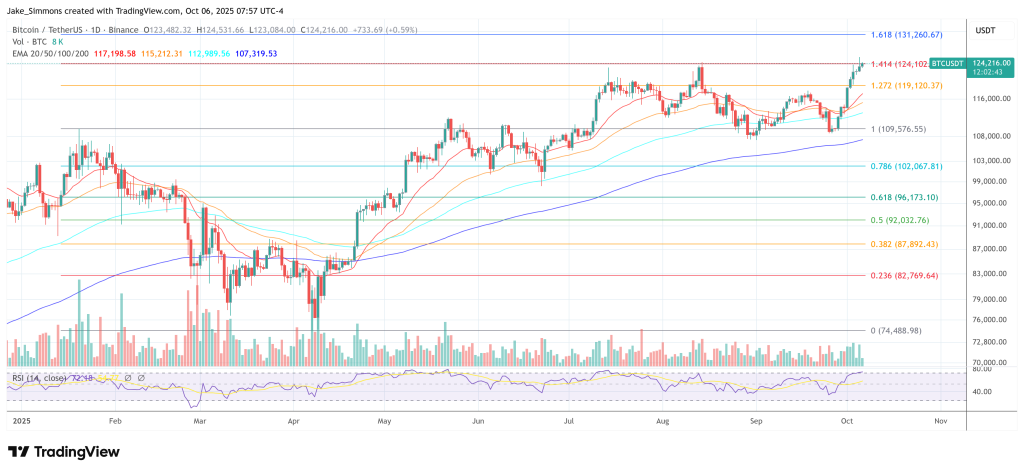
Bitcoin price
BTC remains above $124,000, 1-day chart | Source: BTCUSDT on TradingView.com
Featured image created with DALL.E, chart from TradingView.com
Editorial Process for bitcoinist is centered on delivering thoroughly researched, accurate, and unbiased content. We uphold strict sourcing standards, and each page undergoes diligent review by our team of top technology experts and seasoned editors. This process ensures the integrity, relevance, and value of our content for our readers.

Jake Simmons has been a Bitcoin enthusiast since 2016. Ever since he heard about Bitcoin, he has been studying the topic every day and trying to share his knowledge with others. His goal is to contribute to Bitcoin's financial revolution, which will replace the fiat money system. Besides BTC and crypto, Jake studied Business Informatics at a university. After graduation in 2017, he has been working in the blockchain and crypto sector. You can follow Jake on Twitter at @realJakeSimmons.

Related Reads

Treasury Secretary's Move to Suppress Treasury Yields Ignites 'Currency Debasement Trade'! Gold Hits Three-Month High, Bitcoin Surges Over 25% in a Single Week

US Treasury Secretary Besant's efforts to lower long-term Treasury yields by announcing expanded buybacks had only a brief market impact. However, this move fueled a "currency devaluation trade," weakening the US dollar while boosting both gold (to a three-month high) and Bitcoin (up over 25% for the week). Analysts attribute this reaction to deepening market concerns over the massive US fiscal deficit and structural pressures keeping long-term rates elevated, including fierce competition for capital from global government borrowing and massive AI sector financing. Despite the Treasury's actions, fundamental forces like growth, inflation, and capital demand are seen as limiting its ability to sustainably suppress yields. Bitcoin's strong positive correlation with gold has reinforced its narrative as a hedge against devaluation. While equity markets have shown resilience, some strategists warn that Treasury yields nearing 5% increase pressure on the dollar and high-leverage assets. Figures like Ray Dalio have advised reducing bond exposure in favor of gold and some Bitcoin, citing US debt risks. Market opinions are divided on the sustainability of the devaluation trade, with some noting the lack of a near-term catalyst for its next leg higher. The underlying tension between the Treasury's desire for lower borrowing costs and the Federal Reserve's focus on inflation and reducing market intervention remains a key theme. Upcoming events like Nvidia's earnings and the Jackson Hole symposium will test whether AI profits can continue supporting stocks and if the Fed aligns more with Washington's preference for easier financial conditions.

华尔街日报2h ago

Treasury Secretary's Move to Suppress Treasury Yields Ignites 'Currency Debasement Trade'! Gold Hits Three-Month High, Bitcoin Surges Over 25% in a Single Week

华尔街日报2h ago

Alexander Shokhin: Business Needs an Interest Rate Below 10% and the Dollar at 90-95 Rubles

Alexander Shokhin, head of the Russian Union of Industrialists and Entrepreneurs (RSPP), has advocated for potentially using "non-market" tools to keep the ruble within a target exchange rate corridor. This, he argues on August 21, would help avoid excessive volatility, though he called the topic a separate discussion. Shokhin had previously raised the idea of a currency corridor in late May, noting the ruble's current exchange rate is not fully market-driven due to a limited currency segment and reduced foreign currency demand. He stated that many business community colleagues propose fixing a corridor, even through non-market methods, to ensure predictability. The business community's key targets, as outlined by Shokhin in late December 2025, are a Central Bank key rate of 12%, inflation of 4–5%, and a US dollar exchange rate of 90–95 rubles by the end of 2026. A turning point for investment, he said, would be lowering the rate to 12% with 6% inflation, though truly comfortable business conditions would require a rate below 10%. He stressed the critical importance of currency predictability for corporate investment decisions. From a data analysis perspective, the idea of a ruble corridor is not new. A similar mechanism was used in Russia from 1995 to 1998, where the central bank held the dollar within fixed boundaries through regular interventions. This regime lasted three years before ending abruptly during the 1998 default, illustrating the fragility of rigid targets under external shocks. The macro-economic link is clear: stricter corridors require more reserves to defend against currency pressure. The key unresolved technical aspect is the specific sources and volume of such interventions given the current market's limited liquidity. Whether this discussion remains theoretical or leads to concrete corridor parameters will be seen in the coming months.

cryptonews.ru3h ago

Alexander Shokhin: Business Needs an Interest Rate Below 10% and the Dollar at 90-95 Rubles

cryptonews.ru3h ago

Trading

Spot
活动图片





