Crypto Market Reacts as U.S. Government Shutdown Begins, Can the Uptober Rally Survive?

bitcoinistPubblicato 2025-10-02Pubblicato ultima volta 2025-10-02

Introduzione

The U.S. government officially entered a shutdown at 12:01 a.m. ET, and markets, including crypto, immediately recalibrated in response to...

Trusted Editorial content, reviewed by leading industry experts and seasoned editors. Ad Disclosure

The U.S. government officially entered a shutdown at 12:01 a.m. ET, and markets, including crypto, immediately recalibrated in response to uncertainty. U.S. equity futures slipped, the dollar extended its losing streak, and gold punched to fresh records near $3,875/oz as investors sought safety.

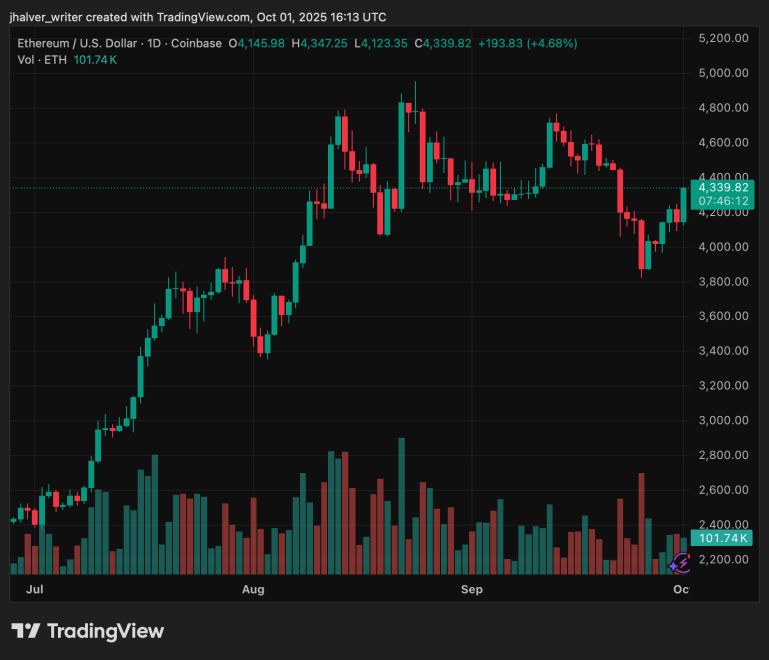
Crypto, however, has been more balanced, as Bitcoin (BTC) hovered around $114,000–$116,000 after a two-day rebound, while Ethereum (ETH) traded near $4,300. Total digital-asset capitalization held above $4 trillion, even as altcoins posted mixed, defensive moves.
Crypto Ethereum ETH ETHUSD

ETH's price trends to the upside on the daily chart. Source: ETHUSD on Tradingview

Options desks flagged a modest tilt toward puts, typical when macro visibility deteriorates, yet derivatives liquidations remained contained, suggesting positioning was not excessively stretched into the event.

Shutdown History Meets Uptober Seasonality

Historically, U.S. government shutdowns have delivered mixed outcomes for Bitcoin. In 2013, BTC gained around 14% during the 16-day closure, while the 35-day standoff in late 2018 coincided with a 6% decline amid a broader bear market.

Beyond those short-term swings, shutdowns have had little lasting influence compared to Bitcoin’s broader cycle trends. What matters more now is seasonality, as Q4 has traditionally been one of Bitcoin’s strongest periods, with “Uptober” often marking the start of double-digit gains.

That pattern keeps dip-buyers alert, suggesting sentiment may lean bullish if price confirms above resistance instead of reacting solely to political headlines.

Data blackout and thinner regulators: Why Volatility Could Rise

A shutdown delays key economic releases like jobs reports, CPI, and PPI, which deprives the market of the data it uses to gauge the Fed’s future actions.

When these reports are delayed, implied volatility often increases because traders need to account for a wider range of possible outcomes. For crypto, this uncertainty is worsened by limited staff at agencies like the SEC and CFTC, which may slow down ETF reviews and other rulemaking processes.

Many issuers and traders had aimed for early to mid-October for potential spot-altcoin ETF milestones, but those timelines might slip if staffing and approval delays continue, reducing one of the quarter’s most anticipated catalysts. Still, macro trends aren’t always straightforward.

A weaker dollar, already on track for its worst year in decades, can support risk assets, and a potential Fed pause in the near term could reduce yield-related headwinds. In short, path dependency dominates, meaning the longer the shutdown and data blackout last, the more unpredictable the market becomes.

Cover image from ChatGPT, ETHUSD chart from Tradingview

Editorial Process for bitcoinist is centered on delivering thoroughly researched, accurate, and unbiased content. We uphold strict sourcing standards, and each page undergoes diligent review by our team of top technology experts and seasoned editors. This process ensures the integrity, relevance, and value of our content for our readers.

Letture associate

Anthropic's IPO Launch: Commercial Miracle or Valuation Bubble?

Anthropic has confidentially filed for an IPO, led by Morgan Stanley and Goldman Sachs, potentially going public by October. Following its latest $650 billion funding round, its pre-IPO valuation stands at $965 billion, with projections reaching up to $2 trillion at listing, which would make it the highest-valued private company ever. The article, written by Fu Sheng, addresses skepticism that this represents an AI bubble akin to the 2000 dot-com crash. It argues the current situation differs fundamentally. Unlike the internet bubble era, which relied on speculative narratives with little revenue, Anthropic's valuation is backed by unprecedented, measurable financial performance. Key data points include: * **Revenue Growth:** ARR skyrocketed from $10 billion in early 2025 to $470 billion by May 2026, targeting $100 billion by year-end—a growth curve unmatched in business history. * **Profitability:** It achieved operating profitability in Q2 2026 with an estimated $5.6 billion profit. * **Efficiency:** With ~3,000 employees and ~$470 billion ARR, its revenue per employee exceeds $10 million. Products like Claude Code, launched less than a year ago, already generate $25 billion in annualized revenue. * **Enterprise Adoption:** It boasts a strong enterprise client base, with 8 of the Fortune 10 and over 1,000 large firms spending over $1 million annually on Claude. The valuation is framed using a traditional SaaS model (e.g., a 10x Price-to-Sales multiple on $100 billion revenue). The author contends the core question for analysts has shifted from "How big could this be?" to "How much is it earning and will earn next quarter?" The discussion extends beyond Anthropic to a broader paradigm shift: the transition from a "carbon-based" to a "silicon-based" economy. Companies are increasingly prioritizing investment in compute and AI capabilities over human resources, as these directly scale productivity and competitive advantage. Anthropic's IPO is thus positioned not just as a corporate milestone, but as a price anchor for this new economic era.

链捕手48 min fa

Anthropic's IPO Launch: Commercial Miracle or Valuation Bubble?

链捕手48 min fa

Near Returns to the AI Stage: Transformation into a Public Chain Due to 'Payroll Difficulties,' Agent and Privacy Emerge as New Growth Narratives

NEAR Returns to AI Origins: From Payroll Struggles to Blockchain, Now Focusing on AI Agents and Privacy NEAR Protocol's journey began not with grand blockchain ambitions, but from a practical hurdle: its AI startup founders, including Transformer paper co-author Illia Polosukhin, couldn't efficiently pay international developers in 2017. This led them to pivot and build a high-performance, scalable blockchain. After years navigating various crypto narratives like sharding and cross-chain interoperability, NEAR is now leveraging its AI roots to re-enter the AI arena. A key driver is its "NEAR Intents" layer, which abstracts complex cross-chain transactions. Users simply state their goal (e.g., swap BTC for ETH), and a solver network finds the optimal route. This system has processed over $20B in cross-chain volume, generating significant fee revenue. A major growth area is private transactions via "Confidential Intents/Swaps," which hide trade details until settlement to protect against MEV and front-running. Remarkably, private swaps recently accounted for over 40% of NEAR's transaction volume, highlighting strong demand but also potential regulatory scrutiny. With its AI-founder pedigree, NEAR is positioning itself at the intersection of blockchain, AI agents, and privacy, aiming to become infrastructure for the emerging agent economy while navigating the challenges of its rapid adoption.

marsbit3 h fa

Near Returns to the AI Stage: Transformation into a Public Chain Due to 'Payroll Difficulties,' Agent and Privacy Emerge as New Growth Narratives

marsbit3 h fa

From Ethereum to AI's 'CROPS': What Exactly is This Set of 'Slow Variables' That Vitalik Repeatedly Emphasizes?

In recent discussions, Vitalik Buterin has frequently emphasized the concept of "CROPS," a framework defining core values for Ethereum's development. CROPS stands for Censorship Resistance, Capture Resistance, Open Source, Privacy, and Security. Initially outlined in the Ethereum Foundation's "EF Mandate," it represents a commitment to user sovereignty, ensuring that the network resists external control, remains open, protects privacy, and prioritizes security. The relevance of CROPS extends beyond Ethereum's foundational principles, becoming crucial in the context of AI integration. As AI agents begin handling wallet operations and automated transactions, the risk increases that users may cede control over their digital assets, privacy, and intentions to centralized AI service providers. A "CROPS AI" would therefore emphasize local execution where possible, privacy-preserving remote model calls (e.g., using zero-knowledge proofs), and transparent, verifiable processes to maintain user agency. Vitalik highlights a significant convergence between "CROPS Ethereum access layer" and "CROPS AI." Both address the same fundamental challenge: how users can access powerful services—be it blockchain data via RPCs or AI models—without exposing sensitive information or relinquishing ultimate control. This intersection points toward a future digital entry point that is more private, secure, and user-controlled. Ultimately, CROPS is not merely an abstract ideal but a practical guidepost. It steers development—from protocol resilience and wallet design to AI agent safety—towards a future where users retain self-sovereignty even as digital systems grow more complex and powerful. In an era of accelerating AI adoption, these "slow variables" of censorship resistance, openness, privacy, and security may define Ethereum's enduring value.

marsbit3 h fa

From Ethereum to AI's 'CROPS': What Exactly is This Set of 'Slow Variables' That Vitalik Repeatedly Emphasizes?

marsbit3 h fa

Trading

Spot
Futures
活动图片