Whales Inject an Extra $329K+ Into Bitcoin Hyper Ahead of Uptober – The Next 1000x Crypto?

bitcoinistPublished on 2025-09-30Last updated on 2025-09-30

Abstract

With ‘Uptober’ just around the corner (literally tomorrow), anticipation is building for what could be a pivotal moment for $BTC....

Trusted Editorial content, reviewed by leading industry experts and seasoned editors. Ad Disclosure

With ‘Uptober’ just around the corner (literally tomorrow), anticipation is building for what could be a pivotal moment for $BTC.

October is historically one of the strongest months for the world’s largest crypto, with average returns at 21.89%.

So, what better time for the Bitcoin Hyper Layer-2 (L2) to soon go live? Suppose this peak demand takes shape, it could position itself as a go-to solution for scaling Bitcoin, precisely when the network needs it most.

It’s no surprise, then, that whales have latched on. Just yesterday, three invested $113.8K, $109.9K, and $105.4K into the ecosystem’s $HYPER presale, signaling strong confidence in the L2’s potential.

Suppose this buzz continues, $HYPER might even become the next 1000x crypto.

$BTC Rockets 4.5% in One Month, Before Possible October Rally

Since last month, $BTC has increased by over 4.5%, a sign that bullish momentum may already be underway.

Yes, $BTC has plummeted from $114K to $113K since just yesterday. But it’s not all doom and gloom for the #1 crypto.

Even during the most challenging market cycles, October is often a turning point where $BTC sentiment flips from bearish to bullish.

Take 2023 as a prime example. After a modest 3.91% gain in September, it soared by 28.52% the following month.
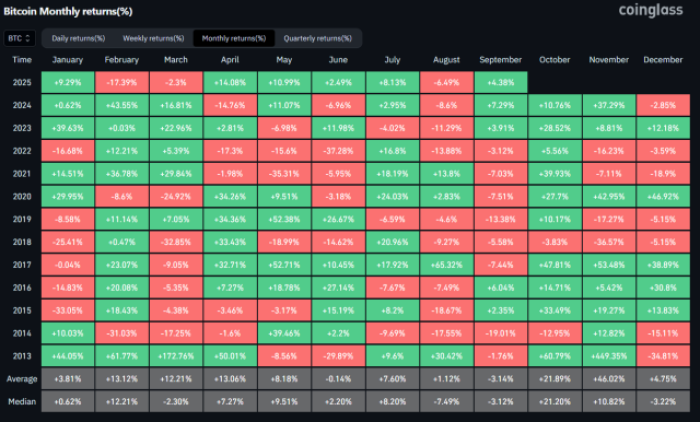
Bitcoin monthly returns on Coinglass.
Source: Coinglass

Given this, it’s no wonder that institutions are positioning themselves for what might be another legendary spike.

Just yesterday, Michael Saylor announced that his firm – Strategy (formerly MicroStrategy) – has acquired an additional 196 $BTC, worth roughly $221M.

As of September, Strategy now holds an eye-boggling 640,031 $BTC valued at $47.35B+. The average price per token is approximately $73,983.
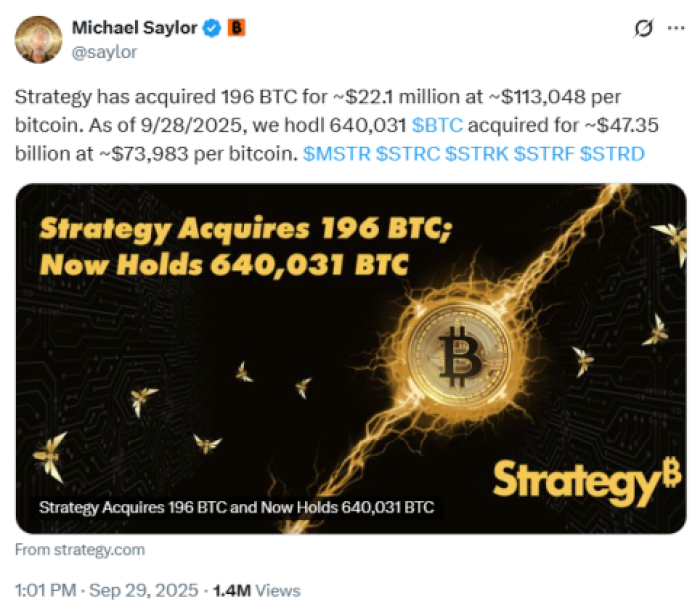
Michael Strategy announced Strategy’s most recent BTC acquisition on X.
Source: X (Michael Saylor)

Strategy isn’t the only public company acquiring sizable amounts of $BTC in the hope of capitalizing on the next bull run.

Over the past 30 days, MARA Holdings has boosted its stack to 52,477 $BTC valued at nearly $5.94B.

XXI also bets big on the crypto leader jumping to greater heights. In total, it owns 43,515 $BTC, currently worth approximately $4.92B.
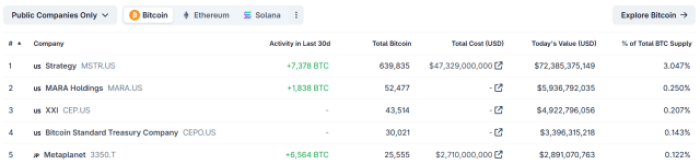
BTC held by public companies on CoinGecko.
Source: CoinGecko

When firms commit billions to $BTC, it validates the asset’s role as a store of value as opposed to being yet another speculative asset.

In turn, they fuel demand for $BTC and boost market confidence. But there’s a hitch: as the coin’s popularity surges and transaction volumes increase, the network often faces mounting pressure.

Bitcoin Processes Fees 43%+ Slower Than Ethereum

Bitcoin’s no stranger to scalability challenges. Today, the network can process just 12.47 transactions per second (tps), 43.32% lower than Ethereum’s 22.01 tps.

Even at its record level, Bitcoin has only managed 13.2 tps – a far cry from Ethereum’s 62.34 tps and nowhere near Solana’s 65K tps.

The network’s limited throughput often causes higher gas costs during peak activity. Following the halving event last October, average transaction fees rose as high as $8.36 one month later.

While fees have since dropped to just $0.84, they’re still no stranger to fluctuating. This makes it tricky for everyday traders to rely on Bitcoin for everyday transactions.
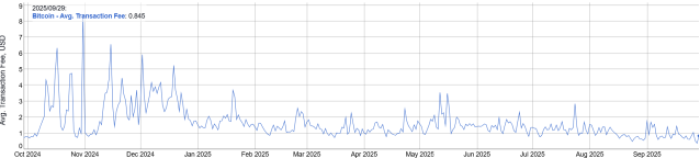
Average Bitcoin transaction fee.
Source: BitInfoCharts

Thankfully, there’s a solution. It’s Bitcoin Hyper, and it’s getting set to launch this quarter to address the network’s bottlenecks.

Bitcoin Hyper L2 to Bring Solana’s Speeds to Bitcoin

Built on the Solana Virtual Machine (SVM), Bitcoin Hyper strives to deliver Solana-level speeds and scalability to Bitcoin. In turn, it’ll enable thousands of tps at a lower price tag.

For even faster, cheaper, and more versatile transactions, the L2 will leverage a Canonical Bridge. But that’s not all; it’ll help turn Bitcoin into a hub for DeFi, dApps, launchpads, and even the best meme coins.
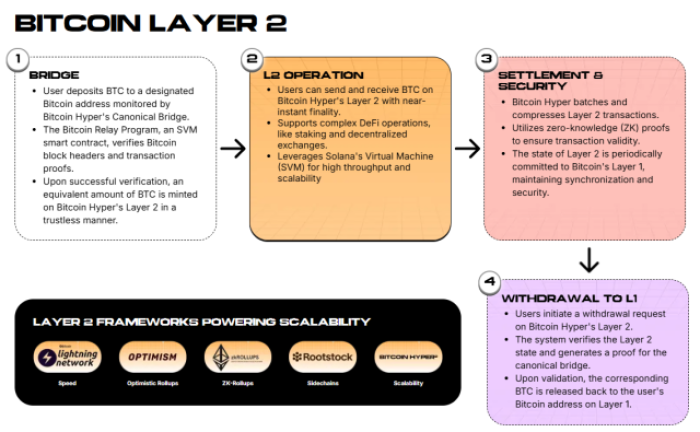
 How the Bitcoin Hyper bridge works.
Source: Bitcoin Hyper

All is achieved by enabling $BTC to move seamlessly between the Bitcoin base layer and the Hyper L2 ecosystem. And once bridged, $BTC can interact directly with smart contracts, dApps, and liquidity protocols.

$HYPER Fuels L2 Growth & 61% Staking Rewards

$HYPER is at the heart of the entire ecosystem, supercharging every aspect of its utility and growth. A sizable 30% of its total token supply is allocated to fund development, after all.

Also fueling its long-term growth is an additional 25% of $HYPER being earmarked for the ecosystem treasury.
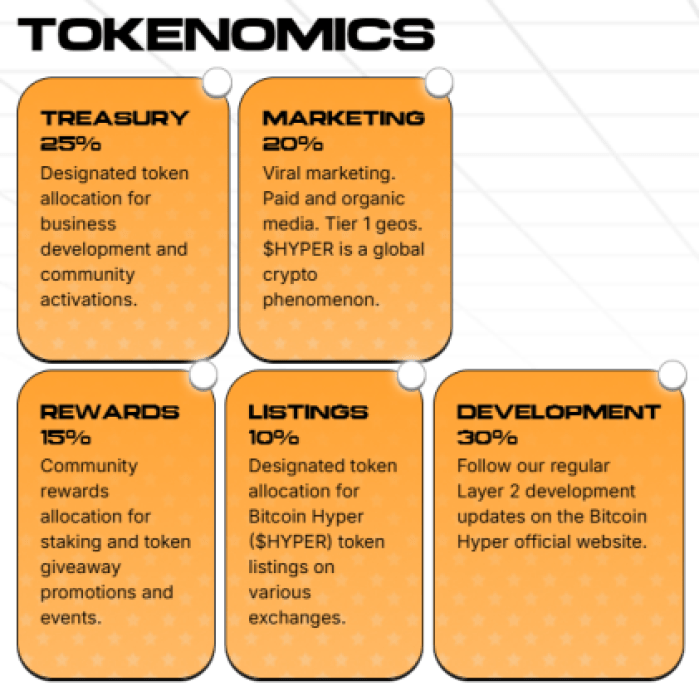
30% of Bitcoin Hyper goes to development funding.
Source: Bitcoin Hyper

Holding $HYPER doesn’t only mean you’ll contribute to the project’s sustainability; it also unlocks meaningful utility.

By purchasing $HYPER on presale – now available for $0.013005 – you’ll gain governance rights, enjoy reduced gas fees, and can stake your token at a 61% APY.

But time is of the essence: the APY will nosedive as more investors lock up their tokens. So, now’s an opportune moment to start staking $HYPER for the greatest possible gains.

Our Bitcoin Hyper price prediction also anticipates $HYPER to surpass $0.32 this year, following its listing on major CEXs. So, joining now could generate 20 times the returns (and that’s not even counting the staking rewards).

Join Bitcoin Hyper today.

We’re not financial advisors. Always do your own research and never invest more than you’d be sad to lose. 

Authored by Leah Waters, Bitcoinist – https://bitcoinist.com/bitcoin-hyper-next-1000x-crypto-whales-buy-329k/

Editorial Process for bitcoinist is centered on delivering thoroughly researched, accurate, and unbiased content. We uphold strict sourcing standards, and each page undergoes diligent review by our team of top technology experts and seasoned editors. This process ensures the integrity, relevance, and value of our content for our readers.

Leah is a British journalist with a BA in Journalism, Media, and Communications and nearly a decade of content writing experience. Over the last four years, her focus has primarily been on Web3 technologies, driven by her genuine enthusiasm for decentralization and the latest technological advancements. She has contributed to leading crypto and NFT publications – Cointelegraph, Coinbound, Crypto News, NFT Plazas, Bitcolumnist, Techreport, and NFT Lately – which has elevated her to a senior role in crypto journalism. Whether crafting breaking news or in-depth reviews, she strives to engage her readers with the latest insights and information. Her articles often span the hottest cryptos, exchanges, and evolving regulations. As part of her ploy to attract crypto newbies into Web3, she explains even the most complex topics in an easily understandable and engaging way. Further underscoring her dynamic journalism background, she has written for various sectors, including software testing (TEST Magazine), travel (Travel Off Path), and music (Mixmag). When she's not deep into a crypto rabbit hole, she's probably island-hopping (with the Galapagos and Hainan being her go-to's). Or perhaps sketching chalk pencil drawings while listening to the Pixies, her all-time favorite band.

Related Reads

Agents Take Over Traffic Distribution Power: What Are Tencent, ByteDance, and Alibaba Competing For?

In the race to dominate the AI era's entry point, China's tech giants—Tencent, ByteDance, and Alibaba—are aggressively deploying AI Agents to control the future of traffic distribution. Alibaba is pursuing a dual-track "closed loop + openness" strategy. Its Qianwen app is evolving into a super-Agent integrated across its ecosystem (Taobao, Alipay, etc.) to handle complex tasks like travel planning. Concurrently, it is opening its platform to external brands (Luckin Coffee, KFC) and has launched a B2B Agent platform, "Wukong," targeting enterprise automation. Its other flagship, Quark, aims to be an "AI super search box" for information and tasks. ByteDance is executing an omnipresent "sprawl strategy." Its Doubao app boasts over 300 million monthly active users and is evolving into a default AI entry point for daily life, with plans for paid versions and e-commerce integration. Its core weapon is the Kouzi platform, a visual "AI assembly factory" for developers to build custom Agents. ByteDance is also pushing hardware integration, collaborating on AI phones and developing smart glasses to embed Doubao everywhere. Tencent is playing its long-held "ultimate card" by quietly embedding an AI Agent directly into WeChat. This Agent, accessible via a swipe, can understand user commands and automatically execute tasks by calling upon WeChat's millions of mini-programs (e.g., finding and ordering coffee). This leverages WeChat's unparalleled 1.4-billion-user ecosystem to position the app as an AI-powered "service operating system," a move that could dramatically reshape the competitive landscape. The core battleground is shifting from competing for "user screen time" to competing to be the "default execution layer" for user intent. The business model is evolving from an "attention economy" to an "intent economy," where the Agent that can most efficiently fulfill a user's need gains control over service access and token flow. This represents a fundamental change in how users connect with digital services, making the fight for the Agent入口 (entry point) a pivotal moment for redefining industry leadership in the AI age.

marsbit7m ago

Agents Take Over Traffic Distribution Power: What Are Tencent, ByteDance, and Alibaba Competing For?

marsbit7m ago

From Banning Doubao to Embracing Honor: Why Did WeChat Suddenly 'Change Its Face'?

The article explores the sudden shift in WeChat's strategy towards AI assistants from mobile phone manufacturers, transitioning from strict opposition to active collaboration. For over a year, WeChat fiercely resisted attempts by phone AI assistants (like ByteDance's Doubao in late 2025) to control its features via GUI automation ("simulated clicking"), citing security and data control concerns. This stance created a significant barrier for system-level AI integration. Now, Tencent has initiated A2A (Agent-to-Agent) partnerships with major phone brands like Honor, Xiaomi, OPPO, and vivo. This model allows a phone's system AI (e.g., Honor's YOYO) to parse a user's voice command and send a structured request directly to WeChat's own internal AI agent via secure APIs. WeChat then executes the action (e.g., sending a message) and returns the result. The article attributes Tencent's "change of face" to strategic pressure. While leading in social app usage, Tencent trails rivals like ByteDance and Alibaba in standalone AI app popularity. WeChat, with its vast mini-program ecosystem, is Tencent's key asset for an AI comeback. The upcoming WeChat AI agent aims to handle tasks like booking and payments within the app. However, phone system assistants remain the primary AI entry point for most users. The A2A collaboration allows Tencent to extend WeChat's AI reach to this crucial system layer while maintaining control over its core functions and data. For phone manufacturers, embracing A2A is a pragmatic move. The GUI route proved unviable due to WeChat's blocks. A2A offers a compliant path to integrate a vital service, enhancing their AI assistants' usefulness. It allows them to focus on developing their own AI ecosystems for other services while cooperating on WeChat access. The collaboration is framed as a mutual, strategic necessity: Tencent gains a distribution channel, and manufacturers gain a key functionality. The partnership relies on a "dual authorization" mechanism for security, requiring both user and app consent for each action. While questions about long-term data privacy practices remain, experts note A2A is more secure and compliant than GUI automation. Ultimately, this cooperation is seen as a tentative, calculated truce. Tencent's long-term goal is to make WeChat an AI-powered "service OS." Phone manufacturers aim to make their system AI the central user interface. Their paths may converge or clash in the future, but for now, the A2A deal represents the opening chapter in the battle for the AI-era user入口, driven by necessity and strategic calculus on both sides.

marsbit1h ago

From Banning Doubao to Embracing Honor: Why Did WeChat Suddenly 'Change Its Face'?

marsbit1h ago

On-Chain Figures on the Eve of Kickoff: 1.6 Billion Traded Before the World Cup Even Begins

"On-Chain Numbers on the Eve of the World Cup: $1.6 Billion Traded Before Kick-off" Analysis of on-chain markets before the 2026 FIFA World Cup reveals significant crypto integration into football. The most striking figure is the approximately **$1.6 billion** in total trading volume on the single "World Cup Winner" contract on the Polymarket prediction market platform, accumulated before a single match was played. This represents explosive growth for a sector whose annual volume surged from ~$16B in 2024 to ~$64B in 2025. The ecosystem is maturing beyond speculation. Key developments include: 1) **Infrastructure upgrades** like Polymarket's migration to native, regulated USDC stablecoin for settlements; 2) **Reliable data oracles**, such as Chainlink, being used to resolve real-world match outcomes on-chain; and 3) **Official recognition**, with FIFA appointing its first-ever "Prediction Markets" partner. Over 100 contracts now cover everything from the outright winner to individual match results and even non-sporting risks like venue relocation. This evolution marks a fundamental shift. While crypto firms are absent from FIFA's top-tier sponsor list, the technology has deeply penetrated the tournament's financial and predictive infrastructure through regulated stablecoin settlements, decentralized oracles, and new official partnership categories. The regulatory landscape remains complex and varies by jurisdiction, but on-chain markets for the World Cup are already a multi-billion-dollar reality.

marsbit2h ago

On-Chain Figures on the Eve of Kickoff: 1.6 Billion Traded Before the World Cup Even Begins

marsbit2h ago

Trading

Spot
Futures
活动图片